


From Village Cinemas’ Cine School and Spain’s Cine Sénior to solo moviegoers and creator communities, CineEurope showed how identifying specific audiences – and removing the barriers keeping them away – can build attendance.
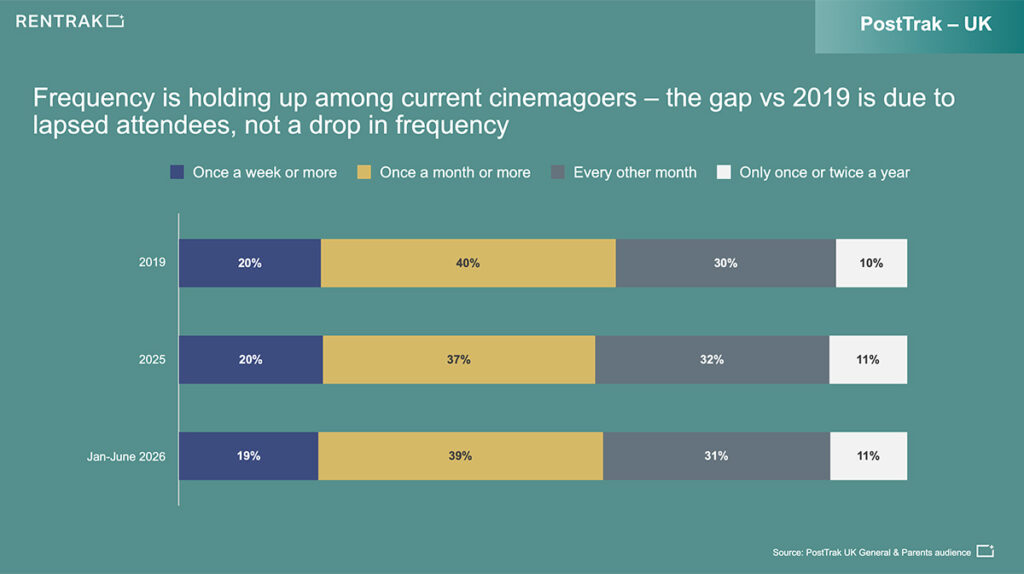
The most revealing audience statistic presented during CineEurope 2026 may have been the one that had barely changed. A slide from Rentrak’s UK PostTrak exit polling showed that 19% of current cinemagoers attended once a week or more during the first half of 2026, compared with 20% in 2019. The shares attending monthly, every other month or only once or twice a year were similarly close to their pre-pandemic levels.
That relative stability might have sounded reassuring had Lucy Jones, Executive Director at Rentrak, not placed it alongside a much less comfortable number: UK box office revenue in 2025 remained 21% below 2019. The British Film Institute’s official annual statistics independently reported the same decline, with 2025 receipts of GBP £996.8 million (USD $1.34 billion) compared with approximately GBP £1.3 billion (USD $1.75 billion) before the pandemic. The problem, Jones explained, was not necessarily that everyone who still goes to the cinema is going less often. It is that a substantial portion of the former audience is no longer showing up at all.
“The people that are in the cinema are coming just as often as they always were,” Jones said. “But there’s a group of people that really are just not coming at all.”
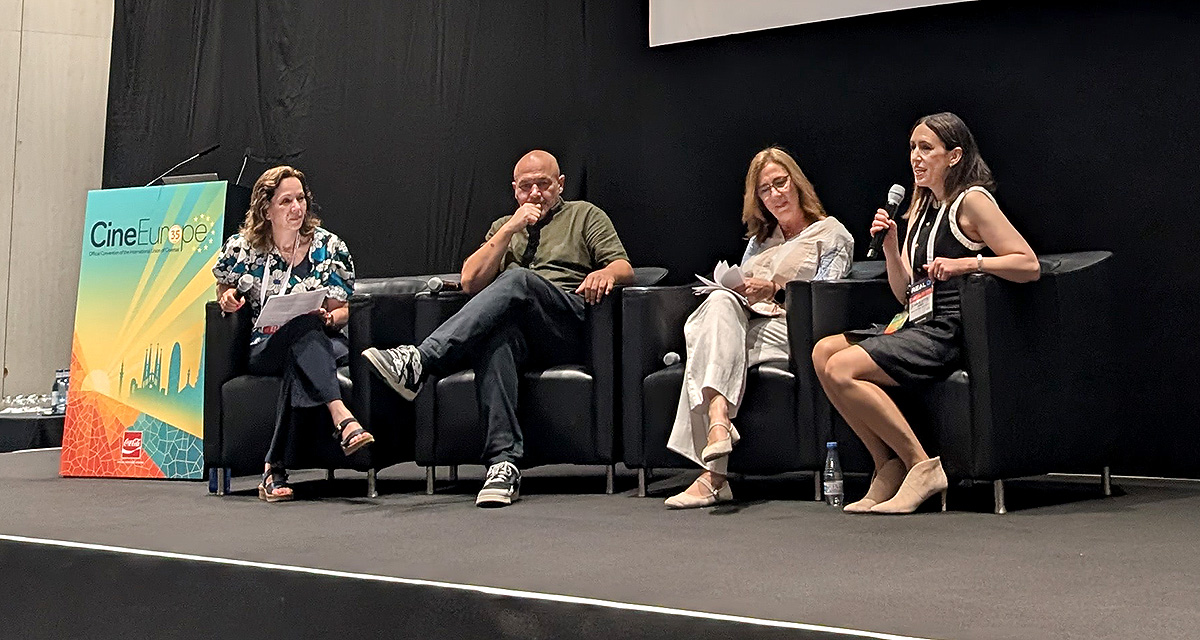
That distinction provided a useful starting point for “Audience Engagement Across Europe: What Really Works?,” a UNIC Focus Session held during CineEurope in Barcelona. Moderated by Cathy Huis in ’t veld-Esser, Chief Technology Officer at Gofilex, the session brought together Jones, Harry Bakas, Business Development and Marketing Manager at Village Cinemas Greece, Almudena Fernández-Golfín of the Federación de Cines de España (FECE) and Omdia analyst Charlotte Jones. Their presentations ranged from school trips and subsidized senior tickets to solo moviegoing and YouTube creators, but together they pointed toward the same conclusion: there is no single cinema audience waiting to be won back by one message, one price promotion or one sufficiently persuasive trailer.
Audience development works best when the industry first decides exactly whom it is trying to reach, identifies the particular obstacle standing between that group and the cinema, and then designs an invitation that is simple enough to understand and easy enough to repeat.
The Audience That Is No Longer There
Rentrak’s data also demonstrated why averages can obscure as much as they reveal. A demographic breakdown shown during Jones’s presentation found that women under 25 were the only group to increase weekly-or-more attendance between 2019 and 2026, with the share rising from 15% to 18%. Young women were not merely attending; they were also more likely to express an interest in seeing the same film again. Across all the titles Rentrak studied, 22% of respondents said they would like to rewatch the film in a cinema, with teenagers, young adults and women under 25 over-indexing considerably.
Music-oriented releases were particularly effective at generating that response. Jones said 43% of viewers surveyed for a Billie Eilish release wanted to see it again theatrically, as did 41% for “Michael” and 33% for “EPiC: Elvis Presley in Concert” – evidence that repeat viewing can be a form of participation, especially when a film comes attached to a performer, community or shared cultural moment.
Women also frequently serve as the organizers of cinema visits involving families or groups of friends, Jones noted. In other words, their importance cannot be measured only by the individual ticket they purchase. They may be the person who initiates the outing and brings several other customers with them.
Solo cinemagoers present a very different opportunity. Approximately 12% of the audiences surveyed by Rentrak attended alone, with men and older moviegoers particularly likely to do so. That group is sometimes discussed as though going to the movies alone were a problem to be corrected, but it may be more useful to see solo attendees as customers who have already overcome one of cinema’s largest perceived barriers – they do not need to coordinate schedules, persuade a reluctant partner or assemble a group before buying a ticket.
What some may be looking for is not company during the screening, but a greater sense that the visit connects them to something beyond it. Jones suggested that films such as “Mother Mary” or “The History of Sound” could be paired with music events, while “The Christophers” might lend itself to an exhibition or discussion about art. The cinema, she argued, can function as a third space in which someone arrives alone to watch a film but remains to participate in a community.
This is the central challenge hidden inside the industry’s repeated calls to bring “the audience” back. Younger women, occasional moviegoers, lapsed patrons and solo attendees are not one constituency. They are groups with different motivations, habits and points of resistance, and treating them as interchangeable makes it harder to understand why some are returning while others remain absent.
Turning School Trips Into a Growth Engine
Village Cinemas encountered that problem in Greece despite already attracting a notably young customer base. According to Bakas, the circuit’s Marketing and Business Development Director, 65% of its visitors are between 18 and 35. Yet when Village examined school attendance more closely, it found a large audience “hiding in plain sight.”
Village’s presentation identified approximately 4,100 schools and 727,000 pupils in the areas where its cinemas operate, while school admissions in 2025 represented less than 3% of that potential audience. The circuit had screens, seats and strong brand awareness, but its approach to schools was largely passive – teachers contacted its commercial department to ask what was playing, with no dedicated educational catalog, targeted outreach or digital booking pathway.
Bakas described Village’s Cine School as taking “one of the oldest ideas in our industry – taking school students to the movies – and turning it into a platform, a genuine growth engine for our business.” Village did not invent school screenings; it attempted to remove the administrative and educational friction that made them difficult to organize.
The initial Cine School catalog contained 55 titles divided among documentaries, animated films, Christmas programming and narrative features, including films with positive social messages and current or recent releases that distributors had cleared for educational screenings. The selection covered primary, middle and secondary school levels, with documentaries addressing topics including science, society, arts, culture, nature and the environment.
For many of those titles, Village created downloadable educational guides containing suggested classroom activities and discussion topics, and teachers could keep students in the auditorium for another 30 minutes at no additional cost to discuss the film afterward. That small operational choice helped reposition the visit from an entertainment excursion that had to be justified to administrators and parents into a structured educational activity.
The program’s website turns the process into a defined sequence: choose an age-appropriate film, download the educational guide, submit a booking request and wait for a Village representative to make contact within two working days. Accompanying teachers receive free admission, the program offers free tickets to students from financially vulnerable households, and Village backed the platform with a dedicated schools database, outreach staff and promotion through its own media and the wider Antenna Group.
Village’s early results slide, covering March and April 2026, reported that the program had reached 1,000 schools and generated more than 700 website visits. The company reported a 165% increase in school-group visits and a 328% increase in school admissions compared with its 2025 benchmark.
Bakas was careful to acknowledge that much of the initial surge was driven by “Kapodistrias,” Yannis Smaragdis’s historical drama about Ioannis Kapodistrias, the first governor of independent Greece. The film’s local relevance made it an immediate success with schools, demonstrating that even the best audience-development infrastructure still benefits from the right content arriving at the right moment.
Still, the platform meant Village was prepared to capture that demand rather than merely fielding calls on an ad hoc basis. The company’s initial investment, Bakas said, was less than EUR €20,000 (USD $23,000), largely covering the website and promotional materials. Participating distributors did not require upfront licensing payments for the films.
The model will inevitably require localization if it is replicated elsewhere. School structures, curriculum requirements, distributor agreements and booking habits differ by country. What is transferable is the decision to treat teachers and schools as a defined customer group with needs of their own. The teacher does not merely need a film. The teacher needs suitable content, educational justification, predictable pricing, a safe environment and a booking process that will not consume an afternoon.
Tuesday Is for Cine Sénior
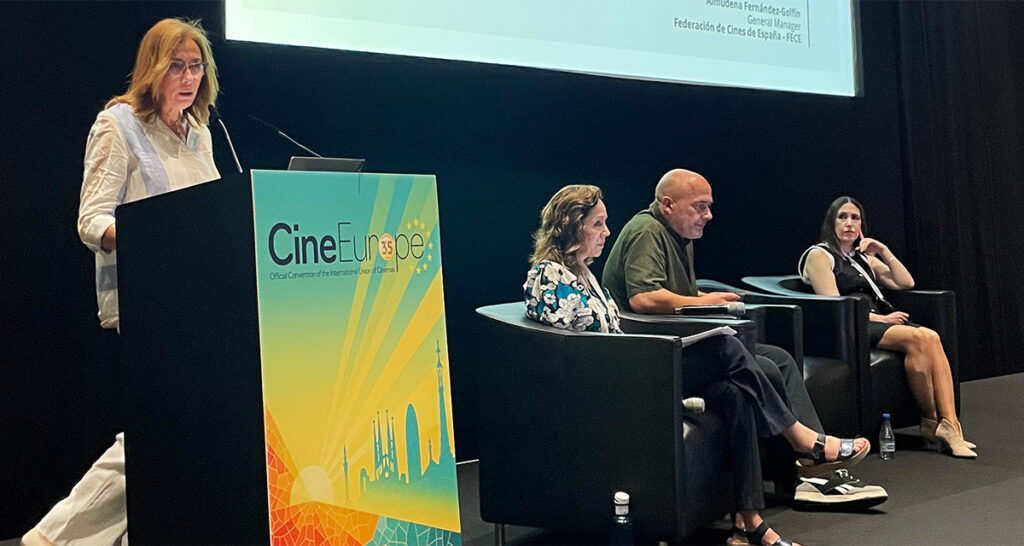
Spain’s Cine Sénior program addresses a very different audience through an almost opposite approach. Where Cine School required an educational catalog, teacher materials, direct outreach and human assistance, Cine Sénior succeeds partly because the offer can be explained in a sentence: people aged 65 and over can go to the cinema on Tuesdays for EUR €2 (USD $2.31).
Launched by Spain’s Ministry of Culture in 2023 with the support of the exhibition sector, Cine Sénior was created in response to two connected problems. Older audiences had not fully returned following the pandemic, while cinemas needed stronger attendance on traditionally quieter weekdays. Participating cinemas opt into the program voluntarily, and the government subsidizes the difference between the promotional ticket and the cinema’s usual price up to a defined limit. Because the subsidy is treated as part of box office revenue, distributors and rights holders are not asked to absorb the entire reduction.
According to figures presented by FECE, the edition discussed at CineEurope involved 397 cinemas representing more than 90% of the Spanish market, with EUR €11.5 million (USD $13.3 million) in total funding supporting a 12-month program. Since CineEurope, Spain’s Ministry of Culture has launched a fourth edition covering 394 cinemas and more than 2,800 screens, backed by EUR €11.15 million (USD $13.3 million) in funding for another 12 months.
The funding is essential, Fernández-Golfín acknowledged, and a nationwide subsidy of that size cannot simply be copied by every territory. But price alone does not account for the program’s effectiveness; Cine Sénior also combines routine, clarity, visibility and scale, with no membership scheme to decipher and tickets available through the cinema’s usual box office and online channels.
“Public funding is important. We cannot forget about that, but creating a strong sense of a cinema-day brand for them is important,” Fernández-Golfín said. “Tuesday is for Cine Sénior. It’s a well-known brand nowadays.”
That weekly appointment helps rebuild behavior rather than simply creating an occasional bargain. Going to the cinema becomes part of Tuesday’s routine, reinforced by hundreds of cinemas repeating the same straightforward message across the country. What might otherwise feel like a temporary promotion gains the credibility of a continuing national program.
The results also suggest that Cine Sénior is doing more than moving admissions from one day to another. FECE reported that Cine Sénior tickets represented 37% of all Tuesday tickets sold during 2025, while eight of the ten films most watched through the program were Spanish productions. Separate figures published by Spain’s Ministry of Culture show that the second edition drew nearly 1.69 million attendees in 2024, an increase of 83% over the inaugural year, and that the first 28 weeks of the third edition had already generated nearly 1.58 million admissions. The program has therefore created a meaningful weekday constituency while revealing a particularly strong affinity between older audiences and Spanish films.
The lessons are broader than the subsidy. A specific audience was identified, the economic barrier was reduced, a fixed moment was established and the communication was kept simple. As Fernández-Golfín’s presentation put it, targeted initiatives work when they respond to the needs of a specific audience. Older moviegoers are not passive or permanently lost; they respond when the proposition is clear, accessible and relevant.
When the Community Already Exists
Omdia’s presentation shifted the discussion from audiences that cinemas must cultivate to communities that have already formed elsewhere. YouTube ranked as the most-used video service across the United States, United Kingdom, France and Spain in Omdia’s November 2025 consumer survey, while long-form viewing on the platform has risen sharply across major European markets.
This does not necessarily mean younger audiences are choosing YouTube instead of cinemas. Charlotte Jones, Senior Principal Analyst for Cinema at Omdia, said approximately 45% of YouTube users also attended cinemas, rising to 55% among people under 35.
Rather than functioning only as a competitor for time and attention, YouTube has become an incubator for production skills, creative formats and intellectual property. Creators build direct relationships with viewers, receive almost immediate feedback and develop communities that may follow a project across videos, games, live appearances and eventually cinemas.
The documentary “Kaizen,” from French creator Inoxtag, demonstrated how quickly that online relationship could be converted into a theatrical event. According to Omdia’s presentation, the film sold more than 350,000 cinema tickets in a single day despite being scheduled to appear on YouTube two days later. The theatrical release did not depend upon keeping the film unavailable elsewhere for months. It gave fans a limited opportunity to gather around a creator and project they already considered their own.
“The Backrooms” provided Omdia with a more complex example of community-built intellectual property. Jones traced its development from an original 2018 post on 4chan through a growing online fandom, Kane Parsons’s YouTube series and an eventual A24 feature. The community did not appear when a conventional film campaign began; the movie arrived only after years of audience participation had already expanded and reinterpreted the idea. That history also explains why creator-led theatrical content cannot simply be polished into something unrecognizable – the attraction is often the voice, texture or unconventional quality that allowed the work to emerge outside traditional development systems in the first place.
“There’s obviously a very clear appetite for creator content, but to translate it into the cinema environment, that has to be done correctly,” Jones said. “It has to remain authentic, and it has to retain an appeal to the younger generation.”
The opportunity is not limited to horror, even if low-budget genre films such as “Obsession,” “Iron Lung” and “Backrooms” have provided some of the earliest examples. Comedy, animation and children’s content could follow, as could projects that do not fit neatly into the conventional distinction between a feature film and an event screening. Omdia’s larger point was that digitally native ideas and personalities are expanding what can qualify as a theatrical release.
“Younger audiences want to see that new IP, and they want to see their own heroes on the big screen,” Jones said. “Cinemas can harness that collective demand that is now building, and they can bring those fan communities together.”
One Screen, Many Invitations
Schoolchildren, Spanish seniors, solo moviegoers and YouTube fans may have very little in common demographically, but the programs and behavior presented at CineEurope shared a recognizable logic.
In each case, audience development begins by abandoning the notion that there is one undifferentiated public standing outside the cinema. The audience is made up of communities with their own motivations, constraints and expectations. The most effective initiatives do not ask everyone to respond to the same invitation. They identify the group, locate the friction and design a path into the cinema that makes sense for those particular people.
“It’s a matter of mentality – to open our minds, try new things and not stick to what we know,” Bakas said at the end of the session. “Cinemas will always be our core business, but trying to optimize what we have, or even finding new ideas, will get some payback.”
The industry may still speak about winning back “the audience.” The more productive task is determining which audience it means.
Editor’s note: This feature is part of Celluloid Junkie’s coverage of the seminars presented at CineEurope 2026 in Barcelona. See more reporting from the sessions below.
More from CineEurope 2026

- Cinema Owners Have Invested $2.7 Billion in Theatres. What Is That Money Buying? - October 1, 2026
- The Paramount-Warner Merger Is Permanent. The Guardrails for Movie Theatres Are Not - September 22, 2026
- Cinemas Aren’t Just Marketing Movies Anymore. They’re Marketing Auditoriums - September 15, 2026