


Once known as alternative content, event cinema has long since established itself on the theatrical calendar. Now exhibitors are treating it as a year-round programming discipline built around fan communities, advance demand and reliable technical delivery.
Event cinema largely shed the label “alternative content” roughly 15 years ago, as live opera, theater and concert broadcasts became established parts of the theatrical calendar. The category acquired its own distributors and specialists, and audiences grew accustomed to seeing performances and cultural events on cinema screens. What is changing now is not the legitimacy of event cinema, but the way exhibitors approach it. Rather than waiting for an occasional major concert or one-night broadcast to arrive, some circuits are treating event cinema as an always-on programming discipline requiring the same attention to audience behavior, local market preferences and screen allocation as the conventional film slate.
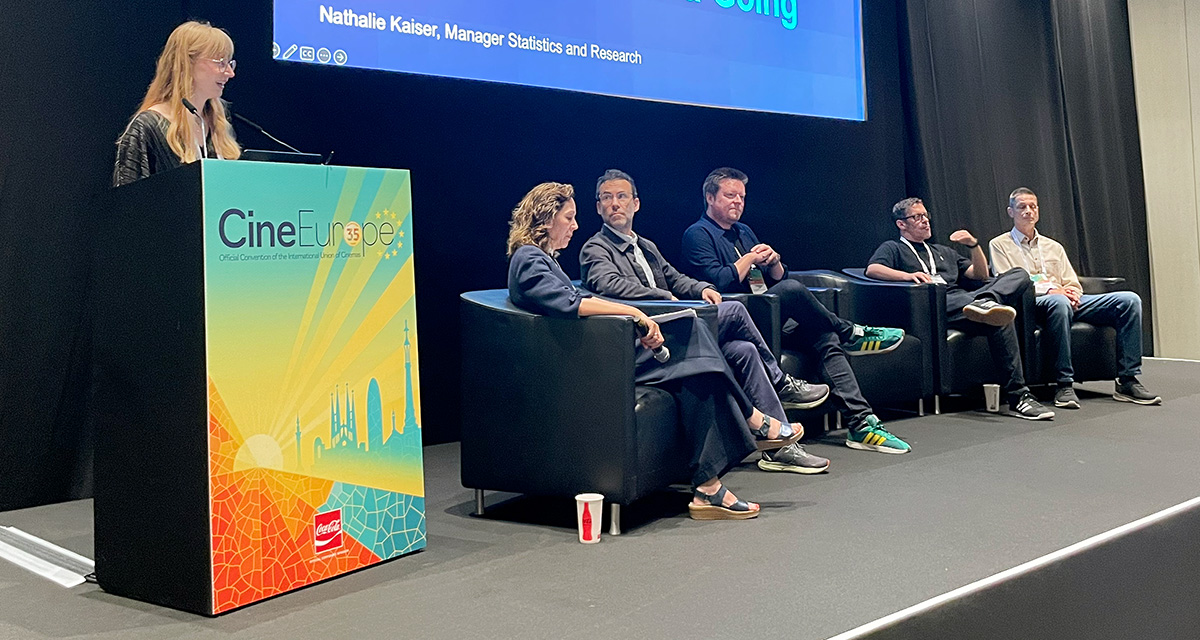
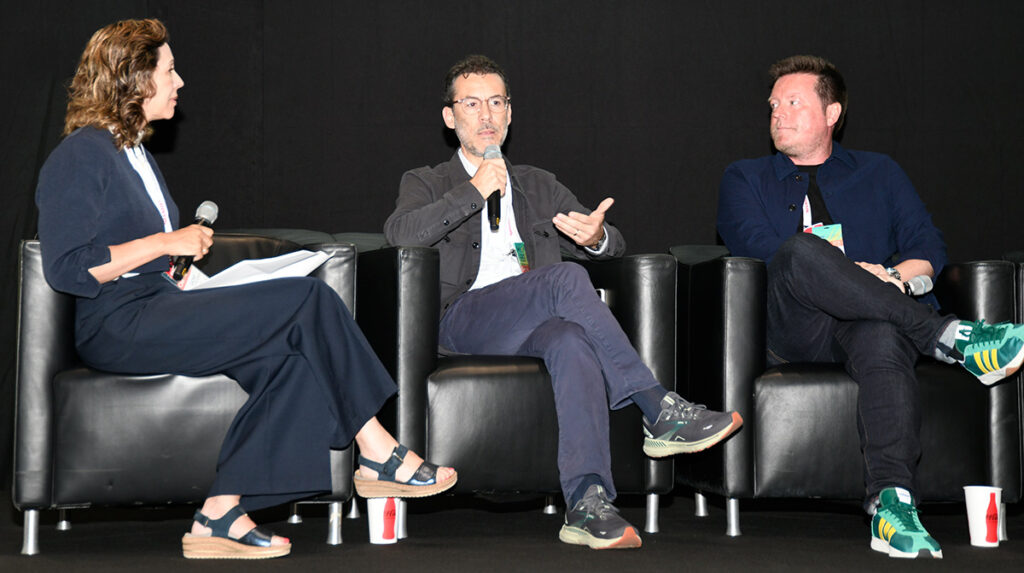
That evolution was the focus of “Live & Direct: How Event Cinema, Live Experiences & Streaming Technology Are Set to Transform Cinema-Going,” an ICTA Focus Session held during CineEurope 2026 in Barcelona. Moderated by Gofilex CTO and co-owner Cathy Huis in ’t veld-Esser, the panel brought together Rentrak Manager, Statistics and Research Nathalie Kaiser, Cinépolis Group VP Global Film Programming and Content Miguel Rivera, Vue International Head of Event Cinema and Distribution Johnny Carr, Trafalgar Releasing CEO Marc Allenby and Gofilex CEO and owner Paul Huis in ’t veld. Together, they described a category that may account for a modest share of annual admissions, but increasingly requires year-round programming expertise.
One Category, Many Markets
Even defining what belongs within event cinema has become more complicated. Kaiser began the session by describing alternative content as a spectrum rather than a universally agreed category. A live opera, theatrical performance or concert broadcast clearly sits at one end. At the other are conventional feature films, while limited releases, rereleases, documentaries, anime, television-derived programming and other hybrid forms occupy an increasingly debatable space in between. The uncertainty is more than semantic: depending on what is included, measurements of the category’s market share and growth can change considerably.
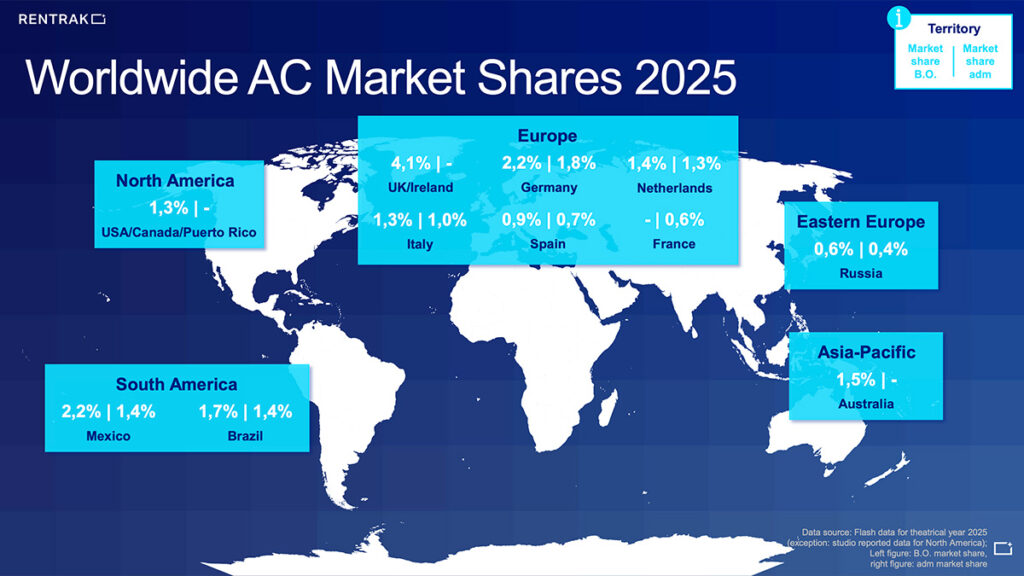
Using a narrower definition centered on recognizably event-driven programming, Rentrak estimated that the category accounted for approximately 0.5% to 4% of 2025 box office revenue across the markets presented, with the UK at the upper end of that range. Its share of admissions was generally lower because event cinema often commands a higher average ticket price. The UK led Europe both in market share and absolute terms, while event-cinema admissions had risen from pre-pandemic levels in numerous territories. Latin America showed the strongest uplift in the comparison presented, followed by the UK, North America and Australia, although France and Italy remained closer to their earlier market shares.
The growth has not produced a uniform European market. Theater, led by National Theatre presentations and other stage productions, accounted for a particularly large proportion of the UK’s leading titles. Concerts, opera and children’s programming assumed different levels of importance in Germany, while the Netherlands presented a more fragmented mix led by music events. Concert films and music-related programming were prominent in Italy, while opera retained greater weight in Spain and theater, comedy and children’s events contributed more heavily in France. Rock and pop concerts came closest to being a broadly transferable category, but the larger lesson from Kaiser’s data was that an event that performs strongly in one country cannot automatically be expected to travel with equal force into another.
That regional variation is one reason event cinema increasingly demands dedicated expertise rather than occasional booking. “Get inspired by trends in other countries, or even realms outside and beyond the theatrical world,” Kaiser advised. The category’s fourth-quarter concentration also remains pronounced, with the final three months accounting for between 30% and 43% of annual event-cinema ticket sales in the post-pandemic averages presented. Major music releases, opera, theater and ballet seasons all contribute to that weighting, though a more diverse slate is beginning to create opportunities throughout the year.
Why Audiences Leave Home
The uneven supply of conventional studio releases since 2020 undoubtedly gave exhibitors more reason to seek those opportunities. Rivera noted that fewer major films created openings for additional programming, while Carr pointed to shorter theatrical windows and greater flexibility within cinema schedules. Yet the panelists were careful not to position event cinema merely as material used to plug holes in the film slate. Its stronger foundation is the appetite for experiences that audiences cannot reproduce by watching alone at home.
“There is a desire from audiences to come together to have a communal, collective experience,” Allenby said. Cinema exclusivity remains a major selling point, he added, along with the comfort, audiovisual presentation and sense of occasion offered by the auditorium. Carr cited “Doctor Who” as an example of content audiences may be able to watch free at home but nevertheless consider it an experience worth venturing out and paying for. “People will still choose to come to the cinema and be around fellow fans,” he said.
Affordability and access are equally important. A fan may be unable to secure a concert ticket, afford the price or travel to the city where the artist is performing. Rivera pointed to BTS’s concerts in Mexico City, where even fans who live in the city may not be able to afford a ticket to see the group live. The cinema provides what Rivera called “the next best way” to experience the event, while also adding the communal atmosphere and fear of missing out that have become especially important among younger audiences.
Kaiser suggested that the living room is not always event cinema’s real competitor. In many cases, cinema offers a more affordable and accessible alternative to attending the concert, opera or theatrical performance in person. Audiences are purchasing participation in a shared occasion rather than simply access to content that may later reach television or streaming.
Finding the Fans Who Will Show Up
Finding those audiences requires more than counting followers. Allenby cautioned that a widely recognized artist or property does not necessarily possess a fan base willing to commit to a cinema ticket.
“The breadth of the fan base doesn’t necessarily equate to an active audience that will commit to a cinema ticket,” he said. Smaller acts can sometimes have a more dedicated, even “rabid,” following capable of producing a stronger theatrical event than their overall reach might suggest.
For exhibitors, the process has become an exercise in continuous demand assessment. Carr said Vue evaluates comparable titles, studies how content has performed in other markets and works closely with distribution and internal marketing teams to determine the likely scale of each release. Advance sales are especially valuable. Once tickets go on sale, the circuit can monitor the initial response and expand or reduce the booking accordingly.
“You put something on sale and quickly monitor it,” Carr explained. “With some events, you’re there hovering to see what goes out the door at the start, and then you react.”
Cinépolis follows a similar approach, using presales to adjust the number of cinemas, screens and performances allocated to an event. Rivera said social listening has also become an increasingly valuable programming tool. Audience requests do not necessarily arrive through surveys or formal research. They can appear in the comments below an Instagram, TikTok or X post promoting an entirely unrelated film, with fans asking when a concert, anime title or other piece of programming will reach their local cinema.
“Constantly looking for and reading those comments and figuring out what people are looking for has become a source for us to go and seek out that content,” Rivera said.

An Always-On Programming Model
The breadth of those niches allows event cinema to become more frequent without necessarily making each individual presentation feel less special. Cinépolis programmed more than 80 event titles during 2025, according to Rivera. That volume need not diminish the sense of occasion because the programming can target entirely different communities.
Rivera noted that a BTS concert, a Pink Floyd presentation and World Cup matches could appear during the same week without competing for the same audience. During the 2026 FIFA World Cup, then underway at the time of the panel, Cinépolis scheduled 32 matches in its Mexican cinemas, including stretches with one game per day.
Vue has moved even further toward what Carr called an “always-on approach.” Across the circuit’s markets, some form of event cinema may be available virtually every day, whether a live presentation, encore, children’s program or another specialized release. Larger music or theater titles can provide the commercial weight while smaller events serve more narrowly defined audiences.
Making that approach work is not simply a matter of putting more titles into the booking system. The exhibitor must match each event with the right locations, auditorium size, date and showtime. An oversized auditorium with a small audience can undermine the communal energy that drew customers to the event in the first place. Conversely, strong early sales may justify moving a presentation into a larger room, adding shows or opening additional cinemas.
“You want a decent occupancy,” Carr said. “You don’t want people in a room where there are two people here and four people there. That’s not the kind of experience I look for.”
The potential programming pool continues to expand beyond the concerts, opera and theater broadcasts with which the category first became established. Sports, preschool entertainment, television events and anime are already finding audiences, while Carr identified digital creators as a likely next frontier. Vue had recently carried “The Amazing Digital Circus,” a digital-native animated property with a large online following, providing one example of content developed outside the traditional film and television pipeline moving onto cinema screens.
“There’s an audience that’s growing up that’s fully digital, and they’re consuming content in a different way,” Carr said. “It’s going to be about leaning into that and bringing it into the theatrical space, giving it a theatrical pedestal and giving it that community moment to get the kids out of the basement.”
Paul Huis in ’t veld broadened the definition further, pointing to schools using cinemas to stream ceremonies for family members, companies transmitting executive presentations across multiple territories and exhibition groups sharing a local red-carpet premiere with cinemas elsewhere in their circuit. Such uses may not fit the public’s conventional understanding of event cinema, but they demonstrate how the same network of venues and delivery systems can be used to bring dispersed communities together.
Making Live Content Reliable
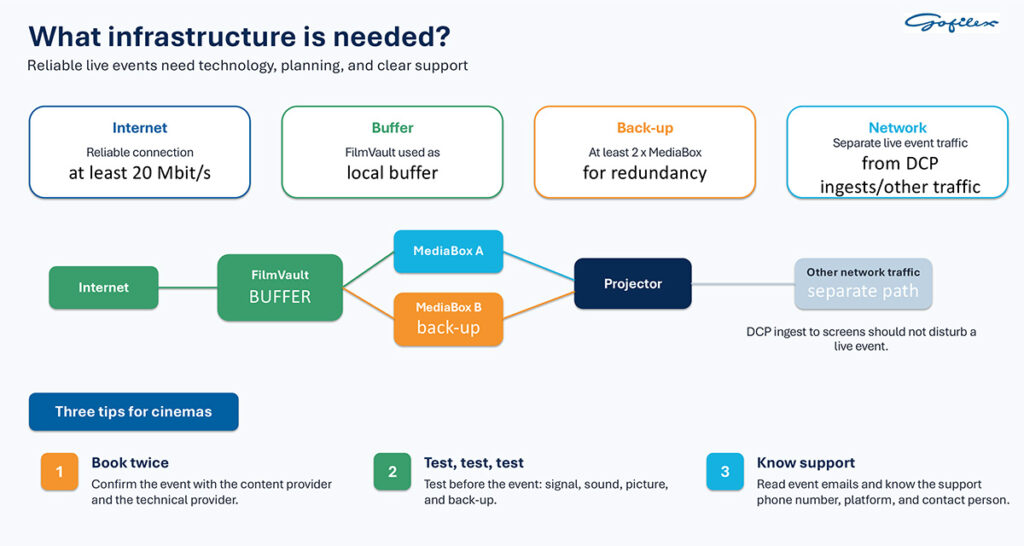
That opportunity depends on a technical foundation audiences should never have to think about. Paul Huis in ’t veld outlined the principal delivery options available to exhibitors, ranging from satellite and improvised internet feeds to managed IP streaming systems with local buffering and dedicated playback equipment. Recorded and encore presentations can increasingly be delivered as DCPs, giving cinemas additional scheduling flexibility, but genuinely live events require adequate bandwidth, backup paths and systems capable of surviving brief interruptions without immediately disrupting the auditorium.
Local buffering is particularly important because it allows a portion of the incoming stream to be held at the cinema, reducing the risk that a momentary connection problem will appear instantly on screen. Redundant delivery paths can offer further protection against equipment or network failures. The technical detail may vary by system, but the operational principle is straightforward: an exhibitor cannot promise a premium communal experience while treating delivery as an improvised laptop feed.
Testing is therefore as much a part of event-cinema programming as selecting the auditorium or setting the ticket price. A cinema must verify the picture, sound, synchronization, network connection and complete playback chain before customers take their seats.
“Make sure you perform the tests that are being made available,” Huis in ’t veld said. “Test before you put your audience in the auditorium and make sure that you have what you believe that you have.”
The final requirement may be organizational rather than technical. Allenby urged cinema companies to invest in people who can become specialists in the category and champion it internally, from getting shows on sale promptly to supporting local marketing and evaluating unfamiliar fan communities. Event cinema may no longer need to prove that it belongs on the theatrical calendar, but its next stage of growth will require exhibitors to treat it as more than a sequence of isolated special bookings.
The event itself should still feel exceptional. The programming, audience analysis and delivery behind it can no longer be occasional.
Editor’s note: This feature is part of Celluloid Junkie’s coverage of the seminars presented at CineEurope 2026 in Barcelona. See more reporting from the sessions below.
More from CineEurope 2026

- Cinema Owners Have Invested $2.7 Billion in Theatres. What Is That Money Buying? - October 1, 2026
- The Paramount-Warner Merger Is Permanent. The Guardrails for Movie Theatres Are Not - September 22, 2026
- Cinemas Aren’t Just Marketing Movies Anymore. They’re Marketing Auditoriums - September 15, 2026