


An independent film can have an enthusiastic audience and still play to an empty auditorium. Sometimes the problem isn’t the movie, the marketing or even the cinema. Sometimes the audience is simply in the wrong postal code.
That was one of the lessons John Fithian and Patrick Corcoran of The Fithian Group learned while helping release “Two Sleepy People,” a romantic comedy from filmmaker and online creator Baron Ryan and the Creator Camp collective. The filmmakers had something many independent productions lack: an established audience of enthusiastic followers. The challenge was getting those followers into actual movie theatre seats.
Working with The Fithian Group, the filmmakers developed a system through which fans could indicate the postal code where they wanted to see the movie. When enough fans in one area registered interest, a screening was booked there.
The results were instructive. According to Fithian, screenings booked where demand had been identified substantially outperformed those booked elsewhere. When a Chicago circuit played the film where the data pointed, a single screening outgrossed more than half of the other titles at that cinema that weekend, despite those films playing multiple showtimes over three days. In Austin, however, a cinema chain without space at the downtown location where the data suggested demand was strongest placed the film in the suburbs instead. The results were disappointing.
“Put it in the theatres where you have an audience,” Fithian said. “Don’t just put it in theatres.”
It sounds like common sense. Yet theatrical distribution has spent decades relying on experience, relationships, comparable film performance and educated guesswork to decide which movies play where. That works reasonably well for established distributors. Smaller films often struggle to navigate it at all.
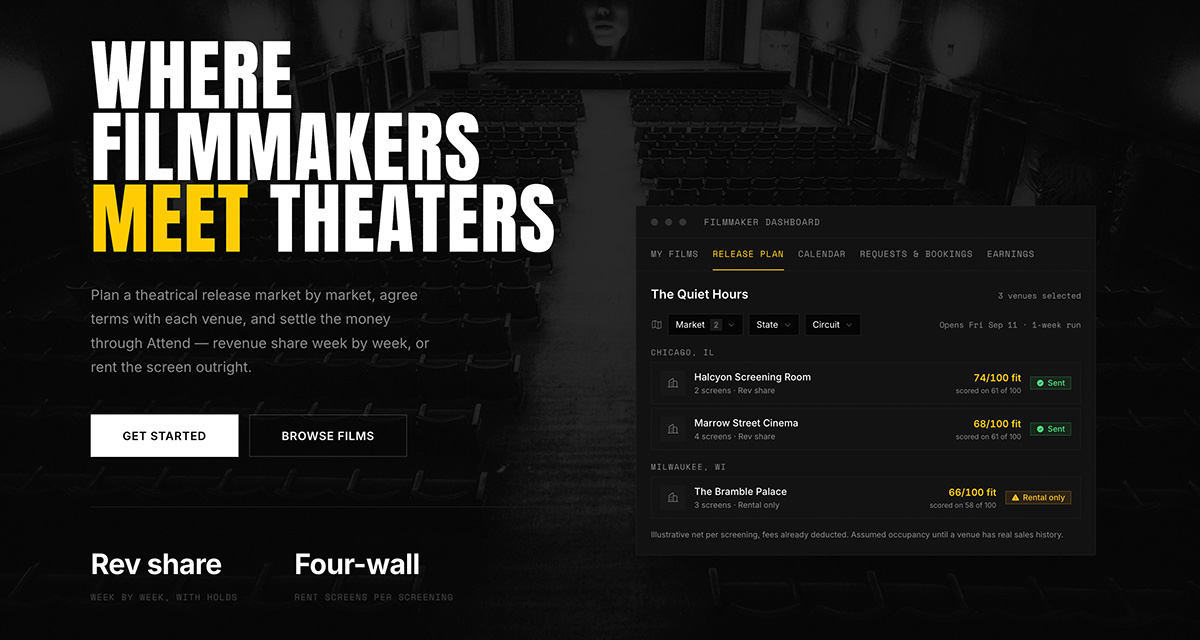
Fithian and Corcoran, who helped lead and run the National Association of Theatre Owners for decades, and technology partner Charles Beale believe they have a fix. Their creation, Attend Theatrical Marketplace, officially launches Wednesday, 11 November, at the American Film Market in Los Angeles, where the company will be based at the new AFM House all week for meetings and demonstrations. The platform connects filmmakers and rights holders directly with cinema operators, helping them identify appropriate locations for theatrical releases, negotiate bookings, coordinate marketing and delivery, and manage box-office revenue.
The Fithian Group’s third founding partner, Jackie Brenneman, became president and CEO of the Independent Film & Television Alliance, which runs AFM, earlier this year. She remains on Attend’s board alongside Fithian and Corcoran.

An Idea 15 Years in the Making
For Corcoran, Attend is the realization of an ambition he first explored roughly 15 years ago, when he was still working at NATO, the exhibition trade organization now known as Cinema United.
The underlying problem was hardly new. Independent filmmakers routinely struggled to obtain theatrical distribution, while cinema operators complained about the shrinking supply of movies available to fill their screens. Both sides wanted something the other could provide. Connecting them, however, was easier said than done.
“I’ve got a movie, great. I’ve got a theatre. There’s a lot of stuff in between that,” Corcoran explained during a demonstration of Attend for Celluloid Junkie.
That “stuff” includes choosing cinemas, negotiating rental terms, arranging delivery and promotion, reporting grosses and collecting payments. Experienced bookers and distributors navigate it through relationships and hard-won expertise. First-time filmmakers often discover the complications only after making a movie.
Meanwhile, as studios concentrate resources on their biggest productions, mid-budget movies have become less prominent on theatrical release calendars. For exhibitors, the resulting gaps have created both a programming problem and an opportunity. Screens need movies, but booking additional titles only helps if those movies can attract paying customers.
“The problem for independent film is trying to wedge these films into a business model that does not work for them,” Corcoran said.
Sometimes a wide release serves a different objective: triggering an ancillary or streaming deal. That may work for the filmmaker or distributor, but Corcoran argues it can leave exhibitors “booking empty auditoriums by design.”
Corcoran also sees an issue of exhibitor independence. Studio release strategies can, he argued, be “about keeping other movies out, which keeps theatre owners dependent.” More viable independent programming could give cinemas greater choice and leverage. He wants exhibitors “to take control of their own destiny in a way that they haven’t for a long time.”
The Fithian Group encountered the wide-release problem firsthand with “Lost & Found in Cleveland,” an independent ensemble comedy starring Martin Sheen, Dennis Haysbert and June Squibb that opened in November 2025.
The filmmakers wanted at least 500 screens, partly to attract the attention of streaming buyers. Fithian and his colleagues believed the movie would be better served by starting in Cleveland and expanding through Ohio before attempting a broader release.
The film opened on more than 500 screens. According to Fithian, it performed exceptionally well in parts of Cleveland, reasonably well elsewhere in Ohio and poorly across much of the rest of the country.
The experience helped crystallize Fithian’s thinking about the platform. The objective, he said, is “not just to find the right theatres, but to find the right theatre count.”
A movie can be successful in 20 cinemas and unsuccessful in 500. The trick is knowing which 20 cinemas to book, and having the discipline not to insist on the other 480.
Building a Marketplace Around the Film, Not the Release Pattern
Announced in October 2024, Attend promised to connect filmmakers with exhibitors using local audience data and cinema-specific recommendations. An initial pilot was envisioned for 2025.
Before the software was ready, The Fithian Group tested those principles by handling releases including “You, Me & Her,” “Lost & Found in Cleveland,” “Two Sleepy People” and “Hunting Matthew Nichols.” Sometimes described as alpha or beta phases, these were hands-on experiments, not releases booked through a finished marketplace.
Technology development took longer. An early partner produced what Corcoran called “a really good proof of concept,” but progress was agonizing because “they don’t know the business. They know software.”
Anyone who has attempted to build cinema booking software will recognize the challenge. Film booking is an industry where a seemingly simple question about a screen, a showtime or a rental term can produce a remarkably complicated answer. And sometimes a different answer from the same exhibitor six months later.
The breakthrough came through Charles Beale, a producer and the CEO of Titlepool, a company specializing in film rights management, revenue accounting and collection services.
Beale had hit the same wall from the other side. Having made his cast and crew equity participants, he was spending his days on payments and paperwork.
“As a producer, the tools that I wanted didn’t exist. So we started building them,” Beale explained.
Through mutual clients, Beale became familiar with Attend’s ambitions and recognized that much of Titlepool’s underlying infrastructure could support the marketplace Fithian and Corcoran were trying to create. Rather than propose another lengthy development process, he took a shortcut. “Why don’t I just build this and then pitch it to them?” Beale recalled thinking. His demonstration closely matched what The Fithian Group had envisioned.
The partnership combines exhibition experience with existing distribution technology. Beale walked Celluloid Junkie through Attend from both the filmmaker’s and exhibitor’s perspectives.
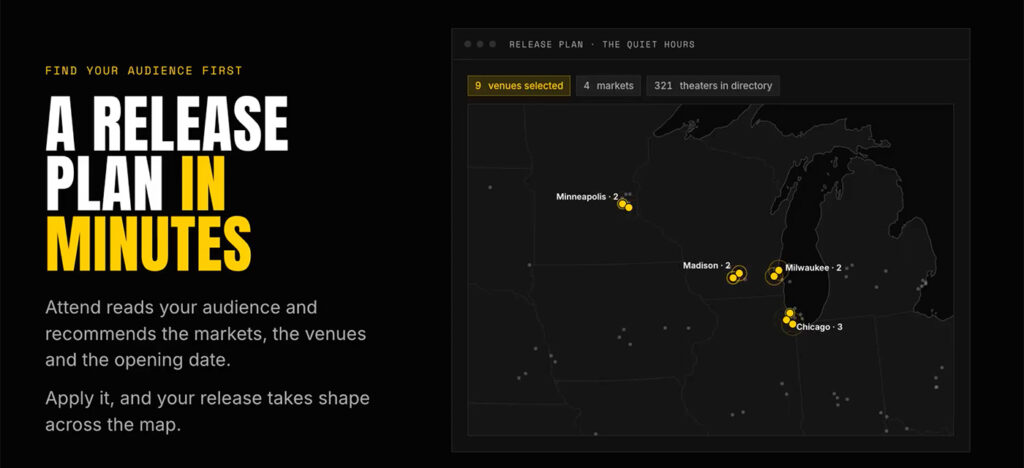
Filmmakers enter a movie’s release details, formats, screeners, proposed terms, audience information and marketing budget. From there, the platform generates a recommended theatrical release plan. In the example demonstrated, Attend suggested an initial opening in eight markets across 17 cinemas, identifying specific locations and explaining why they might be appropriate. It also flagged a competing horror release scheduled for the same opening date, suggesting the filmmaker might want to reconsider the timing.
The recommendations draw on several sources. Attend uses machine learning to analyze filmmakers’ marketing plans and audience information against U.S. Census Bureau demographic data tied to the postal codes surrounding each cinema, along with evidence of actual demand. Fithian said the company is also negotiating for access to historical box-office data.
One feature, called “Demand It,” allows filmmakers to share a link or QR code through which prospective moviegoers can register their interest in seeing a film and identify their postal code. As with “Two Sleepy People,” this information can help determine where screenings might be commercially viable.
The system also considers less conventional factors. Beale described how a forthcoming movie about a girls’ ice-skating club could be evaluated partly by looking at cinemas within a certain distance of an ice rink.
The goal is to avoid relying solely on demographics or comparable releases. “We don’t want this to purely run on comps,” Beale said. Corcoran called comps “an increasingly narrowing funnel.”
The early estimates are heavily caveated, Beale acknowledged. More releases, and more performance data, should make future recommendations stronger.
Filmmakers can review the proposed locations, adjust the selection and send booking requests directly through the marketplace. Films without a performance track record may be steered toward four-walling, in which the filmmaker rents an auditorium rather than splitting box-office receipts, to generate the data needed to support a wider booking.

Exhibitors can review films, terms and audience evidence. A developing scoring system considers financial terms, genre, programming fit, festival pedigree and demonstrated demand. Filmmakers, meanwhile, can assess a cinema’s payment reliability.
Exhibitors can accept, decline or counter proposed terms, suggest alternative locations and manage negotiations within the platform. They can also set their own rules; an exhibitor that doesn’t want offers seeking a 50% split, for example, won’t receive them.
The marketplace could also help bookers separate credible releases from enthusiasm and a finished movie. Theatre owners have told Corcoran they field a steady stream of pitches from filmmakers who “don’t know what they’re doing.” “We don’t want to flood you with movies that aren’t going to be useful for you,” he said.
Attend isn’t meant exclusively for filmmakers handling their own releases. Independent distributors and other rights holders can use its booking, targeting and administrative tools. Fithian described a recent exchange with one producer and distributor considering putting four or five films a year through the platform. “They see the cost savings, they see the efficiencies, but most importantly, they see the targeting function of the system,” he said.
Getting the Booking Is Only Half the Battle
A booking isn’t a marketing strategy, and appearing on a showtime schedule doesn’t guarantee anyone outside a filmmaker’s family knows the movie is playing.
“You, Me & Her,” the romantic comedy written by and starring Selina Ringel and directed by Dan Levy Dagerman, shows just how hard that can be. With The Fithian Group handling the release, the film opened in roughly 250 theatres on Valentine’s Day 2025, backed by $350,000 the filmmakers raised for marketing and distribution on top of a $500,000 production budget.
In a detailed case study published by Distribution Advocates in April 2025, Ringel and Levy Dagerman described an inventive campaign, from influencer gift boxes to billboards in Times Square and on Sunset Boulevard. They also documented a familiar problem: many cinemas didn’t list showtimes until the week of release, leaving early calls to action with nowhere to send interested audiences. Opening against Marvel’s “Captain America: Brave New World” didn’t help, nor did screenings moved or canceled mid-run. The theatrical release, they wrote, came nowhere near recouping its marketing and distribution costs, though it helped secure a Starz licensing deal.
After the release, Corcoran and the participating exhibitors discussed what had gone wrong. His conclusion was pointed:
“You can’t help indie movies thrive if you’re not booking them until the Monday before the Friday, because they can’t market,” Corcoran said.
Attend is trying to encourage commitments to at least some showtimes three or four weeks in advance, with tickets on sale two weeks out. Corcoran said some circuits will add showtimes if filmmakers demonstrate demand.
The platform also lets cinemas list the marketing opportunities they offer and what they cost, from co-op fees for printed flyers at smaller venues to the trailer placements and loyalty-program emails the big circuits charge for. “Part of the idea of the marketplace is openness and transparency about what’s on offer,” Corcoran said.
Attend also plans a marketplace for service providers, covering everything from creating and delivering DCPs to shipping in-theatre marketing materials. An individual filmmaker ordering DCPs, Beale noted, may pay “potentially double or triple what a studio pays.” By pooling volume across releases, Attend hopes to secure rates closer to what studios get. The platform then builds a production calendar that tells filmmakers how far in advance each deliverable needs to be in motion.
Attend’s more ambitious marketing tools are still in development. Beale demonstrated an advertising planning interface that will eventually connect to filmmakers’ Google and Meta accounts to track spending and campaign performance. Those integrations won’t be available at launch.
The larger objective is to help filmmakers make the most of whatever resources they have. “Part of this is scaling the ambitions to the resources,” Corcoran said. Filmmakers with limited budgets may be better off concentrating on a handful of viable markets. Evidence of demand also gives cinemas a reason to promote the film.

The Less Glamorous Business of Getting Paid
There is another aspect of theatrical distribution that rarely makes it into filmmakers’ dreams of seeing their movies on the big screen: collecting the money afterward.
Different exhibitors have different payment processes, reporting schedules and accounting practices. Beale, who has worked on collections for the “You, Me & Her” team, described a mix of Zelle and Venmo payments, direct deposits and checks arriving with little information about which engagement or invoice they cover. A film may finish its theatrical run long before its rights holder has collected everything it is owed.
Corcoran recalled one independent distributor who, during a video call, turned her camera around to show a stack of checks on her desk. Depositing them and matching them to invoices, she told him, was what she and her team spent most of their time doing.
Attend allows cinemas to report box-office grosses, while filmmakers can generate invoices and receive payments through the marketplace. Titlepool can help accommodate exhibitors who pay outside the platform. Filmmakers can track what’s been paid and what’s outstanding, reducing a familiar administrative headache.
Attend will also ask exhibitors for data: preliminary weekend grosses while a film is playing, followed by the same official box-office reports cinemas already submit. That information drives invoicing and settlement, informs filmmakers’ decisions about expanding or contracting a release and, over time, builds the platform’s performance database. Not every exhibitor will be eager to share it, though Beale noted that as data accumulates, the system will increasingly be able to triangulate performance even where cinemas don’t report it directly.
None of this is glamorous, but it may be one of the marketplace’s most commercially useful features. Every hour a small distributor spends chasing payments is an hour not spent booking another film. It is also where Attend’s own economics are exposed. A marketplace paid on a percentage of receipts is only as healthy as its collections, and slow-paying exhibitors have long been one of independent distribution’s most stubborn problems.
At launch, Attend takes 11% of the filmmaker’s gross share of film-rental revenue, with no additional marketplace charge. “Our success is based on the filmmaker’s success,” Corcoran said.
That could evolve as the platform opens up. Corcoran said Attend may eventually require filmmakers to commit to a minimum guarantee, partly to cover infrastructure costs and partly as a filter. “We also want to know that you’re serious,” he said. Established distributors may be offered different tiers of service.
Starting Small to Build Something Bigger
For all its ambitions, Attend is beginning cautiously.
The company launches with a slate of four curated films planned for 2027 release: “Honeyjoon,” a dark comedy from writer-director Lilian T. Mehrel; “Mouse,” a crime thriller written and directed by and starring Kenny Riches; “Spoke,” a documentary from Filmabee Studios about what firefighters carry home with them; and “Censurada,” Mario Garza’s LGBTQ+ drama set in 1969 Spain. Other filmmakers can join a waiting list.
“We’re starting small,” Fithian said, with the aim of broadening the slate as 2027 progresses and the system gains operational experience. He added that Attend is in negotiations on larger titles that could open on as many as 1,000 screens beginning in July of next year, as well as a possible December holiday release.
Exhibitor participation will be just as important. Attend says several thousand screens are served at launch, including cinemas operated by Cinemark, Marcus Theatres and Warehouse Cinemas, and expects to incorporate most U.S. screens by the end of 2026. That’s an ambitious target. Adding a circuit is one thing; getting its bookers to use a new platform during a busy booking week is another. Attend sends email notifications because, as Corcoran acknowledged, “we got to build in that habit.”
Corcoran emphasized that the initial curation is not meant to make Attend another gatekeeper deciding which films deserve a theatrical release. “We’re not going to judge the movie because, frankly, bad movies succeed and really good movies fail in the marketplace,” he said. What matters is whether filmmakers can show their work: a credible plan and the resources to support it.
Access to a marketplace and the ability to succeed in one are not the same thing. And exhibitors, accustomed to known distribution partners and established booking processes, will need to get comfortable with a different way of discovering movies.
If Attend can overcome those challenges, Fithian hopes the platform will be handling a couple of hundred films a year within three or four years. The company also sees opportunities with independent distributors, international films seeking a U.S. release and mid-budget projects that no longer fit comfortably into studio release strategies.
The timing works in Attend’s favor. Cinema operators have spent years calling for a more consistent supply of commercially viable films to fill the gaps in studio release calendars.
Fithian is clear that the goal is not to take over the distribution of studio tentpoles. “We’re not trying to go after those types of studio movies. They need a studio,” he said. For Fithian, success looks like “a much better, much more commercially successful, much more targeted theatrical release and marketing campaign for independent films and international films.”
Beale goes further. Programming independent films at a granular enough level, he believes, could make the independent sector so vibrant that it “could potentially compete with the studios as a whole.” That is a tall order.
For all the sophistication of the new marketplace, its underlying proposition is remarkably traditional. Find the right movie, put it in the right cinema, tell the right audience about it, and give everyone involved a fair opportunity to make money.
“What we want to do is create the conditions in which each film can be successful on its own terms,” Corcoran said.
If Attend can accomplish that, its greatest contribution may not be making it easier to book independent films. It may be making it possible for more of those films to succeed once they’re booked.

- After Years in Development, Attend Opens a Direct Path to Cinemas - November 11, 2026
- CJ’s Top Women In Global Cinema – 2026 - October 29, 2026
- Cinema Collectibles Are Big Business, but Knowing What to Order Requires Strategy - October 15, 2026