


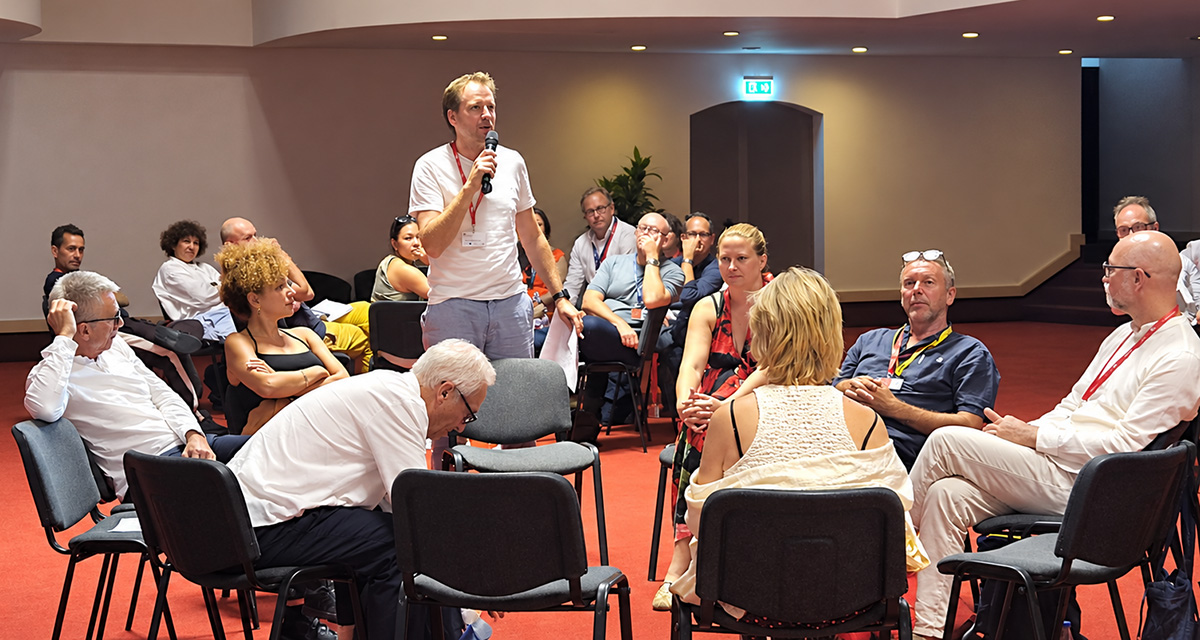
A working session at the Venice Production Bridge attempted to unpick the varying priorities of producers, distributors and sales agents, raising some uncomfortable questions.
The independent film sector is never short on conversations about audience development. What it lacks, judging by a closed working session at the 2026 Venice Production Bridge, is a reliable way to make those conversations happen early enough to change a film’s fate.
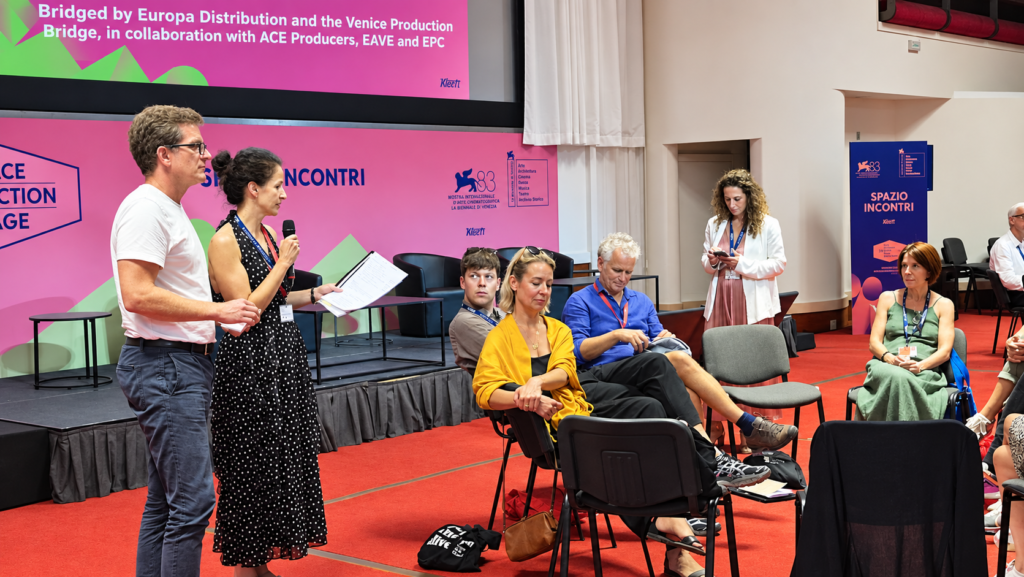
That tension ran through “New Paths to Audiences: Strengthening Collaboration Between Independent Film Distributors and Producers,” the fourth edition of Europa Distribution’s producers and distributors working session, held 6 September at the Hotel Excelsior’s Spazio Incontri. Organized in collaboration with ACE Producers, EAVE and the European Producers Club, the event brought together 30 distributors and 30 producers for three hours of small-group discussion followed by a plenary wrap-up.
Pascal Diot, head of the Venice Production Bridge, opened the session, while Europa Distribution project coordinator Valentina Serra introduced the association and its partner organizations. Before the room split into groups, Eurimages program manager and financial controller Thierry Hugot and project manager Iris Cadoux updated attendees on the Council of Europe fund’s Film Marketing & Audience Development Support Programme, which, crucially, is now rewarding marketing work that begins before principal photography. This set up the question that would dominate the afternoon: how much earlier can marketing, distribution and audience work realistically begin?
Ahead of the curve
The Eurimages figures suggest there is institutional appetite for trying. Across 2024 and 2025, the scheme received 72 applications and supported 30 films, a 45% selection rate, awarding EUR €1.47 million (USD $1.71 million) to projects led by producers from 23 countries. Seven supported titles were animations and four documentaries. Among the lessons Eurimages says it has drawn so far: early research pays off, digital can outperform traditional marketing, taste-based targeting can beat demographic targeting, centralized assets save money and the physical presence of talent matters.
For 2026, the program offers non-refundable grants of up to EUR €50,000 (USD $58,193) per film for activities ranging from audience research and digital campaigns to media assets, PR and outreach. Eligible projects must already have Eurimages co-production support, have a sales agent attached and not yet have reached their first market presentation or festival screening. The next deadline is 5 October. The 2026/27 assessment grid also explicitly rewards marketing work begun before principal photography, with five equally weighted criteria replacing the previous six-part system. The five 2026/27 criteria, each scored from 0–20, are: Strategy, Audience Targeting & Unique Selling Points; Transnational Dimension & Associated Promotional Material; Collaboration & Professional Capacity of the Parties Involved; Budget Coherence & Feasibility; and Timeliness & Implementation Readiness.
That notion of “early,” however, became considerably less straightforward once practitioners compared how films are actually financed, acquired and released.
Larry Bass of Ireland’s ShinAwil said one of the clearest missing links was not between producers and distributors but the absent third party. “Sales agents are missing in action everywhere,” he said. His group found that transparency between producers and distributors was often less of a problem than actual communication, particularly on international titles where a distributor may never meet the producer and instead deal exclusively with the sales company.
A second group, led by Jan Macola of the Czech Republic’s Pilot Film, exposed how different national systems can make any universal model difficult. Participants compared larger territories such as France, where pre-sales are common, with smaller markets where they are not. More importantly, Macola’s group returned to the same structural issue that Bass had laid out: “It’s very important to have dialogue from the early stage of development of the project,” while arguing that exhibitors, sales agents and funding bodies should also become part of that conversation.
Bass also identified practical areas where earlier collaboration could reduce duplicated costs. Posters and trailers were obvious examples. While participants disagreed on who should ultimately cut a trailer, Bass argued that trailer-making is “a specific skill base” and that sharing or coordinating such expenditure could improve recoupment for both sides.
He also stressed something increasingly decisive: cast access. “Cast is getting even more important for all parts of filmmaking,” he said, from financing through to getting a movie noticed. Therefore, availability needs to be built into the process rather than negotiated later.
Macola’s group also called for more money at the development stage, rather than concentrating resources on production and release. Better-funded development, they suggested, can allow producers to stop projects that are clearly going nowhere instead of being pushed to finish them “at any cost,” feeding an oversupply of films competing for already fragmented audience attention.
Cull my agent?
Igor Stankovic of Serbia’s Megacom Film offered the most combative take on sales agents. For domestic films, he said, early marketing collaboration is already possible: distributors can involve talent, visit locations and start digital communication during production. International acquisitions operate on another clock entirely. Some movies are pre-bought on the strength of a director or cast; others are only discovered once they emerge as festival titles.
“It is impossible to talk at that level [about] the early stage of the marketing strategy and campaigns,” Stankovic said of the latter category.
He argued that distributors need more direct access to talent and clearer information about release timing, particularly when a film’s international rollout may stretch across an 18-month window. Then came the session’s sharpest jab. On getting filmmakers and actors to support local releases and festivals, Stankovic suggested distributors might sometimes be better off approaching producers directly, quipping that sales agents “care just about the commission — and flying business class.”
Beneath the joke was a genuine frustration: local distributors can be expected to build campaigns around filmmakers and actors whom they may have little ability to access.
His group also questioned whether minimum guarantees are always the smartest place to concentrate distributor risk. Stankovic floated a model in which MGs could come down while contractual prints and advertising commitments become more explicit, giving producers reassurance that money will actually be spent on launching the film. “Maybe MG could be structured differently,” he said, with P&A becoming “an obligatory part of the contract.”
Simon Wullens of Lumière Benelux brought the discussion back to audiences. His group compared the film business with theater companies that employ dedicated audience developers whose job is to identify organizations and communities likely to connect with a work. “That might also be a good strategy for film distributors,” Wullens said.
His larger point was that distributors cannot solve audience problems at the end of the chain if the project never had a plausible audience to begin with. “Producers and distributors are actually forming a very good marriage,” he said. “Things go up, things go down, as long as we stay together.”
But that marriage requires early candor, including telling producers when a project appears destined to “fall between two chairs.” It also requires usable materials on time. Good stills, positioning materials and trailers are not decorative extras added once a movie is completed; they are the means through which distributors begin finding audiences.
Next, Stefan Bradea of Romania’s Bad Unicorn described a paradox that perhaps best summarized the afternoon, building on Stankovic’s comments. Distributors say they want to be involved early, and on national productions they often are, partly because local financing structures reward having a domestic distributor attached. Yet with international films, the same distributors want to minimize risk and may only commit once a project is substantially further along.
Finding the sweet spot
What they do want early, Bradea said, is influence over the marketing toolkit. Distributors “would like very much to be as soon as possible in the mix” when materials and strategy are being developed. He singled out set photography and trailers, arguing that having a trailer two or three months before the first international release would already represent an improvement.
Sales agents, in this formulation, are less villains than gatekeepers: the parties frequently controlling materials and marketing strategy, with local distributors sometimes brought in only after the campaign’s “sweet spot” has passed.
Bradea’s group also revisited financing. MGs remain critical to producers’ financing plans, so simply eliminating them is unrealistic. But rights structures, P&A guarantees and other deal terms could potentially reduce upfront MG exposure. He also raised contractual “callbacks” that can hold up releases until a film’s commercial potential has diminished, arguing for fewer such mechanisms and greater flexibility around secondary rights.
Later, Jakub Duszynski of Poland’s Gutek Film closed with the most philosophical report. His table began by imagining a “utopia” in which distributors could engage very early, discuss a project’s merits and perhaps invest. That vision immediately ran into resistance from producers worried about “too many cooks” and about protecting the filmmaker’s creative vision.
Duszynski’s group therefore reframed the proposition: if producers want distributors to share financial risk earlier, what exactly do distributors receive in return? Influence over development? Access and information? Or simply the expectation that they fall in love with the project as completely as the producer already has? This discussion was particularly important because it exposes the crucial tension of early distributor involvement: producers may want distributors to take financial risk earlier without necessarily wanting them to have greater influence over development. That’s a major contradiction that, as yet, is still in search of a meaningful resolution.
One idea floated was a database of first-time, lower-budget projects open to “courageous distributors” willing to read treatments and identify promising films before the normal acquisition stage. But the more telling complaint came from producers themselves. They do not simply want distributors to send back box-office figures and demographic metrics after release.
“They are very much disappointed with just getting numbers, statistics, metrics,” Duszynski said. “They would like to understand from distributors who are the audiences for their films.”
That may be the workshop’s clearest takeaway. The problem is not a shortage of data, schemes or marketing terminology. Every part of the chain still tends to make its biggest decisions at a different moment. Producers need financing before distributors feel safe. Distributors need materials before producers have finished making them. Sales agents sit between the two. Exhibitors enter later still. Meanwhile, the audience — the stake holder everyone claims to be working toward — is too often treated as something to locate once the film is already complete.
Eurimages is now explicitly putting money behind an attempt to reverse that sequence. The Venice discussion showed why doing so is difficult, but also why the status quo is increasingly untenable. Or, as Stankovic put it with considerably less diplomacy: without films, cinemas would be “just huge popcorn stores.”

- Nordic Cinema Doesn’t Have an Export Problem. It Has a Conversion Problem - September 16, 2026
- Young Audiences Already Like Cinema. The Hard Part Is Giving Them a Reason to Go - August 31, 2026
- At Locarno, Restored Films Face Their Next Challenge: Finding an Audience - August 20, 2026