


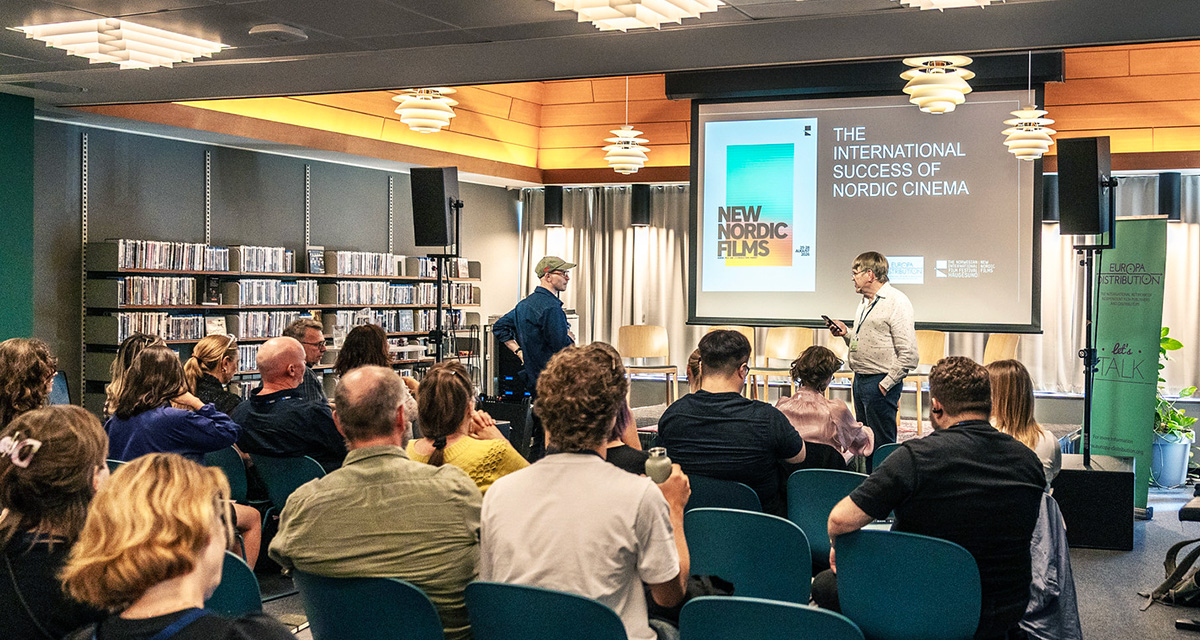
A Europa Distribution session at New Nordic Films in Haugesund looked at a well regarded subcategory of international cinema, and found that a reputation for quality doesn’t always lead directly to strong ticket sales.
At festivals, Nordic films travel extraordinarily well. They win prizes, attract sales agents, generate press and enter foreign markets carrying exactly the kind of cultural prestige independent distributors are supposed to monetize. The harder step comes afterward: converting that prestige into a reason for somebody to leave home and buy a cinema ticket.
That distinction matters because the European theatrical market has become increasingly unforgiving. More than 3,400 European films received commercial releases worldwide in 2024, yet only 47 passed one million admissions, 35% fewer than during the pre-pandemic period. In 2025, European cinema attendance then fell another 5.5%, from 843 million to 796 million admissions. More European films are circulating, but relatively few are achieving scale.
A Europa Distribution session at New Nordic Films during the Norwegian International Film Festival in Haugesund on 27 August offered a close-up of that conversion problem through Joachim Trier’s “Sentimental Value” and Hlynur Pálmason’s “The Love That Remains.” The wider question was how visibility turns into positioning, urgency and admissions.
Prestige Is Raw Material, Not a Business Model
For “Sentimental Value,” the advantages were considerable: Trier’s profile after “The Worst Person in the World,” a Cannes Grand Prix, awards momentum and a cast including Renate Reinsve and Stellan Skarsgård.
Yet even those assets did not make success automatic.
Bianca Maria Roiu of Bucharest-based arthouse distributor Bad Unicorn called the Romanian release “the perfect storm.” It drew more than 29,000 admissions over 16 weeks. Yet Bad Unicorn’s “Armand,” also starring Reinsve, had struggled, while Golden Bear winner “Dreams” still did not approach Trier’s numbers. Prestige and familiarity created favorable conditions; they did not produce a repeatable formula.
Taiwan offered the same warning from another angle. “For us, I would position Nordic films alongside other European films,” said Swallow Wings’ Albert Yao. In a market where arthouse competes with Hollywood, Japanese animation, Korean cinema and local releases, “Nordic” can signal quality without becoming a mass-market proposition.
That is the weakness in treating Nordic cinema as a bankable category. Quality recognition and consumer demand are not the same thing.

The Most Useful Festival May Not Be the Biggest
The international festival hierarchy can obscure another part of the equation.
Cannes, Berlin and Venice remain unmatched for global visibility, but for a Nordic debut or less immediately commercial auteur film, a festival outside the Big Three can sometimes provide a clearer market signal precisely because the film has more room to dominate the conversation.
Lilja Ingolfsdottir’s Norwegian debut “Loveable” is almost a textbook example. It world-premiered in Karlovy Vary’s main competition in 2024 and left with five awards, including the Special Jury Prize, Best Actress for Helga Guren and the Europa Cinemas Label. The latter matters particularly from an exhibition perspective: the film did not merely leave with critical validation, but with a recognizable theatrical selling point.
Karlovy Vary produced another striking Nordic example this year. Danish filmmaker Mads Mengel’s debut “The Guest,” sold internationally by LevelK, world-premiered in the Crystal Globe Competition and emerged with both the Special Jury Prize and Best Director. For first features such as “Loveable” and “The Guest,” becoming one of the discoveries of Karlovy Vary may therefore be more useful than simply possessing a laurel from a more crowded program elsewhere. Prizes, concentrated press attention and industry exposure give distributors and exhibitors a narrative they can actually sell.
Locarno has long performed a similar auteur-building function. Pálmason’s “Winter Brothers” world-premiered there in 2017, beginning the accumulation of recognition that would eventually make “a Hlynur Pálmason film” a meaningful proposition in itself.
More recently, Janicke Askevold’s Norwegian “Solomamma” entered Locarno’s 2025 competition with international sales already underway. The point is not that Locarno generated every deal, but that selection itself forms part of a film’s international positioning, giving buyers, distributors and press a platform around which momentum can accumulate.
Maria Bäck’s Danish-Swedish-Greek “Brave New Love” offered a fresh example this August. Sold by Reinvent Yellow and selected for Locarno’s International Competition, the film arrived with Anders Danielsen Lie, Kathrine Thorborg Johansen and an unruly story about marriage, motherhood, infidelity and desire. Its immediate Locarno value is easier to measure in attention than completed sales, but that distinction matters: festival impact begins with visibility and positioning, not when a box-office result appears.
Rotterdam makes the exhibition connection more explicit. Swedish-Finnish drama “Raptures” won IFFR’s 2025 Big Screen Award, which provides EUR €15,000 (USD $17,473) to the filmmaker and another EUR €15,000 to the Dutch distributor acquiring the film. Here the festival does not merely confer prestige; it directly incentivizes theatrical circulation.
The lesson is not that one festival tier has replaced another. It is that for independent cinema, fit can matter more than rank.
There is another striking pattern across these examples. “Loveable,” “The Guest,” “Brave New Love,” “Sentimental Value” and “The Love That Remains” all revolve, in different ways, around families under pressure. For all the talk of Nordic cinema as an exportable aesthetic, one of its most internationally legible recent strands may be remarkably domestic: universal emotional material filtered through a distinctive mixture of candor, discomfort and dry humor.
Distributors Are Increasingly Selling an Occasion
The Haugesund campaigns were most revealing when distributors described everything they had constructed around the films. Independent distributors are increasingly being asked not simply to advertise a movie, but to manufacture an occasion around it.
Swallow Wings turned “Sentimental Value” into a series of limited theatrical collectibles in Taiwan. In Romania, Bad Unicorn asked more than 200 guests at a press screening to bring objects carrying sentimental value. Roiu said the resulting images helped communicate that “this is a very intimate film and you can participate in this.”
Aerofilms pursued the same logic through Scandinavian food, design and a relationship-focused conversation game. For “The Love That Remains,” it went further with dog-friendly screenings, a therapist Q&A and Icelandic-themed collaborations, while Mozinet built its Hungarian campaign around slow living, nature and craftsmanship.
The common logic matters more than the individual stunts. These campaigns try to rebuild something streaming has weakened: urgency. A film that audiences assume they can watch later needs a reason to be experienced now. A collectible, a filmmaker visit, a themed event or an audience ritual can turn a screening into a time-specific proposition rather than another item waiting in a digital queue.
And Sometimes Even That Isn’t Enough
That is why “The Love That Remains” may ultimately be more revealing than “Sentimental Value.”
Jour2Fête invested around EUR €150,000 (USD $174,725) in P&A and released Pálmason’s film on roughly 50 prints in France. Admissions nevertheless remained below 20,000. In Czechia, Aerofilms mounted an unusually hands-on campaign but remained under 7,000 admissions. Anna Rampa summarized the contradiction plainly: “We tried really hard to approach broader audiences, but it didn’t really happen.”
Yet both distributors intend to keep following the filmmaker.

For Jour2Fête’s Johanna Mayer, that continuity is part of the economics of independent distribution. European support, she argued, is vital because commercial resonance can rise and fall across an auteur’s career. “It’s super important for us to grow with our [filmmakers],” she said, adding that without such support, sometimes it simply would not be possible.
This is where auteur distribution stops resembling a sequence of isolated bets and starts looking like portfolio economics. A breakout proves that breakout is possible; a difficult release exposes the machinery required to keep arthouse distribution functioning. The value of the relationship can only be understood across several films, not from a single opening weekend.
European backing therefore becomes structural rather than decorative. Without risk-sharing mechanisms, distributors would face ever stronger incentives to buy only films with stars, immediately communicable concepts or already overwhelming festival momentum.
The European Audiovisual Observatory’s figures reinforce the problem. Domestic markets typically generated between 62% and 66% of admissions to European films in 2024, while 63% of export admissions were still generated elsewhere in Europe. European cinema crosses borders, but its ability to achieve scale far beyond those borders remains limited.
The wrong conclusion is that the Nordic label needs to be marketed harder. The evidence suggests the opposite.
A film from Finnish filmmaker Aki Kaurismäki may travel as romance and deadpan comedy. A Trier title can move through stars, awards and emotional accessibility. Pálmason can be sold through landscape, artistic authorship and the accumulated value of a career built across festivals such as Locarno. A Norwegian or Danish debut can arrive at Karlovy Vary relatively unknown and leave carrying a ready-made theatrical narrative.
The Nordic label may open a door. A festival may help prop it open, but the distributor still has to persuade somebody to walk through it.

- Cinema’s Creator Problem Is No Longer Just About Marketing - September 25, 2026
- Film Marketing Needs to Start Earlier. Eurimages Is Learning How Hard That Can Be - September 24, 2026
- Nordic Cinema Doesn’t Have an Export Problem. It Has a Conversion Problem - September 16, 2026