


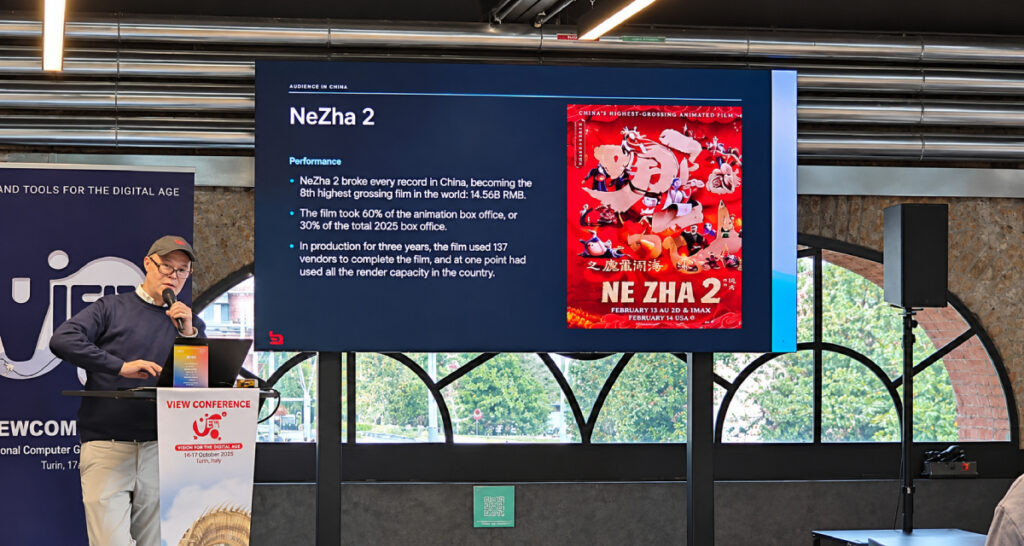
At Turin’s VIEW Conference, Base Media’s Chris Bremble discussed sustainability issues in the lucrative Chinese animation market, in a wide-ranging talk covering hits like ‘Ne Zha 2’, the reason why Pixar’s films don’t often land in China, and the importance of female ticket-buyers to the box office total.
China has demonstrated that it can produce some of the world’s biggest animated blockbusters. Whether their extraordinary commercial success translates into a sustainable industry is another question. Speaking at Turin’s VIEW Conference (12-16 October 2026), Base Media founder and CEO Chris Bremble offered an unusually candid assessment of the Chinese theatrical animation market, revealing that “Ne Zha 2”, the highest-grossing animated film in history, was also the project on which his firm lost the most money.
The revelation was particularly striking given Base’s involvement in some of the film’s most technically demanding sequences. A production schedule initially expected to last four months eventually stretched to 18, Bremble explained, leaving the studio absorbing substantial additional costs.
His presentation, titled “The Future of Independent Theatrical Animation in China: Global Implications,” combined two decades of industry experience with detailed audience research and occasionally provocative observations about Hollywood, Chinese culture and the future of animation. The resulting picture was one of enormous opportunities, but also uncomfortable contradictions.
From Children’s Entertainment to a Billion-Dollar Industry
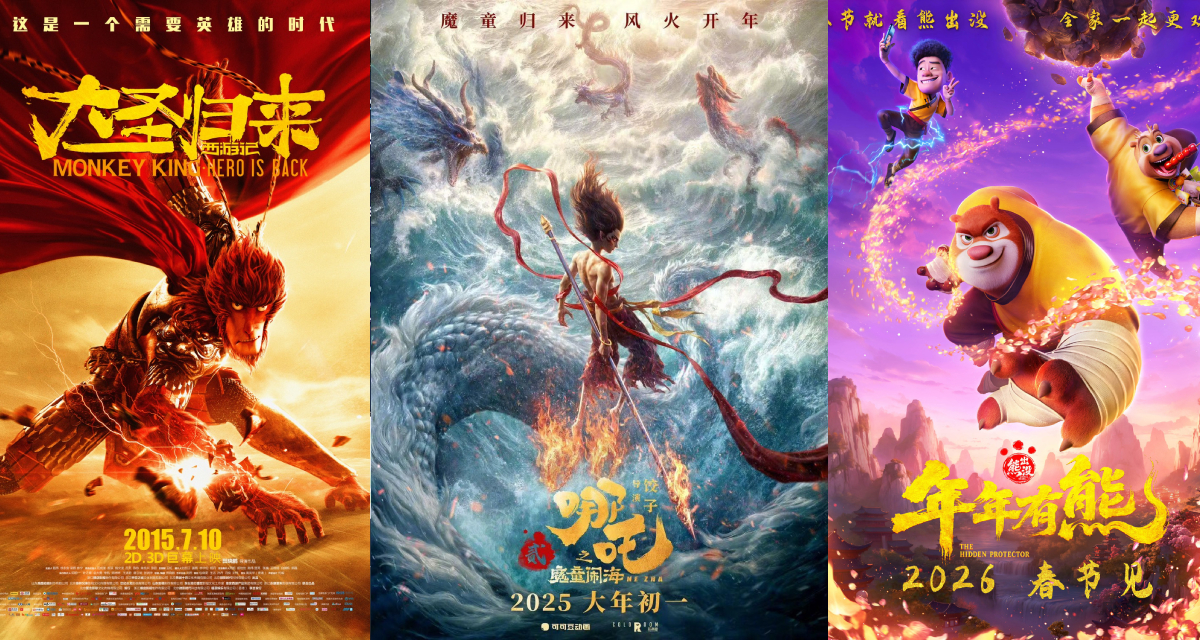
First, Bremble traced the transformation of China’s animation industry through several landmark productions. “Monkey King: Hero Is Back” (2015), for example, demonstrated that domestic animation could attract young adults rather than exclusively children, while the “Boonie Bears” franchise established the Lunar New Year holiday as an annual appointment for family audiences.
The latter was particularly important in smaller Chinese towns, where repeated holiday releases helped develop consistent moviegoing habits. The franchise’s financial growth also reflected an evolving understanding of its audience: parents accompanying their children were not simply additional ticket buyers, but viewers whose emotional expectations increasingly shaped the films themselves.
“White Snake” (2019) subsequently demonstrated the commercial potential of young adult romance, particularly among women, while “Ne Zha” broadened the market further. Productions such as “Deep Sea” (2023) also showcased increasingly sophisticated technical capabilities, establishing the foundations for China’s spectacular recent achievements.
Those developments culminated in “Ne Zha 2”, which grossed approximately RMB ¥ 15.45 billion (USD $2.2 billion) and accounted for roughly 30% of China’s total 2025 box office, according to Bremble’s presentation.
Yet the following year’s results offered an immediate reminder of the market’s volatility. China’s 2026 Spring Festival box office fell 39.5%, from RMB ¥ 9.51 billion (USD $1.42 billion) to RMB ¥ 5.75 billion (USD $860 million). Although the comparison reflects the entire theatrical market rather than animation alone, it illustrates the difficulty of reproducing an exceptional blockbuster’s impact.
Animated productions nevertheless continued to generate substantial business, with “All Wishes Come True!” earning RMB ¥ 2.04 billion (USD $300 million) and “Boonie Bears: The Hidden Protector” surpassing RMB ¥ 1 billion (USD $150 million).
Women Buy the Tickets, but What Makes Audiences Return?
“Women are the market,” Bremble stated, arguing that producers developing animated features for China should first identify the woman purchasing a ticket and then determine whom she might bring along.
“Who’s walking in and buying a ticket? Is it a woman? If it isn’t, stop,” he highlighted, describing a commercially minded approach to project development that begins with identifying a film’s core demographic.
His reasoning extends beyond traditional audience segmentation. An animated film’s commercial potential depends on its ability to engage several audiences simultaneously, particularly women attending with children, relatives or friends.
Bremble illustrated the point through the Chinese concept of tap water, an expression describing spontaneous word of mouth. Marketing campaigns and favorable opening-weekend conditions may generate initial attention, he argued, but only sustained emotional engagement can deliver the theatrical multiples necessary for a major success.
“If you don’t have the culture right, if you don’t have the product market fit, you’re not going to go very far,” he warned.
Two movies from 2026 provided a revealing comparison. According to Beacon audience data presented at VIEW, 46% of ticket buyers for “All Wishes Come True!” were aged 35 or older, compared with 47% for Pixar’s “Toy Story 5.” Their other age brackets were similarly distributed. Yet the Chinese production grossed RMB ¥ 2.04 billion (USD $300 million), approximately 9.8 times its opening-weekend revenue, while “Toy Story 5” generated RMB ¥ 286 million (USD $42.7 million), just 2.4 times its opening weekend.
The numbers suggest that reaching comparable demographic groups does not necessarily translate into comparable enthusiasm. However, they do not independently establish why the films performed differently. Marketing, release conditions, brand recognition and competing attractions also influence theatrical results.
Bremble’s explanation focused primarily on cultural relevance and emotional identification. “If tears flow, tap water flows,” he summarized, suggesting that films capable of generating powerful emotional responses are particularly well positioned to sustain their theatrical runs.
Does Pixar Really Have a Cultural Problem in China?
Bremble was especially critical of Pixar’s perceived difficulties in connecting with Chinese audiences, describing the studio’s storytelling sensibility as “soft, warm, Northern California” and broadly progressive.
“That approach in China doesn’t stick,” he argued, suggesting that Chinese moviegoers respond more strongly to narratives reflecting material struggles, social expectations and practical challenges than to certain forms of aspiration associated with Pixar’s storytelling.
There is an interesting argument here, although the distinction is perhaps not quite as clear cut as this interpretation of the figures suggests. Commercial performance alone cannot establish that a studio’s ideological or cultural outlook is responsible for a movie’s reception. Bremble himself pointed to the exceptional Chinese performance of Disney Animation’s “Zootopia 2,” making clear that his criticism was aimed primarily at Pixar rather than American animation as a whole. Yet that comparison also raises a question his explanation does not fully resolve: how much of the gap is cultural, and how much reflects differences between individual films, franchises and release strategies?
More broadly, Bremble’s cultural analysis occasionally relied on questionable generalizations. His suggestion that most working Chinese adults are employed by state-run industries, for example, is contradicted by official statistics indicating that private businesses account for more than 80% of urban employment.
Still, his underlying argument deserves consideration: stories that connect personal dilemmas with recognizable social pressures may resonate more strongly than productions relying solely on spectacular imagery or familiar intellectual property.
Two Layers, One Story
Bremble’s most convincing evidence came from a slide examining what children and adults take away from the same animated narratives.
In “Ne Zha 2,” younger viewers encounter a demon boy battling monsters, while adults may recognize a story about refusing a destiny imposed by others. “All Wishes Come True!” similarly presents children with a fantastical heist involving eight immortals, while older audiences can interpret its conflict as ordinary people challenging seemingly untouchable authorities.
Nobody follows little monsters on an adventure, but its workplace subtext concerns employees trapped in endless revisions and obligations imposed by their superiors. “Boonie Bears: Time Twist,” meanwhile, combines familiar animal characters with questions about middle age, regret and paths not taken.
This layered storytelling is hardly exclusive to China. Animation studios worldwide have long developed narratives intended to operate simultaneously for children and adults.
What makes Bremble’s interpretation useful is its emphasis on specific contemporary anxieties rather than generic universal themes. The objective is not merely to deliver entertainment suitable for multiple age groups, but to give each group a distinct emotional investment in the same story.
There is, however, a potentially uncomfortable implication. Bremble repeatedly emphasized testing, audience segmentation and product-market fit, including the use of animatic screenings to refine Base’s forthcoming productions. Nevertheless, he insisted that understanding audiences should encourage filmmakers “not to cater to them, but to challenge them,” he explained.
Maintaining that distinction may become increasingly difficult when commercial expectations are integrated so closely into creative development.
The Spectacle of ‘Ne Zha 2’ and the Price of Success
“Chinese animation is like the Michael Bay of animation. They want to go big,” Bremble remarked, describing the industry’s increasing appetite for elaborate action and spectacular imagery.
“Ne Zha 2” involved approximately 137 production vendors, according to his presentation. Base contributed a sequence featuring around 1,000 individually modeled demons, with complex chains and interactions requiring extensive technical coordination and directorial approvals.
Bremble described the expanding talent pool as the result of decades of training, international collaboration and the movement of experienced artists between companies. He particularly credited Industrial Light & Magic with helping establish the demanding technical standards that Chinese artists subsequently spread throughout the industry. But this progress has not eliminated the economic vulnerabilities of independent suppliers.
Bremble’s account of Base’s losses on “Ne Zha 2” raises a fundamental question about how production risks are distributed across the animation pipeline. A given movie can achieve historic box-office revenues while individual vendors struggle to accommodate changing requirements, prolonged schedules and escalating demands.
His discussion of working conditions was equally revealing. Bremble portrayed long hours and intense concentration as characteristic of China’s creative industries, while also acknowledging that “the burnout is really high.”
Such explanations warrant scrutiny. Extraordinary productivity does not necessarily demonstrate a uniquely advantageous national work culture, particularly if it depends on extended working hours and pressure absorbed by artists or smaller contractors.
China’s animation industry may have developed the capacity to produce spectacle on an unprecedented scale. Its next challenge is ensuring that the companies and workers delivering that spectacle can benefit sustainably from its success.
From China to the World: Co-productions, AI and the Next Challenge
For independent producers, Bremble argued, the next major opportunity lies in developing projects specifically for Chinese audiences while retaining the ability to reach international markets.
“It’s no longer a market you sell into. It’s a market you target, and then you sell to the rest of the world,” he explained.
That particular approach is important, because China’s biggest domestic animated successes have struggled to reproduce their financial performance overseas. International coproductions may offer an alternative, although Bremble warned against projects that use Chinese mythology or historical settings merely as decorative elements rather than developing stories grounded in contemporary experiences.
Artificial intelligence represents another potential turning point. Bremble described a striking contrast between American clients, who may impose contractual restrictions on AI use, and Chinese partners increasingly interested in how extensively the technology is being deployed.
“If you want to raise money and you don’t have AI in your business plan no one will take your phone call,” he observed, suggesting that the technology has become almost unavoidable in investment discussions, even as younger artists express considerable anxiety about their professional futures.
Yet his enthusiasm remained qualified. Having recently watched footage from what he described as an entirely AI-generated animated feature, Bremble acknowledged improvements in lighting and visual consistency, but questioned whether the result offered a compelling reason to purchase a cinema ticket. “Not bad at all,” Bremble commented, before adding a caveat: “But I wouldn’t pay to watch it. I might watch it if I was in an airport in New York.”
Ultimately, he argued that AI should not be considered as an independent substitute for human creativity. “AI is a tool set,” he said.
The contradiction neatly encapsulates the industry’s current position. China can produce animation of extraordinary technical sophistication, while new tools promise to make certain aspects of production faster and cheaper. Neither achievement automatically guarantees meaningful storytelling, profitable production arrangements or lasting audience loyalty.
For all its impressive box-office records, China’s animation revolution may ultimately be judged less by the scale of its next blockbuster than by whether it can build a viable industry around the people making it.

- China’s Animation Boom Has a Hidden Cost - November 6, 2026
- Did TIFF’s First Market Deliver for Buyers? The Answer Is Yes, With Caveats - October 8, 2026
- The Global Film Sales Playbook Is Changing as Pre-Sales Carry Less of the Load - October 7, 2026