


At Locarno Pro 2026, archivists, exhibitors, distributors and filmmakers explored why restoring a classic film is only the first step in putting it back in front of audiences.
Locarno Pro (August 5-11) – the Swiss film festival’s industry platform – closed its biggest edition yet this August with 2,140 industry accreditations (up 10% year-on-year), nearly 100 countries represented and 1,463 pre-scheduled meetings. Among the 76 films shown across its industry programs was one whose journey encapsulated a less obvious question facing the sector: once a film has been rescued and restored, what happens next?
“Letter from My Village,” Safi Faye’s 1975 debut feature, won the third Locarno Heritage Restoration Contest in 2025 after being selected from more than 30 submissions. Cinegrell subsequently undertook the digital restoration, which was presented at Locarno in 2026. Arsenal Filminstitut, which has represented Faye’s oeuvre since 2015, sees the restoration as the first step in a broader effort to return her work to circulation, including a retrospective planned for late 2026 followed by screenings and events internationally.
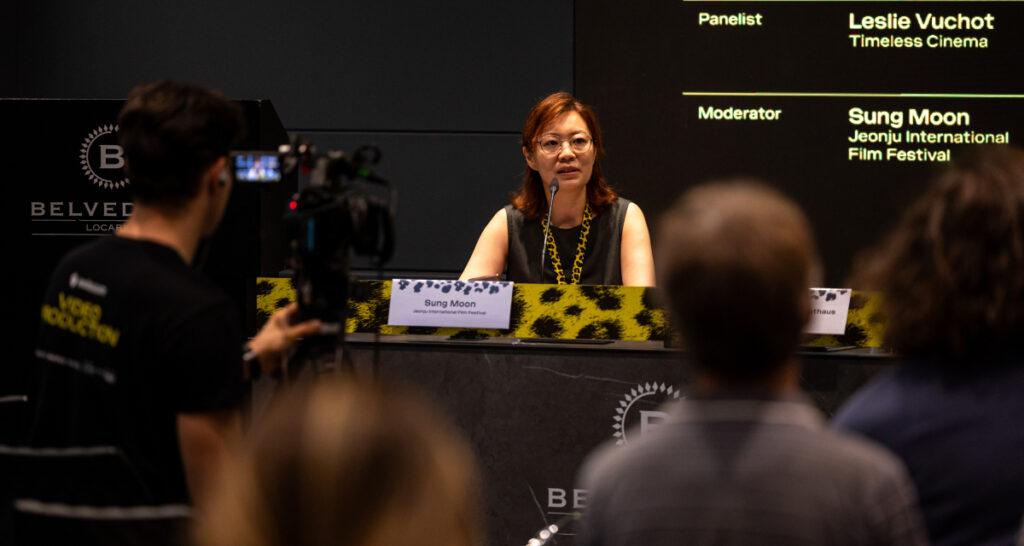
The Senegalese filmmaker’s work was not tackled directly during Locarno Pro’s Heritage Monday roundtable, “How Classic Cinema Finds New Audiences.” But its return to the screen offered a timely case study for many of the questions raised there: what comes after restoration, who is responsible for rebuilding an audience around a catalog title, and how can repertory cinema compete for attention?
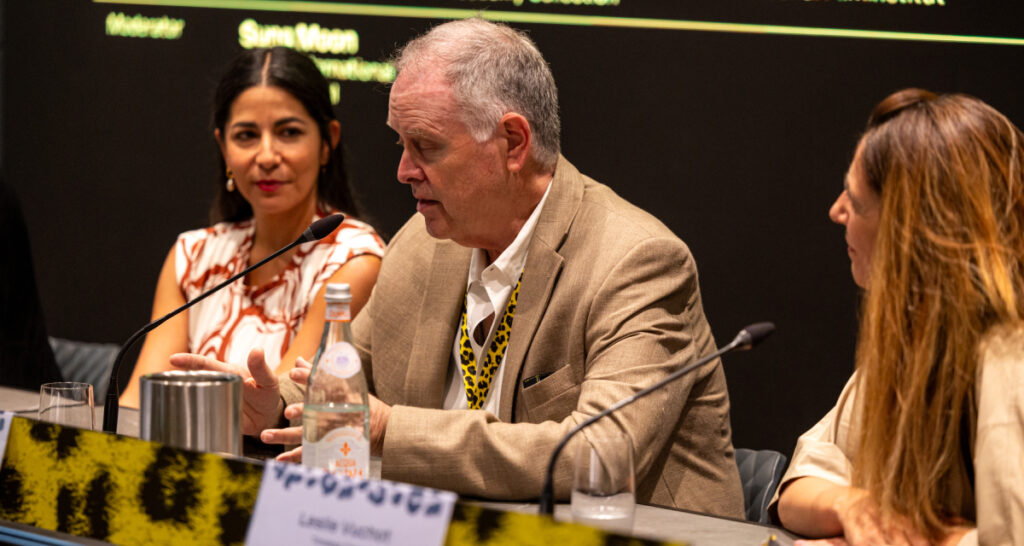
For Leslie Vuchot, founder and CEO of Timeless Cinema, the problem often begins with access.
Her company grew partly out of requests from cinemas seeking festival and classic titles during the pandemic. Rights could be difficult to clear, while locating prints, DCPs, subtitles and information about territorial availability could become a project in itself.
Timeless Cinema, launched this summer, aims to simplify that process for programmers. But Vuchot stressed that making a film available does not automatically make it attractive to an audience.
“Every venue needs curation and editorialization and eventization,” she said. The challenge is to extend the circulation of classic films in a theatrical environment already crowded with new releases.
Exhibition Can Fund Preservation
For Film Noir Foundation founder Eddie Muller, exhibition itself became the engine of preservation.
Muller began organizing festivals after publishing his book “Dark City: The Lost World of Film Noir,” only to discover that some of the films he wanted to screen were effectively unavailable. That led him to establish the nonprofit foundation to locate and restore orphaned or neglected films.
Today, revenue generated by its festivals feeds back into restoration work, creating what Muller described as a closed loop beginning with exhibition.
The foundation now operates ten festivals in the United States. Muller deliberately works with venues that can offer something of a classic moviegoing experience, with double bills, ushers and programming designed to make the screening feel like a night out rather than simply access to an old movie.
“My actual job was maintaining the audience to watch these movies,” he said.
That can mean keeping audiences coming through the doors during 10-day festivals even on Monday, Tuesday and Wednesday nights, when repertory cinemas might otherwise struggle to fill seats.
The cultural argument, however, has limits when dealing with commercial rights holders.
Recalling his efforts to convince US studios to make seemingly dormant titles available, Muller boiled the pitch down to one sentence: “I’m going to make you money.”
“That is the only viable answer that you can give in the United States of America,” he added.
As an example, he cited “The Crimson Canary,” a 1945 B movie that had barely been requested for decades but nevertheless found an audience through the foundation’s festivals. Another supposedly “lost” film, “Laughter in Hell,” produced an even simpler explanation from a Universal archivist: “It wasn’t lost. It was just nobody was asking for it.”
Give Audiences More Than a Screening
At the Academy Museum of Motion Pictures in Los Angeles, the same principle operates at a different scale. Its two theaters screen around 600 repertory titles each year, according to the museum’s director and president Amy Homma, but programming increasingly expands beyond the film itself.
A screening of Disney’s “101 Dalmatians,” for example, featured a real Dalmatian in attendance, and also ran alongside a live drawing class exploring hand-drawn animation. When Guillermo del Toro participated in a Hitchcock program, he was encouraged to work with archival papers and production materials rather than simply introduce the screening.
The aim, Homma explained, was to create “forever memories.”
“We have to be thinking of audience engagement as creatively as we possibly can,” she added.
Not every repertory venue can produce that level of event regularly, but Homma argued that consistency matters almost as much as scale. A dependable monthly screening can gradually create word of mouth, membership and a recognizable community around a venue.
Heritage Is Not Just Nostalgia
Perhaps the strongest evidence that this is not simply a nostalgia market came from Arsenal artistic director Stefanie Schulte Strathaus — whose institution, separately from the panel discussion, is also behind the renewed circulation of “Letter from My Village.”
“We make more income now with heritage film than with new films,” she told the audience.
The unexpected successes include restored shorts by India’s feminist Yugantar collective and the Sudanese Film Group. These are not necessarily canonical titles with pre-existing mass recognition, yet they have been circulating internationally.
Schulte Strathaus linked that interest to a younger audience searching the past for alternatives to dominant historical narratives.
“Film heritage offers so many potential futures,” she said.
Interest also extends to analog processes themselves. Arsenal’s workshops on Bolex cameras, film development, digitization, cataloging and projection can book out within days. The institution sometimes screens material before restoration, allowing audiences to understand the condition of the work and follow the process of bringing it back.
“Being transparent, being open, letting people in and not keeping them outside is the key,” she said.
That approach gives additional context to Arsenal’s plans for Faye. The restoration of “Letter from My Village” is not being positioned as an isolated technical achievement: the institution says it is intended to initiate renewed visibility for her wider filmography.

Build the Relationship Earlier
A second Locarno Pro session suggested that this audience-first thinking begins long before a film reaches the archive..
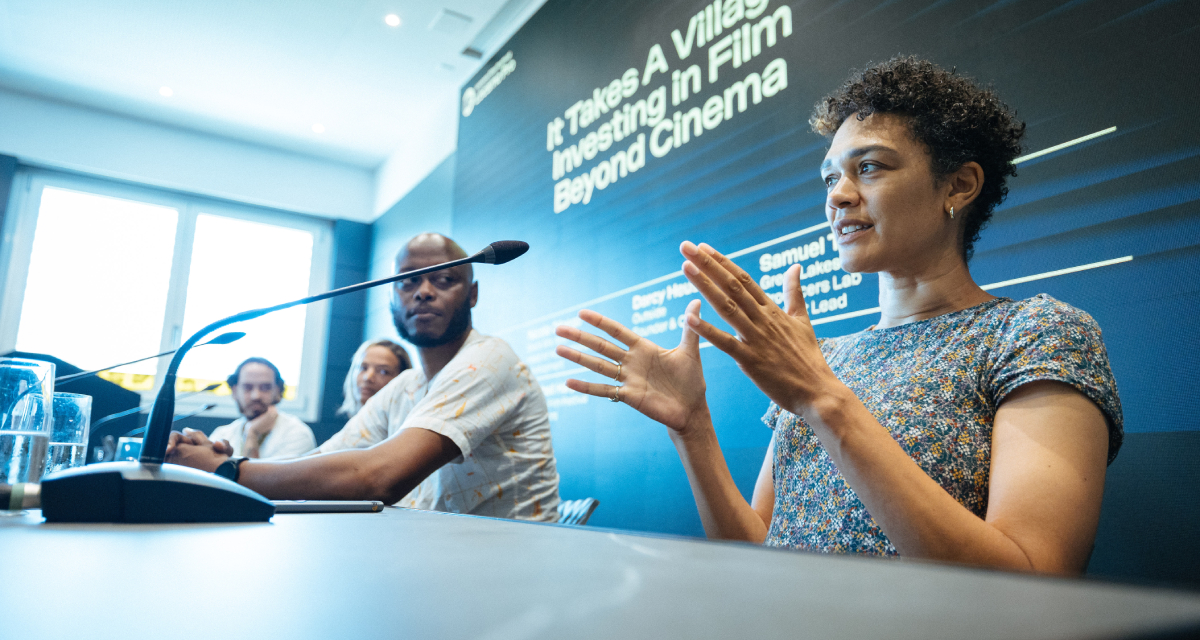
During Open Doors’ “It Takes a Village: Investing in Film Beyond Cinema,” Darcy Heusel, founder of audience-development and US distribution company Outside, described audience as something more fundamental.
“Audience really is the infrastructure,” she said.
Heusel argued that a small but committed group can be more useful than hundreds of thousands of passive social media followers, and that the relationship should begin during development rather than shortly before a festival premiere or theatrical release. Ugandan producer Samuel Tebandeke echoed that point. “I need to build that community from the moment I get a green light and say, ‘We’re shooting this film,’” he said.
For a newly financed feature and a 50-year-old restoration, the mechanics are obviously different. The underlying challenge is not. Films do not automatically find audiences because they have been funded, selected, digitized or restored. Someone still has to provide context, create an experience and establish a relationship between the work and people who might never have known to ask for it.
For “Letter from My Village,” Locarno’s restoration therefore marks less an endpoint than the beginning of another cycle: from preservation to circulation, and from circulation to rediscovery. Restoration can save a film; rediscovery, however, requires an audience.

- Did TIFF’s First Market Deliver for Buyers? The Answer Is Yes, With Caveats - October 8, 2026
- The Global Film Sales Playbook Is Changing as Pre-Sales Carry Less of the Load - October 7, 2026
- Cinema’s Creator Problem Is No Longer Just About Marketing - September 25, 2026