


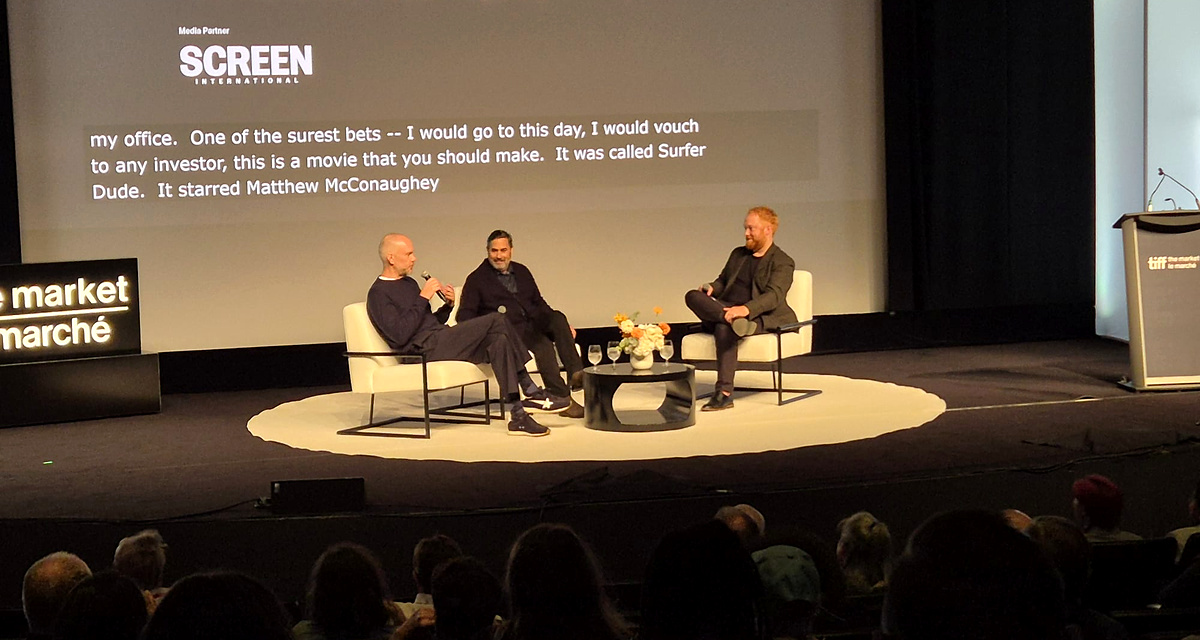
As international pre-sales become harder to rely on, FilmNation’s Glen Basner and CAA’s Roeg Sutherland argue at TIFF: The Market that sales agents must take more risk, package films earlier and help filmmakers think about audiences from the outset.
At TIFF: The Market’s “Perspectives: The Global Sales Playbook,” FilmNation Entertainment founder and CEO Gle
n Basner and CAA Media Finance and International Film Group co-head Roeg Sutherland argued that the traditional role of the international sales agent is expanding well beyond selling territories. Pre-sales remain crucial to independent film financing but are increasingly unable to carry the burden on their own.
“In a basic sense, we are sort of the connective tissue between someone’s creative endeavor and how the marketplace will respond to that creative endeavor,” Basner said, describing a sales company’s role as increasingly collaborative.
Rather than simply taking a finished package to buyers, he argued that sales companies need to engage filmmakers much earlier, offering market intelligence that can help a project become financeable without dictating its creative direction.
“Even in a challenging environment as we’re in right now, international pre-sales are the backbone of the infrastructure of independent film financing at any real scale,” Basner said.
But the mechanics of those pre-sales have changed dramatically.
“There was a time where you would just go into Toronto or Cannes or Berlin or AFM and you could go and pre-sell 80% of a movie,” Sutherland said. “That’s not true anymore. You’re lucky if you can go and pre-sell four or five major territories, and then you still have to figure out how to make the puzzle work.”
That shift has pushed companies such as FilmNation beyond the conventional sales-agent model. Sutherland pointed to FilmNation’s ability to put its own equity into projects when the international market alone cannot provide sufficient financing.
When a company truly believes in a movie, he suggested, the question can no longer simply be whether enough territories will pre-buy it.
“You have to do that because the movies and voices that he likes, sometimes it’s easy to go and pre-sell, sometimes it isn’t,” Sutherland said of Basner. “When it isn’t, when he believes in these small movies, he just commits to going and fully financing the movie.”
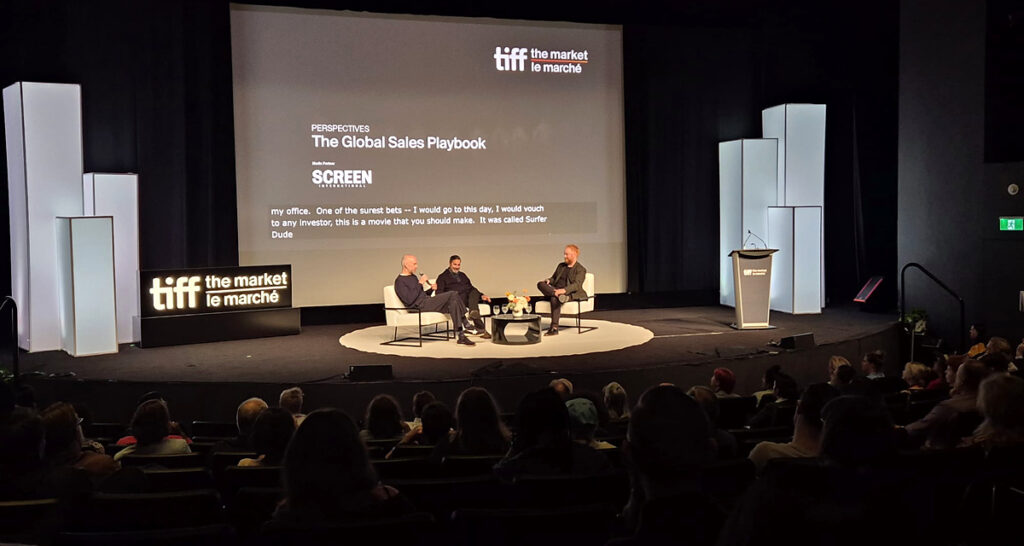
Forget the Formula, But Know the Market
Perhaps paradoxically, both executives argued that the more market information becomes available, the more important instinct becomes.
FilmNation, Basner said, gathers constant feedback from distributors around the world. But that data is not supposed to become a formula for determining which projects deserve to exist.
“We get all the information from the market every day,” he said. “We’re speaking with distributors in most countries every single day. We want to understand that, and then we want to throw it away.” Instead, the two questions FilmNation asks are: “Do we love it creatively?” and “Does it feel unlike anything that’s out there right now?”
“If those two things are yes, follow your instincts, and let’s go make it happen,” Basner said.
Sutherland similarly warned against becoming too comfortable with whichever assumptions currently dominate the business. “Instead of having to reset yourself every six months, you have to reset yourself every two weeks,” he said. “You have to stay ahead of information.”
His own reminder of how badly apparently obvious commercial logic can fail is the largely forgotten film “Surfer, Dude,” the 2008 Matthew McConaughey comedy whose investors, he recalled, effectively lost its entire USD $3 million budget.
On the opposite end of the spectrum was Darren Aronofsky’s “Black Swan” in 2010. Sutherland said the project received 76 passes before eventually becoming a major commercial and awards success.
The lesson, he argued, is not that market intelligence is useless, but that seemingly rational assumptions are never guarantees of future success.
Packaging for Theaters, Not Algorithms
Basner reserved some of his sharpest criticism for what he sees as an overly conservative approach to packaging among independent distributors. “It’s a very traditional approach to packaging,” he said. “This actor means this much money and this director, and it’s got to have X, Y and Z for it to make sense.”
That calculus, he argued, increasingly reflects buyers’ efforts to reduce risk and ensure downstream value from pay television and streaming.
“The only problem is that we’re building movies for the streaming companies,” Basner said. “It may work great on streamers, but it’s not the same thing as building a theatrical proposition.”
For FilmNation, the better question is how to make a film compelling enough that audiences feel they need to see it theatrically. He cited Olivia Wilde’s “The Invite,” which unfolds with four actors largely in a single apartment over one dinner party. Both streamers and theatrical buyers, Basner said, initially questioned its limited physical scope.
FilmNation’s response was that “this is Olivia Wilde’s version of this movie, and that’s what’s going to make it special.”
“That movie worked because Olivia Wilde made a great movie,” Basner said. “Therefore it breaks the packaging rules.”
Sutherland added that packages are also being assembled further upstream. CAA may become involved with a book, article or idea before a screenplay even exists, provided some creative element – such as a writer or producer – is already attached.
Studios’ retreat from traditional development has, in his view, created “an unbelievable opportunity to the independent community.” At the same time, CAA is reluctant to expose projects to the market before their downside risk has been accounted for.
“It used to be that you would be comfortable going out with a script and actors,” Sutherland said. “Now you kind of want to go out with a script, actors, and know that you have the financing in place before you actually introduce it to the marketplace.”
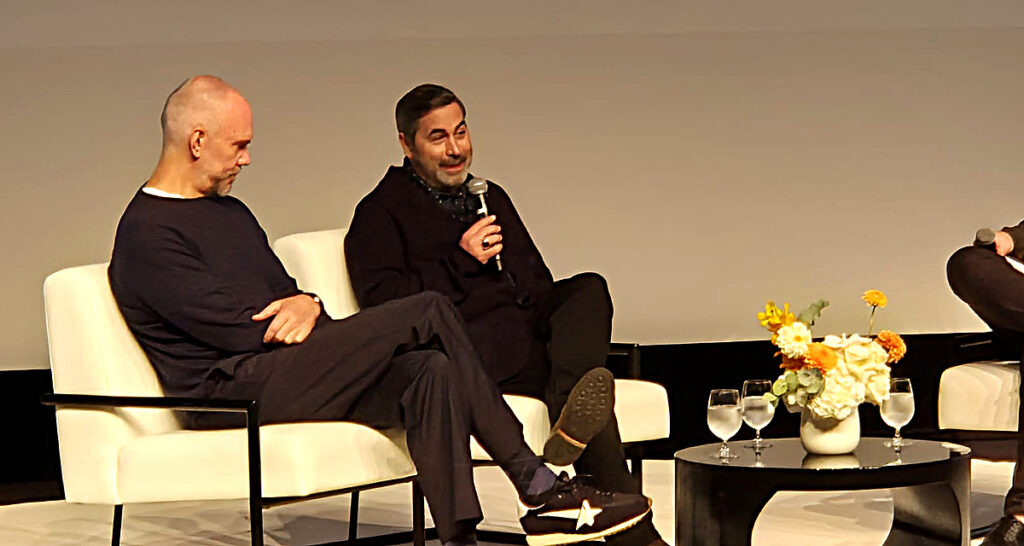
Filmmakers Now Have to Think Like Marketers
Another major change concerns the filmmaker’s own responsibilities. Sutherland argued that the sheer volume of audiovisual content has created a discoverability problem that cannot simply be handed to a distributor once production is complete.
“You as a creator have a responsibility to almost pre-market everything that you’re doing,” he said.
That does not mean every filmmaker needs to become a conventional marketer, but they do need a clearer understanding of who a project is for and how it might reach that audience – whether through theaters, social platforms or YouTube.
“That’s a layer of responsibility that did not exist,” Sutherland said. “Filmmakers five years ago did not really have [it], but that’s your responsibility.”
Both executives remained notably bullish about theatrical exhibition. They welcomed exhibitors experimenting with distribution, arguing that additional routes into cinemas could help smaller independent releases secure and retain screens.
Basner also pushed back on the industry’s constant language of crisis, whether around artificial intelligence, shrinking windows or changes in audience behavior.
“I think it’s going to be another great year,” he said when asked for a prediction for 2027. “Filmmakers are finding a way not just to get their films made but to tell their stories from their own unique perspective the way that they want to – and audiences are responding.”
For all the structural upheaval described during the session, the pair’s ultimate playbook was surprisingly straightforward: know the numbers, prepare for the worst-case financing scenario, embrace new tools and distribution channels – and then be willing to disregard conventional wisdom when a project is simply too good to ignore.

- Did TIFF’s First Market Deliver for Buyers? The Answer Is Yes, With Caveats - October 8, 2026
- The Global Film Sales Playbook Is Changing as Pre-Sales Carry Less of the Load - October 7, 2026
- Cinema’s Creator Problem Is No Longer Just About Marketing - September 25, 2026