


If the industry consensus is now that film marketing needs to start earlier, Eurimages has spent the past two years trying to fund what that actually looks like. The results suggest money helps, but it cannot by itself synchronize producers, sales agents, distributors and festival strategies that still operate on very different clocks.
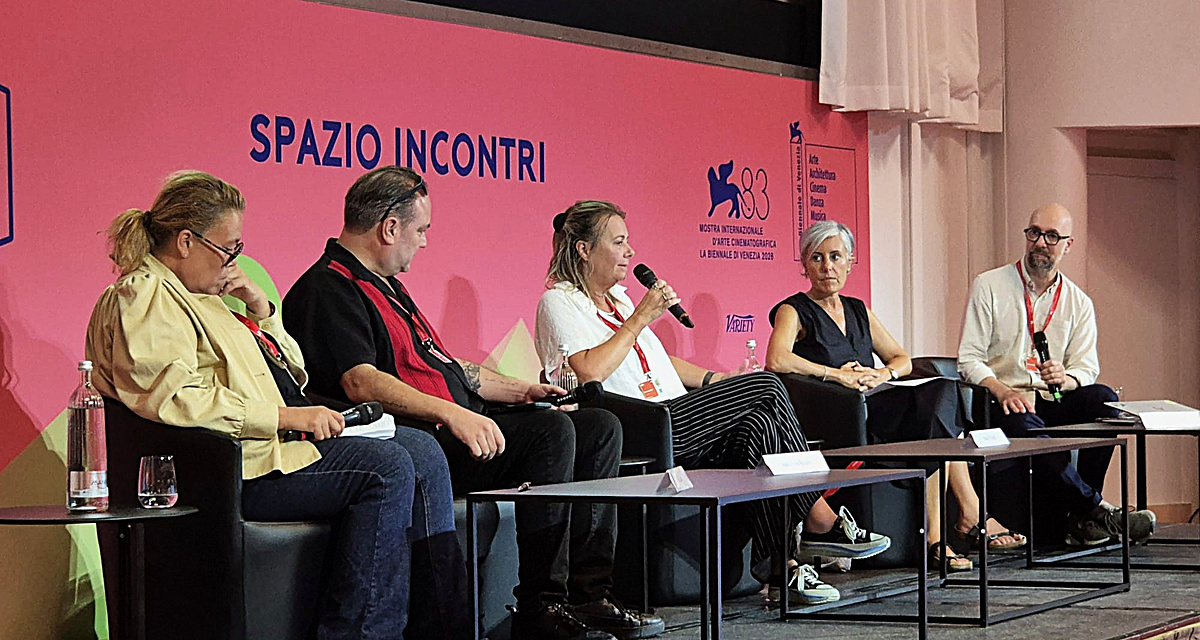
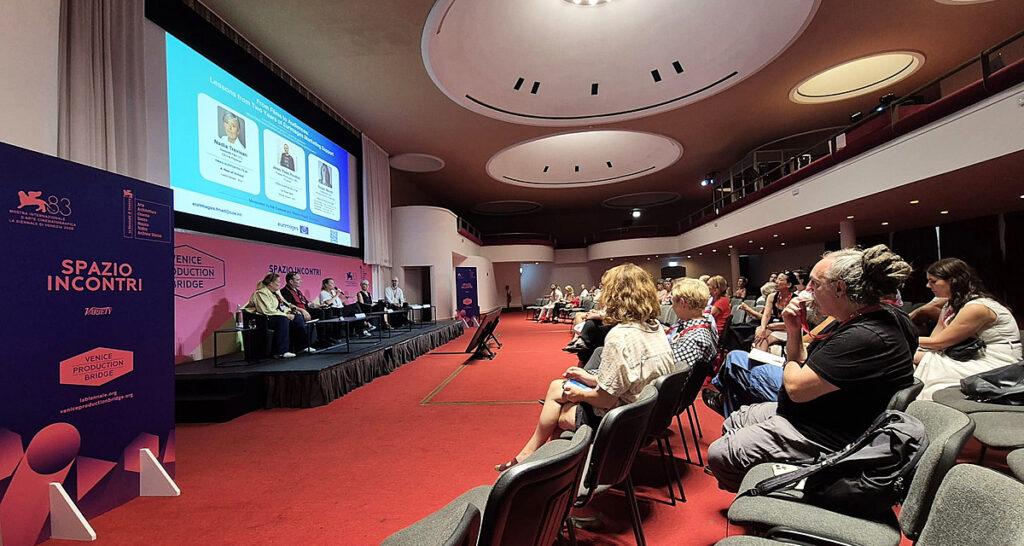
That tension sat at the center of “From Film to Audience: Lessons from Two Years of Eurimages Marketing Support,” a panel discussion held on 4 September at the Venice Production Bridge. The session brought together Eurimages project manager Iris Cadoux and program manager Thierry Hugot with Nefertiti Film CEO Nadia Trevisan, TrustNordisk managing director Susan Wendt and Frakas Productions founder Jean-Yves Roubin. Launched in 2024, the Film Marketing and Audience Development Support Programme backed 15 features with EUR €729,900 in its first call. The aim is not simply to buy more advertising, but to move audience research and strategy further upstream.
For Trevisan, whose Nefertiti Film received support for Laura Samani’s “A Year of School” (“Un anno di scuola”), that shift was already part of the company’s approach. “We as a company always think about marketing strategies from development, even though we don’t have money,” she said. The support gave the team roughly nine months to work with marketing agency Alphapanda on audience design, artwork, trailers and social assets.
Trevisan said the social media package worked best, with Rai Cinema International Distribution receiving more than 25 open files that could be adapted for local territories. A dedicated website underperformed, while influencer activity became harder to sustain once release dates drifted away from the film’s Venice launch.
That exposed a structural weakness no marketing grant can solve on its own. The French and Italian distributors were already attached, Trevisan said, but did not fully engage with the process. The Italian distributor ultimately released the film around nine months after Venice and rebuilt the campaign rather than using the international materials.
For Trevisan, the lesson was that producers, local distributors and international sales need to be part of the strategy from the beginning
One Film, Several Audiences
TrustNordisk approached the same problem from the sales side with Anders Thomas Jensen’s “The Last Viking.” Wendt described the process as making one pot of marketing money serve two functions: B2B positioning for buyers and distributors, and B2C communication that could eventually reach local audiences.
The company tested reactions in the US, France and the domestic market, in part because the film’s violent, provocative comedy could be read very differently outside Scandinavia. Mads Mikkelsen and Jensen brought recognition, but audience testing was still needed to determine how to communicate the film’s violence as part of its comedy rather than let isolated elements define it. Social clips were translated for local reuse, while artwork could vary by territory rather than forcing every market into the same campaign.
For Wendt, one sign that international marketing has worked is surprisingly practical: whether local distributors actually use the materials. “The proof is if most of the distributors worldwide will use the campaign,” she said, rather than deciding to create their own artwork, trailers and social assets.
The experience also changed how TrustNordisk thinks about publicity. Wendt said the company had wanted to bring a publicist onto “The Last Viking” earlier, before its festival destination was known, but did not manage to do so. On subsequent titles, that role has moved further upstream, allowing teams to discuss sensitivities and positioning earlier.
That need for alignment was even more visible on Roubin’s “Le Faux Soir,” Michaël R. Roskam’s Belgian-French wartime drama produced by Frakas. Roubin divided its potential audience into Belgium, France and the rest of the world. Each required a different approach, yet distributors and sales agents were often focused on completed films while his team was trying to make decisions months earlier.
“The main problem actually that we faced is the time,” Roubin said.
Frakas eventually organized a dedicated marketing shoot with the cast and a professional team after principal photography. It was a workaround for something Roubin would rather have embedded into production itself: a marketing unit present during the shoot, when stills, interviews and promotional assets can be created without recreating the opportunity later.
Early, But Not Too Early
The paradox running through the panel was that everybody agreed marketing should begin earlier, yet “earlier” does not mean publishing everything sooner. At the time of Trevisan’s project, costs tied to the Eurimages support had to be reported within a relatively tight window, encouraging activity around the festival premiere even when theatrical releases remained months away.
Cadoux distilled the problem neatly: the work has to happen “early, but not too early.”
There is also the harder question of measurement. For a sales company, distributor uptake offers one indicator. For a public cultural fund, Cadoux cautioned, admissions and sales cannot be the only measures of success. The first projects entered the program in 2024, and meaningful circulation data can take years to emerge.
That makes the scheme less a quick experiment in boosting ticket sales than an attempt to change working habits. The practical recommendations from Venice were strikingly low-tech: bring sales agents and distributors in sooner, reserve development money for audience work even without a grant, and keep producers at the center of the discussion.
Roubin said the application process itself had changed his thinking. Even without winning support, forcing a producer to build a marketing plan early can be useful. “I will start on every project, even small projects, to think about marketing and audience at an early stage,” he said.
Trevisan pushed the idea further, arguing that “the conversation should begin with the director too.” Ask where a filmmaker imagines the premiere, she suggested, and “the answer can reveal whether the creative and industrial expectations are remotely aligned.”
Cadoux closed with an old marketing truth that sounded newly relevant after 45 minutes of talking about targeting, territories and timing: “It’s like people saying it’s a film for everyone. So it’s for no one.”
All in all, Eurimages’ experiment suggests that audience development can no longer be treated as the final stage of a film’s life. But starting early only works if the rest of the chain is willing to start early with you.

- Did TIFF’s First Market Deliver for Buyers? The Answer Is Yes, With Caveats - October 8, 2026
- The Global Film Sales Playbook Is Changing as Pre-Sales Carry Less of the Load - October 7, 2026
- Cinema’s Creator Problem Is No Longer Just About Marketing - September 25, 2026