


For years, the film industry’s relationship with online creators followed a fairly predictable model: invite them to premieres, provide access to talent and hope their followers notice the movie.
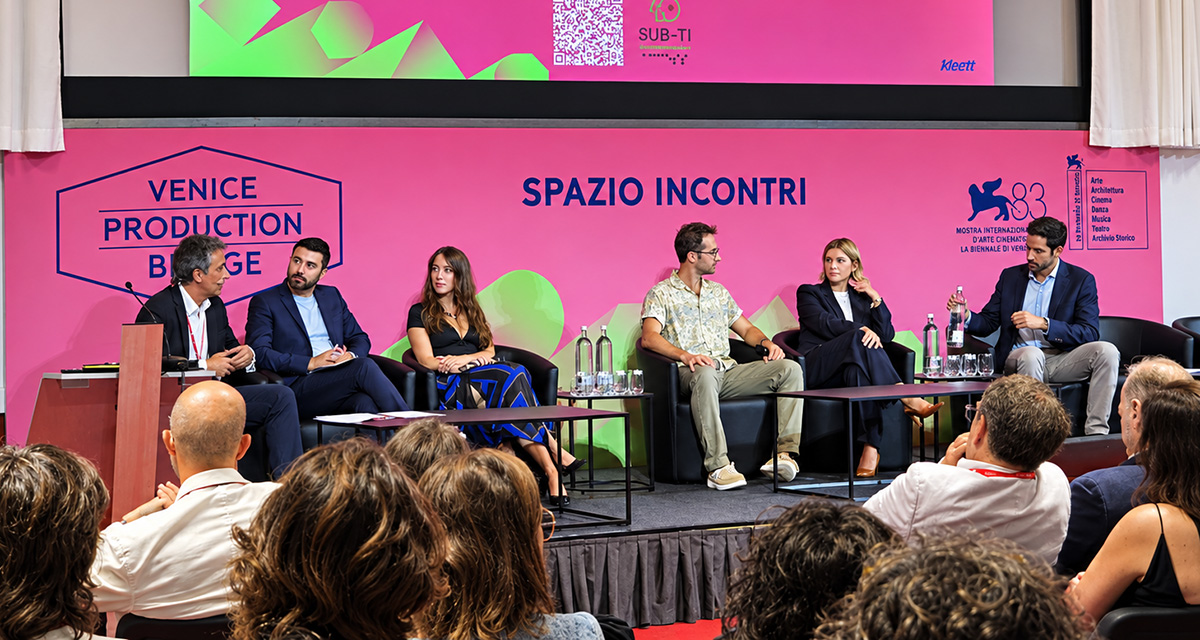
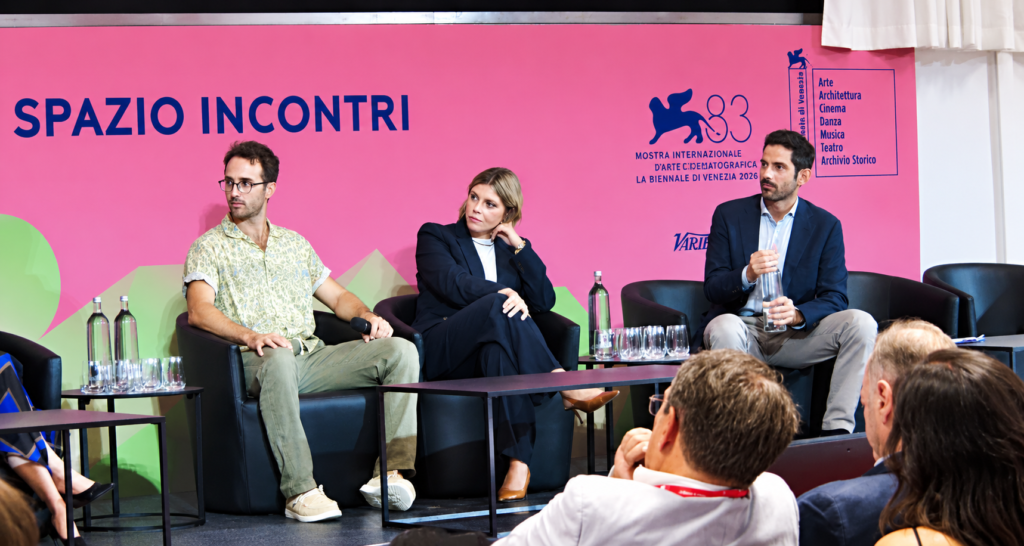
At the Venice Production Bridge (3-9 September), producers, platforms, creators and Italian film institutions made the case that this model is already outdated. “Creators Meet Cinema: A Talk on the New Audiovisual Ecosystem,” held on 7 September and hosted by ANICA’s Publishers and Digital Creators Union and the Venice Production Bridge, brought together representatives from Rai Cinema, Cinecittà, YouTube and TikTok alongside creator-led companies, journalists and filmmakers.
The central proposition was considerably bigger than creators becoming better movie marketers. It was that they are becoming part of the underlying infrastructure of the audiovisual business: writers, producers, publishers, filmmakers and companies that arrive with both production expertise and direct relationships with audiences.
Carlo Rodomonti, president of ANICA’s Publishers and Digital Creators Union, framed the divide between the two sectors as increasingly artificial.
“What are creators?” he asked. “It’s a strange concept, because you could replace the word ‘creator’ with director, inventor, developer, teacher, producer or distributor.”
The useful distinction, he argued, is not that creators are simply new personalities with large followings. “These are not faces. They are minds. They are projects,” he said. “It’s not that they are beautiful and therefore successful. We are talking about somebody who knows how to design something.”
For Rodomonti, bringing that world closer to film is both “a cultural bridge” and “a generational bridge.” The film industry can learn from people who have developed their businesses inside platforms rather than treating them as temporary promotional tools.
That distinction is important, commercially. If the creator economy is understood primarily as another marketing channel, film companies are essentially buying temporary access to an audience. If creators are involved earlier, their understanding of audience behavior can begin influencing development, format, storytelling and distribution.
Andrea David Rizzi, Head of YouTube Media & Sport Partnerships for Italy and Portugal, described precisely that advantage. “These creators had immediate access to an audience,” he said. They were able to “find their audience and create a community around specific worlds,” rather than completing a project first and only then attempting to manufacture awareness around it.
In other words, the conventional order can be reversed. A filmmaker traditionally makes a movie and then tries to find an audience. A creator may spend years building the audience before making the movie. In 2026, there has been a noticeable trend for creators-turned-directors having success in the movie space. Curry Barker’s “Obsession” and Kane Parsons’ “Backrooms” being the two biggest examples.
For YouTube, that creator-audience relationship is also becoming increasingly compatible with formats normally associated with television and film. Rizzi rejected the assumption that digital audiences are interested exclusively in short-form content, pointing instead to consumption of increasingly long videos and episodic material.
The company, he said, is developing products “that go in this direction,” including tools to organize episodic content and additional monetization models. Meanwhile, technological infrastructure around rights management and likeness detection is becoming increasingly relevant as the platform grows closer to established entertainment industries.
TikTok’s Alessandra Sangalli similarly argued against defining the platform purely through the people appearing on screen.
“When we talk about the film industry on TikTok, there aren’t only directors,” she said. “There are critics, there are creators, but there are also enthusiasts.”
That mixture is important because much of the platform’s value to cinema comes not from a traditional advertising relationship but from a network of conversations surrounding films. TikTok, Sangalli said, became “not only an entertainment platform but also a discovery platform,” where content emerges organically around individual interests.
The platform has increasingly tried to connect that behavior back to the industry itself, including through dedicated film spaces and Spotlight campaigns that link creator content to information about individual titles.
But the most interesting question raised in Venice was what happens when the creator is not positioned downstream from the movie at all.
Rome-based Slim Dogs is an obvious test case. Founded in the online-video world, the company has expanded across branded content, documentaries and conventional audiovisual production. Co-founder Marco Cioni described that evolution less as abandoning digital media for traditional production than as the disappearance of the boundary between the two.
“For us, television is not a destination,” he said. “It is a parallel track that we can activate and that, actually, we want to contaminate with what we do elsewhere.”
That is a materially different model from the familiar story of the YouTuber attempting to “graduate” into television.
Slim Dogs director and co-founder Matteo Bruno described the audience instinct inherited from digital production as something closer to a creative principle.
“We have to reach people,” he said. “And if we don’t reach them, then we are getting something wrong.”
That remained true even while producing a documentary around a specialized subject such as Formula 1 history. “If I’m telling my personal story, or the story of a Formula 1 team that revolutionized that world in the 1980s and 1990s, I have to find a way to make it reach a 20-year-old and a 40-year-old,” Bruno said. “How do you do that? By telling a story that works and can reach people.”
The implication is significant for conventional producers. Digital-native companies have spent years operating in an environment in which audience response is immediate, measurable and unforgiving. Accessibility is not something handed to a marketing department when production is finished; it can be embedded into the storytelling itself.
Anna Manzo, head of The Jackal Management at CiaoPeople, was explicit about the danger of treating the people who developed those skills merely as promotional inventory.
“A creator is not just their follower count,” she said.
“Creators are already inside cinema,” Manzo continued. The more useful question, in her view, is “how we can enhance and recognize the skills that are behind them.”
The industry still frequently encounters creators through promotional campaigns attached to finished movies. “It is certainly a system that can work to bring people into theaters,” she said, but “it is not the only way.”
Manzo urged producers, platforms and institutions to look behind the visible personality and recognize “the competence behind that face and behind that content,” including production ability and expertise in developing formats and languages specific to particular platforms.
Her broader argument was that cinema should stop constructing creators as a separate category that occasionally enters its territory.“Every year there are these big articles about influencers arriving in Venice,” she said. “No. That’s not it.”
Instead, she argued, creators and established audiovisual companies should increasingly be understood as operating inside “a single ecosystem, without creating another territory.”
That philosophy was also visible in Good Morning Venezia, an initiative discussed during the panel in which creators covered the festival and particularly its Orizzonti section through digital formats.
“This isn’t about bringing creators into Venice,” Manzo said. “Creators are already here.”
The point, she continued, was to officially provide space within the festival where creators could use “their language, their positioning and their voice” alongside producers and publishers to “open new doors of access to cinema,” including films audiences might otherwise never encounter.
Antonio James Mascoli, whose work combines social content with direct access to professional film sets, offered perhaps the clearest description of what those doors could look like.
A creator’s role, he argued, does not have to stop at recommending the finished product. Creators can explain the machinery behind filmmaking and introduce audiences to crafts, workers and processes that conventional film marketing rarely foregrounds.
“We try not only to follow trends or understand what could potentially work,” Mascoli said. “We also try to create interests, to make people discover new things.”
That relationship depends heavily on trust. “I want to tell you a story,” he said. “If you follow me and you trust me, then let’s try to tell you something you might not expect, something you may never even have thought about approaching.”
For Mascoli, cooperation with the industry could ultimately allow creators to promote something broader than individual releases.
“We as creators could try to pursue that objective better — promoting not only films, but cinema as a whole, cinema as a machine — if we work together,” he said.
“We aren’t just people making videos in a little bedroom,” he added. “We are people who want to come here, go onto sets and work with all of you.”
Yet two less comfortable questions were largely absent from the Venice discussion.
The first concerns access. The growing embrace of creators has coincided with an increasingly tense relationship between studios, film journalists and professional critics, particularly when limited interview slots, junkets and early screenings are involved. Creators can produce sophisticated work that goes well beyond straightforward promotion and may occasionally overlap with criticism or journalistic practices, but they can also occupy a fundamentally different position in the publicity ecosystem: one in which access is granted specifically because their coverage can help sell a title to an audience.
That distinction can become problematic when promotional reach begins competing directly with independent editorial work for the same finite access.
Christopher Nolan’s “The Odyssey” provided a revealing recent example. Universal unusually opted against organizing the kind of separate early influencer screenings that have become commonplace around major studio titles, meaning professional film press largely drove the first wave of reactions. Creators were hardly excluded from the wider campaign, but the decision stood out precisely because critics and journalists have increasingly found themselves competing for access with personalities whose value to a campaign may lie primarily in promotional reach rather than independent evaluation.
This is not an argument for rebuilding an artificial wall between the two groups. A handful of creators produce truly compelling work, while a growing number of journalists increasingly operate across social platforms; neither category guarantees quality. But pretending there is no structural distinction between editorial independence and promotional partnership risks making the conversation about “one audiovisual ecosystem” rather too convenient for the companies controlling access.
The second unresolved issue is abundance. If practically anybody can become a creator, how does the industry distinguish genuinely distinctive talent from the enormous volume of accounts producing increasingly interchangeable material? Followers and views are the obvious shorthand, but neither necessarily measures audience trust, originality, storytelling ability or the capacity to sustain a project beyond short-form content. Even engagement figures provide only part of the answer.
There are now enormous numbers of creators covering the same trailers, festivals, releases and entertainment news through strikingly similar formats, editing rhythms, visual grammar and, at times, even delivery and tone of voice. The low barrier to entry that made the creator economy so powerful also produces tremendous amounts of duplication.
That creates a difficult selection problem for an industry increasingly eager to work with it. If cinema is serious about treating creators as writers, directors and producers, rather than simply marketing channels, it will eventually need more sophisticated criteria for identifying creative value than the size of an account.
Professionalization therefore requires more than providing creators with greater access. It also means determining what skills, standards and responsibilities should accompany that access — and being willing to distinguish between someone who has developed a genuine creative practice and someone who has simply learned to reproduce a successful content template.
None of that invalidates the argument made in Venice. It makes the next stage more difficult, and probably more interesting.
The creator economy’s contribution may ultimately have less to do with importing internet celebrities into an established film system than with importing a different relationship with audiences. But if that relationship is to become part of cinema’s infrastructure rather than merely another branch of its marketing apparatus, questions of access, editorial independence, quality and selection will have to be confronted alongside reach.
Creators tend to build the community before they build the project. Cinema has traditionally done the opposite. The opportunity is real, but so are the trade-offs.
- Did TIFF’s First Market Deliver for Buyers? The Answer Is Yes, With Caveats - October 8, 2026
- The Global Film Sales Playbook Is Changing as Pre-Sales Carry Less of the Load - October 7, 2026
- Cinema’s Creator Problem Is No Longer Just About Marketing - September 25, 2026