Tag Archives: Opera

Opera Industry Voices Concern Over Movie Theatre Broadcasts

YouTube Preview Image

Many who know me are aware what a big opera buff I am.  I’ve held a subscription to the Los Angeles Opera‘s annual season for at least the past five years, and when I travel I make a point of trying to see an opera in each city I visit.  But when CJ’s co-editor Patrick Von Sychovski forwarded me an article from last Friday’s New York Times about operas being screened in cinemas around the world I was a little ambivalent.  Why did we need another article about how wonderful it is operas are reaching the masses through movie theatres?  Especially the umpteenth article from the Times about the successful Metropolitan Opera program.  We get it; opera is the new black, it’s the greatest thing to happen to movie theatres since the invention of the popcorn kernel.  What more could we possibly learn about operas being shown in movie theatres?!

Apparently. . . quite a lot.

In fact, the article by Daniel J. Wakin’s article advanced the story of showing operas in cinemas quite a bit and went deeper than simply rehashing the successful program offered by the Met.  Back in June of 2008, at Opera America’s annual conference of opera professionals, several managers and artists actually complained about the Met’s ongoing dalliance with streaming its performances into movie theatres.  Wakin’s writes:

The dissenters say that the movement will lead to more conservative programming; that the voice will become subservient to appearance; that listeners will be trained to hear something electronic and lose an appreciation for a live experience.

Some worry that vocal training will change, de-emphasizing the ability to project, and that the Met’s effort is a deal with the Devil, because it will divert audiences from local opera houses to make the easier, cheaper trip to the mall.

Read More »

Popularity: 31% [?]

Financials of Met Simulcasts Revealed

It’s no secret that with the success of the Metropolitan Opera’s high definition simulcasts into movie theatres, first rate opera companies around the world have jumped on the alternative content bandwagon and struck deals to have their performances beamed to cinemas around the world. The San Francisco Opera recently announced a deal with Bigger Picture to broadcast certain performances to theatres and Emerging Pictures struck a deal to simulcast selected performances from La Scala to theatres in the United States.

Peter GelbThough the Met’s simulcasts had been seen by many in the exhibition industry as successful based on the sold out screenings, little was known about how much money was really being made, or lost, on the venture. That is until now.

In an Associated Press story which hit the wire on January 28th, the Met’s general manager, Peter Gelb, stated that each simulcast is costing around USD $1 million which includes the cost of satellite feeds, crew and equipment. Of course, on top of that the Met has to produce each opera production at upwards of USD $3 million. Gelb reports that by including revenues from anicllary sources such as DVD sales, the Met is hoping to “break even” on the HD simulcasts by the end of 2008.

What Gelb is not entirely clear about is whether the Met pays NCM Fathom a fee for each simulcast. A little known fact in the exhibition industry is that Fathom charges those broadcasting events into the theaters that are a part of their network. Some who have approached Fathom hoping to broadcast similar events report the company asks for a minimum of USD $100,000 up front. Fathom claims this is a promotional fee to help advertise the event in theaters during NCM’s preshow spots. Those broadcasting the event can collect a portion of the box office to help recoup their cost.

Whether the Met has to pay Fathom or not, their HD simulcasts are proving to be a huge hit at the box office. Their presentation of Charles Gounod’s “Romeo and Juliet” made USD $1.65 million during the weekend it was broadcast giving it an 11th place finish at the box office. And that’s just ticket sales, the Met is also garnering priceless marketing in countless news stories and the promotional spots running in movie theaters. As Gelb stated:

“We’re creating, basically, satellite opera houses. But the Met offers something you don’t get at a performance — cameras that show action behind the scenes and interviews in dressing rooms, the equivalent of going into the locker room of a sports team.”

Popularity: 18% [?]

DDCinema Beams Opera To European Cinemas

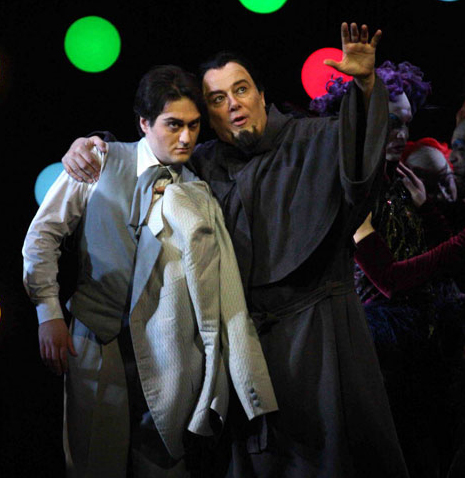
MefistofeleOn Sunday January 27th, Distribution Digital Cinema (DDCinema), the joint venture between XDC, Qubo and Dynamic, jump started their operations by broadcasting a live performance of composer Arrigo Boito’s opera “Mefistofele” from the Teatro Massimo in Palermo, Italy to 19 screens located in Belgium, Germany, Italy, Spain, Switzerland, The Netherlands, and the United Kingdom.

There was no official word on attendance of “Mefistofele” at any of the European theatres or how much tickets cost, but the Teatro Massimo, one of the largest opera houses in the world at 3,500 seats, was sold out with patrons paying top dollar to attend the opening night of the of the season and the first performance of a new production of Boito’s only complete operatic work. The opera, originally based on Goethe’s Faust, was beamed to cinemas via satellite and presented in high-definition.

In an oddly worded press release Elena Rasori, Project Manager of DDCinema seemed quite pleased with the event:

“‘Mefistofele’ was really fine, the singers were excellent and the image quality was really nice and colourful. The lights were modified for the video shooting and the quality was top rate. There was also an introduction by Madleyn Monti of the main artists with short interviews, as well as the plot in English and Italian.”

DDCinema joins a growing number of digital cinema service companies and alternative content distributors delivering live opera and fine arts events to motion picture theatres. AccessIT recently announced they would be simulcasting performances of San Francisco Opera productions to theatres throughout the United States and National Cinemedia started the trend in 2006 by working with the Metropolitan Opera out of New York to do the same. DDCinema seems to be the first company focusing exclusively on broadcasting European events to European cinemas.

The DDCinema partnership was only announced in late December 2007 by the trio of companies as an alternative content distribution initiative. The company will specialize in distributing between 10 and 12 recorded fine arts events to movie theatres each year with a few live broadcasts in the mix. These days that seems to be either operas or ballets filmed in HD, though DDCinema hopes to expand their offerings to sporting events, stage products, concerts, documentaries and even television programs.

While it is nice to see opera making a resurgence amongst patrons, even if it’s at the local multiplex, for such programs to be sustainable on an ongoing basis DDCinema may have to broadcast to more than 19 screens. Presumably the number of screens on which such content will grow over time along with XDC’s install base and the adoption of digital cinema.

Popularity: 36% [?]

2007 – the Year of Opera at the Movies

If there was one true surprise in the digital cinema industry this year it was that people were prepared to pay a premium for a night at the opera at their local multiplex. It was the New York Metropolitan Opera (The Met) that kicked it off in the early days of the new year with a world-wide HD transmission of The Magic Flute. And it is only set to get bigger for the Met next year, as confirmed by this interview with Peter Gelb, the general manager of the Met (High-def Opera for the Masses):

Tomorrow, The Met launches its second season of the “Metropolitan Opera: Live in High Definition” – simulcasts at the multiplexes in those cities, among more than 600 movie theaters, performing arts centers and universities worldwide.

That’s triple last year’s number.

Leading off is Charles Gounod’s sensuous “Roméo et Juliette,” starring Netrebko and tenor Roberto Alagna as the doomed lovers, with another legendary tenor, Plácido Domingo, at the podium.

As opera lovers savor the last of this season’s simulcasts April 26 – Gaetano Donizetti’s sparkling “La Fille du Régiment,” with soprano Natalie Dessay in the title role and Flórez in the part that made Luciano Pavarotti famous – “Live in HD” will reach an audience approaching 1 million.

After the Met kicked it off, the rest of the arts and cinema world followed and the phenomenon seemed to grow and grow, with non-live HD play-outs of Glyndbourne Opera in the UK and announcements of the beaming of La Scala to the US. Even other stage-related performances all across the world found favour with local audiences, be they the Royal Dramatic Theatre in Sweden or the Australian Ballet in Sydney, both going out to small towns and villages i the outback normally not touched by this sort of culture. NATO president John Fithian himself declared that he was surprised by this trend.

Rounding of this year comes a confirmation of the trend in that AccessIT has found an opera to climb into bed with by announcing a deal with the San Francisco Opera in a four-year world wide agreement. Significantly a deal with the opera’s unions finally sealed the deal. From the press release:

A landmark revenue sharing agreement with the International Alliance of Theatrical Stage Employees (IATSE), American Guild of Musical Artists (AGMA) and the American Federation of Musicians (AFM) paves the way for these digital cinema presentations and other electronic media projects. The parties have reached a tentative agreement, pending final ratification, for a four-year experimental agreement that involves a supplemental media fee to clear vastly expanded rights for up to six titles per year. In this new agreement, union members would also participate in revenue sharing on top of the supplemental fee. Earned revenue received by San Francisco Opera, less 20% to the Company as a flat all-inclusive distribution and administration fee, would be split 50/50 with the unionized groups, the conductor, and the designers. The Companys significant capital investment in technology allows for revenue sharing from the first dollar earned rather than from any calculation of net profits.

The New York Times has a very good article looking at the whole trend of operas-with-popcorn. It also nails the key differentiator between the Met and the SFO that could further spell the difference between ‘Encore!’ and ‘start sweeping up the popcorn’ for cinemas, which is that “the Met shows its operas live. San Francisco will transmit them after the fact.” While Glyndbourne found and audience, opera lovers prefer their product fresh rather than caned.

Next year we are likely to see big hitters like the Covent Garden’s Royal Opera House enter this space and with it there will be increasing segmentation between A-list and non-A-list operas. There will also be a renewed look at the exclusivity that some of these distribution deals entail for cinema chains. In the case of alternative content for digital cine,a it seem tp be that it ain’t started at your local ‘plex until the Fat Lady sings.

Nutcracker

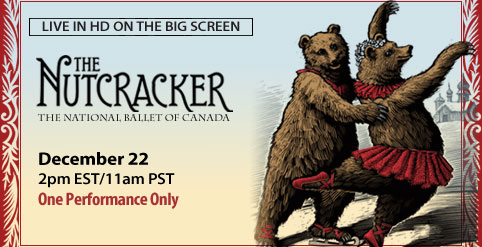
Update: In addition to the ones above, the Washington National Opera is beaming to US college campuses (see here) while north of the border, the National Ballet of Canada is giving Cineplex patrons a taste of The Nutcracker shown live on 69 screens. Detail here.

Popularity: 14% [?]

Pavarotti lives on – on the cinema screen

Vienna Pavarotti cinema

The big man of opera is getting a fitting tribute at a small cinema in the Austrian capital. Between October 4th and 28th you can catch a big screen tribute to the recently deceased Italian tenor in what is described as ‘Opern-Kino: In memoriam Pavarotti‘ (or Opera Cinema: Remembering Pavarotti) at the 1. Wiener Opern-Cinema, better known as Bellaria KINO in Vienna. Pavarotti fans will be treated to a collection of a dozen famous performances:

Anlässlich seines Todes am 6. September diesen Jahres widmet das Opern- Kino dem Tenor einen Pavarotti-Schwerpunkt. Zwölf Opernaufftritte und -filme werden im Bellaria ausgestrahlt.

Die Auswahl reicht von Verdis “Rigoletto”, über “La Boheme” und “Il Tabarro” bis “Hoffmanns Erzählungen” von Offenbach. Aufgezeichnet wurden die Opernproduktionen unter anderem in der Mailänder Scala oder in der Metropolitan Opera in New York.

So while it is from the Metropolitan, it won’t be the live from Metropolitan screenings that sparked the massive new interest in alternative content. For just 13 euro up to 163 opera lovers at a time can cram in to see what the world has lost.

Incidentally, if you have not read Walter Murch’s great piece on how cinema overtook opera as the ultimate art (Wagner’s Gesamtkunstwerk) here is your chance to do it now: A Digital Cinema of the Mind? Could Be. It really is one of the best pieces about the past and future of cinema ever written.

Popularity: 4% [?]