


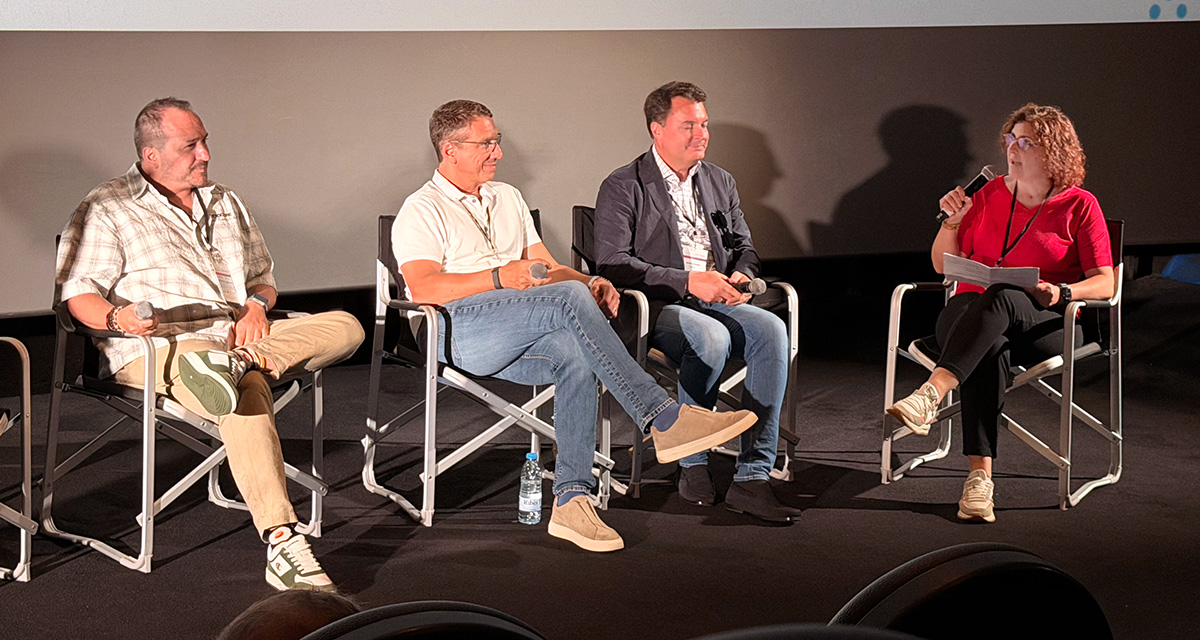
At the 2026 ICTA Barcelona Cinema Technology Experience, executives from Odeon Multicines, Cineplexx and DCDC examined how exhibitors can identify the technologies audiences will value – —and whether cinema’s current economics can sustain the industry’s accelerating upgrade cycle.
Asked where cinema operators should invest today if they want to remain relevant a decade from now, three industry executives gathered at the ICTA Barcelona Cinema Technology Experience did not begin by naming a projector, screen or sound system.
Christof Papousek, CFO and managing partner of Cineplexx International, led with quality and customer experience. Howard Kiedaisch, CEO of Digital Cinema Distribution Coalition, suggested that audiences increasingly approach out-of-home entertainment with a “go big or stay home” mentality, though he cautioned that what motivates customers varies by market and cinema.
Juan García, operations manager at Spanish exhibitor Odeon Multicines, was more emphatic, during the panel which was moderated by Marion Rosset, President of ADDE.
“For me, it’s identity, identity, identity,” García said. “It must be aligned with your idea of what cinema is for your customer. It’s not about one size fits all.”
That answer became a useful shorthand for much of the discussion that followed. Cinema operators are being presented with a widening range of premium screens, immersive sound systems, branded formats and alternative uses for their auditoriums. But the central question is no longer simply which technology produces the best technical result.
It is whether the technology fits the cinema, its market and its audience – —and whether the economics allow the exhibitor to pay for it before the next upgrade cycle arrives.
Different Technologies for Different Cinemas
García spoke from direct experience operating both premium LED auditoriums and advanced laser projection systems, including Christie’s CINITY format. Rather than positioning one as the inevitable replacement for the other, he argued that they offer different capabilities.
An emissive LED screen can change the way an auditorium is used. Because it does not require a projector or a completely darkened room, García sees the potential for cinemas to function more like adaptable event venues or even television studios, accommodating presentations, live events and community programming alongside conventional film screenings.
“It’s not about black or white,” he said. “It’s not about whether you prefer this or that.”
Laser projection and LED can both provide exceptional images, García argued, but they may suit different applications and different communities. Traditional projection also retains an important advantage: flexibility. A projector and screen can be installed or adapted in spaces where building a permanent LED wall would be impractical.
That distinction matters because technology purchases are often discussed as if the industry is moving toward a single future. García’s argument was that cinemas should instead begin with the experience they intend to create and the audience they are trying to serve.
The technology comes afterward.
When the Screen Is Ready Before the Movie
The limits of a hardware-first approach are particularly evident in the rollout of cinema LED.
García said Odeon’s LED auditoriums are still primarily presenting standard dynamic range versions of films because the supply of properly mastered cinema HDR content remains limited. The screens may be capable of far more, but the content pipeline has not yet caught up.
The problem is hardly unique to LED. Every new format creates what Kiedaisch described as a familiar chicken-and-egg dilemma.
Studios may be reluctant to create, manage and distribute another version of a film until a format has built a meaningful installed footprint. Exhibitors, meanwhile, are unlikely to make a substantial investment until they know there will be enough films to support it. Technology suppliers need both sides to move at roughly the same time.
Each additional format also adds complexity. Studios already manage numerous language, accessibility and technical versions across global markets. New premium variants require additional mastering, delivery, storage and quality-control work, increasing both labor and the possibility of mistakes.
The panel briefly discussed Disney Infinity Vision, the studio’s attempt to identify qualifying exhibitor-branded premium auditoriums and make them more recognizable to consumers. As Celluloid Junkie reported separately, Disney has positioned Infinity Vision primarily as a marketing and audience-navigation program rather than another consumer-facing technical specification.
Kiedaisch suggested Disney may be uniquely positioned to make such a program work because of its consistent supply of large-scale franchise titles. For exhibitors, however, the appeal is straightforward: a studio with considerable marketing resources would be helping audiences understand why certain auditoriums merit attention.
That may prove as important as the technology itself.
Four Questions Before Writing the Check
Papousek offered the panel’s most practical framework for deciding which investments are likely to create long-term value.
The first consideration is the economics of the market. Ticket prices, disposable income and the potential size of a premium surcharge differ considerably by territory. Cineplexx introduced certain high-end experiences earlier in Austria than it did in Serbia, Papousek noted, because Serbian ticket prices were roughly half those in Austria.
The second consideration is local history and audience expectations. Has the market previously supported premium presentation formats such as 70mm? Are moviegoers familiar with large-format cinema? Do local distributors support the necessary versions? In markets with a strong amusement-park tradition, motion-based or effects-driven formats may have more natural appeal.
The third factor is competition. Exhibitors must understand which systems are already available locally, whether a second mover can introduce something meaningfully different and whether contractual exclusivities affect the available choices.
Only then comes the fourth question: financial feasibility.
What is the capital investment? Can the system be financed as an operating expense rather than purchased outright? Will the supplier provide funding support? How long will the equipment remain commercially useful, and how quickly can the cinema recover its cost?
Papousek’s conclusion was bluntly pragmatic: the technically best system may not be the right technology for a particular cinema or market.
A less ambitious installation with a sustainable business model is more valuable than a spectacular auditorium whose economics never work.
The End of the 50-Year Projector
The pressure is greater because the digital cinema replacement cycle bears little resemblance to the equipment economics of the film era.
A 35mm projector could remain in service for decades. Digital cinema equipment may need to be replaced or substantially upgraded every seven or eight years, Papousek said, requiring exhibitors to begin planning for the next investment well before the current one has been fully depreciated.
The original conversion to digital projection was made possible in large part by the Virtual Print Fee model, which redirected some of the distribution savings from eliminating film prints toward exhibitors’ equipment costs.
There is no equivalent industry-wide mechanism funding today’s transition to laser, HDR, LED or the next generation of premium formats.
At the start of the digital rollout, cinemas could sometimes add a modest surcharge for a digital presentation. Early immersive sound installations could also command an additional fee. Those technologies eventually became standard, and the surcharges disappeared.
Exhibitors now face the prospect of repeatedly investing in technology that customers may soon regard not as premium, but as the basic price of admission.
Premium Pricing Requires Recognizable Value
Papousek said audiences remain willing to pay more when they recognize the added value, when the film suits the format and when the overall experience delivers on its promise.
That recognition cannot be assumed.
He cited a Cineplexx location in Vienna where a premium auditorium was installed within a cinema better known for arthouse and crossover programming. Some customers arriving for a weekday afternoon screening encountered a EUR €17 ticket and reacted by asking, in essence, whether the cinema had lost its mind.
The technology may have been impressive. The positioning was wrong.
Papousek also illustrated the demanding economics behind a large premium-format investment. An auditorium may need to generate somewhere between 70,000 and 100,000 admissions annually to produce sufficient incremental revenue. With a EUR €5 net surcharge, the exhibitor might retain approximately EUR €2.50 to EUR €2.75 after the film rental split.
That can produce meaningful additional margin, but a system costing EUR €1 million – —particularly once financing costs are included – —remains a difficult calculation if its useful commercial life is only eight years.
Auditorium capacity matters. So does film supply. A premium room that performs exceptionally for a handful of tentpoles but sits underutilized during the rest of the year will struggle to justify its cost.
A Format Needs a Story
Papousek argued that a successful premium format requires more than equipment installed at the end of the production chain.
“The PLF high-quality experience needs a bigger story,” he said. “It starts at the beginning, with the creation and the work with the filmmakers, and it ends in the cinema auditorium.”
Filmmakers, studios and technology companies must collaborate if a format is to become recognizable and desirable. James Cameron’s association with “Avatar,” Christopher Nolan’s advocacy for IMAX and large-format film, and Denis Villeneuve’s work on the “Dune” films demonstrate how filmmakers can become ambassadors for a presentation experience.
Without that connection, exhibitors are left trying to market technical distinctions most customers neither understand nor necessarily care about.
Papousek also stressed that not every film belongs in every format. A spectacle-driven release may benefit from the largest screen and most advanced sound system available. A smaller arthouse title may be better served by a more intimate auditorium, careful programming and a cinema whose identity matches the audience.
Both can represent premium experiences. They simply offer different kinds of value.
Innovation’s Less Glamorous Backlog
Kiedaisch introduced another complication: while the industry discusses advanced screens and immersive formats, it has still not completed some of digital cinema’s basic technological housekeeping.
Trusted Device Lists, which identify equipment authorized to receive encrypted content, remain cumbersome and are often collected through manual processes. Security keys are still distributed by email. Advance ticketing remains inconsistent in some European markets. Live-event delivery lacks the standardized, integrated workflows needed to scale efficiently.
“There are still basic things that we don’t necessarily get right on the technology and operations side,” Kiedaisch said.
The Trusted Device List problem is particularly illustrative. The industry has discussed creating a global, non-proprietary system for years, but commercial interests and questions over ownership have repeatedly stalled progress.
“Ownership of the address book of the industry should be a pretty clear, simple thing to overcome,” Kiedaisch said, “but we’re still not there yet.”
None of this is as easy to market as a brighter screen or a new premium brand. Yet those foundational systems determine whether films, keys, live events and new formats can move efficiently through the theatrical ecosystem.
The cinema of the future will need both visible innovation and less visible infrastructure.
Audiences Still Come for the Film
For all the attention paid to projection, LED, HDR and immersive experiences, the panel ultimately returned to content.
“No one wakes up and goes, ‘I want to go see a big projector,’” Kiedaisch said.
Audiences choose the film, concert, sporting event or shared experience first. Technology can enhance that choice, make it more memorable and persuade customers that leaving home is worthwhile. It can also give exhibitors new ways to use their auditoriums and reach communities that traditional movie programming may not serve.
But it cannot manufacture demand for content audiences do not want.
That does not make technology secondary or unimportant. It means the investment has to support a larger idea: the cinema’s identity, the film being presented and the expectations of the audience buying the ticket.
García summarized the challenge by looking beyond the equipment itself.
“I look to the cinema, not the technology,” he said. “What are you doing with it?”
For exhibitors considering their next major investment, that may be the most important specification of all.
Editor’s note: This feature is part of Celluloid Junkie’s coverage of the 2026 ICTA Barcelona Cinema Technology Experience. See more reporting from the seminar below.
More from ICTA Barcelona

- The Paramount-Warner Merger Is Permanent. The Guardrails for Movie Theatres Are Not - September 22, 2026
- Cinemas Aren’t Just Marketing Movies Anymore. They’re Marketing Auditoriums - September 15, 2026
- The Cinema Concession Stand Is Becoming a Marketplace - September 11, 2026