


For most of the modern multiplex era, the cinema concession stand has operated according to a familiar routine. Customers line up, study a menu board, place an order, wait while an employee assembles it and then pay before moving toward their auditorium.
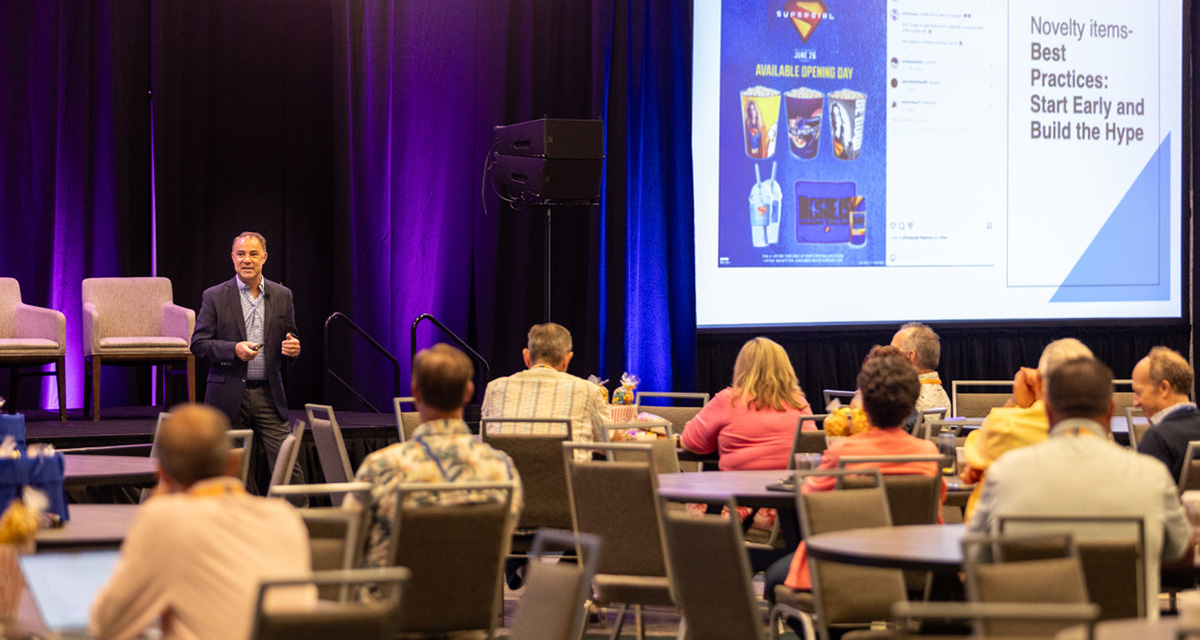
At CinéShow 2026 in Dallas, two consecutive sessions examined different systems for reducing friction in theater operations. One focused on the technology and processes that help exhibitors identify lost sales; the other showed how redesigning the concession stand can make purchases faster and easier.
Two Panels, One Diagnosis
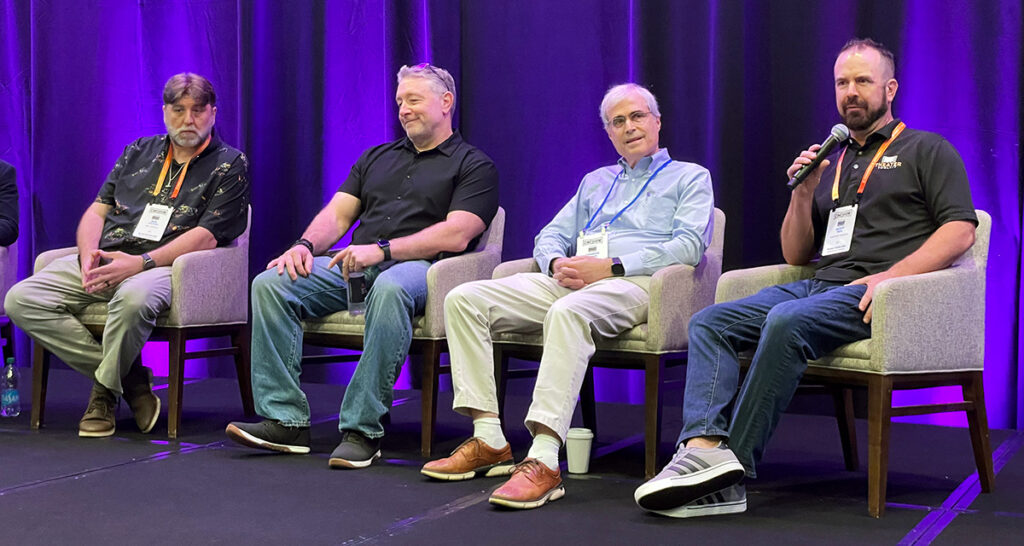
During “The Cost of Guessing in Theatre Operations,” speakers examined how exhibitors can use analytics, apps, kiosks and regular testing of the customer journey to identify operational friction that top-line sales figures may not reveal. Brandon Calder of CinemaPlus offered one particularly striking example.
Calder said the conversion funnels his company reviews sometimes show between 65% and 87% of customers who begin an online ticket purchase abandoning it before checkout. He did not present that as an industry-wide rate, but as evidence that exhibitors should investigate where their systems introduce friction — a broken page, payment redirect, difficult seat map, unexpected booking fee or slow mobile transaction.
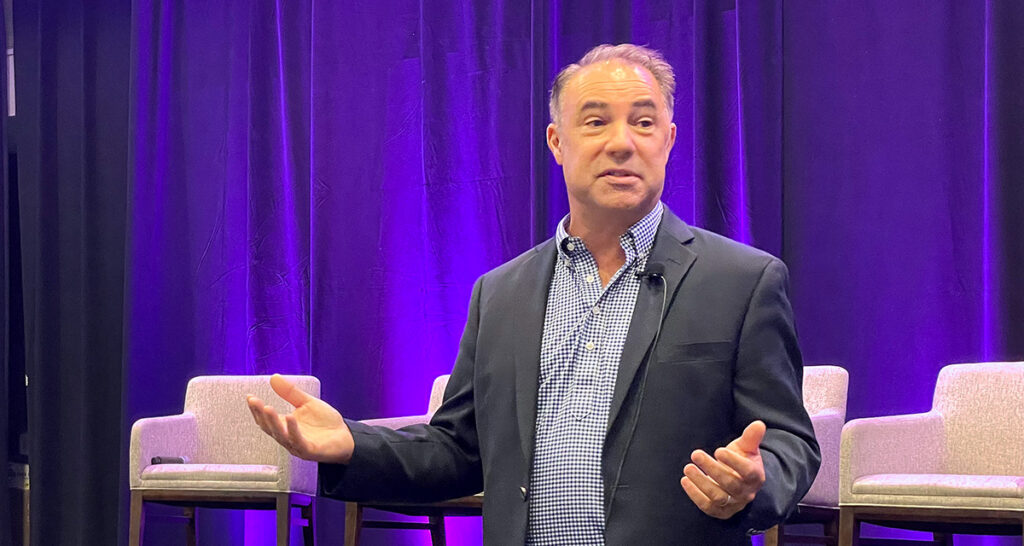
The operations panel examined how technology, data and routine testing can expose and reduce those obstacles. In the session immediately afterward, Epic Theatres Director of Food and Beverage Dan Herrle applied the same principle to a more physical system: the concession stand.
“When you’re on your websites and you’re clicking through, where is that friction? What is stopping that transaction?” Herrle asked. “It’s the same thing that happens in the concession stand. Where is the friction? Why are people turned off? Why are they walking past your concession stand instead of just browsing and shopping and making it part of the experience?”
The alternative Herrle described looks less like a conventional concession counter and more like a retail marketplace. Customers move through a deliberately designed shopping area, pick up packaged products, serve themselves popcorn and beverages and complete the transaction at either a staffed register or self-checkout kiosk.
“It should be easy,” Herrle said. “We’ve got to remove that friction.”
From Line to Marketplace
In a traditional cinema lobby, the concession line is primarily a mechanism for keeping customers orderly while they wait to reach the counter. In a marketplace layout, the queue becomes part of the sales floor. Operators can place candy, packaged food, collectibles and other merchandise directly along the purchasing path, giving customers time to browse and decide before they ever reach the register.
A conventional counter, by contrast, processes customers largely one at a time: an employee takes an order, retrieves the products, fills drinks, handles payment and repeats. Even a simple transaction can become a bottleneck when several auditoriums are seating at once. Marketplace designs separate product selection from payment, so a guest who already knows what they want can move quickly while someone browsing does not block the next customer.
Herrle presented results from NCG Cinemas showing how consequential that change can be. NCG had started from an especially traditional model, with everything kept behind the concession stand and not even impulse candy racks positioned in front of customers. Working with NCG’s Jason Brown, Herrle said the circuit introduced a relatively simple queueing and grab-and-go system that let customers move through the space, pick up products and let other guests pass while they kept deciding.
According to figures NCG provided to Herrle, revenue increased 51% at one test location and 165% at another, while per-capita spending increased 41% and 36%, respectively. Herrle said the new system generated approximately $7,454 in additional monthly revenue and paid for itself in roughly two months.
Those unusually large increases should be considered in light of NCG’s starting point. A theater that already displays products throughout its concession area is unlikely to replicate the same gains. But the results demonstrate how much revenue can be constrained when nearly every purchasing decision must be made at the counter.
Putting a Buc-ee’s in the Lobby
Herrle’s marketplace vision extends beyond a few candy racks alongside a conventional queue.
“You can put a Buc-ee‘s in your lobby,” he said, invoking the Texas convenience-store chain known for turning roadside retail into something approaching a tourist attraction. That could include reach-in coolers, packaged food, novelty merchandise and even a bar, folded into the same shopping environment rather than operated as a separate destination. The approach lets an exhibitor expand its number of stock-keeping units without forcing every product to compete for limited menu-board space or a single coveted spot beside the register.
Design matters. Herrle pointed to Cinemark’s own queue redesign (credited to David Haywood, the circuit’s senior vice president of food and beverage) as a model: aisles wide enough for one customer to browse while another passes, low fixtures that preserve sightlines across the lobby, and familiar brands positioned at both the start and end of the shopping path to draw people in and reassure them on the way out.
The model also suits the growing assortment of film-related merchandise exhibitors now sell — premium popcorn buckets, drink vessels and collectibles priced well above the ticket itself, which are better suited to a retail display customers can browse and examine than to a line on a menu board. None of this means every lobby needs to become a convenience store. It means the product mix has outgrown the counter it’s traditionally sold from.
Self-Service Changes the Labor Equation
Every Epic Theatres location now uses a marketplace-style, grab-and-go model with self-checkout, Herrle said, with products barcoded and scanned at the end of the shopping path. One employee typically welcomes customers at the entrance; another stays near checkout to help when needed. “Customers know what to do,” Herrle said.
Self-service popcorn and Coca-Cola Freestyle machines extend the same logic. Herrle said customers enjoy filling and topping off their own popcorn, and that Freestyle machines encourage two people who might once have split a large drink to buy separate ones because they want different flavors.
The bigger change is staffing. Herrle said it is possible to run concessions at a 14-screen complex with one person behind the counter, supported by an usher overseeing self-service — a setup he said could replace work that might otherwise require five to seven employees. During a packed “Spider-Man” weekend, he said, Epic’s concession lines never built up; employees spent their time popping corn and restocking while customers moved through on their own.
On the operations panel, Rob Crocker of The Boxoffice Company described apps and kiosks as tools that can automate transactions and compensate for staffing constraints. Think of an app, he said, as “an employee that’s working for you 24/7 and never calls in sick.” Herrle’s marketplace model applies much the same principle to the physical concession stand: product selection, dispensing and payment no longer require an employee at every step. That flexibility matters in a business where traffic can move from quiet to hundreds of customers arriving before an evening show.
Employees are still needed — to welcome guests, restock, assist with kiosks and troubleshoot — but no longer to perform every stage of every transaction. Herrle said leaving customers entirely on their own isn’t the goal, even though he has seen the system keep running when an employee calls out sick. For exhibitors, the more useful measurement may be throughput per labor hour: how many customers a cinema can serve during its busiest periods, and how much they buy while they are there. Pairing self-checkout with cashless payment can add further savings by eliminating cash handling, trips to the bank and armored-car pickups.
Efficiency or Inconvenience?
Whether self-service feels like an improvement depends entirely on execution. A system that moves quickly and gives customers control feels convenient. One that leaves a guest confronting an unresponsive kiosk with nobody nearby to help merely exchanges one kind of friction for another.
The same applies to mobile ordering. Herrle said apps work well once a customer has already downloaded one and connected payment and loyalty information. Requiring someone to download an app, create an account and enter a credit card while sitting in an auditorium introduces precisely the obstacle the technology was supposed to remove.
The lesson isn’t that every human interaction should be automated. It’s that exhibitors need to distinguish between service that adds value and steps that exist mainly because that’s how the theater has always operated.
More Sales, Less Control
The marketplace model also asks operators to reconsider a principle that shaped concession design for decades: inventory control.
A traditional counter keeps most products behind employees, where customers cannot handle them before purchase. That reduces theft, limits waste and makes inventory easier to monitor. Moving products onto the sales floor inevitably creates more opportunity for shrinkage. Herrle said Epic has not experienced significant losses and that most customers scan and pay for everything they select. The circuit continues to inventory certain items but no longer treats the possible loss of an individual cup, bag or piece of candy as the overriding concern.
That is the fundamental tradeoff. Keeping every product behind the counter may reduce shrinkage, but if it slows service, discourages impulse purchases or causes customers to abandon the line, some of that control is being purchased with revenue the theater never records. A successful marketplace still requires disciplined replenishment and enough supervision to prevent self-checkout from becoming the new bottleneck. Control does not disappear; it shifts from restricting access to managing inventory and customer flow across the sales floor.
Converting Demand Already in the Building
Much of the cinema industry’s attention understandably focuses on creating demand: finding the right films, marketing them effectively and convincing audiences to leave home. The CinéShow discussions raised a more immediate question. Once someone has decided to visit a cinema, how much potential spending is lost because the transaction takes too long, the purchasing path is confusing or the theater lacks the capacity to serve everyone during a short peak?
“The number one data point that operators don’t focus enough on,” Calder said, “is not what sales did I close, it’s what sales did I not close, and why.” Herrle’s marketplace argument applies the same idea to the lobby instead of the website: the moviegoer who arrives prepared to buy concessions but meets a line or ordering process that makes the purchase feel like too much trouble. In both cases, the customer’s intent already exists. The operator simply fails to convert it.
Crocker recommended that exhibitors regularly become their own customers — buying tickets, joining loyalty programs, attempting refunds — and Calder added that they should do it on the mobile devices and cellular connections their audiences actually use, rather than testing everything on an office desktop with reliable broadband. The same principle belongs in the lobby: walk the concession queue at peak times, try to read the menu, pick up products and complete a purchase exactly as a customer would.
There is no single model for every theater. Older buildings may lack the lobby space for a retail-style queue, and some locations will keep benefiting from personal service where menus are more complex. Others may land on a hybrid: grab-and-go products and self-service beverages, backed by staffed registers. But the underlying question applies everywhere: how much of the concession operation is organized around making it easy for customers to buy, and how much simply reflects the way cinemas have always sold?
For decades, the concession counter controlled the transaction by placing an employee between the customer and nearly every product. The marketplace reverses that logic, putting customers inside the selling environment and asking employees to support the transaction rather than personally conduct every part of it.
The popcorn machine is not going anywhere. The line in front of it might.

- Cinema Owners Have Invested $2.7 Billion in Theatres. What Is That Money Buying? - October 1, 2026
- The Paramount-Warner Merger Is Permanent. The Guardrails for Movie Theatres Are Not - September 22, 2026
- Cinemas Aren’t Just Marketing Movies Anymore. They’re Marketing Auditoriums - September 15, 2026