


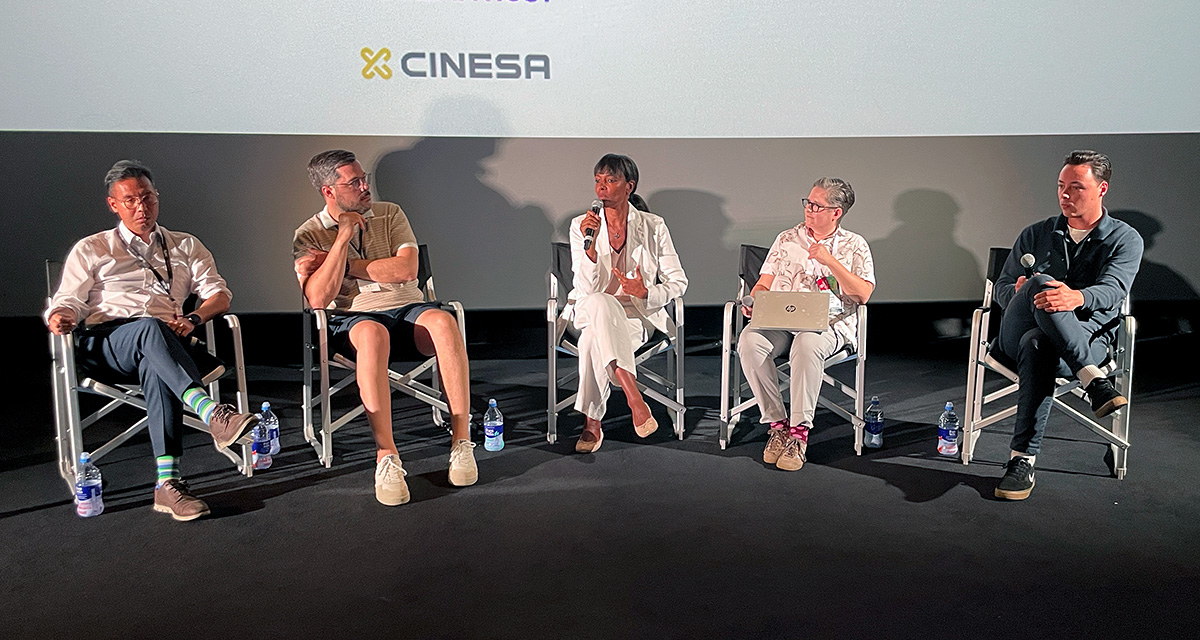
Cinema technology vendors at the 2026 ICTA Barcelona Cinema Technology Experience examine why the systems handling ticketing, content delivery and theatre operations still struggle to share data, what those disconnections cost exhibitors and whether open standards or consolidation will finally bring the industry together.
On a busy Friday night, a modern multiplex can look like a small technological miracle.
Digital cinema packages arrive through a delivery network. A theatre management system schedules and plays them. Projection, sound, lighting and building controls are automated. Tickets, concessions and loyalty transactions flow through a point-of-sale system. An audience member may use an app for audio description or another language.
“Six sophisticated systems, six brilliant pieces of engineering,” said Till Cussmann of Vista Group during the “Connected Cinemas” panel at the ICTA Barcelona Cinema Technology Experience. “But here’s the problem: half of them don’t really speak to each other.”
That disconnect remains one of the cinema industry’s most persistent operational contradictions. Individual systems have become extraordinarily capable, but employees still re-enter information, export spreadsheets and manually transfer data between products inside the same building.
The problem is not a shortage of technology. It is getting the technology to cooperate.
Timo Holtkamp of Gofilex described a content delivery workflow that can send digital cinema packages and security keys into a theatre management system, but offers limited visibility into what happens afterward. At the other end of the chain, Seneit Debese’s Greta app provides accessible and alternate-language versions, but still depends on accurate film and screening information.
Employees as the Integration Layer
When those connections fail, employees fill the gaps. Sophie Doherty of TAPOS noted that some operations managers are still entering information manually at the end of the night.
“For a lot of exhibitors, that would be at two or three in the morning,” she said. “That should not have to happen.”
Doherty added that many point-of-sale providers can automate end-of-night reporting. Sometimes the issue may be training, configuration or a small development request. Still, staff members are too often required to act as an unofficial integration layer.
Why Integrations Require More Than an API
Building a real integration is considerably more complicated than adding a few lines of code.
Asked what had allowed OneCinema to connect programming schedules with projection equipment, power management and building automation, Andreas Stier offered a concise answer: “Perseverance, and a lot of love, sweat and tears.”
The work can involve non-disclosure agreements, API documentation, discussions between developers, access to equipment for testing, remote laboratory sessions and validation inside a functioning cinema. An API, or application programming interface, is a controlled doorway through which one system exchanges defined information with another.
Even when that doorway exists, it must be maintained. A software update on either side can break an integration that had previously worked.
David Ong of Arts Alliance Media, now a Qube Cinema company, said AAM’s theatre management system is connected to 31 different point-of-sale companies, yet many more remain unsupported.
“Who is actually owning that integration?” Ong asked. “And if one side changes their API, that could potentially break that integration.”
The challenge begins with something as fundamental as identifying the film.
Stier said the industry still lacks a single film and release identifier consistently used across markets, cinema circuits and software platforms. The problem multiplies when the same title has several releases, formats, languages or accessible versions. Identifier systems exist, but none has been universally adopted across booking, scheduling, delivery and operations.
Cinema has already shown that standards can work. The digital cinema package, or DCP, standardized how movies are packaged and played, while the key delivery message, or KDM, controls when and where encrypted content can be screened. Neither created a universal language for the data surrounding a show.

The Real Barrier Is Commercial
According to Ong, the main obstacle is not technical.
“It’s definitely commercial,” he said. “I believe every technology problem can be solved. We have a lot of smart people in our industry.”
The real question is whether both companies see enough value to commit development time, testing resources and ongoing support.
“Both vendors, or both platforms, need to see the value for them to be incentivized to put that time and money into that integration,” Ong said.
That does not necessarily mean vendors oppose openness. Software teams have finite capacity, and integrations compete with customer-specific features and product development. Doherty suggested that exhibitors may rank broader integration below tailor-made functionality already requested from their POS supplier.
There are also incentives to keep customers within a single product ecosystem. A tightly integrated stack from one vendor can be easier to install, support and operate than several specialist systems. Doherty said many cinema operators choose the vertical option when available because it is simpler and can produce a better experience.
The danger is that convenience can become dependence.
Stier argued that exhibitors should retain the freedom to choose the best product for each part of their operation.
“It shouldn’t be a walled garden,” he said. “It should be the customer’s choice.”
He was equally direct about claims that allowing another vendor to use an API would expose a company’s intellectual property.
“API is not intellectual property,” Stier said. “The other party defines what they give into the API.”
Providing controlled access to selected information is not the same as handing over source code or unrestricted access. Stier also argued that operational and customer data generated by an exhibitor should remain under its control.
“In my perspective, it’s the customer’s data,” he said. “I think it’s the right of exhibition to forward their data to other parties, and suppliers should enable that.”
What Disconnected Systems Cost Cinemas
The business case for better connectivity goes beyond saving employees from late-night spreadsheets.
OneCinema’s systems can start auditorium equipment before the first screening and shut it down after the final show, reducing staff hours and preventing equipment from running unnecessarily. They can monitor whether servers and projectors are ready, copy content at the appropriate time and alert staff before a technical problem becomes a missed performance.
When a screening fails, the cost is not limited to refunded tickets.
“You have to pay back the ticket price, but the reputational damage is way higher,” Stier said.
Reliable automation also frees employees to spend more time with guests instead of checking that each auditorium’s equipment has started correctly.
Artificial intelligence will not make the underlying problem disappear. AI may improve forecasting, maintenance and reporting, but it can only analyze the information it can access.
“If everything is still siloed, your prediction output, or whatever you’re trying to predict, will always be very limited,” Ong said.
Open Standards or Vertical Integration?
The panel did not settle whether connected cinemas will arrive through open standards, company consolidation or some combination of the two. Consolidation can remove interfaces by placing more products under one roof. Open standards preserve choice and make it easier for specialized suppliers to enter the market.
A neutral industry body or third party could define data standards, certify open interfaces or act as a trusted intermediary between competing suppliers. Yet such a system would still require funding, governance and vendors willing to participate.
Exhibitors may therefore have the most immediate leverage. Ong urged cinema operators to ask vendors about interoperability before signing a contract: Does the platform have an open interface? What is its API strategy? Which integrations are supported? Who maintains them when either product changes? Can the exhibitor direct where its operational data is sent?
Those questions would begin to turn connectivity from an optional benefit into a basic condition of purchase.
As Ong concluded, cinema will finally be truly connected when interoperability becomes “a competitive expectation and not a competitive advantage.”
Editor’s note: This feature is part of Celluloid Junkie’s coverage of the 2026 ICTA Barcelona Cinema Technology Experience. See more reporting from the seminar below.
More from ICTA Barcelona

- Cinema Owners Have Invested $2.7 Billion in Theatres. What Is That Money Buying? - October 1, 2026
- The Paramount-Warner Merger Is Permanent. The Guardrails for Movie Theatres Are Not - September 22, 2026
- Cinemas Aren’t Just Marketing Movies Anymore. They’re Marketing Auditoriums - September 15, 2026