


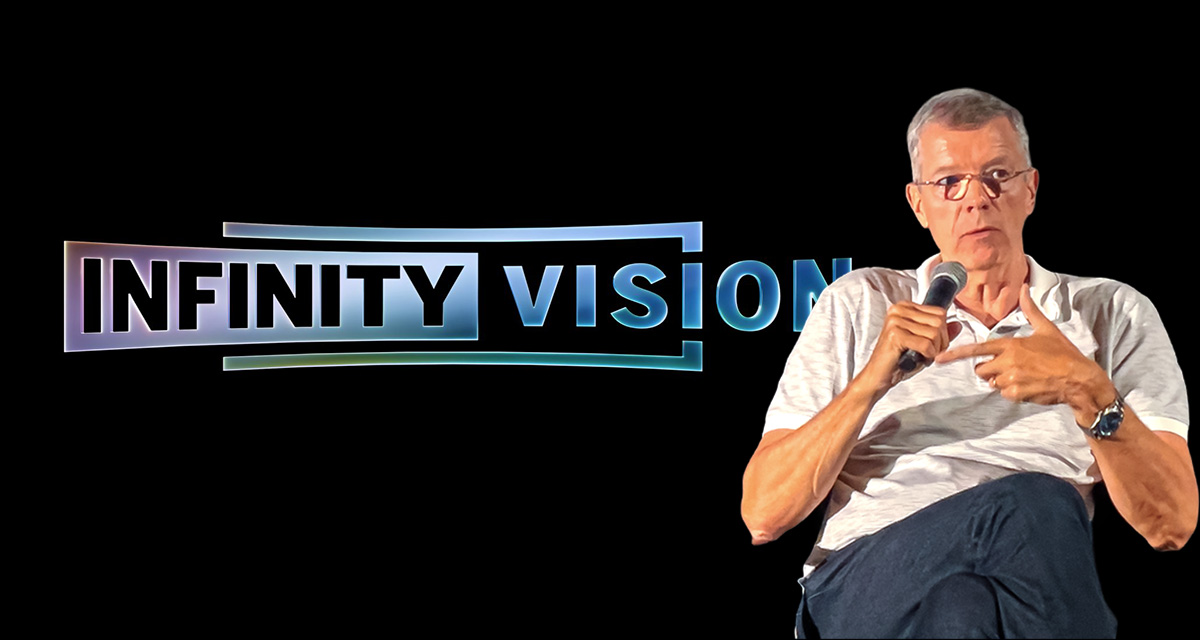
Speaking at ICTA’s Cinema Technology Experience in Barcelona on the eve of CineEurope, Disney’s head of global theatrical distribution offered the clearest public explanation yet of Infinity Vision — and confirmed that several key details are still being worked out.
When Andrew Cripps, Head of Global Theatrical Distribution at The Walt Disney Company, arrived at the International Cinema Technology Association’s seminar in Barcelona on Sunday — one day before CineEurope officially opened — the audience was expecting clarity.
Two months after Disney unveiled Infinity Vision at CinemaCon in Las Vegas, exhibitors, technology partners and distributors were still trying to decipher exactly what the program was, who qualified and what it meant for their screens. Was it a new premium large format? A certification scheme? A Disney-owned quality mark? A marketing umbrella for exhibitor-branded PLF auditoriums?
Cripps is a well-liked executive, genuinely respected across the industry, and his willingness to engage on the topic was appreciated. But if the goal was to leave the room with a shared understanding of Infinity Vision, the session fell somewhat short — less because Cripps was evasive than because the program itself still appears to be evolving. What became clear is that Infinity Vision remains a work in progress, one with an obvious commercial rationale and a number of practical details yet to be fully defined.
What Infinity Vision Actually Is
Cripps framed the origins of Infinity Vision in straightforward commercial terms. The program emerged from a recognition that Disney’s marketing machine simply cannot effectively promote every premium large format screen in the world — of which, by his count, there are a staggering number.
“There are 75 exhibitor-owned PLF brands in North America, and there are over 320 exhibitor-owned PLF brands around the world,” Cripps said. “It’s very difficult — impossible — for us to effectively market all of those brands.”
The brands Disney can market globally are the ones with recognized consumer-facing names: IMAX, Dolby Cinema and ScreenX among them. Everything else — however technically impressive — lacks the shorthand that drives ticket buyers to seek out a specific auditorium.
Infinity Vision, in theory, is designed to solve that problem by creating a single umbrella brand Disney can actively promote: a signal to consumers that a screen meets a quality threshold worth paying for.
“What we want to make sure,” Cripps said, “is that customers understand — we want to set some standards, we want to make sure that we can try to drive customers to the best experience possible, with a shorthand marketing communication.”
That makes Infinity Vision less a new cinema technology than a studio-led attempt to identify, package and market high-quality non-IMAX premium auditoriums at scale.
The “Doomsday” Context Nobody Is Pretending Doesn’t Exist
Cripps also acknowledged the obvious subtext directly.
“We have a movie, it’s no secret, at the end of the year, ‘Avengers: Doomsday,’ that does not have IMAX,” he said.
With “Dune: Part Three” widely expected to command the IMAX footprint on the same 18 December 2026 release date, Disney needs an alternative premium tier to market for one of the biggest films on its upcoming slate. Infinity Vision is designed to be that alternative.
Cripps was candid that the timing provided a useful launch platform, while also pushing back against the idea that the program is purely reactive. “It felt like something — like I said, we talked about it for a while. How do we more effectively market the premium large formats that are out there? This feels like a really good launch pad for that.”
The rollout sequence confirms the stakes. A reissue of “Avengers: Endgame” in Infinity Vision will serve as a test run in September, followed by “Avengers: Doomsday” as the true commercial launch in December.
More Than a Badge, But Not Quite a Format
The most concrete element of Infinity Vision may be the one that distinguishes it most clearly from a simple logo program: Infinity Vision screens will receive a different DCP than standard auditoriums.
“The DCP will be a different DCP,” Cripps said. “We’re going to have different content for the Infinity Vision screens, whether it’s a button… a special piece of hopefully a filmmaker introduction at the beginning… different aspect ratio. There’s different things that we’re working on for Infinity Vision, and every movie I think will be different.”
That matters. If Infinity Vision were only a label applied to exhibitor-owned PLF auditoriums, exhibitors might reasonably ask what Disney is adding beyond a marketing badge. Cripps’ answer appears to be: global marketing support, potentially earlier ticketing and some form of differentiated theatrical content — with the specifics varying title by title.
What remains less clear is how meaningful those differences will be at the consumer level. Whether the alternate DCPs contain material unavailable in other theatrical versions, and whether any exclusive content is specific to Infinity Vision screens or simply part of a broader theatrical window, was not entirely resolved in the session. When an audience member asked Cripps to define what a “button” actually is, he explained it as an Easter egg or additional piece of content — “probably for another movie, or linking the movie to another movie coming.” He confirmed such material would be “exclusively to theaters,” though it remained unclear whether that exclusivity extends to Infinity Vision screens specifically or to theatrical exhibition generally.
Qualification vs. Certification
One of the more pointed audience questions cut to the heart of what has left exhibitors confused since CinemaCon: is Infinity Vision a qualification program — where an exhibitor ticks the boxes and is included — or a certification program, where Disney or an outside party verifies the quality of the auditorium?
Cripps’ answer was honest, and probably the most illuminating thing he said all session.
“It’s voluntary,” he said. “We don’t have a team of people that we can send out and check. We want to work collaboratively with exhibition. So, we said these are generally the standards we’re working to — work with us. Send us the screens that qualify, and then let’s talk about how we can more effectively market those screens.”
At least for now, Infinity Vision is closer to a voluntary, Disney-reviewed qualification process than a formal third-party certification scheme. Exhibitors submit screens. Disney evaluates them. There are no inspectors, no THX-style audit process, and no precise public technical checklist — only standards Disney describes as still being refined in collaboration with exhibitors.
Cripps indicated Disney would issue further details before its Wednesday presentation at CineEurope, including target screen counts. Until then, exhibitors are left with the broad contours of the program rather than firm specifications.
When Premium Does Not Fit One Global Standard
The limits of that flexibility came into focus when a questioner raised a very concrete version of the ambiguity. Some French exhibitors, he noted, have invested significantly in premium screens — in some cases with 4K laser projection — but those screens may be only 12 meters wide, potentially falling short of whatever screen-size threshold Infinity Vision requires.
Cripps’ response was notable for its pragmatism, and for the question it left hanging.
“I think if it’s the premium screen for that region, then I think we should be talking about trying to elevate that experience,” he said. “I think too often we come up with these standards that — one size doesn’t always fit all.”
That is a reasonable instinct. It recognizes the reality that a premium screen in a smaller regional market may not look like a flagship PLF auditorium in London, Paris or Shanghai. But if one size does not fit all, the obvious follow-up is: what exactly is the standard? At this stage, the answer appears to be that Disney is still working that out. Cripps said thousands of screens had already been submitted for evaluation, but the criteria remain opaque enough that some exhibitors left the room still unsure whether their auditoriums were in or out.
That uncertainty cuts both ways. Too rigid, and Infinity Vision risks excluding worthwhile premium screens in smaller markets. Too flexible, and it risks becoming a marketing term without enough technical meaning behind it.
Who Owns the Brand — and Who Else Might Use It?
Those standards questions connect directly to the ownership question, because a brand is only as meaningful as the consistency of what it represents. Disney has registered the Infinity Vision trademark in nearly every major market, with Cripps noting exceptions in India and Japan where prior registrations existed.
Cripps framed that as a starting point rather than a territorial claim. “The intention was not to create something that Disney were going to own and control,” he said. “The first two movies coming out will be Disney movies. We’ve actually presented to other studios and tried to encourage them to come along… but I think people are waiting to see how it rolls out.”
That is a familiar dynamic in this industry. Everyone likes the idea of a shared solution. Everyone also wants someone else to take the risk of going first. Disney is going first — and whether Infinity Vision ultimately becomes a broader industry standard or remains a Disney-branded marketing vehicle may depend as much on what “Avengers: Doomsday” does at the box office in December as it does on the elegance of the qualification framework.
What Can Play on an Infinity Vision Screen?
One source of confusion among attendees was whether a screen that qualifies for Infinity Vision would somehow be restricted in what it could play. The answer, based on Cripps’ remarks and the nature of the program, is no.
Infinity Vision is not a proprietary projection system. It does not prevent an auditorium from playing non-Disney titles. A screen that qualifies for “Avengers: Doomsday” could still play “Dune: Part Three,” or any other title, subject to normal booking decisions.
But unless another studio adopts the label, that film would not be playing “in Infinity Vision.” It would be playing in that exhibitor’s premium auditorium — whether branded as a circuit PLF, Dolby Cinema, ScreenX, 4DX or something else. That distinction may be obvious to studio distribution executives. It was not obvious to everyone in the room.
Pricing Is the Exhibitor’s Call
Cripps also clarified that Disney is not imposing a ticket surcharge on Infinity Vision presentations.
“Distributors don’t set ticket prices, you do,” he told exhibitors. “There’s no premium that Disney’s charging. Exhibitors are free to charge whatever they want.”
That does not mean exhibitors will not charge more. Premium branding exists in part because moviegoers have shown they will pay for better experiences — and Cripps made that case elsewhere in the conversation, arguing that when premium tickets go on sale, “the first tickets that sell out are the premium expensive tickets.” Infinity Vision is designed to help exhibitors sell those seats, not discount them.
What We Still Don’t Know
Cripps made a genuine and good-faith effort to explain Infinity Vision to an audience that wanted and needed an explanation. The program’s commercial logic is clear, and the core proposition — a Disney-led (for now) umbrella brand that helps consumers identify premium non-IMAX auditoriums — has real value for an exhibition sector whose PLF investments have long outpaced the industry’s ability to communicate them to ticket buyers.
What remains unclear are the practical mechanics: minimum screen specifications, the degree of territory-by-territory flexibility, what happens to strong regional premium screens that fall short of global thresholds, and whether a voluntary, exhibitor-submitted process can sustain enough consistency for the brand to mean something at scale.
Those answers may come from Disney’s Wednesday presentation at CineEurope, from the September “Avengers: Endgame” reissue, or from “Avengers: Doomsday” itself in December. For now, Infinity Vision is a program with a compelling premise and a strong commercial rationale — and a lot of fine print still being written.
Update — June 24, 2026: One day after this article was published, Disney provided additional public details about Infinity Vision during its CineEurope presentation in Barcelona, with Jeffrey Forman, Senior Vice President, International Film Distribution at The Walt Disney Studios, referring to Infinity Vision as a “certification program.”
According to Disney, auditoriums seeking Infinity Vision branding must meet several technical standards, including a screen at least 45 feet wide, immersive audio such as Dolby Atmos or 7.1, and brightness levels of either 14 footlamberts for 2D or 6 footlamberts for 3D presentations. Disney has also launched an Infinity Vision ticketing landing page at InfinityVisionTickets.com.
The additional details clarify some of the questions raised during Andrew Cripps’ ICTA appearance, particularly around minimum technical specifications. They also confirm that Disney is positioning Infinity Vision more formally as a certification program, even as its initial public explanation emphasized a voluntary, collaborative process with exhibitors. Disney reportedly received more than 7,500 applications from global exhibitor screens seeking certification and is now reviewing those auditoriums.
Editor’s note: This feature is part of Celluloid Junkie’s coverage of the 2026 ICTA Barcelona Cinema Technology Experience. See more reporting from the seminar below.
More from ICTA Barcelona

- Cinema Collectibles Are Big Business, but Knowing What to Order Requires Strategy - October 15, 2026
- Cinema Owners Have Invested $2.7 Billion in Theatres. What Is That Money Buying? - October 1, 2026
- The Paramount-Warner Merger Is Permanent. The Guardrails for Movie Theatres Are Not - September 22, 2026