


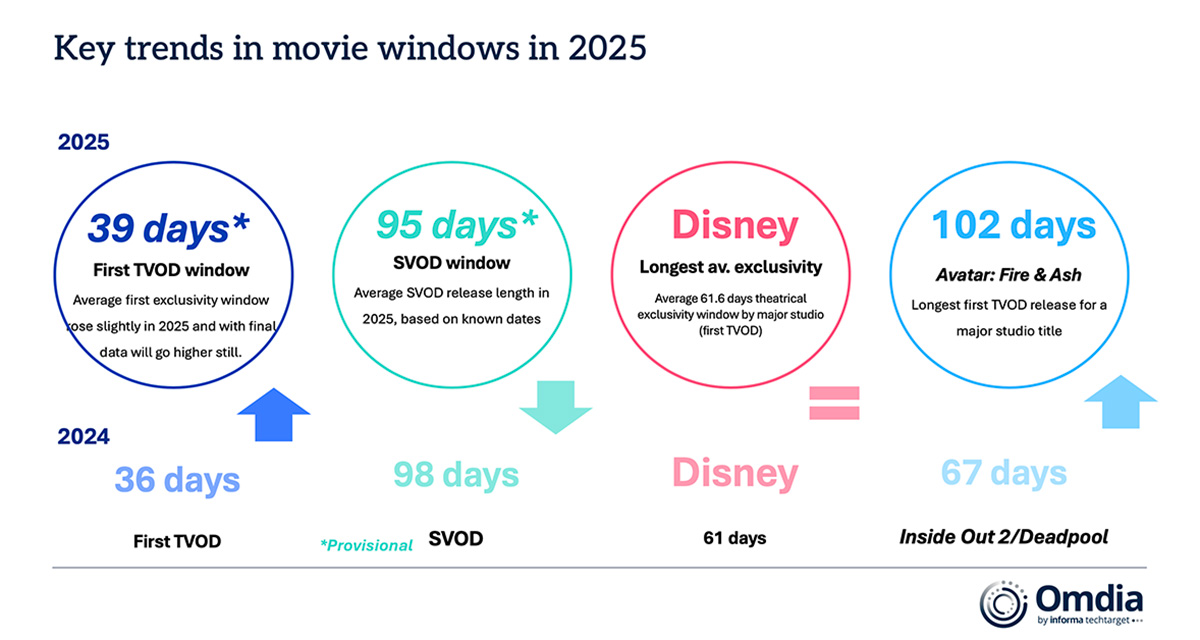
Average first TVOD windows rose in 2025, Disney again led the majors with a 61.6-day average, and early 2026 releases point toward a stronger 45-day baseline.
After several years in which theatrical windows seemed to be shrinking by the quarter, the North American market may finally be settling into something that looks less like experimentation and more like strategy.
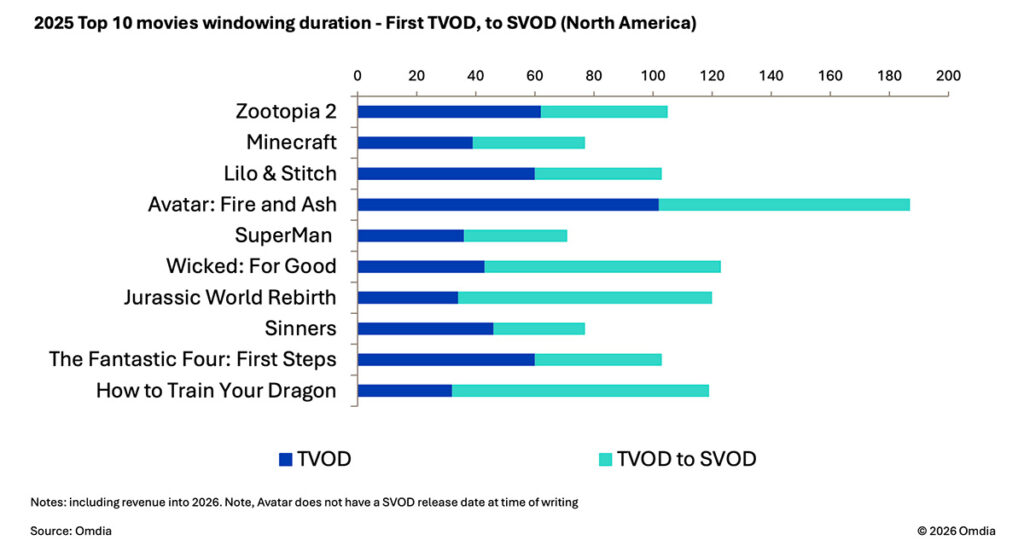
New research from Omdia suggests that studios are not returning wholesale to the old pre-pandemic windowing model. Instead, they are increasingly protecting theatrical exclusivity for the films most likely to benefit from it. In 2025, the average first transactional video-on-demand window rose slightly to a provisional 39 days, while the top 10 North American films averaged 51 days before reaching first transactional video-on-demand (TVOD), up from 45 days in 2024.
The message is not that the industry has solved the windows debate. It is that the debate has changed. Studios are still using flexible, title-by-title strategies, but the aggressive compression of theatrical exclusivity that followed the pandemic appears to be giving way to a more stable pattern — especially for the biggest releases.
Omdia’s findings were presented by Charlotte Jones, Senior Principal Analyst at Omdia, during the June 10 edition of the CJ Cinema Summit. The data came from the firm’s report, “US Movies: Theatrical, TVOD, SVOD, and Other Windowing Strategies 2025,” which tracks theatrical, transactional, subscription and other release windows across the North American market.
“What we found is that the average window did increase slightly,” Jones said during the Summit. “Generally, we are seeing a resurgence in some of the longer windows for some of those outlier titles.”
A Modest Shift, Concentrated at the Top
Omdia uses “first TVOD” to refer to the first transactional window, encompassing both premium rental and digital purchase availability. That measure has become one of the most closely watched indicators in the windows debate because it is often the first point at which a theatrically released film becomes available in the home.
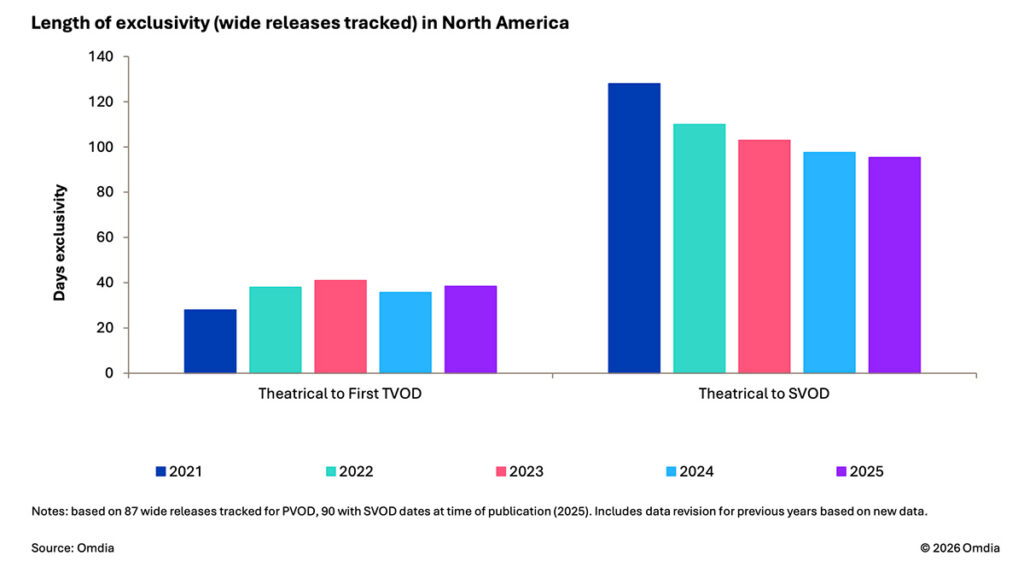
In 2025, the average first TVOD window for wide releases tracked by Omdia rose to 39 days, up from 36 days in 2024. The average window to subscription video-on-demand (SVOD) release was a provisional 95 days, down slightly from 98 in 2024, based on known dates at the time the report was published in April.
Omdia noted that those figures could move as additional release dates become available, particularly on the SVOD side. Still, the provisional data points to a market in which studios are managing windows by platform and by title rather than reverting to one fixed model.
The shift was clearer among the highest-grossing films. Based on known dates at publication, seven of the top 10 North American titles in 2025 had more than 100 days between theatrical release and SVOD debut, up from six in 2024. All of the top 10 titles waited at least 30 days before first TVOD availability, a notable contrast with 2024, when Universal’s “Twisters” reached transactional platforms after 21 days.
Disney’s Benchmark, and the Outliers Pulling the Average Up
Disney stood out as the most consistent major studio in preserving a longer transactional window. Omdia found that Disney averaged 61.6 days from theatrical release to first TVOD in 2025, effectively matching its 61-day average in 2024. The studio also had the longest first TVOD window for a major studio title, with “Avatar: Fire and Ash” reaching transactional platforms after 102 days.
“Disney does have the longest in terms of that transactional window,” Jones said, pointing to the studio’s “consistency there over 60 days for many of those key titles.”
That consistency is significant because it places Disney’s approach closer to the kind of 60-day-plus model exhibitors have been advocating, even as the rest of the market continues to vary by studio and by title. Omdia’s data showed that 22 studio releases debuted on first TVOD after 45 days or more in 2025, up from 18 in 2024. But of the 17 studio titles that opened in 2025 to more than USD $50 million in North America, less than half had a 45-day window.
That finding may be one of the more revealing points in the study. Bigger opening weekends do not automatically guarantee longer theatrical exclusivity. Studio strategy still matters. So does the nature of the title, its performance trajectory, the distributor’s downstream priorities and the perceived value of keeping a film in cinemas longer.
“I would say that on average, when you have titles that perform at the higher end, in terms of the top three, top five, top 10, even top 20, they do tend to have on average longer windowing duration than the market average,” Jones said. “But you can see within that top 10 quite a lot of differences in studio approach and studio strategy.”
The Sentiment Shift, From the Top
The early 2026 data points toward further stabilization. According to Omdia, the top five films year-to-date for which data was available, all had theatrical-to-first TVOD windows of 45 days or more. Even traditionally shorter-window studios are tracking in that direction: Jones noted during the Summit that Amazon MGM’s “Project Hail Mary” ran roughly 53 days before TVOD, above that studio’s historical norm.
For exhibitors, that may be the most encouraging signal in the report. The industry is not necessarily returning to one fixed window for all films, but 45 days appears to be re-emerging as a meaningful floor for major releases, with stronger performers often allowed to run longer.
“It’s certainly very clear that the sentiment is now shifting towards backing longer windows,” Jones said.
That sentiment has been increasingly visible across the industry. Omdia’s presentation cited recent comments from Universal, Paramount, Sony Pictures, Steven Spielberg and Cinema United, all emphasizing the value of theatrical exclusivity. Paramount’s David Ellison has pledged a minimum 45-day theatrical window for releases, while Cinema United president and CEO Michael O’Leary has called for broad adoption of at least 45 days and, ideally, more.
Amazon MGM’s contribution to the same presentation struck a different note. Distribution chief Kevin Wilson framed the issue less in terms of a target number of days and more in terms of avoiding a scenario where a title is pulled from “a significant number of theaters after three weekends” and left to sit on a digital shelf for whatever is left of its window.
“I think there’s a middle ground that’s going to work for both studio and exhibitor,” Wilson said — a reminder that the consensus on longer windows is real, but the underlying math still varies by distributor.
The Cinema-Goer Premium
Still, the new windows landscape is not simply about holding films back from the home for a few extra weeks. Omdia’s consumer research suggests that cinema-goers are among the entertainment economy’s most valuable consumers precisely because they are active across so many other platforms.
In the U.S., Omdia found that cinema-goers over-index compared with non-cinema-goers across pay TV, SVOD, hybrid SVOD, FAST, social video, gaming and YouTube. Among surveyed U.S. cinema-goers, 95% used SVOD services, 95% used social video, 82% played video games and 91% used YouTube. They were also more than twice as likely as non-cinema-goers to subscribe to a traditional pay TV service.
“Cinema-goers are highly active across all of these windows,” Jones said. “Across all of these windows, we’re seeing the cinema-goer outperform the non-cinema-goer, which I think is a very interesting takeaway when we’re discussing the whole ecosystem.”
That complicates the familiar framing of theatrical and streaming as purely competing behaviors. Omdia’s data suggests that people who go to the cinema are not rejecting at-home entertainment. They are among its heaviest users. The issue for studios and exhibitors is therefore less about choosing between theatrical and downstream platforms, and more about sequencing those platforms in a way that preserves value.
“The cinema-goers are very valuable consumers across the value chain,” Jones said.
Windows as Value Preservation
That does not eliminate the tension around windows. A film can still be playing theatrically when it becomes available on TVOD, and exhibitors continue to argue that too-short windows train audiences to wait. But the Omdia study suggests the market has moved away from the most aggressive post-pandemic compression of theatrical exclusivity, particularly for bigger releases.
Jones noted that Omdia has not recently conducted a dedicated study on the impact of PVOD availability on individual box office runs, but said the subscription window likely carries the greater risk of cannibalization. In most cases, that window remains significantly longer than the transactional window, generally arriving closer to or beyond the three-month mark for major titles.
The current model is therefore neither a full restoration of the old windows system nor the free-for-all some feared during the pandemic. It is more flexible, more tactical and more dependent on performance. But it is also increasingly built around a recognition that theatrical exclusivity creates value that can carry into every later window.
For exhibitors, the significance of the Omdia data is not simply that windows are lengthening. It is that the strongest moviegoing audiences are also among the most active consumers across streaming, social video, gaming and other entertainment platforms. That makes theatrical exclusivity less of a defensive measure than a value-preservation strategy.
In other words, the window is no longer just about keeping a film off streaming for a few extra weeks. It is about giving theatrical enough room to create the awareness, word of mouth and cultural weight that every downstream window still depends on.

- Cinema Owners Have Invested $2.7 Billion in Theatres. What Is That Money Buying? - October 1, 2026
- The Paramount-Warner Merger Is Permanent. The Guardrails for Movie Theatres Are Not - September 22, 2026
- Cinemas Aren’t Just Marketing Movies Anymore. They’re Marketing Auditoriums - September 15, 2026