European cinemas spent much of 2025 proving a point that has become familiar in the post-pandemic theatrical business: audiences show up when the films are there. The harder question, and the one the International Union of Cinemas’s (UNIC) 2026 Annual Report keeps circling back to, is whether the industry can deliver that supply consistently enough, broadly enough and with enough exclusivity to rebuild attendance across every market.
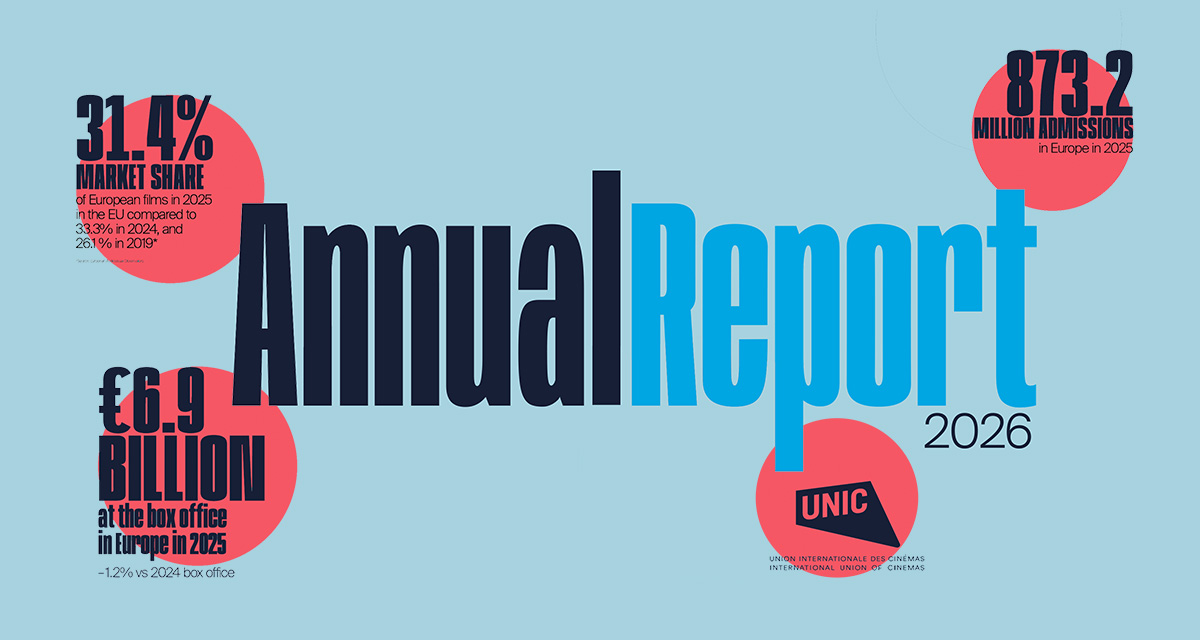
The headline numbers read as stability rather than rebound. Cinemas across the trade body’s 39 territories generated EUR €6.875 billion (USD $7.84 billion) at the box office in 2025, down 1.2% from 2024, while admissions fell harder, down 4.4% to 873.2 million tickets. Part of that gap is a pricing story: the implied average spend per admission across Europe rose from about EUR €7.62 (USD 8.69) in 2024 to roughly EUR €7.88 (USD $8.98) in 2025, an increase of just over 3%. The topline held up in part because tickets cost more, not because more of them were sold — a pattern that recurs market by market, not just in the continent-wide total.
“Although 2025 did not present as significant a step on the road to recovery… as many hoped,” wrote Phil Clapp, chief executive of the UK Cinema Association and UNIC’s outgoing president, in the report’s opening section, “there were still many positive signals” for the sector. That caveat matters: the 2023 Hollywood writers’ and actors’ strikes continued to ripple through the 2025 release calendar, contributing to an uneven schedule of U.S. titles, while several countries lacked the breakout domestic hits that lifted attendance the year before. Europe did not move as one market in 2025 — it rarely does, but this year made the differences unusually visible.
A Patchwork of National Results
Box office grew year over year in 17 markets, including Austria, Denmark, Germany, Greece, Poland, Saudi Arabia, Turkey, the United Kingdom and Ukraine; France, Spain, Portugal, Sweden and Belgium, among others, declined.
The UK was the cleanest growth story among major Western markets: box office reached GBP £990.5 million (USD $1.36 billion), up 1.2%. “A Minecraft Movie” was the year’s top-grossing title at GBP £52.3 million (USD $69.4 million), while “Bridget Jones: Mad About the Boy” was both the UK’s top local release, at GBP £43.3 million (USD $57.5), and — across Europe — the single most-watched European film of 2025, with 11.8 million admissions.
France and Spain show the other side of the price-cushion pattern. French admissions fell 13.9% to 156.2 million, though the comparison is complicated by the fact that 2024 had been lifted by the extraordinary, one-off success of “Un p’tit truc en plus,” which alone drew 11 million admissions. This year’s top French film, “God Save the Tuche,” sold 3 million tickets — the only local title to crack the annual top 10, but no match for the prior year’s outlier.
Spain’s admissions fell 8.5%, to 65 million, while box office fell a shallower 5%, to EUR €453 million (USD $516 million)— a similar per-ticket cushion at the country level. Revenue was up 3% in the first half before falling 16% in the second, while Spanish films held a steady 19% share, roughly flat against 2024 and a sign the problem was thin overall supply rather than a weak local slate.

Where Local Cinema Did the Heavy Lifting — and Where It Wasn’t Enough Alone
Germany delivered the cleanest example of domestic strength translating into real growth: box office rose 6.4% to EUR €924 million (USD $1.05 billion) and admissions rose 2.1%, with local films capturing 27.4% of admissions, up eight percentage points, led by Michael Herbig’s “Manitou’s Canoe,” which drew more than 5 million admissions and EUR €50.9 million (USD $58 million).
Denmark posted the strongest attendance growth in Scandinavia, up 4.5% to 10.25 million admissions, on a record 37% domestic market share against 23.3% in 2024; “Checkered Ninja 3” and “The Last Viking” led a slate of local releases that nearly doubled, from 19 titles to 39.
Italy is the more complicated case, and the one that best captures the report’s central tension. Local productions claimed 32.7% of box-office revenue, the highest share since 2016, on the strength of Checco Zalone’s “Buen Camino,” which opened on Christmas Day, took EUR €36 million (USD $41 million) in its first week, and went on, with a strong holdover into 2026, to become the highest-grossing release in Italian box office history, surpassing 2009’s “Avatar.” Yet Italy’s overall box office barely moved, up just 0.5%, and admissions actually slipped slightly, because Hollywood’s share of Italian revenue fell 25% year over year. Local content did not lift the market so much as keep it from sinking under that pullback — arguably the clearest evidence in the report for UNIC’s case that exhibition needs both halves of the slate.
Across the EU, European films held a 31.4% market share — down from 33.3% in 2024, though still above the 26.1% recorded in 2019. A record 42 European titles ranked among the top five highest-grossers in their national markets, up from 39 in 2024 and 26 in 2023: evidence of a broader, more evenly distributed slate, even as the aggregate share dipped.
Hollywood Still Anchors the Slate
The report does not pretend Hollywood is any less essential to the recovery story. The year’s most widely viewed titles across UNIC territories included Disney’s “Zootopia 2,” “Avatar: Fire and Ash” and “Lilo & Stitch”; Warner Bros.’ “A Minecraft Movie”; Universal’s “Jurassic World: Rebirth” and “Wicked: For Good”; Paramount’s “Mission: Impossible – The Final Reckoning”; and Sony’s “28 Years Later.”
Those titles supplied the tentpole infrastructure local hits need to flourish — Italy’s case shows what happens when that infrastructure weakens. UNIC’s report argues that cinema-going cannot be sustained on tentpoles alone, nor can local production carry every market on its own; it takes a steady, year-round mix of both to keep admissions from sliding further.
Windows, Mergers and the Fight Over Supply
That argument is why theatrical exclusivity sits at the center of UNIC’s policy section, linked directly to admissions recovery, reduced piracy risk and exhibitors’ ability to keep investing in auditoriums and premium formats. The timing is not incidental: UNIC devotes substantial space to opposing the proposed Paramount Skydance–Warner Bros. Discovery transaction, citing Disney’s 2019 acquisition of 20th Century Fox as precedent, where the combined studio’s theatrical output fell more than 30% despite assurances made at the time.
UNIC wants the European Commission and the UK’s Competition and Markets Authority to make any release-volume and windowing commitments legally binding rather than voluntary — a fight that will shape exhibitor supply conversations well beyond this CineEurope. With fewer studios controlling more must-see content, the risk is not only a further shift in bargaining power away from cinemas, but a narrower and less diverse release pipeline overall.
Momentum Builds Into 2026
The report closes on a more optimistic note than 2025’s figures alone suggest. December 2025 generated $3.5 billion at the worldwide box office, the strongest December since 2019 and up 10% year over year, momentum that carried into the first quarter of 2026, with more than 15 European territories posting double-digit growth. Gower Street Analytics has revised its 2026 outlook accordingly, raising its international projection, excluding China, by $50 million to $18.45 billion, citing stronger performance in Europe, the Middle East and Africa.
That optimism and the merger fight are two sides of the same argument. UNIC’s pipeline case — a deeper, steadier slate, with windows protected regardless of how the Paramount-Warner deal shakes out — is what is supposed to turn 2026’s early momentum into something durable rather than another year propped up by pricier tickets.
The challenge is making that less of a patchwork and more of a pattern. Whether that happens may depend less on audiences than on what regulators in Brussels and London decide to do next.