Category Archives: Business

The Commoditization of VPFs, or, Why Having a Deal With Hollywood Studios Isn’t The Big Deal It Used To Be

Scrabble Entertainment has announced virtual print fee (VPF) deals with five Hollywood studios (“Hello Scott from SPE, in the back.”) to roll out digital cinema in India.  This may be the last notable VPF deal for some time, if not for ever.

Scrabble has signed up Walt Disney Studios, Warner Bros., 20th Century Fox, plus Paramount and Universal, with only Sony Pictures yet to come on board. At the press conference in Las Vegas on the second day of ShoWest 2009, three of the studio representatives joined Scrabble’s CEO Ranjit Thakur on stage to praise his efforts. Tom Molter from Warner Bros said that WB has supplied more digital cinema titles internationally than any other studio (definitely true for India) and was looking forwards to doing more of this with Scrabble. Julian Levin from Fox praised Ranjit’s determination and effort, acknowledging that negotiating with the Hollywood studios is a “very difficult and complicated process.” Lastly Jason Brenek from Disney was happy that Scrabble digital cinema roll-out would include 3D installations, understandable given Disney’s 17 3D titles over the coming three years. Jack Klein from Christie was also up on stage. Christie is the 2K digital cinema projector supplier of choice for Scrabble, but what is not discussed is that Christie is said to have helped behind the scenes to facilitate the VPF deals for Scrabble. Universal and Paramount were not on stage, though they had signed up as well (Paramount’s logo was on the banners, though Universal’s was missing), though this may be due to the fact that both are represented jointly in India by the (elsewhere largely defunct) UIP, with Paramount branding, in India, meaning that there is some untangling to be done still.

Screen International covered the agreement:

Scrabble has signed contracts with Twentieth Century Fox, Warner Bros, Walt Disney Studios and Paramount Pictures that become effective on April 1, and the company is in the process of finalising deal points in the agreement with Universal Pictures. The agreements are based on the self financing virtual print fees model, which is essentially a pay-per-use or booking system. Read More »

Popularity: 40% [?]

DTS Digital Cinema Back From The Not-Quite-Dead With Qube Deal

DTS Digital Cinema and Qube Deal DTS Digital Cinema has been going through a bumpy ride in the past year, but appears to be seeing a light at the end of the tunnel.  One year ago DTS Inc. spun off its two non-licence division.  DTS Digital Images reverted to being Lowry Digital under the new ownership of Reliance/Adlabs.  DTS Digital Cinema had a question mark over it until it was eventually acquired by the United Kingdom’s Beaufort International Group.  Almost immediately the company closed down its server manufacturing arm and people in the industry started speculating – as we are prone to do – whether the company would survive.  [Full disclosure: the co-editor of Celluloid Junkie, J. Sperling Reich works for DTS DC, but we take care not to mix paying day jobs with non-paying blogging, so he kept a stoic silence about how the company was doing any time we talked.]

DTS Digital Cinema has now staged something of a small comeback through a smart deal with Real Image Media Technologies, the Indian makers of the Qube server. Here are the key bits from the press release:

DTS Digital Cinema and Qube Cinema have announced a co-branding strategic alliance to develop and market numerous digital cinema products including a digital cinema server, a theatre management system, an enhanced digital cinema mastering solution and other allied products. The alliance will bring together the best of both companies’ strengths to form a strong commercial and technology presence in the digital cinema marketplace.  Qube will bring to the relationship, their experience of having developed cutting edge digital cinema products such as the Qube XP-D digital cinema server, QubeMaster Pro encoding suite and the QubeCast media delivery system. Besides providing sales and marketing presence and expertise in many regions around the world, DTS Digital Cinema will lend the partnership experience in developing motion picture technology, such as 5.1 digital surround sound, as well as the content management software knowledge that helped develop their Theatre Management System, Satellite Delivery System and Digital Booking System. Together the two companies will develop numerous digital cinema products, starting with the DTS Digital Cinema DC-20 powered by Qube, a digital cinema server that meets DCI specifications and will be on display at ShoWest 2009. Read More »

Popularity: 31% [?]

Q & A: Mark Christiansen Talks About Paramount’s VPF Deal

Paramount's Mark Christiansen

Paramount's Mark Christiansen

Since January 22nd, when we first posted our story on Paramount’s direct-to-exhibitor virtual print fee agreement, we have received quite a bit of correspondence on the topic.  Some typed out their thoughts in the comments section of the post, (and thank you for that).  Many of your emails asked questions about the agreement that we were simply unable to answer as we did not have enough information.  So, we felt it would be best to turn to the most qualified person to answer some of these questions; Mark Christiansen, Paramount’s executive vice president for motion picture distribution.

We compiled all of your questions into an email and sent it off to Mr. Christiansen.  He was kind enough not only to respond, but also to let us post the VPF agreement for your review.  At the time of his response in February, Mr. Christiansen said the feedback he was receiving about the deal was entirely positive and he was happy to report that between 10 and 12 exhibitors had already made commitments to sign the agreement.  He understandably declined to state exactly which exhibitors given that details were still being worked out.

You might think some of Mr. Christiansen’s responses are rather brief, though please keep in mind he was answering these questions via email.  When necessary we’ll provide our own interpretation of his responses, which are noted as such.  Please do not mistake this for Mr. Christiansen’s own opinions or responses.

Celluloid Junkie: Why did Paramount wait until now to put together a VPF they can offer direct to exhibitors?  Why not last year or earlier?

Mark Christiansen: DCI compliance testing was not available.  We wanted to have a testable specification in place before going directly to exhibitors.

Read More »

Popularity: 40% [?]

Booming U.S. Box Office Makes Headlines

John Fithian of NATO

John Fithian of NATO

These days, with the global economic crisis at full force dominating headlines, it seems mainstream media will jump on anything that even smells like positive news.  So, it’s no wonder with North American box office earning a billion dollars in January and an additional US $800 million in February that media outlets would break their tradition of only covering box office grosses on Monday mornings in favor of feature stories about how moviegoers have returned to theatres.

A spate of articles in various publications was kicked off on February 25th by Andreas Fuchs’ Film Journal piece in which John Fithian, president of the National Association of Theatre Owners (NATO), holds forth in a “state of the industry” interview.  A good portion of the lengthy piece is devoted to the current state of the digital cinema transition, which Fithian still believes will heat up in 2009 despite any financial woes.  Fithian then goes on to describe the exhibition industry as being “recession-resilient” though stopped short of calling it “recession-proof”:

“The cinema is a relatively inexpensive way to be entertained. If people don’t have money to go on a big vacation, they take a mini-holiday at their local movie theatre. So the environment of challenging times is generally good for us, but that doesn’t mean it always works. You need to have good movies. People are not going to escape the burdens of the day by going to see a bad film.”

While U.S. box office set an all time record in 2008 with US $9.79 billion in grosses, Fithian points out that admissions were actually down 2.5% Read More »

Popularity: 33% [?]

How much did AMC pay for 54 Sony 4Ks?

AMC logoThe tail end of ShowEast brings the announcement that AMC Theatres will install 54 of Sony’s 4K projectors in four of its new cinemas. The press release gives the details of how many projectors will go into which multiplexes and when:

Sony will provide 54 SXRD 4K digital cinema systems at new AMC theatres in Dallas (12 screens); Indianapolis (14 screens); Riverside, Calif. (16 screens); and San Diego (12 screens). Work will begin next month, with the theaters scheduled to open in December.

The theaters will feature a combination of Sony’s SRX-R210 10,000 lumen* model and the SRX-R220 18,000 lumen* unit. The systems, which were specifically designed for theater applications, will be paired with Sony’s LMT-100 Media Block servers.

“This inaugural effort with AMC Entertainment is the latest example of the exhibition and motion picture industry’s continued adoption of 4K digital cinema technology,” said John Scarcella, president of Sony Electronics’ Broadcast and Business Solutions Company.

But if you read the whole press release there is something missing. A quote from AMC. No ‘We are thrilled to be working with Sony to bring our patrons the highest quality digital….yadi…yada…’ And this tells us off that there is something unusual about this announcement and deal.

More specifically, how much did AMC pay for these projectors and on what terms were they installed?

Sony SXRDIt seems strange that AMC, which is part of DCIP, should decide to suddenly install fifty odd projectors when they are presumably just months away from concluding VPF negotiations with the Hollywood studios, which will form the basis for funding the rollout in 2008. It’s also not as if there is pressure to install 4K projectors in time for an upcoming 4K film release, like there is for 2K projectors for the digital 3D version of ‘Beowulf‘ this autumn. Which leads me to guess that AMC must have got these projectors from Soy on very favorable terms. Perhaps even free. Because DCIP has already been testing the 4, so it is not as if AMC needed a beta field test. For Sony, this gives them more prestige than the single US exhibitor deployment with Muvico. They must also be hoping that this will put them in a better position for when DCIP places its order for 2008.

Having said that, good things are being said about Sony’s Theatre Management System (TMS), plus the Hollywood studios have made clear that they will not pay VPFs for equipment going into new cinemas, where no 35mm projector or print is being replaced, and these are all new sites. Still, we will have to wait for AMC’s next 4K filing to get any details on what AMC did or didn’t pay for this. Until then, any article about the AMC-Sony deployment should end with the disclaimer ‘Financial details of this transaction were not disclosed.’

Popularity: 20% [?]

Rumour mill: Technicolor loses a studio while Arts Alliance gains one

Two items from the unsubstantiated-but-strong-rumour department.

Whisper in earTechnicolor is said to have lost one of their two large Hollywood studio clients for prints and lab work. That would mean that either Warner Bros or Disney have opted to go with Deluxe – and another nail in the coffin for Technicolor. A contract like this would be worth tens of millions, or even hundreds. While digital cinema is set to sweep the Us in the next five years, there’s still a lot of print work to be done in that time and with a clearer end date for 35mm, there is more scope for a single player to dominate without fears of anti-monopoly lawsuits. Plus where print goes, digital tends to follow. It really does not look good for Technicolor at the moment, but it is too soon to write them off yet.

Secondly, Arts Alliance Media is said to be close to announcing a fourth Hollywood studio for its VPF deal, with fingers pointing at Sony Pictures. This would mean that AAM has nabbed four of the Big Six: Universal, 20th Century Fox, Paramount and SPI, with Warner Bros and Disney holding out. Impressive feat and it means that AAM has something that could conceivably entice European exhibitors. At least that aren’t looking to do a VPF deal directly with the studios themselves and cut out the third party middleman.

Popularity: 24% [?]

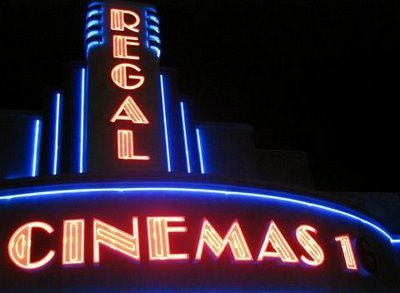
Regal Q2: BO OK, D-Cine and 3D Plans On Track

Regal Entertainment Regal Cinemas’ transcript of their Second Quarter Earnings conference call provides some interesting insights into their road map for digital cinema and particularly for digital 3D. Overall BO is up slightly, mainly on the back of the billion dollars earnings from the trinity of threequels that was Pirates 3, Spider-Man 3 and Shrek 3. The digital cinema plans of DCIP remain apparently ‘on track’ with some interesting semi-new nuggets of information from the transcript (courtesy of Seeking Alpha) and particularly the Q&A with investor analysts that followed the presentation:

Our goal at the beginning of the fiscal year was to begin digital installations in our new theaters opening during the fourth quarter of this year, and we are on track to meet that timeline.

We would also expect to begin converting our existing locations to digital during the first half of 2008. And again, we would expect that a complete conversion of our circuit will take approximately three to four years.

DCIP is continuing to work with the studios to negotiate and finalize the virtual print fee contracts. And negotiations of the financing plans are also in process. We remain optimistic regarding the benefits of digital cinema, primarily as it relates to future growth potential associated with 3D film product and other 3D content.

On the subject of digital 3D, Regal is keen on it….

Based on forecasted film slates from the major Hollywood studios, we believe that 3D technology may be suitable for as many as three to four screens in each of our high-volume 16 to 20-screen megaplexes and possibly totaling 1,000 to 1,500 screens circuit-wide for Regal at maximum deployment.

…but not so keen that they want to dig deep into their pocket in time for Beowulf, leaving it up to RealD to make it happen:

Regarding Beowulf, we have currently 109 units. And we’ve made it clear in the past that once we begin our own deployment of digital conversions through DCIP, we could rapidly accelerate the roll-out of 3D screens.

That being said, during that interim period, we have made it clear to REAL D that we would continue to accept additional screens as long as they can provide the projectors that we need free of charge to us to roll out prior to our overall roll-out. So, I guess, the answer is we would expect to probably have a few more 3D screens for Beowulf, but I can’t give you a definitive answer on how many.

The whole transcript is well worth reading for understanding the dynamics of the largest US (and global) exhibitor, who will shape digital cinema reality in a BIG way in 2008.

Popularity: 11% [?]

MovieTickets.com partners 100th cinema chain

MovieTickets.comInternet and telephone booking service MovieTickets.com has signed its 100th cinema chain partner, BowTie cinemas, which has 115 screens in 15 locations in Connecticut, New York, Maryland and Colorado. The announcement was made in a press release, which also highlighted the fact that it sales were up 40 per cent on the previous summer. Despite this the US continues to lag European and Asian territories where higher broadband penetration and more advanced mobile phone services means that in some contries that box office ticket sales comes third after on-line and mobile/phone sales. While MovieTickets.com may style itself “the world’s most powerful Internet movie ticketing service” and that “The MovieTickets.com theater chain group, which includes 100 theater chains, is about five times the number of chains of its nearest competitor,” it will always labour in the shadow of AOL’s Moviefone, if for no better reason than that Moviefone was immortalized in the classic Seinfeld episode ‘The Pool Guy’.

Popularity: 6% [?]