


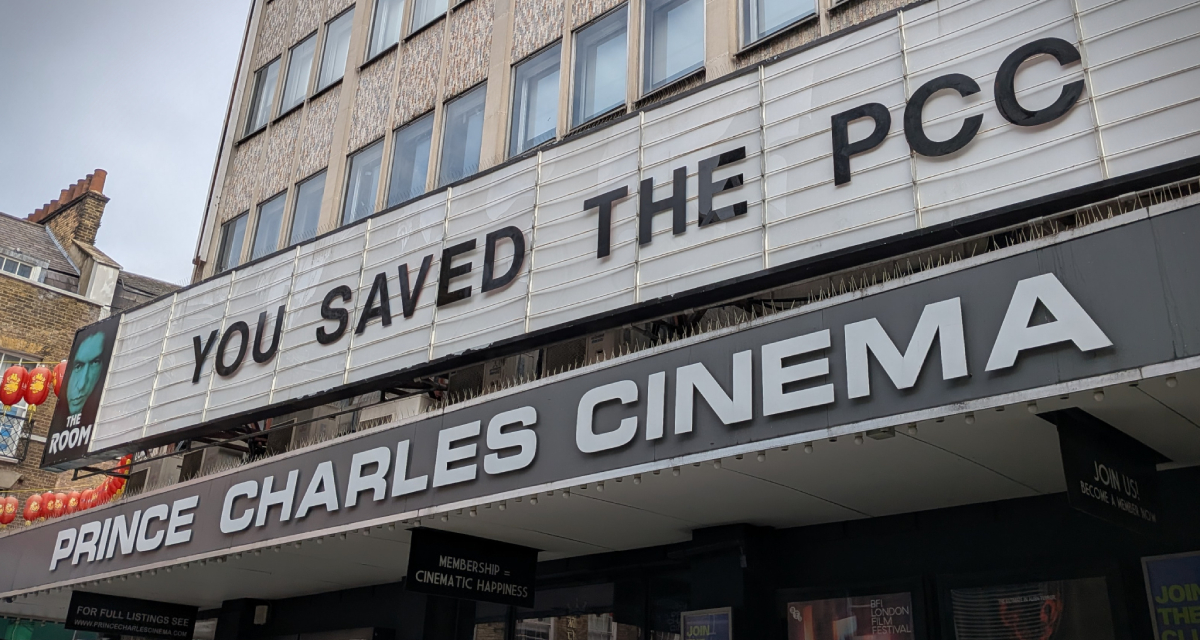
Co-owner Ben Freedman tells Celluloid Junkie about how he protected the beloved repertory cinema in a David versus Goliath clash, thanks to fan support and cultural and community capital.
This month has been a time for celebration at the Prince Charles Cinema, London’s prime spot for film fans wanting to seek out cult and obscure movies. After a 21-month battle, the cinema was finally able to secure a new lease. Posting on social media “You Saved the PCC”, the cinema thanked all those members of the public who signed a petition back in January 2025, reaching over 168,000 signatures. “I do think it caused the landlord to look at us in a different light,” remarks Canadian-British co-owner Ben Freedman. “I think it helped them understand that it just wasn’t any old place.”
Situated just off Leicester Square in the heart of the British capital, the space the PCC occupies was converted into a cinema in 1969 after being bought by the Star Cinema chain. At the time, it was known for showing softcore adult films – famously screening 1974’s “Emmanuelle” for three years straight. In 1991, when Freedman came in, the PCC was reborn, showing films shortly after their West End run and charging the princely sum of £1 a ticket. “That was the origin of the idea,” says Freedman. “The sensibility of the building always – we’ll show anything that fills the place as long as it’s legal, which is what we stick to today.”
A Favourite of Filmmakers
While London has recently been blessed with the arrival of new cult movie houses, like the Garden Cinema and The Nickel, the PCC remains a favourite for both the public and filmmakers. As Christopher Nolan told GQ recently, “Film culture in Great Britain is unthinkable without the Prince Charles.” Or, to quote Robert Eggers, the director of “The Lighthouse” and “Nosferatu”, “Where else can you see a Boetticher western, “Blade Runner”, Klimov’s “Come & See”, and “Muppet Treasure Island” on the big screen?”
Likewise “One Battle After Another” director Paul Thomas Anderson – whose films are regularly screened there on 35mm and 70mm prints – is a major fan, as is Quentin Tarantino, whose 1992 debut Reservoir Dogs coincided with the beginnings of the PCC as it’s known today and was screened there every week for a year. “It’s lovely to get the support of that calibre of person, but more important is the support of the people who buy tickets,” says Freedman. “And that is truly the test of whether you’ve got something that’s worth keeping. When you’re sitting there and the auditorium is full.”
It also helped that, in 2025, Westminster Council made the PCC an “asset of community value”. “I think that’s completely legitimate because I think we bring people into the West End,” says Freedman. “Just from an economic point of view, I think that’s very important. Also, I think we offer an outlet for films that otherwise wouldn’t get seen.” Indeed, as Freedman points out, on 31 August this year, the main screen showed extended editions of Peter Jackson’s “The Lord of the Rings” trilogy. And in screen two? Jacques Rivette’s rarely-screened near-13 hour experimental mystery “OUT 1’. “And they both sold out.”
Innovating the notion of singalong screenings of “The Sound of Music” and “The Rocky Horror Picture Show”, the PCC has always been a venue that encourages audience participation. None more so than frequent showings of Tommy Wiseau’s 2003 cult effort “The Room”. With Wiseau frequently in attendance, hardcore fans of what became dubbed “the “Citizen Kane” of bad movies” would dress up as characters and even chuck cutlery at the screen (if you know, you know). “I don’t think there’s many other cinemas that would accept the amount of plastic spoons that get thrown!” smiles Freedman.
Lease of Life
Yet nearly two years ago, this all threatened to come to a shuddering halt. “The building was owned by Soho Estates for about twenty years,” explains Freedman. “We had been to see Soho Estates a few years ago and talked to them about renewing the lease, and they seemed quite open to it. And then they suddenly – having never sold a building before, as far as I was aware – sold the building.” The new owners – and the PCC’s new landlord – was hotel brand Zedwell LSQ Ltd and their parent company Criterion Capital, founded by the billionaire property developer Asif Aziz.
“Out of the blue, I got an email from Mr. Aziz saying ‘I bought the building. Let’s have a chat.’ We had a conversation and I expressed a desire to renew the lease,” says Freedman. “They came back to us in January 2025, saying we’re happy to give you a new lease, but only for five years. Even though we’d asked for fifteen, and the law says we are entitled to fifteen.” The proposed rent was also “double what we originally had researched through a number of surveyors” even though, as Freedman points out, “cinema rents have dropped significantly since COVID”.
The real killer was that Aziz’s company was asking for a so-called break clause in the lease. “That would enable them to break any lease with six months’ notice, subject to having a proper or a reasonable planning permission to redevelop,” notes Freedman. “And that was really the first thing we had to address because any lease – no matter how long – if it has a six-month break clause, is a six-month lease. So that’s what we had to fight for, and that’s why we went public when we did in January of 2025.”
As encouraging as the wealth of public support was, Freedman and co-owner Gregory Lynn, who has run the day-to-day operations of the PCC since the early 2000s, were naturally concerned. “When you’re having an argument with a GBP £6bn (USD $8.1bn) company, money talks. You have to be realistic,” says Freedman, who notes that the legal campaign they mounted was entirely self-funded. “We put aside money to fight. We’ve always said we are a commercial business, and we are fiercely independent and don’t want to be dependent upon anybody.”
Initially, Freedman felt “we had no rights” in the situation, until he did his own due diligence, learning about the 1954 Landlord and Tenant Act, of which he previously knew little about. “And that slightly changed the balance of the dialogue.” As he explains, “the 1954 Landlord and Tenant Act gives a tenant the right to renew their lease at the going market rent for up to 15 years.” The only way an owner can either “take it back for their own use or redevelop the site” is if “they have to have planning or a very clear or high chance of getting planning permission in order to do that”.
At the time, Aziz’s recent purchase of the building meant he would be unable to do that. “You have to own the building for five years before you can take it back for your own use. And they didn’t seem to have any clear plans to redevelop the building when we first started to talk to them.” Subsequently, Zedwell has been able to implement plans for the four floors above the PCC, turning the space into a budget-friendly hotel, featuring 222 pod-style bedrooms, or “sleep capsules” for tourists.
A New Hope
Putting its own legal team in place, the PCC set about applying for a new lease, working through “various things one step at a time”. As is the way, it was a slow process. “The court sets down a series of set pieces in terms of agreeing as much of the lease as you can,” says Freedman, noting that – thankfully – they never got to the next stage: mediation. “In a way, in a situation like this, where the main sticking point is a six-month break clause, there’s nothing to mediate.”
As he notes, “We got to a crunch point where we were due to exchange our expert reports.” But then came a breakthrough, with a change in personnel at Criterion Capital. Vaqas Farooq – who had previously led the UK Real Estate Legal business at Deloitte – was installed as CEO. “We had a conversation with him,” says Freedman. “[It was the] first time we’ve been able to enter into discussions about resolving it rather than having to go to court,” says Freedman.
Whether or not Farooq had weighed up the costs of a legal battle is unclear. “We didn’t see his side of the equation,” says Freedman. “But I don’t think anyone ever particularly wins when you go through a legal process other than the lawyers. It was nice to have somebody to talk to, and it was a reasonable negotiation.” Removing the six-month break clause, Farooq’s team also offered to extend the lease from 15 to 25 years. “Having the extra ten years was, I think, the deal clincher from our point of view,” says Freedman.
It now means the PCC’s future is now secured for the foreseeable, and Freedman and his team can return to the business of running a landmark cinema. With an ongoing partnership with the London Film Festival – as one of several cinemas across the capital screening movies during the LFF – Freedman is also hatching plans for a sister cinema in Stratford, with an offer already in on an existing site. “It would be programmed in a very similar way. But because it has four screens rather than two, I think it gives us a much more leeway.”
In terms of an arthouse cinema battling a corporate giant, the PCC’s victory should strike joy into the hearts of every film fan. “The level of support was way beyond expectation,” admits Freedman. “It was not support from people who were just doing it for the sake of supporting it. So many of the people wrote about personal experiences at the cinema, and that’s really the true test, isn’t it? People who say, ‘I’ve been there many times’ and they keep coming back. Nothing is more honest than a customer who’s paying for a ticket.”
- How London’s Prince Charles Cinema won the battle to secure its lease - November 9, 2026
- Venice 2026: Defiant Documentaries, Female Filmmakers and a Scaled-Back Studio Offering - September 17, 2026
- How the Mediterrane Film Festival in Malta Is Putting the Island on the Map for Filmmakers - July 10, 2026