


There was a point, not all that long ago, when the movie theatre industry wasn’t wondering whether it had enough premium large format screens. It was wondering whether audiences would ever come back at all.
Five years removed from some of the darkest days the movie theatre business has experienced, the industry conversation has changed considerably. According to Cinema United’s newly released Fall 2026 Cinema Investment Report, North American exhibitors have spent USD $2.7 billion on capital improvements over the past two years, including USD $1.2 billion during the most recent year. The eight largest exhibitors accounted for USD $1.8 billion of the two-year total and USD $840 million during the past year.
The obvious takeaway is that exhibitors are investing in their theatres. They clearly are. The more interesting question is what kind of exhibition industry all that money is building.
More Than a Fresh Coat of Paint
Cinema United’s report also serves as a counterpoint to a stubborn narrative that movie theatres are somehow standing still while the rest of the entertainment business moves on around them. As a trade organization representing exhibitors, making the case for continued investment in moviegoing is part of its job.
The report is not a comprehensive audit of every cinema in North America, nor does it pretend to be. Cinema United itself says the document showcases “just a few” examples of the investments being made across the industry. Conducting a detailed survey of the physical condition and capital spending of every member company would likely require an entirely different research exercise… and presumably quite a bit more time and money.
There are certainly theatres across North America where it can appear the last meaningful capital improvement arrived sometime around 2002. Maybe even earlier. But that doesn’t negate the billions being spent elsewhere. If anything, it helps explain why continued investment matters.
More importantly, the money isn’t simply going toward replacing worn carpet and applying a fresh coat of paint.
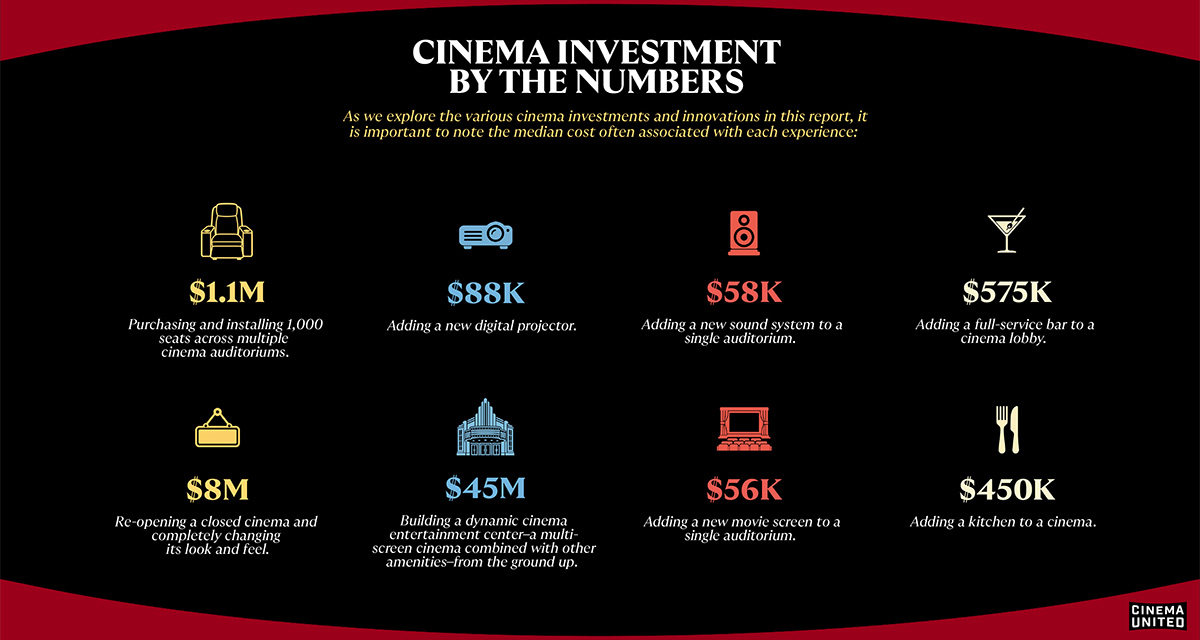
Cinema United estimates that installing a new digital projector in a single auditorium carries a median cost of USD $88,000. A new sound system runs about USD $58,000. Installing 1,000 seats across multiple auditoriums can cost roughly USD $1.1 million, while adding a kitchen costs around USD $450,000 and a full-service lobby bar about USD $575,000. Reopening and completely transforming a closed cinema can reach USD $8 million. Building a new cinema entertainment center from the ground up? About USD $45 million. (Just ask the folks at B&B Theatres.)
Suddenly USD $2.7 billion starts looking less like an abstract corporate expenditure and more like a very large collection of projectors, seats, screens, kitchens, bars, auditoriums and construction costs.
Follow the Money
Perhaps more revealing than the amount being spent is where exhibitors are choosing to spend it.
During the first half of 2026 alone, Cinemark added 21 premium large format auditoriums — seven XD, 12 ScreenX and two IMAX — along with 112 D-BOX motion-seat auditoriums. The circuit says 72% of its auditoriums now feature recliners, while 60% of its locations serve alcohol.
Arizona-based Harkins Theatres says it invested more than USD $30 million during the past year, adding 13 CINÉXL premium auditoriums and four CINÉBAR locations while continuing a major remodel of its Norterra location in Phoenix, including Arizona’s first Lumma 4D E-Motion auditorium.
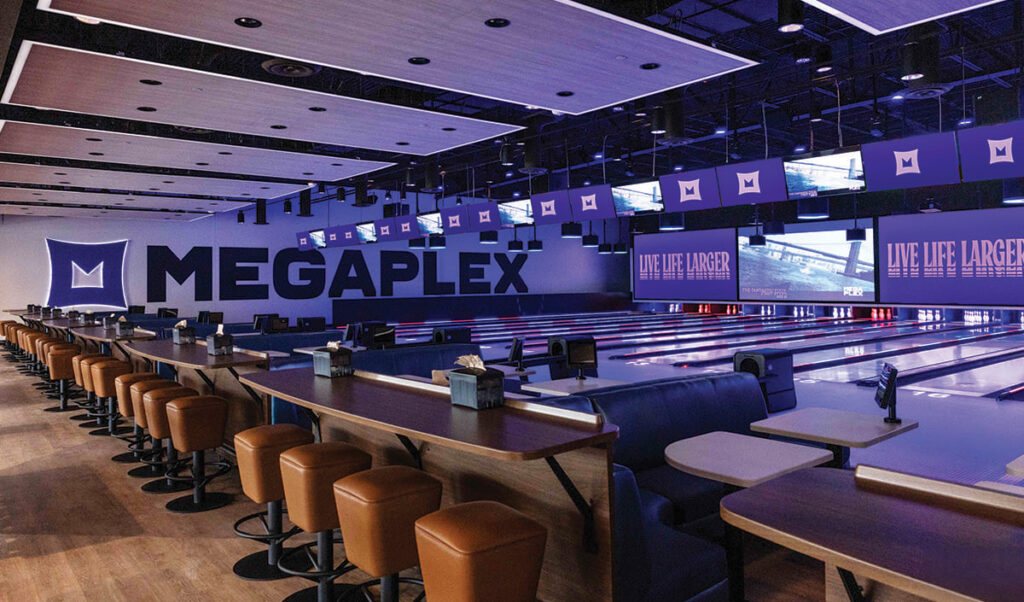
Epic Theatres renovated its Deltona, Florida flagship with recliners, expanded food and beverage, a bar, arcade and a Lumma 4D E-Motion system. Megaplex’s Downtown Daybreak location combines premium auditoriums with bowling, lane-side dining, games and private event space.
There are smaller-scale examples as well. CineLux renovated its Tennant Station location in Northern California with a reimagined lobby, digital marquee and luxury recliners across 11 auditoriums. Classic Cinemas, which remarkably seems to always be upgrading at least one of their locations, recently completed what it describes as a decade-long capital expenditure initiative across its circuit.
All this spending suggests that cinema operators increasingly see their competitive advantage not simply as having a movie on a big screen, but, as that hackneyed mandate goes, in providing an experience that is demonstrably different from watching that same movie at home. Yes, that means premium formats. Better projection and sound. Recliners. Improved food and beverage. Motion seating. Social spaces. In some cases, bowling, arcades and other entertainment options that turn the cinema into something closer to a broader entertainment destination.
In case anyone was wondering, this is the kind of investment studios love, and apparently they’d like more of it.
When Disney’s Head of Global Theatrical Distribution Andrew Cripps appeared at a June industry discussion marking the renovation of Regal’s Sherman Oaks Galleria in Los Angeles, the panel generally agreed that cinemas remain under-screened when it comes to premium large format auditoriums.
Cripps explained the distributor’s interest rather plainly: when a studio spends hundreds of millions of dollars producing and marketing a film, it wants those first moviegoers seeing it in the best possible environment. Those customers then become some of the film’s earliest advocates. “You want as many premium screens as possible,” he said.
The contrast with just a few years ago is hard to miss. In 2021, studios were still experimenting with shortened windows, day-and-date releases and, in some cases, sending films directly to streaming.
Now one of Hollywood’s largest distributors is saying there aren’t enough premium screens. For movie theatre owners, that is a considerably better problem to have.
About That USD $1.2 Billion
There is an interesting wrinkle in Cinema United’s numbers. If exhibitors spent USD $2.7 billion over two years and USD $1.2 billion during the most recent year, simple arithmetic puts spending during the preceding year at roughly USD $1.5 billion.
In other words, annual capital spending declined. Now, that sounds more ominous than it necessarily is. After all, capital spending is inherently… well, lumpy, for lack of a better word.
A circuit that spends several million dollars converting a theatre to laser projection, recliners and premium auditoriums in one year doesn’t need to spend those same millions upgrading the same location again twelve months later. The equipment is installed. The seats are there. The work has been done. Ideally, capital can move on to the next location or be used for other purposes.
Some of the equipment being displaced can move on as well. Projectors, servers and other cinema hardware don’t necessarily reach the end of their useful lives simply because one exhibitor has upgraded. Refurbished equipment can find a second life with smaller operators, meaning one cinema’s capital investment can sometimes put better technology within reach of another at a lower cost than buying new.
So while the decline from approximately USD $1.5 billion to USD $1.2 billion is worth noting, it would be difficult to draw much of a conclusion from that movement without knowing the timing of individual renovation programs. Annual expenditures can decline even while the number of upgraded cinemas continues to grow.
Nor is all of the spending coming from the largest chains. Roughly USD $900 million of the USD $2.7 billion spent over the two-year period came from exhibitors outside the eight largest circuits. During the latest year, that figure was approximately USD $360 million.
In an industry whose investment story can sometimes sound as though it begins and ends with AMC, Cinemark and Regal, that’s kind of refreshing to hear.
There is another way to appreciate the scale of the spending. Cinema United puts the 2025 North American box office at approximately USD $9 billion. On that basis, USD $1.2 billion in annual capital investment is equivalent to roughly 13% of an entire year’s theatrical box office.
That is not the same thing as saying exhibitors are spending 13% of their revenue, much less their profits. Theatre operators keep only a portion of ticket grosses and, naturally, generate substantial revenue from concessions, advertising and other sources. But the comparison is useful if you’re looking for a measure of scale.
Put another way, the industry has gone from a business that emerged from the pandemic wondering how much of its physical infrastructure it could afford to preserve to spending an amount equivalent to more than one-tenth of annual box office on improving that infrastructure.
The Job Isn’t Finished
None of this means every moviegoer walking into a cinema this weekend will encounter laser projection, a premium auditorium, a freshly renovated lobby and a bartender waiting to make them a martini (I take mine stirred, not shaken, no matter what James Bond says).
They won’t. The experience remains highly uneven, sometimes even within the same chain or market. Cinema United’s featured locations are illustrative examples, not a statistically representative sample of the average North American cinema.
The report also stretches beyond North America for some of its case studies, spotlighting investments by Major Cineplex in Thailand and HOYTS in Australia, even though the headline USD $2.7 billion capital expenditure figure applies specifically to North American exhibitors.
But that distinction doesn’t obscure what the report does demonstrate.
And those expenditures are beginning to reveal what exhibitors believe the future of moviegoing looks like: fewer generic auditoriums, more premium experiences; better projection and sound; more comfortable seating; broader food and beverage offerings; and, increasingly, venues designed to offer customers more than the movie itself.
The more interesting question is how quickly that investment can move through enough of the cinema estate that upgraded moviegoing stops feeling like something customers have to seek out and starts becoming what they simply expect when they go to the movies.

- Cinema Owners Have Invested $2.7 Billion in Theatres. What Is That Money Buying? - October 1, 2026
- The Paramount-Warner Merger Is Permanent. The Guardrails for Movie Theatres Are Not - September 22, 2026
- Cinemas Aren’t Just Marketing Movies Anymore. They’re Marketing Auditoriums - September 15, 2026