


At a time when traditional distribution remains under pressure, micro cinemas and independent exhibition spaces may be offering one of the most concrete answers to the question of how films can still find committed, physically present audiences.
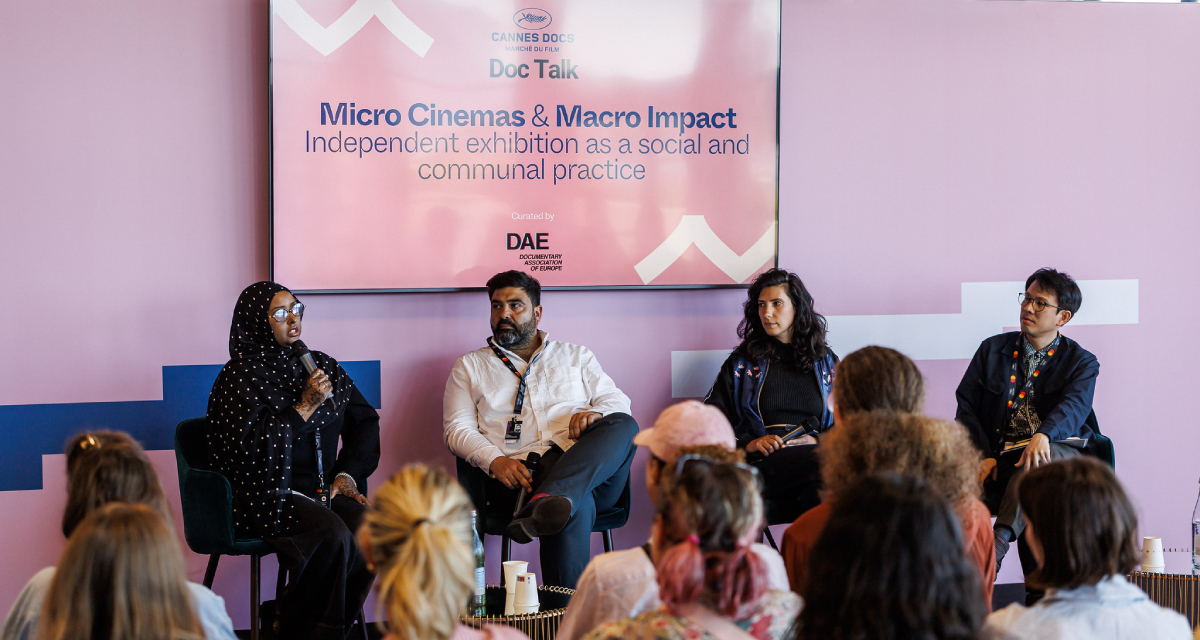
That was the central argument emerging from the Cannes Docs panel “Micro Cinemas and Macro Impact: Independent Exhibition as a Social and Communal Practice,” held on 16 May at The Viewpoint, Lérins, and curated by DAE – Documentary Association of Europe. Moderated by Jeremy Chua, producer at Potocol and executive director of the Singapore International Film Festival, the session brought together Ruun Nuur, documentary programmer at the Vancouver International Film Festival and co-founder of No Evil Eye Cinema; Kira Simon-Kennedy, film producer and volunteer member of Paris’ La Clef collective; and Can Sungu, artistic director of Berlin’s SİNEMA TRANSTOPIA.
Chua opened the discussion by asking how such spaces address audiences underserved by conventional distribution, in a context where the Marché du Film itself embodies a traditional structure of buying and selling films.
For Simon-Kennedy, the answer lies in programming films that audiences are unlikely to encounter elsewhere. Speaking from the perspective of La Clef, a collective-run Paris cinema, she said the group’s work was driven by frustration with what is typically shown. “One of the guiding editorial lines, if there is one in a giant collective, is movies that aren’t shown elsewhere,” she explained. The aim was not to repeat “the same dead white guys,” but to look around the world for films that open up other histories and political memories.
Simon-Kennedy linked this directly to France’s colonial legacy and to gaps in cultural education. She cited the importance of showing films connected to independence movements, noting that works such as “The Battle of Algiers” had long histories of censorship or limited visibility in France. In that sense, programming becomes a way of “rectifying what’s not taught,” and of pushing back against what she called a “failed canon.”
Sungu argued that independent exhibition spaces can also offer distributors and producers a more meaningful route to audiences than some conventional festival strategies. While acknowledging the continued importance of premieres, he said that a small festival screening in a city may not always reach the communities a film is actually speaking to. By contrast, SİNEMA TRANSTOPIA can sometimes screen a film three or four times, bringing it into contact with communities that are ready to engage with it.
“We are putting a lot of effort into finding the right communities, to bring the right film with the communities that they are really interested in,” he said. For Sungu, the value lies not only in attendance figures, but in the “discourse space” that opens around a screening, where audiences talk, argue, reflect and even dislike a film together. “I think this belongs to the cinema and this happens also in this physical space of cinema,” he added.
Nuur described how No Evil Eye Cinema’s own model emerged almost accidentally. When the collective first toured its programme “Sequence 01: Diasporic Reckoning”, it brought a new film and filmmaker to each town. “What we didn’t know at the time is we were creating a distribution model for this programme of short films that we would take all over the place,” she recalled.
Because No Evil Eye Cinema did not initially have access to sales agents or distributors, it used the networks it did have. Nuur, whose background is in film criticism, said the organisation made a point of inviting critics, editors, writers and festival programmers to screenings so that emerging filmmakers could receive coverage and visibility. The programme mixed first-time filmmakers with more established names, and this created a responsibility to support all of them beyond the single screening event.
Futureproofing Engagement
Looking ahead, Nuur said the collective is interested in working with a streaming platform that could host grouped programmes and pay filmmakers, expanding access beyond physical venues. She also described plans for masterclasses involving contemporary film workers, from cinematographers and directors to archivists and preservationists, as a way to connect audiences more deeply with artistic practice.
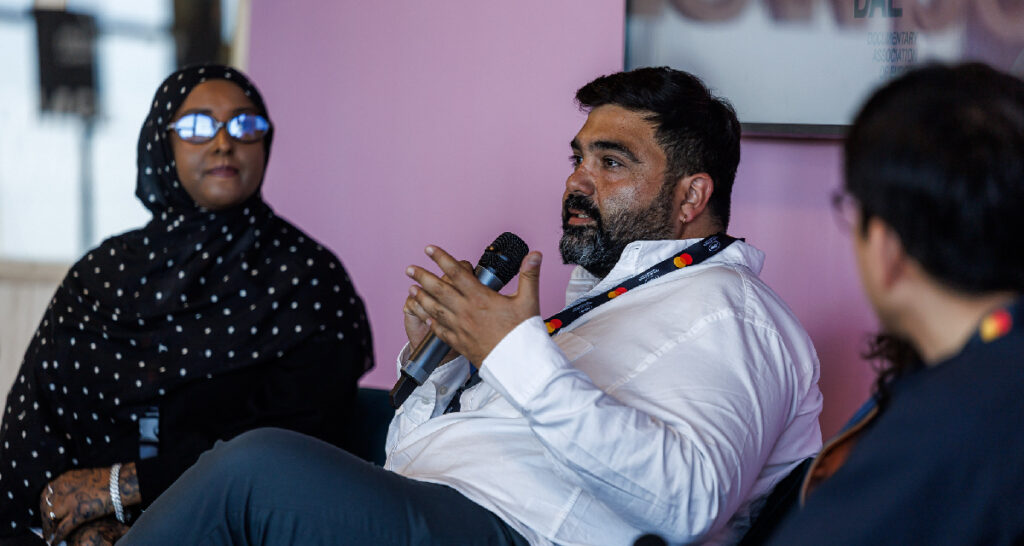
Sungu also pointed to SİNEMA TRANSTOPIA’s “Cinema of Harmony” project, launched in 2022, which brings together alternative cinema practices around the world, with a focus on the Global South while also involving European partners. The initiative shares films between micro cinemas, supports subtitling and allows works to circulate across different cities and linguistic contexts. He suggested that these models may eventually create new synergies with distributors.
The conversation became more urgent when an audience member raised the lack of cinemas in low-income neighbourhoods and communities of colour, particularly in New York. Simon-Kennedy responded by connecting cultural access to wider systems of inequality. “There’s an enormous lack of access,” she underscored. “There’s an overconcentration of resources, but not just cultural – like medical, educational – in the wealthiest, whitest neighbourhoods because of racism and segregation.”
Nuur made a similar comparison, saying the lack of cinemas in Black, brown and low-income neighbourhoods resembled the existence of food deserts. “Film, art, cultural centres are a source of nourishment in a way like food is,” she said. He pointed to grassroots initiatives such as Alfreda Cinema in New York and Cinespeak in Philadelphia as examples of organisations bringing films directly to communities rather than expecting audiences to travel to institutional spaces.
For Sungu, the key was trust. He expressed scepticism about top-down outreach policies aimed at BIPOC communities, arguing that meaningful audience-building can only work through organic relationships. “I don’t believe in these kind of outreach policies that some institutions are doing,” he said. “This can only function if the organic relation is basically functioning.”
The speakers also discussed practical tools: La Clef’s printed flyers distributed in local markets, No Evil Eye Cinema’s press outreach and partnerships with institutions connected to filmmakers, and SİNEMA TRANSTOPIA’s use of Q&As, conversations and even WhatsApp groups where communities organise outside mainstream social media platforms.
Across the session, micro cinemas emerged not as marginal alternatives, but as living infrastructures: spaces where distribution, access, criticism, community and care can be rebuilt from the ground up.
- Young Audiences Already Like Cinema. The Hard Part Is Giving Them a Reason to Go - August 31, 2026
- At Locarno, Restored Films Face Their Next Challenge: Finding an Audience - August 20, 2026
- Indie Film Marketing Can’t Wait Until the Film Is Finished - July 27, 2026