


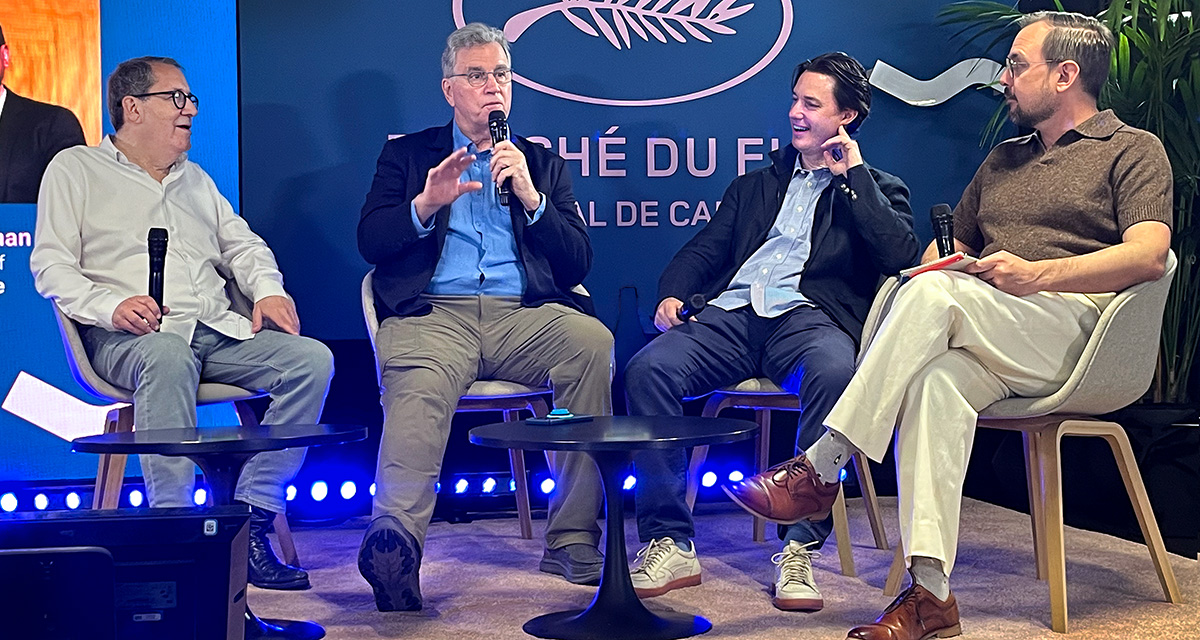
There are easier ways to make a living than selling independent and international cinema in 2026. There are safer businesses than theatrical distribution, quieter ones than acquisitions, and certainly more predictable ones than building a release strategy around festival discovery, Oscar momentum, repertory audiences, ancillary windows and the stubborn belief that some films still need to be seen in a room full of strangers.
Sony Pictures Classics has been doing it anyway for more than three decades.
The deal that best captured the early days of the 79th Cannes Film Festival’s Marché du Film wasn’t made by SPC. It was made across from them — in the abstract, at least — when A24 dropped a reported $17 million to acquire Jordan Firstman’s “Club Kid” after a bidding war that drew Netflix, Searchlight, Focus Features and Mubi before the price tag rocketed into eight figures.
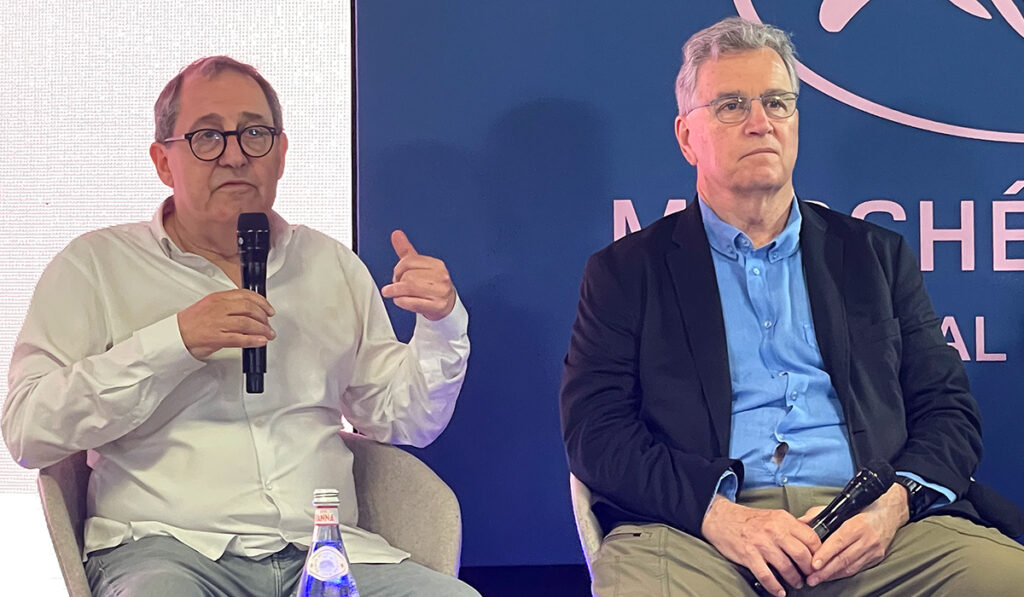
The news broke just as Sony Pictures Classics co-founders and co-presidents Michael Barker and Tom Bernard, along with Dylan Leiner, EVP of Acquisitions, Production and Business Affairs, took the stage at the Palais des Festivals for a Marché du Film panel titled “How Sony Pictures Classics Navigates the World of Indie and International Cinema,” moderated by Los Angeles Times editor Matt Brennan.
The timing was pointed. For exhibitors wondering which model of independent distribution is actually built to last — the headline-chasing eight-figure swing or the slow-burn, evergreen play — the SPC response was instructive.
“When we acquire a movie, whether anyone else has offers, we try to block it out,” said Barker. “We have trained ourselves to not let that noise bother us. What is it worth to us? What do we think it’s going to do?”
“You Never Lose Money on a Movie You Didn’t Buy”
The panel began, appropriately, with Cannes stories. Barker recalled 1984, when he and Bernard were at the festival with Orion Pictures and thought they were going to acquire Wim Wenders’ “Paris, Texas.” Then 20th Century Fox “swooped in for three times our offer,” Barker said, and the film was gone.
But over lunch with French producer Serge Silberman at the Carlton Hotel, they learned Silberman was preparing Akira Kurosawa’s “Ran.” “At that lunch we bought the film,” Barker said. “He literally wrote the deal on a napkin at the restaurant at the Carlton Hotel. So I think we turned out okay.”
Leiner’s own Cannes acquisition story was more physical. During a screening of “Son of Saul,” he stepped out, called Barker and Bernard, and told them this was the film they needed to pursue. The after-party was closed and the gatekeepers wouldn’t let him in, so Leiner found another route. “The only way I was going to be able to get in was through the beach,” he said. “I was in my tux, and I waded through the ocean.”
He met director László Nemes and the sales team. Later that night, SPC bought the movie. “Son of Saul” went on to win the Academy Award for Best Foreign Language Film.
These are not just good stories. They are the texture of an era in which Cannes was a smaller, stranger operation — and in which the deals that shaped international cinema were made by people who trusted their guts and worked the room. That instinct-first philosophy remains at the center of SPC’s methodology, now reinforced by Leiner’s financial modeling: scenario ranges on the low end and high end, followed by a disciplined decision about where SPC can make the numbers work.
Bernard put the guiding principle in terms Silberman himself might have appreciated: “He always said you never lose money on a movie you didn’t buy.”
That discipline may sound almost quaint in a marketplace where acquisitions increasingly double as brand announcements. But for exhibition, the SPC model carries a direct analog: programming discipline — knowing which films you can actually make work on your screens — is as valuable as chasing the next hot title. The specialty circuit’s healthiest operators have always known this.
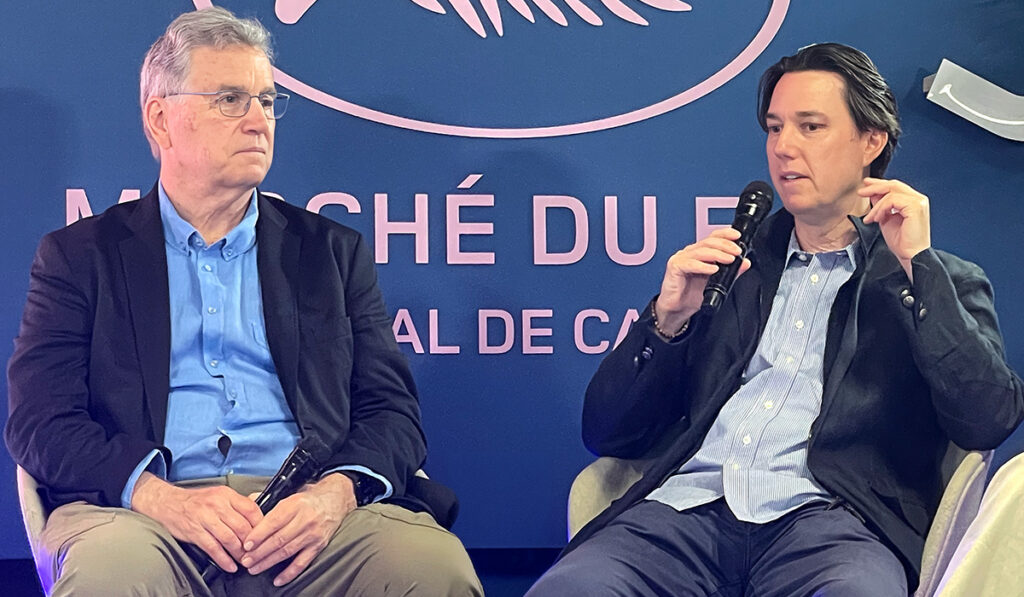
Sony Pictures Classics during the “How Sony Pictures Classics Navigates the World of Indie and International Cinema” panel on March 18, 2026 at the 2026 Marché du Film alongside the 79th edition of the Cannes Film Festival. (Photo: J. Sperling Reich – Celluloid Junkie)
The Festival as Intelligence Network
SPC acquired four films from this year’s Sundance and picked up South by Southwest premiere “Wishful Thinking” — five domestic festival acquisitions before Cannes opened. The trio’s account of how festivals actually drive those decisions is more pragmatic than romantic.
For Leiner, the value of in-person festivals crystallized at the first post-COVID Berlin International Film Festival. Several international distributors asked whether SPC had seen “The Teachers’ Lounge.” It wasn’t on their radar. They saw it quickly and acquired it; the film later earned an Oscar nomination for Best International Feature Film.
“Being at a festival and being in this fishbowl environment is really helpful,” Leiner said. “These films that we acquired at these domestic festivals recently — they were not planned. That’s what’s always amazing.”
The festival circuit, in other words, is not primarily a screening schedule. It is a distributed intelligence network — one that only functions when the right people are physically in the same room. For exhibitors making programming decisions months in advance, that same network helps determine which specialty titles arrive on their screens with genuine word-of-mouth velocity versus manufactured buzz. The difference often shows up in holdover performance.
Bernard described the festival ecosystem as one of fiercely guarded premiere politics and distinct personalities. Cannes carries the most weight, partly because of what Barker called the singular contribution of longtime selection chief Thierry Frémaux: “What he has done in the last 25 years has kept film relevant — for all of us and for the public.”
By the time the festival closed, Cristian Mungiu’s “Fjord” had taken the Palme d’Or and Andrey Zvyagintsev’s “Minotaur” the Grand Prix — further confirmation, if any were needed, that the director-driven international cinema SPC has championed for decades remains Cannes’ defining currency. Neon extended its remarkable Cannes winning streak, reinforcing exactly the competitive dynamic the panel had been interrogating all morning: which acquisitions represent genuine long-term value, and which are brand positioning?
“Nuremberg,” Timing and the Evergreen Principle
No film in the session illustrated the SPC model more concretely than “Nuremberg,” the James Vanderbilt-directed courtroom drama starring Russell Crowe and Rami Malek, acquired at last year’s Cannes and released theatrically in November 2025. The film grossed more than $56 million globally — exceptional by contemporary specialty-market standards — and has continued to perform in ancillary markets, including airlines, where SPC deliberately holds rights.
“Nobody else was really interested in the movie,” Leiner said. The challenge was convincing the team behind a $40 million production to trust an independent distributor.
“We felt we were auditioning, like to get married to somebody,” said Bernard. “We said, sell it to us. We think it’s going to be a great success — and we’ll make your movie way more valuable over the test of time.”
Part of that value came from an unscripted source. At a Museum of Modern Art screening before release, Barker watched the audience react to Michael Shannon’s speech about the fragility of constitutional law by whispering “Trump.”
“That movie was timely for what Americans were going through,” Barker said. “Whatever side they were on at that moment — very timely. And that helped that film.” SPC bought advertising on both Fox News and MSNBC.
The lesson is the one SPC has been demonstrating for 30 years: a film with genuine evergreen potential — “Run Lola Run,” “Call Me by Your Name,” “Living” — can generate revenue long after its theatrical run closes. That long tail changes how even a modest opening looks on the full balance sheet.
Bernard was direct about pay-one windows: “We look at pay one as part of the theatrical release, in a sense. We continue to promote with all the different aspects of whoever our partner is… to get people to see it at home.” In the post-COVID marketplace, he argued, that window has become “a more valuable revenue stream than it ever was” — a point exhibitors negotiating window lengths with distributors should weigh carefully.
“Blue Moon” and the Art of the Planned Nomination
“Blue Moon,” Richard Linklater’s one-night biographical drama following lyricist Lorenz Hart on the opening night of “Oklahoma!,” earned Ethan Hawke his first Best Actor Oscar nomination at the 98th Academy Awards alongside a Best Original Screenplay nod for writer Robert Kaplow. For Barker, the nomination was not a surprise. It was a planned outcome.
“We sat down with Rick Linklater in 2024 and we said we’d like to make this movie,” Barker recalled. “Our confidence was that movie is going to be nominated for Best Actor and Best Screenplay. The screenplay was spectacular, and it was so obvious — we had to do that for Ethan. Twenty years earlier, we had ‘Capote’ with Philip Seymour Hoffman. This was a similar kind of spectacular performance.”
The airline strategy was deliberate. SPC placed “Blue Moon” on cross-country flights during the Oscar voting window.
Barker said, “I firmly believe the airline orchestrating it is what helped cause Ethan Hawke to get nominated — because we were all on all these planes and they were all watching ‘Blue Moon.'” Bernard called it “an old-school tactic” deployed with precision in the streaming age.
The implication for exhibitors is concrete: Oscar nominations remain one of the few mechanisms that can return a specialized title to screens multiple times — at announcement, through the ceremony, and after a win.
“That is more valuable than it’s ever been,” Bernard said, “because you can’t get onto that stage without being in that conversation with movies that the theater owners decide they should play.” At the end of the voting period, chains play all nominated films for a full week. That guaranteed screen time has to be earned upstream, through exactly the kind of long-range campaign architecture SPC described.
The Weekday Audience and the Repertory Rebound
The session’s most forward-looking thread concerned theatrical exhibition — and whether the signals Barker and Bernard are reading amount to a genuine structural shift or another false dawn.
At CinemaCon, SPC drew more exhibitor attendance at its specialized night presentation than perhaps ever before, a reflection of what Bernard described as a real change: commercial multiplexes beginning to program specialty content in earnest.
Barker flagged a metric with direct booking implications: “The Monday through Thursday gross on a specialized film could be as high as the weekend gross — never happened before.” Younger audiences, he argued, prefer to attend arthouse titles on weekdays. AMC has responded with senior Tuesday discounts. The weekday specialized audience is no longer a rounding error, and exhibitors who haven’t adjusted their midweek programming strategy accordingly may be leaving money on the table.
Then there is the repertory renaissance. “There’s a new generation that’s learning about cinema the way it happened back in the late ’60s and ’70s,” said Bernard. AMC has offered SPC 170 of its largest screens for a week-long “Crouching Tiger, Hidden Dragon” run. SPC is reissuing “Trainspotting” in June on 400 commercial screens and planning a similar outing for “The Piano.”
“It’s not just the older crowd,” Barker said. “It’s younger people that want to see this on a big screen with great sound.”
“Becoming Led Zeppelin” offered the proof of concept. When SPC acquired the documentary, some wondered what the company was doing taking on a rock legacy film. Bernard helped engineer an IMAX strategy that Barker said “blew people’s mind,” and the release became, in Barker’s words, “one of the most successful independent films of the last decade” — establishing a template that SPC then replicated for its Elvis Presley documentary.
“It has rejuvenated the documentary form,” Leiner said. “The key is to eventize these movies — the smallest one to the biggest one. Now is the time when distributors can be more creative than they’ve ever been.”
Bernard offered exhibitors a pointed challenge alongside the optimism: make moviegoing more fun, and find better ways to tell audiences what is playing before their friends have to tell them for you. The infrastructure for discovery still lags behind the appetite.
The Neon Question
An audience question — from Andrew Frank of Mongrel Media — cut directly to the competitive landscape: Is it sustainable for Neon to acquire every major Palme d’Or contender at Cannes year after year?
Bernard reached for history. “I’d say you should asked the people who used to be at Miramax — that doesn’t exist anymore.”
Barker passed entirely. “As long as we’ve been in the business, there’s always been someone saying they’re gonna buy everything on the Croisette. Good luck.”
Leiner offered the more analytically useful frame. A24’s ability to pay $17 million for “Club Kid” was underwritten, in part, by the fact that its international sales arm had already received territory offers before the final deal was closed.
“They’re basically plugging into an existing deal, which is hugely valuable to a US distributor,” Leiner said. “There’s already a sense of how much they can lay off.”
The headline number, in other words, may not tell the whole story — a reminder that acquisition economics in 2026 are increasingly opaque to outside observers.
SPC does not buy for headlines or to establish a floor. It buys films it thinks it can make work: on airlines, in repertory houses, across Oscar campaigns, in territories that open wide once domestic momentum builds — and on screens where the work of getting the audience there has already begun long before opening weekend.
Sony Pictures Classics is not pretending the business has not changed. Barker, Bernard and Leiner spoke like executives who understand that every revenue stream matters, every window must be managed, and every audience must be found. But they also made clear that survival in specialty distribution still begins with taste — not nostalgia, not romanticism, and not the fear of losing a bidding war.
The “Club Kid” deal will generate more column inches in the next month than “Nuremberg” did in six. The question for the film industry is which one is still in rotation in 2030.
That, more than any bidding-war headline, is the Sony Pictures Classics business model.

- Cinema Owners Have Invested $2.7 Billion in Theatres. What Is That Money Buying? - October 1, 2026
- The Paramount-Warner Merger Is Permanent. The Guardrails for Movie Theatres Are Not - September 22, 2026
- Cinemas Aren’t Just Marketing Movies Anymore. They’re Marketing Auditoriums - September 15, 2026