


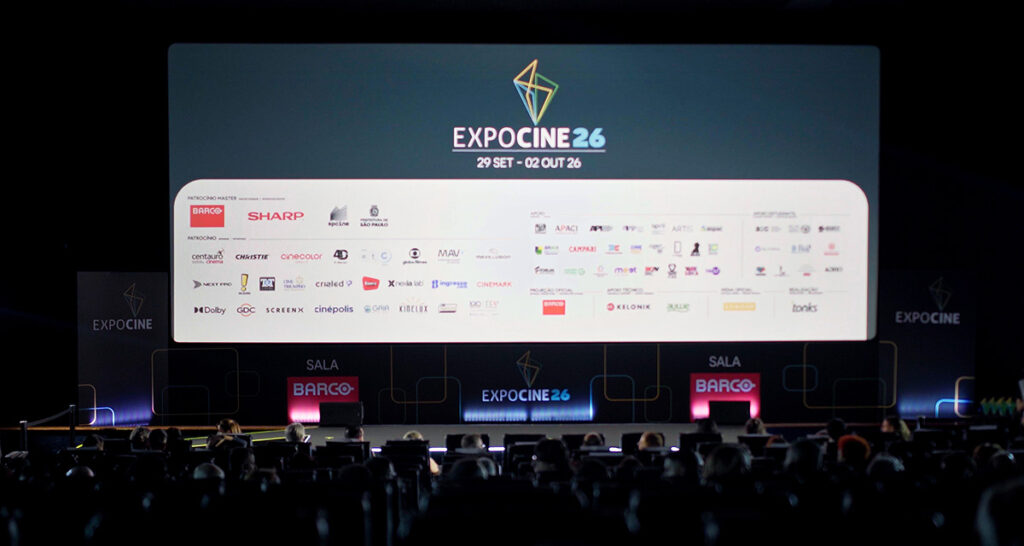
Over 3 days, around 3,000 people visited Espaço Center 3 de Eventos and Cine Marquise to check out the program covering relevant topics for the audiovisual market.
Expocine, the largest Latin American convention for the film and audiovisual industry, concluded its 13th edition last Friday, October 2nd, with around 3,000 registered participants, breaking the record set by the previous edition. Over the three days of activities split between Espaço de Eventos Center 3 and Cine Marquise in São Paulo, the event featured 16 panels, five masterclasses, and 13 presentations by film distributors, delivering a total of 45 hours of high-quality content for credentialed attendees. Participants were also impacted by more than 150 brands showcased at the trade show. Meanwhile, the 4th edition of Decupa, a program aimed at students and professionals in training, gathered more than 250 registrants. This year, Decupa was sponsored by Cinemark Brasil and organized in partnership with Paris Entretenimento, centering its scene-by-scene analysis on the film “Minha Vida com Shurastey.”
The final day of Expocine featured the panel Creative Territories — Actions that Empower Audiovisual in the Periphery. The presentation discussed how peripheral areas can become increasingly powerful drivers for Brazilian audiovisuals, as they are essential spaces for creation, audience development, and sector renewal.
To speak on this topic, Leandro Pardí, Superintendent of Innovation and Creative Businesses at Spcine, shared the initiatives developed to train, include, professionalize, and accelerate talent and companies from the margins. Pardí detailed several ongoing projects, such as “Aprender Brincando,” “Documentário Seu Bairro,” “Formação com Vida,” “Amplificacine” (from Cineclube), “Sampa Games,” “Hub de Games,” and “Circuito Spcine,” among others.
“The film club we want is built on the community experience—the experience of discussing a film, of reflecting on a local, or rather, a social issue through cinema. Therefore, these agents receive training for a year, once a week, entirely focused on the exhibition market, while hosting screenings—at least one monthly screening in each space,” he explained regarding the Cineclube project.
The second and final panel of the day, How Far Data Helps: AI, Data, and the Limits of What Technology Solves in Cinema, aimed to address artificial intelligence with a focus on public state policies and through the lens of consulting that assists and collaborates in this process with data analysis, offering support for both production and market analysis. Moderated by Priscila Beltrame from CQS/FV Advogados, the panel also presented the exhibitor’s perspective on practical application, leveraging artificial intelligence as a technological tool that is accessible to the entire community.
Lyara Oliveira, professor and public policy specialist, who is also a former president of Spcine, commented on the importance of properly reading data and how artificial intelligence contributes to good results. “The use of data is proving to be increasingly promising. We can access a vast amount of information, but we must also understand how to analyze that information, which is extremely important. Perhaps just as important as having information is knowing how to analyze it, because often those of us who work with broad audiences and the sector as a whole have access to data and information but cannot truly interpret it. In this sense, I see artificial intelligence stepping in to help us not only with data collection, but also with processing and interpreting that data,” she explained.
Erika Alvarez from YouTube spoke about audience growth driven by artificial intelligence. “Artificial intelligence comes into play by expanding audiences beyond geographic borders and language barriers. Today, we already see many YouTube channels reaching global audiences. Many content creators are gaining a better understanding of their audience and the potential of that reach. They are delivering significant watch time across multiple countries—hours watched outside Brazil—thanks to automatic AI dubbing.”
Aline Zambrini from Tomun addressed the application of data tools and analysis during the decision-making process for a film. “Whenever a producer, distributor, or screenwriter has a question, we are able to support them with information for decision-making. Data serves to guide decisions; at the end of the day, data alone won’t act—it informs an action. Today, we are also working extensively with distributors, and it is fascinating to see the different types of analyses we continue to perform. In distribution, the film is usually already finished, so we look more specifically at the film market—what people are saying about films, festival history, and so forth—which helps shape the film’s communication campaign.”
Also on the schedule was the training workshop Theatrical Release: How a Film Release Works in Movie Theaters, hosted by Vitrine Lab (Vitrine Filmes) and led by Elaine Vegnaduzzi, Programming Manager at Vitrine Filmes.
Meanwhile, the Barco room at Cine Marquise, which hosted the distributor line-up presentations, screened two films on Friday: Cobrador de Fraque (Gullane/Pandora) and Godzilla Minus One (Sato Company), the surprise film of this edition.
Guided by three pillars—educational, strategic, and market—EXPOCINE 2026 centered its main theme on “Open Screen: Cinema That Moves On Its Own,” placing screen convergence at the core of the discussion, where movie theaters, streaming platforms, and new distribution windows coexist within the same ecosystem.
This year, Expocine took place across two locations on Avenida Paulista: Espaço Center 3 de Eventos (hosting the trade fair, technical workshops, and strategic panels) and Cine Marquise at Conjunto Nacional (which hosted training workshops and distributor lineup presentations).
About Expocine
Established as the largest cinema business gathering in Latin America and the second largest in the world, Expocine continues on a path of steady growth. In its 2025 edition alone, the event brought together over 2,300 credentialed attendees and saw an impressive surge in its business sector, growing from 24 exhibiting brands in 2023 to more than 60. Featuring over 55 hours of content and attended by exhibitors, distributors, producers, and industry executives, the convention solidifies its role as the venue where the Latin American industry decides its next steps. In line with its structural and content expansion, Expocine 2026 reinforces its commitment to inclusion and plurality. In partnership with MAV, the event ensured enhanced accessibility for people with disabilities or reduced mobility. Additionally, presentations featured simultaneous translation into Spanish and English.
About Tonks – Producer of Expocine
Founded in 2006 by Marcelo J. L. Lima, Grupo Tonks started as a technology and digital solutions consultancy for the country’s major exhibition chains. Aiming to expand its portfolio and increase its market presence, the company founded Revista Exibidor, keeping the industry updated with news; Expocine, the annual face-to-face gathering for cinema professionals; and, recently, Cine Marquise, an award-winning venue offering versatile programming for cinema fans with two locations—one in the heart of São Paulo and the other in Poços de Caldas.