


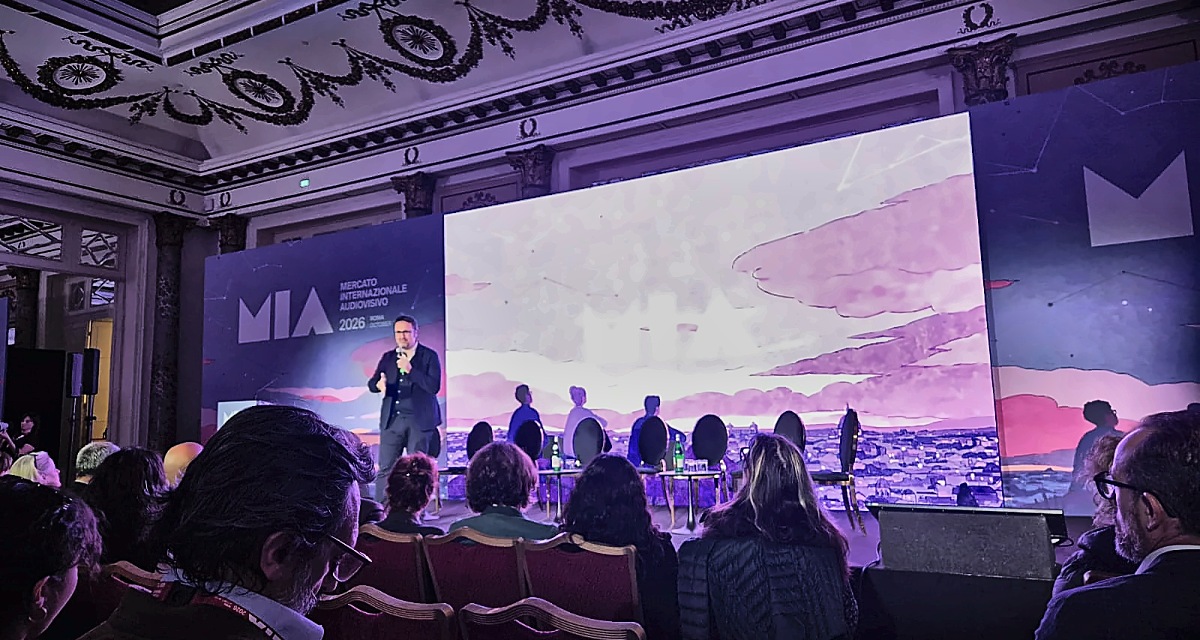
At MIA, the “Back to the Future: It’s All About the Story” panel looked at engaging audiences across all kinds of screens, and how cinemas and digital distributors need to work together to tackle the ever-present threat of piracy.
At Rome’s audiovisual market MIA (Mercato Internazionale Audiovisivo), the “Back to the Future: It’s All About the Story” panel examined how films reach audiences and retain their value across cinemas, television and digital platforms. For Italian exhibitors, that discussion had an immediate commercial relevance: the cinema audience has returned to its pre-pandemic size, but moviegoers are attending less frequently.
Ergo Research’s Sala e Salotto study for ANICA, presented at the market on 22 October 2026, the day before the panel, illustrated that gap. Comparing two 18-month periods (January 2018-June 2019 and January 2025-June 2026) the study found that the number of moviegoers aged three and above was almost unchanged, at 29.5 million and 29.6 million respectively. Yet admissions fell from 134 million to 109 million, a decline of approximately 19%, with average visits per moviegoer dropping from 4.5 to 3.7.
“Assessing the success of films, individually or collectively, Italian or foreign, solely by reporting box office figures is completely misleading,” ANICA President Alessandro Usai warned while mentioning the research during his opening remarks.
The study estimated average consumption at 91 films a year across all viewing methods, or roughly one every four days. Film viewing remains a regular activity even when cinema attendance is occasional. For exhibitors, then, the challenge is to earn a larger place within that routine.
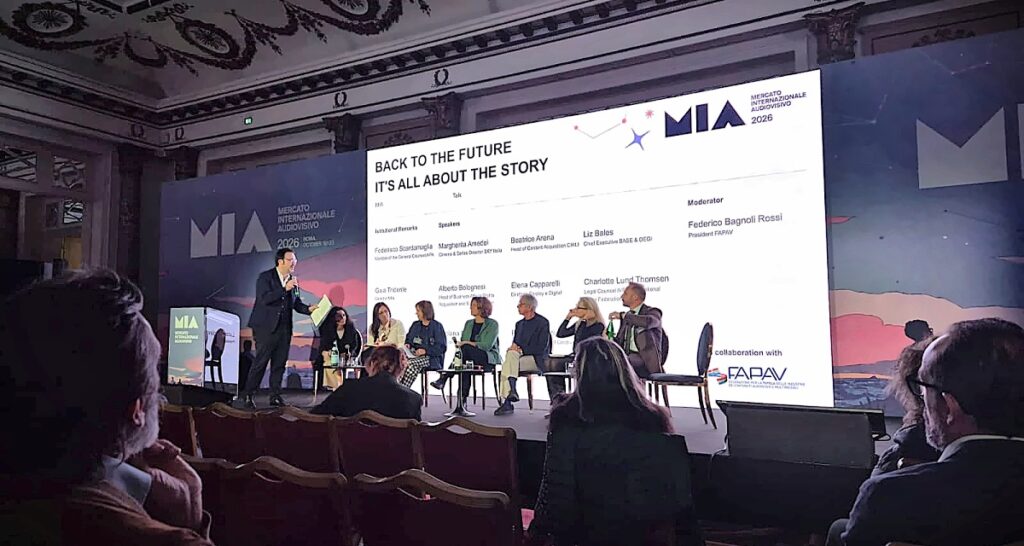
The subsequent panel discussion examined the relationship between cinemas, broadcasters, streaming platforms and home entertainment. Moderated by FAPAV President Federico Bagnoli Rossi, the conversation connected protecting film revenues with reaching audiences and helping them find legitimate ways to watch.
Charlotte Lund Thomsen, legal counsel at the International Video Federation, described co-operation as central to her organization’s policy work. “When we work in Brussels, it’s really across the community of all creators, producers, exhibitors, distributors and, of course, home entertainment.” That last sector, she argued, contributes both to financing production and to recovering investment.
Liz Bales, chief executive of BASE and the Digital Entertainment Group International, emphasized the economic links between theatrical exhibition, home entertainment and subscription services. “Each one of those elements has to thrive, it has to deliver a return on investment in order for the economics of the industry to work.” For cinema operators, the issue is how that shared dependence translates into cooperation supporting a theatrical release. Revenue generated later in a film’s life matters, but each participant still needs a viable business at its own stage of the release cycle.
Helping Audiences Find Films
Lund Thomsen put audiences at the center of that relationship. “It’s all about the audience but it’s also all about the story. In the end it’s about what we create, what we produce, what we distribute.”
Elena Capparelli, director of RaiPlay and Digital, focused on the difficulty of choosing from an offering so abundant it can be overwhelming. Editorial selection, recommendations and accessible services can guide viewers through new releases, older films and restored works. Availability is only the starting point for discovery.
Margherita Amedei, Cinema & Series Director at Sky Italia, linked access with the desire to watch. Strong stories should encourage theatrical visits and sustain their appeal through subsequent windows. Aggregation helps viewers locate titles across services, while editorial programming can give available films renewed relevance.
For cinemas, this raises a question of continuity: how can interest in a film survive its first release, later availability and possible return to the big screen? Curating a title and explaining why it merits an audience’s time are responsibilities shared across screens, even when the viewing experiences differ.
The talk also raised the topic of paid piracy, in which illegal providers sell access to content. That complicates an account of piracy based solely on unwillingness to pay. Convenience and the packaging of legal offers become relevant competitive questions, although the discussion did not establish their influence on individual choices.
Cooperation With a Commercial Purpose
Bales pointed to Mega Movie Week as an example of coordinated commercial activity. Organized by DEGI with Univideo, its second Italian edition ran October 12–18, bringing together 14 distributors and six retail platforms: the Apple TV app, CHILI, Mediaset Infinity, Prime Video, Rakuten TV and TIMVISION. The promotion offered discounted digital purchases and rentals.
“It is about connecting audiences with transactional content,” Bales explained. The scope for joint activity, she suggested, extends further: “So we in home entertainment are used to collaborating, and increasingly we are looking to collaborate across the industry, with exhibitors.”
Beatrice Arena, CHILI’s head of content acquisition, brought the discussion back to price and value. Her contribution stressed communicating what consumers receive, serving price-sensitive viewers and maintaining viable platform economics. She also highlighted the practical work involved in making catalog films available and discoverable.
For exhibition, the campaign demonstrates co-operation in promoting legal viewing. It offers no evidence that digital promotions increase cinema visits. Collaboration involving theaters would need to address release timing, costs, theatrical exclusivity and how the benefits are shared.
Protecting the Longer Life of a Film
Alberto Bolognesi, Mediaset’s head of business affairs, rights acquisition and sales, placed content protection within the valuation of rights. Alongside territory, platform and exclusivity, businesses should consider their ability to protect a work throughout its commercial life. Protection before release also makes this a question for release planning.
A movie’s commercial life can extend for years, requiring protection across successive services. The discussion highlighted the cost of effective measures and the difficulty of justifying the same investment for smaller titles as for major releases. A longer commercial lifespan offers more opportunities to recover investment, while extending the period over which that protection must be funded.
“One of the biggest challenges is piracy. It is the same in many, many territories. Piracy is very much driven by technology,” Bales underscored.
In the ANICA research, piracy represented an estimated 15% of film-viewing acts across viewing methods. Based on respondents’ recalled consumption, the figure measures viewing behavior; it does not calculate lost revenue or displaced cinema admissions.
Later, Bales argued for sustained work combining enforcement, regulation, attractive commercial propositions and consumer awareness. “Sadly, it can never be put in the box to say that’s done, let’s do something else.”
Next, Luciana Migliavacca, president of Univideo, approached longevity through continued availability. At the panel, she discussed the complementary roles of physical editions and digital distribution, alongside recovering and restoring works that have become difficult to find.
Her statement for Mega Movie Week’s launch on October 12 expressed that connection between formats: “What brings them together is the public’s enduring connection with cinema, which remains strong even as viewing habits evolve.” For programmers, renewed availability creates possibilities for repertory screenings and rereleases. The task is to give audiences a reason to see a familiar film in a theater, through the presentation, context or occasion surrounding it.
The commercial test for exhibitors is whether cooperation makes a theatrical booking more attractive and a repeat visit more likely, while preserving release economics. With audience reach recovering more strongly than attendance frequency, the opportunity is to turn an enduring interest in films into another trip to the cinema. And another after that. And another…

- Cinema audiences are as big as ever. So how do you increase frequency? - November 10, 2026
- China’s Animation Boom Has a Hidden Cost - November 6, 2026
- Did TIFF’s First Market Deliver for Buyers? The Answer Is Yes, With Caveats - October 8, 2026