


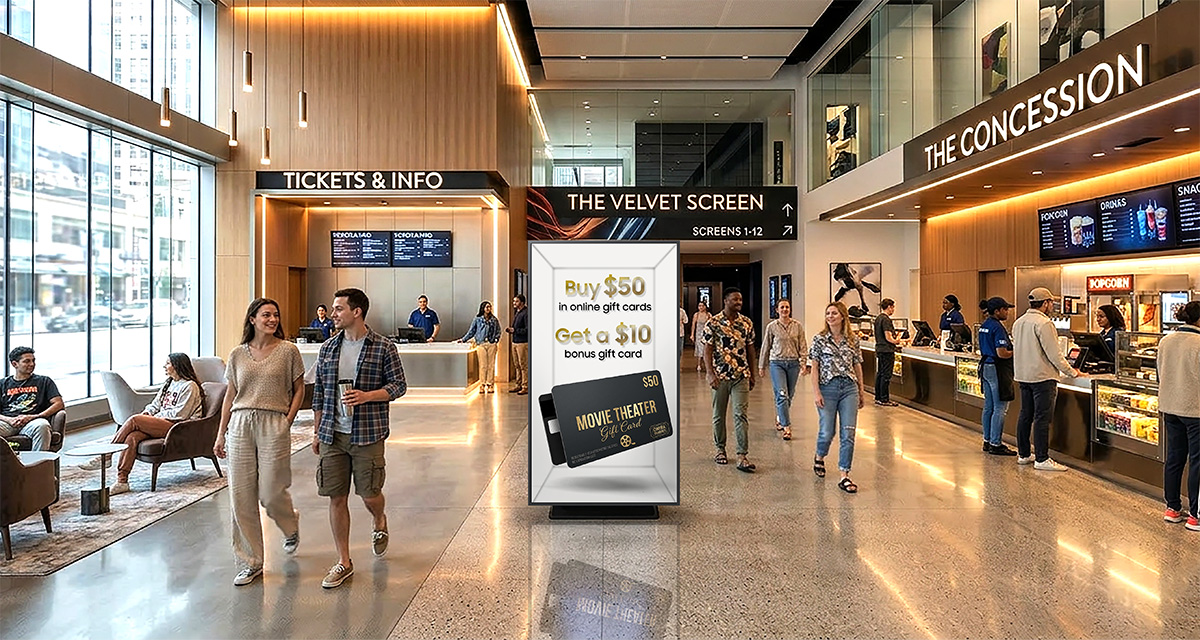
Samsung is bringing glasses-free 3D display technology to the cinema lobby — and betting that immersive visuals could help exhibitors make the case for a more compelling night out.
Walk past the right display at CinemaCon this April, and something might make you stop cold. It won’t be a trailer, or a touchscreen kiosk, or even an unusually well-designed paper poster. It’ll be an 85-inch screen mounted flush to a wall — two inches deep — showing content that appears to float in three-dimensional space, without glasses, without a headset, and without so much as an awkward lean to catch the effect.
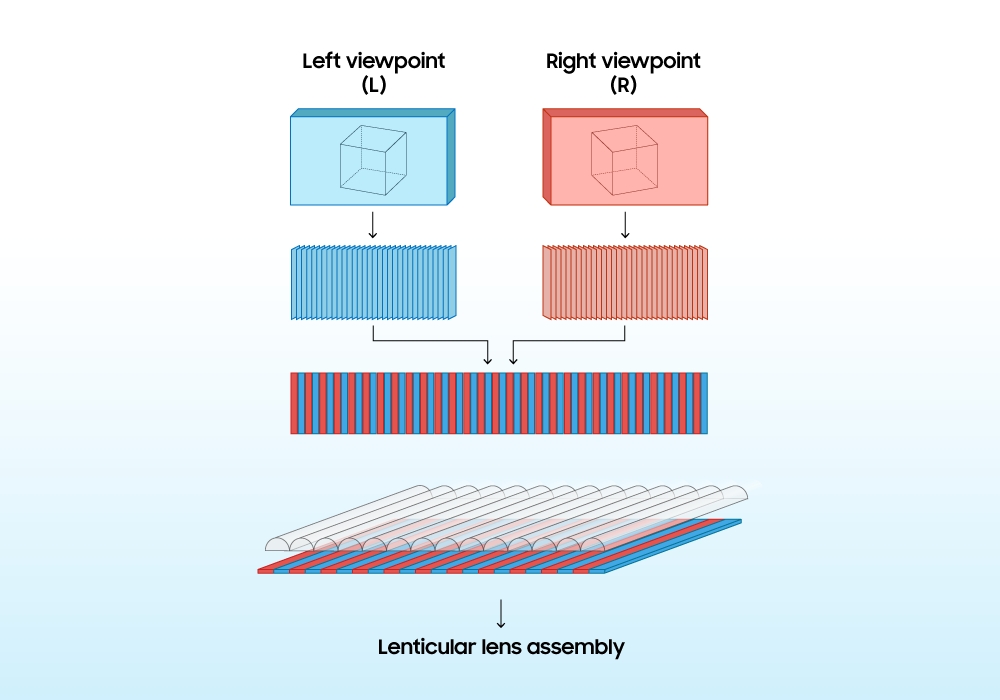
That’s the pitch Samsung is making with Spatial Signage, a new product in the company’s commercial display portfolio that the manufacturer officially launched in February and is bringing to CinemaCon for its first major exhibition industry showcase. The SMHX series — currently available as the SM85HX, an 85-inch portrait-orientation display — uses what Samsung calls a patented 3D Plate, which applies lenticular lens technology to create the impression of depth and dimension in standard content without any special viewing equipment.
“Think of the movie poster, but in a three-dimensional form,” said Christopher Simpson, Samsung’s Senior Business Development Manager – Cinema LED. “And then there’s the ability to have interactive where somebody could be standing in front of it, and there’s a camera embedded in the display, and they’re interacting with that piece of content, and they might have a takeaway piece for themselves that they can then use on social media. That in itself kind of becomes free advertising for the studio.”
From the Baseball Card to the Lobby Wall
The underlying technology behind the new display is older than it might appear. Lenticular printing, the process of layering an image with tiny cylindrical lenses to create the illusion of motion or depth, has been used in novelty products for decades. Samsung has effectively miniaturized and digitized the concept, embedding a lenticular layer into its 3D Plate and combining it with AI-driven processing to enhance depth and motion in real time.
Simpson offered a straightforward analogy: those baseball cards from the early 2000s — the ones that shifted slightly when you tilted them — created depth the same way. The difference now is that the technology has been scaled to an 85-inch commercial display, thinned to a 2-inch profile, and made capable of rendering full-motion video content.
“The real differentiator compared to the other technologies that were out there prior is the depth of the display,” Simpson explained. “Those were very, very deep, maybe three to four feet in depth, and looked mostly like a giant box with somebody standing inside of it. This has shrunk all that down to only a two-inch size. So you can mount it onto a wall instead of just having it on the floor.”
That last point matters more than it might seem. For most cinema lobbies, floor square footage is premium real estate; concessions, ticketing kiosks, merchandise, and foot traffic all compete for the same finite space. A display that mounts flush to the wall like a standard flatscreen, rather than requiring a dedicated footprint and structural rigging, changes the calculus of where and how a technology like this could realistically be deployed.

The Lobby Problem
Samsung is entering a cinema market that’s increasingly focused on the question of what happens before and after the movie. Post-pandemic, exhibitors have invested heavily in the auditorium experience — laser projection, premium large format screens, upgraded seating — but the lobby has remained comparatively static. Paper posters still hang in many theatres. Flat digital signage displays cycle through the same promotional loops they always have. The lobby experience, for most moviegoers, is something to pass through, not linger in.
That calculus is increasingly under scrutiny. The global digital signage market was estimated at roughly $28.8 billion in 2024, with projections pointing toward $45.9 billion by 2030, and much of that growth is being driven by a push to make displays more immersive and more interactive in high-traffic public venues. In the U.S., digital out-of-home (DOOH) advertising hit a record-high third quarter in 2025, with DOOH accounting for roughly a third of total out-of-home (OOH) revenue and growing at 11.6% year over year.
Simpson sees cinema lobbies as a natural extension of that trend, and one that has remained underpenetrated. “When we think about how the theatre environment has changed post pandemic, it’s more important to get more people to go to the theatre than ever before” he said. “Not only are exhibitors thinking about how to make a premium experience for the auditorium, but how do they improve the overall entertainment value when you come into the theatre? And the studios seem to be embracing that as well.”
The core argument for dwell time is blunt but familiar to anyone in exhibition: the longer an audience lingers in the lobby, the more money they spend. Exhibitors have long wrestled with the audience member who arrives 15 minutes late to skip the pre-show and leaves the moment credits roll. A lobby compelling enough to keep people engaged early — or prompt them to arrive early to experience it — becomes, in effect, a revenue driver.
“Their worst case scenario is somebody coming into the movie theatre 15 minutes late, seeing the movie, and leaving,” Simpson noted. “What they want is for people to hang out longer, spend more time, so they’ll buy things.”
Who Makes the Content — and Who Pays for It?
The perennial challenge with lobby technology isn’t the hardware. It’s the content, and it’s the money.
Samsung’s answer to the content problem — historically where technologies like this stall — is a two-track approach. For exhibitors and studios with resources, the display supports custom 3D content created through third-party production pipelines — provided creators adhere to Samsung’s technical specifications for the format. For everyone else, Samsung has built AI Studio into its VXT cloud content management platform: upload an image, write a prompt, and the system converts it into a 3D-optimized video asset ready for the display.
“For somebody, maybe a smaller theatre chain that doesn’t have the resources or budget of a bigger one, they can still take the assets they have and turn them into a really effective experience with Spatial,” said Esther Kim, Samsung’s Head of Integrated Marketing for the Display Division.
That flexibility matters, because the economics of content production have historically been a sticking point. Studios spend enormous sums on physical lobby materials — even the standalone cardboard cutouts represent a non-trivial line item — but are rarely enthusiastic about absorbing costs for new display formats they don’t own. Exhibitors, for their part, tend to expect studios to fund the visibility. The result is a negotiation that has played out, in various forms, over every major lobby technology of the past two decades.
Samsung is clear-eyed about the fact that those conversations are just beginning. “We believe the potential is there, but it’s too soon to tell,” Simpson said, when asked whether exhibitors might be able to charge studios for placement on Spatial Signage displays.
The more immediate revenue hypothesis centers on advertising. As lobby ad networks — think NCM, Screenvision, and the programmatic DOOH ecosystem — continue to expand within theatres, a 3D display capable of running dynamic, glasses-free ads could command a meaningful premium over standard flat signage.
“If it’s a premium placement, a premium execution, advertisers are willing to pay more,” said Kim. “Our hypothesis currently is that, yes, if we can help build a premium advertising experience, then yes, advertisers should be willing to pay a premium for that.”
The display supports programmatic advertising out of the box; units are geotagged upon installation, which allows them to be entered into programmatic exchanges that pull demographic and traffic data based on location. A Coca-Cola or Mars Snacking campaign running on a 3D display in a cinema lobby would draw from the same DOOH infrastructure already in use for outdoor and transit advertising, just moved inside.
Built to Scale
Historically, eye-catching lobby technology has struggled to get past the pilot phase. The list of products that generates genuine excitement at trade shows and then quietly disappears from theatre lobbies is a long one. Samsung, aware of this history, is aiming to make adoption easier.
“Spatial Signage was designed with scalability in mind,” Simpson said. “Rather than functioning as a standalone solution, it integrates into existing digital signage ecosystems through centralized content and device management with Samsung’s VXT platform. Exhibitors can manage these displays alongside their current network without introducing new workflows.”
Operationally, the installation requirements are minimal; power and a network connection. The display works with Samsung’s VXT software for remote monitoring and content management, but it also integrates with third-party cinema-focused CMS platforms and digital signage networks already in use at many exhibitors. It doesn’t require a new support relationship: Samsung sells through channel partners, and service support routes operate through those same partners. VXT also includes remote monitoring capabilities, so issues can be diagnosed and often resolved without a site visit.
A smaller 32-inch version of the display is expected later this year, which would open up additional use cases — countertop retail fixtures, concession stands, smaller lobby configurations — beyond the flagship 85-inch wall unit. Whether larger sizes are in development remains unclear, though is surely dependent on uptake of the current displays.
For CinemaCon, Samsung will be running two Spatial Signage units in its suite; one positioned in the corridor outside the entrance to stop foot traffic, and a second inside the suite itself aimed at something more interactive, content permitting. The company is also bringing its latest Onyx Cinema LED configuration, which will occupy a separate room in Samsung’s CinemaCon trade show suite.
The Bigger Picture
Skeptics will note, reasonably, that no cinema deployments have been announced yet, and that the product is in early discussions with studios and partners rather than rollout. That would likely be true of any product that is a few months old, and Samsung acknowledges as much.
But the argument Kim makes for it is less about novelty than about what exhibitors need to be in the business of delivering. “Every technology investment must deliver a clear business return, especially as cinemas seek new ways to differentiate and attract audiences,” she said. “By introducing dynamic 3D visuals into high-traffic areas, Spatial Signage extends storytelling beyond the auditorium and engages guests from the moment they enter the theatre. Stronger engagement has a direct impact on revenue, where capturing attention at key decision points, such as ticketing and concessions, can influence purchasing behavior.”
The theatrical exhibition industry has spent the better part of a decade making the case that the cinema experience is something television cannot replicate. That argument has mostly been made in the auditorium. Samsung is, in effect, proposing that it needs to start in the lobby.
Whether exhibitors are ready to make that investment, particularly smaller circuits and independents who don’t have the same capital headroom as the major chains, remains an open question. Simpson suggested that revenue-share advertising models could eventually make the technology accessible to operators who can’t absorb an upfront hardware cost. But the business model is still being developed, and the content ecosystem around it is still being built.
What Samsung has done is solve the physical problem that has held this category back: a glasses-free, 3D display that doesn’t require a room of its own. Whether the industry can solve the business case is the question that comes next.

- The Paramount-Warner Merger Is Permanent. The Guardrails for Movie Theatres Are Not - September 22, 2026
- Cinemas Aren’t Just Marketing Movies Anymore. They’re Marketing Auditoriums - September 15, 2026
- The Cinema Concession Stand Is Becoming a Marketplace - September 11, 2026