


The question of whether social media buzz can actually drive potential audiences to cinemas is as pertinent as ever. As the first reactions for “The Odyssey” break, we reflect on panels that explored this topic at the European Film Market earlier this year…
The news that Christopher Nolan’s upcoming epic “The Odyssey” would not hold “word of mouth” screenings for influencers was further fuel for the fire of a discussion that has raged in recent years. Is this marketing tactic – where commonly these more favourable, less critical reactions from influencers break on social media before the formal review embargo lifts – actually increasing awareness of these films, or is it devaluing the work of critics, whose more considered takes only get airtime after the breathless first wave of reactions.
The first reactions to “The Odyssey” flooded online after the global premiere took place in London on Monday, July 6. While there were some influencers and content creators in the mix – those who’d been invited to the premiere and/or seen advance screenings ahead of junket interviews – there were notably more mainstream critics and writers sharing first-look reactions, including Variety’s Jazz Tangcay, who called the film “a triumphant, spectacular epic” and the Guardian’s Peter Bradshaw (“a colossal origin-myth story of postwar disillusion”). When the film hits cinemas next week, the discourse around the necessity of influencer screenings will surely continue.
It’s a subject that was a central talking point at the 2026 European Film Market (EFM, 12-18 February), which took place earlier this year. Across various panels, conversations about social media marketing were notably less about “going viral” as a goal in itself, and more about whether online attention can be translated into something the industry can bank on, such as ticket sales, streaming subscriptions and durable audience habits. Across panels that ranged from TikTok’s #FilmTok showcase to a broader marketing strategy session on attention scarcity, one tension kept resurfacing: platforms can generate extraordinary cultural heat, but the path from community to cash remains uneven, difficult to measure and – too often – oversold.
That split was clearest on 13 February, when the EFM hosted “From Community to Box Office: How Fandom on TikTok Drives Impact,” an afternoon event framed around the platform’s growing role in shaping film discovery and consumption. TikTok’s Stephen Naughton positioned the platform as an entertainment destination rather than a traditional social network — “You don’t check TikTok; you watch TikTok,” he said — arguing that this mindset matters because users arrive primed to be entertained, not merely updated. He added that the company’s research suggests three-quarters of TikTok’s audience come to the app specifically to find new entertainment, and described the platform as a “24-7 virtual stage” where studios, creators and fans can meet on equal footing.
Naughton’s pitch leaned heavily on the idea that fandom on TikTok is participatory by nature: users do not just watch trailers but remix, analyse and reframe content, helping titles travel across borders in ways that can’t be replicated through classic top-down advertising. He sought to reinforce that narrative with headline figures: in 2025, an average of 6.5 million posts per day related to film and TV appeared on the platform; and, crucially, TikTok has been working with market-research company Media Control to track correlations between virality and theatrical performance. The topline result, according to Naughton: “15 of the 20 most successful theatrical releases in 2025 across Europe were TikTok viral hits,” defined as titles generating over one million related posts.
From Content to Connection
It was a confident argument — but it also underscored the central problem with social media “impact” claims: correlation and causation are easy to blur, especially when the biggest releases are already structurally advantaged through awareness, spend and broad availability. If a title is already set up to dominate the theatrical conversation, it will almost inevitably dominate the TikTok conversation too. The more interesting question is what happens beneath the top tier: can fandom meaningfully lift mid-budget and independent films into wider visibility, and can that lift be reliably engineered rather than hoped for?
TikTok’s preferred answer is “yes — if you treat creators as partners rather than megaphones.” Naughton argued that creator-led content can achieve up to 91% more engagement than traditional advertising assets, and pointed to the company’s work with Constantin Film, where collaborations across more than 15 releases generated over one billion video views. He also highlighted TikTok Spotlight, an aggregation tool that collects official and user-generated content into a central hub, suggesting that structuring fan activity — rather than merely observing it — can help campaigns sustain momentum.
Still, even within TikTok’s own framing, the emphasis was less on replacing conventional marketing than on rethinking what marketing is: less campaign-as-broadcast, more campaign-as-community management. Search behavior became part of that story. Naughton noted that one in five users searches for content within 30 seconds of opening the app, with film-related queries growing by more than 100% year-over-year — an indicator, he suggested, that audiences increasingly treat TikTok as a discovery engine for both theatrical and streaming titles, with real implications for how release campaigns are timed and structured.
Community Spirit
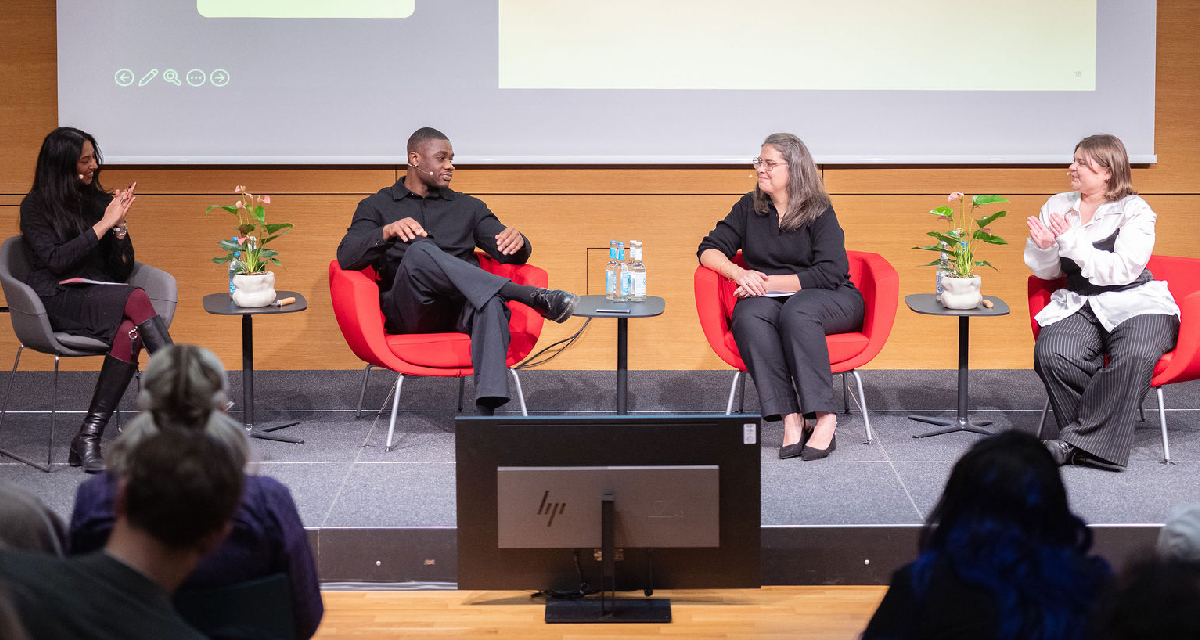
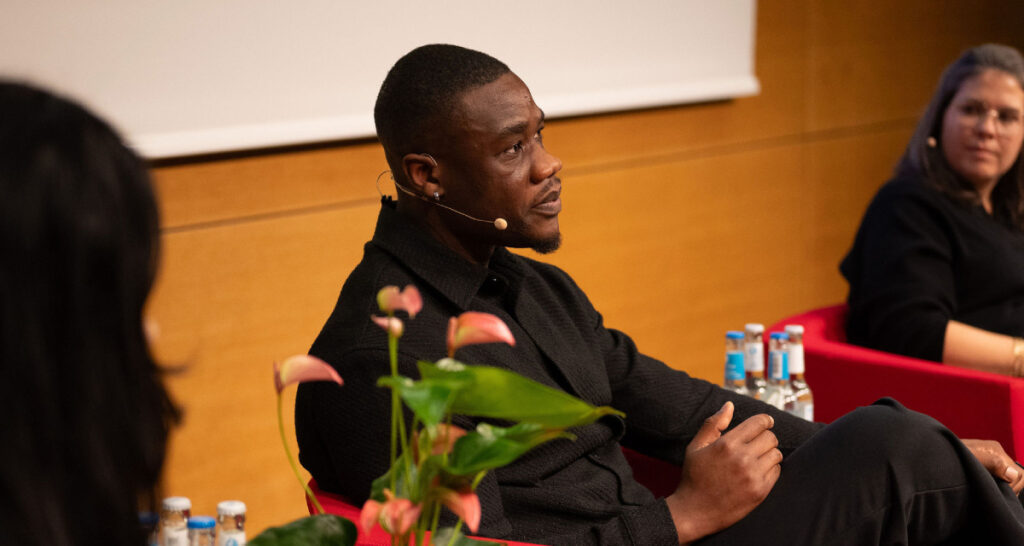
The panel discussion that followed broadened the conversation beyond theatricals into streamer-first dynamics, using Prime Video’s “Maxton Hall” as a case study of a #BookTok phenomenon turned screen hit. Moderated by journalist and presenter Aylin Kazi, the panel brought together Prime Video EU Head of Social Jacky Meire, TikTok creator Melo Nsuka and actress Runa Greiner. If Naughton’s presentation was an attempt to “prove” impact with numbers, the discussion that followed focused on what impact looks like in practice: community engagement as an “extra layer” of storytelling, where fans dissect scenes, debate character arcs and generate an ongoing sense of participation.
The subtext here matters for anyone marketing both theatrical and streaming titles: viewing is no longer a closed experience. Audiences often move straight from watching to TikTok, effectively recreating a shared, communal space around content — sometimes approximating the social energy of theatrical attendance, but with platform-native behaviors, such as commenting, streaming and (doom)scrolling. The talk also returned repeatedly to the idea of creators as trust brokers: recommendations from familiar voices often carry more weight than classic advertising, while behind-the-scenes access and transparency are presented as essential tools for maintaining momentum.
Yet the Maxton Hall example also highlighted a structural asymmetry: streamer launches are already “built” for rapid online conversation, with audiences able to watch immediately once curiosity is triggered. Theatrical releases, by contrast, require friction-heavy conversion: checking listings, choosing a showtime, travelling, paying. Social media can generate intent; cinemas still require action.
That friction came roaring back into focus on 19 February, at another EFM panel titled “Marketing That Works: Turning Change Into a New Advantage,” which approached the same broad subject from a more skeptical, conversion-first angle. Moderated by AC Coppens, the session featured Marina Kosten, USC Annenberg Center for the Digital Future; Adriana Trautman, marketing strategist with experience at Paramount and Prime Video; and Oliver Fegan, co-founder and CEO of usheru, a marketing technology company supporting distributors across 30 countries. Where the TikTok session argued that fandom can drive measurable impact, this panel repeatedly asked: measurable how, and at what rate?
Under the Influence
Kosten framed the current environment as a brutal attention economy — “Content is everywhere, and attention is increasingly a zero-sum game,” she said — arguing that marketers often have mere seconds to communicate not just what a film is, but where and when to see it. “If people remember the where and the when, they are much more likely to convert,” she added, stressing that basic clarity is frequently overlooked even as campaigns chase novelty.
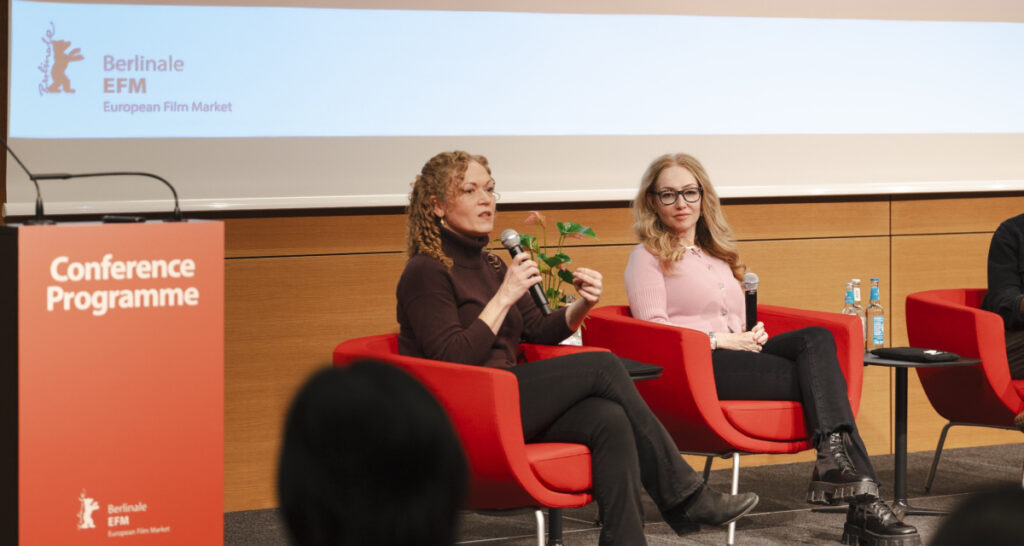
Trautman offered a blunt corrective to influencer-era wishful thinking: “Just because you cast an influencer, it does not mean their audience will convert,” she said — and rightly so. In other words, social reach is not the same as audience action — especially when the “influencer” relationship to the title is thin, transactional or obviously paid. In a market that sometimes treats social as a magic shortcut, her point landed as a necessary deflation.
Fegan then provided the kind of statistic that complicates almost any platform-led narrative of conversion: TikTok-driven traffic, he said, converted at just 0.1% when moving from platform to ticket purchase. That figure doesn’t mean TikTok is “ineffective” — it may still be powerful at awareness, discovery and cultural signaling — but it does force a tougher reading of what social media is doing at each stage of the funnel. If the jump from scroll to sale is that small, then campaigns live or die on what happens next: retargeting, repetition, and a cross-platform system that keeps nudging the interested-but-not-yet-committed audience until the friction is overcome.
In that sense, the most actionable ideas in the “Marketing That Works” session were not about chasing virality, but about engineering follow-through. Fegan stressed retargeting as essential — those who show interest but don’t purchase must be approached multiple times, often via automated but personalized messaging. The panel also turned to first-party data, arguing that direct relationships with audiences — through tools like usheru, cinema websites, email lists and smaller communities (including Discord) — are increasingly valuable in a landscape where platform metrics can be opaque and platform algorithms can shift overnight.
The panel’s European-vs-US contrast also sharpened the conversation. In the US, mass marketing remains dominant, supported by budgets that are simply out of reach for most European distributors. Fegan noted, “In Europe, distributors might spend EUR €3,000 (USD $3,425 to market a film in France,” and argued that such constraints force European campaigns to be smarter: niche targeting, community-building and direct audience relationships rather than scale-led saturation.
There was also a recurring emphasis on habit-building. Trautman and Kosten both argued that younger audiences will still go to cinemas, but often for events that feel communal — fandom experiences that resemble concerts or social gatherings. Trautman put it plainly: “They aren’t going for cinema itself; they’re going for connection with peers and shared fandoms.” In that framing, the real competition is not other films but other forms of connection — and the strategic goal becomes making theatrical attendance feel like participation rather than consumption.
Under the Influence
So what were the key takeaways from EFM 2026 overall, on social media marketing for films? Conversations and analysis were more measured than the usual hype cycles, but some contradictions persist.
On one side, TikTok’s case is persuasive in cultural terms: it is undeniably a major arena where audiences discover, discuss and reshape film and TV narratives, and where communities can form quickly around titles, talent and moments. Naughton’s insistence that fandom is “participatory, personal and perpetual” captures something real about contemporary audience behavior, especially when conversation can outlive opening weekend.
This is a point that was emphasised by more recent FilmTok research, released in April 2026. It bears noting that the research was conducted by TikTok and Cinema United, with support from Comscore. The findings proudly claim that TikTok conversation can lead to box office staying power, beyond the opening weekend buzz. Looking at four varied (albeit high-profile) examples — “The Housemaid”, “Sinners”, “Wicked: For Good”, and “Zootopia 2” — the report studies the correlation between increased TikTok activity tied a title, and strong box office holds. Of course, correlation isn’t causation, and buzzy box office hits could be seen to be driving the conversation on social media, rather than interpreting the relationship to be working in the opposite direction, but there were also positive findings relating to increases in #FilmTok and #MovieTok posts (up 55% year on year), and TikTok surveys indicating that 47% of users polled said they’d discovered new films via the platform, and 36% said they’d purchased a ticket as a result. Is short-form social media video the new watercooler?
“This report reinforces what we know to be true: that moviegoing is a cultural experience that resonates deeply with audiences,” said Michael O’Leary, President and CEO of Cinema United. “The data shows that when films connect with communities on TikTok, people come to theatres. That is good for our members, good for Main Streets around the world, and good for the movie industry.” It’s also worth noting that — even if it can’t be said for certain that TikTok is driving users to theaters — TikTok data could be another valuable tool for exhibitors making programming decisions, by indicating which film are still dominating cultural conversations.
On the other side, the more sobering data points from the “Marketing That Works” panel underline that conversion remains the industry’s weak link — and that social media is not a substitute for fundamentals. Availability, clear messaging (“where and when”), repeat exposure, and infrastructure for retargeting and direct audience contact still do much of the heavy lifting.
That’s why some of the most interesting EFM conversations were the ones that implicitly challenged the idea of social media as a silo. Even panels not explicitly “about” social platforms — such as Europa Distribution’s session on co-operation across the film value chain — kept circling back to a marketing reality: audience work cannot be detached from production, sales, exhibition and long-term release planning. The strongest campaigns increasingly start early, build shared objectives across partners and keep communication tight — because, as Spanish distributor Eduardo Escudero put it, “In our market, we only get one shot.” In a world of compressed windows and overstretched attention, that single shot at getting audiences in seats early on in the theatrical run has to be aligned across every link in the chain.
The biggest question, then, is not whether fandom can move audiences — clearly, sometimes it can — but whether the industry is building repeatable systems around that ability. The “Minecraft initiative” type of thinking — meeting audiences inside the spaces where they already play, create and socialise — can sound visionary, and it may well work for certain IP-driven titles and youth-skewing brands. But EFM’s more grounded voices would likely insist on two tests before celebrating any such initiative: show the conversion path, and show the cost per conversion compared to alternatives. Without that, innovation risks becoming experimentation.
Finally, there is the issue of credibility. Social marketing thrives on authenticity; film marketing often defaults to polish. The gap between those two aesthetics is where a lot of campaigns fail. The EFM panels repeatedly hinted at the same underlying principle: the most effective social strategies treat audiences as collaborators rather than targets — and treat creators not as add-ons, but as culturally fluent partners who can translate a film into platform-native language. A film like “The Odyssey,” with the built in appeal of Christopher Nolan – a rare crossover filmmaker as beloved by critics and cinephiles as mainstream audiences – might be big enough to be able to skip influencer screenings. But like many Nolan success stories, it could yet prove to be an exception rather than a rule.
- Young Audiences Already Like Cinema. The Hard Part Is Giving Them a Reason to Go - August 31, 2026
- At Locarno, Restored Films Face Their Next Challenge: Finding an Audience - August 20, 2026
- Indie Film Marketing Can’t Wait Until the Film Is Finished - July 27, 2026