


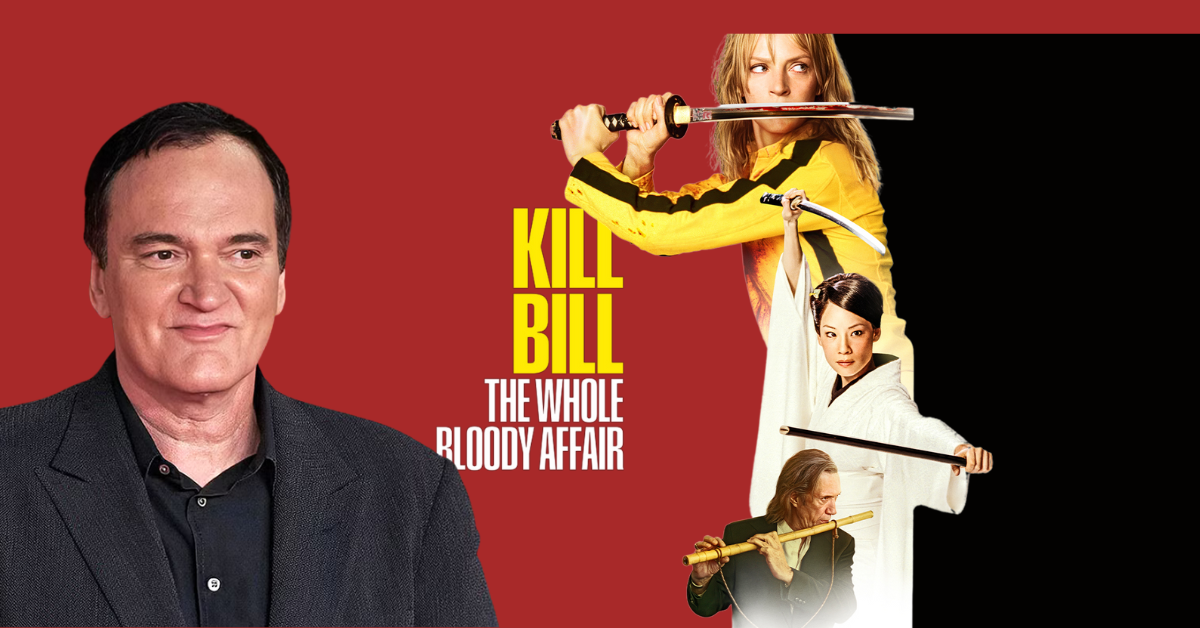
What fans of Quentin Tarantino’s “Kill Bill: Vol I” (2003) and “Vol. II” (2004) know but many others may not, is that the two films weren’t supposed to be separate entities; the original vision for the blood-spattered revenge saga was intended to be a single release. And now, after a 20+ year wait and a long journey, the fan-fueled project has finally reached the silver screen and audiences can see “Kill Bill: The Whole Bloody Affair,” uncut and unrated. But how did we get here and why did it take so long?
The Original “Kill Bill” Concept
Tarantino and Thurman first conceived the film’s main character of The Bride together while shooting “Pulp Fiction” (1994). Tarantino then moved on to adapt Elmore Leonard’s novel, “Rum Punch,” which became his next film, “Jackie Brown” (1997). Turning his attention back to authoring an original screenplay about The Bride, he checked in with Thurman regularly – now a new mother herself – using her new-found maternal instincts as the emotional foundation of the story.
Tarantino wrote the story of a former assassin left for dead on her wedding day, who awakens from a coma years later determined to avenge the attack and discover the truth about her unborn child.
With the story fully developed, Thurman joined the project to play The Bride, while the supporting cast was rounded out by Daryl Hannah, Lucy Liu, Vivica A. Fox, Michael Madsen and David Carradine as the film’s namesake (Warren Beatty was famously courted for the role originally but declined it). Production was delayed when Thurman became pregnant with her second child, however re-casting the role was out of the question for Tarantino.
Once filming commenced in June 2002, it wasn’t until “Kill Bill” entered the editing phase that the producers suggested that Tarantino split the film into two, as it became clear the runtime was heading towards the four-hours plus mark. Understandably, Miramax was nervous about the box office fate of releasing such a lengthy, hyper-violent, exploitation, martial-arts picture.
Tarantino agreed to the split, primarily because doing so would save him from having to make any major cuts to the film, including keeping the revolutionary anime sequence at the film’s centre. With some additional edits mandated by the Motion Picture Association of America (MPAA), he maneuvered their requests by transitioning one of the standout battle scenes to black and white, thereby diluting the impact of some of the bloodier, gorier images, satiating the MPAA in the process.
The Cannes Cut
After their release, both “Vol. I” and “Vol. II” would each go on to be critically acclaimed box office hits, grossing over USD $181 million and $152 million worldwide, respectively. Then, a couple of years later in 2006, Tarantino returned to his original idea and premiered “Kill Bill: The Whole Bloody Affair” as one film at the Cannes Film Festival, albeit with some minor editorial changes necessitated by the new flow of the picture (for example, Vol. I’s cliffhanger when it’s revealed that The Bride’s child is still alive was removed, and that revelation is saved for the third act).
Shifting this major plot point to the climax of the film drives home the emotional impact for the audience as we learn of the child’s fate at the same time as The Bride, adding fuel to her fire as she now realizes the stakes have been raised.
Following this showing, Tarantino would screen the film for the public occasionally on a very limited basis, most frequently in Los Angeles at the New Beverly Cinema (which he owns). More recently, the film enjoyed a very successful run during September 2025, at the Vista Theater in Los Angeles (which he also now owns).
The Long Journey to the Present Day Release
Finally and most recently, it was formally announced on 1 October that Lionsgate would release “Kill Bill: The Whole Bloody Affair” in theatres across the United States on 5 December 2025. A new trailer and teaser poster accompanied the announcement, as well as an additional payoff one-sheet and multiple motion posters, but otherwise the marketing campaign has largely relied on word-of-mouth and fan enthusiasm.
This approach has worked, as internet chatter successfully ramped up anticipation and, of particular interest, new to this release is an additional eight-minute anime sequence. Tarantino has stated that he originally wanted to include the sequence in the 2003 / 2004 release, but it could not be completed in time, nor was there budget for it, which was fortunately not the case this time around.
In fact, the newly animated scene is considered to be a “lost” chapter to the film and plays following the end credits. In the scene, Yuki, the twin sister of school girl assassin Gogo, seeks revenge on The Bride for killing her sister during the battle of The House of Blue Leaves. While the scene does not dramatically alter the story’s overall arc, it enriches the O-Ren Ishii subplot. It also premiered separately within the video game Fortnite, introducing the scene to a younger audience.Along with a planned 15-minute intermission, this definitive version of the film carries a runtime of 4 hours and 35 minutes, making it approximately 27 minutes longer than the “Cannes cut” that first premiered in 2006. The cherry on top for cinephiles is that the film is being screened in 70mm, as well as 35mm, at select locations.
Released in roughly 1000 US movie theatres – and internationally – this weekend (December 6-7), “Kill Bill: The Whole Bloody Affair” debuted on Rotten Tomatoes with a rare 100% rating from both critics and moviegoers.
Box office business has also been robust with the film earning USD $3.25 million with a per-screen average of USD $2800 on its opening weekend. These are impressive numbers, especially for a movie as long as this one. In a time when it’s often feast or famine for new releases in theaters, it’s always encouraging to see what could technically be considered a repertory title generating this level of ticket sales, illustrating the importance of the big screen theatrical event.
Tarantino’s Legacy and Future
“Kill Bill Vol. I” and “Vol. II,” and now “The Whole Bloody Affair,” were collectively marketed as “the fourth film by Quentin Tarantino,” with the filmmaker himself proclaiming on numerous occasions that his intentions are to formally retire from directing after his tenth feature. For those keeping score, he has directed nine thus far.
For Tarantino’s legacy, going back and reshaping those two films into the version he envisioned is a big win, not only for him but for other filmmakers as well. For anyone who ever had to compromise their vision to meet certain commercial criteria or couldn’t do all the things they wanted to do due to various constraints (budgetary or otherwise), the release of “The Whole Bloody Affair” marks an inspirational example of what is possible and shows Tarantino’s own long-term commitment to artistic control and, indeed, self-revision. Directors’ cuts may not be anything new but what Tarantino has done with “Kill Bill” represents a unique achievement.
While waiting patiently for his next – and supposedly final – film, we can relish this opportunity to revisit his magnum opus as never before and as a full expression of one of his most iconic creations. “Kill Bill: The Whole Bloody Affair” shows just how loyally audiences will champion a director’s vision, at a time when commerciality is often prioritized over artistic creativity.

- “Kill Bill: The Whole Bloody Affair”: The Long Journey to the Big Screen - December 9, 2025
- “The Evil Dead” Comes to Life in National U.S. Concert Tour - October 30, 2025
- Cult Classics and Community: Fantastic Fest Marks 20th Anniversary Milestone - October 10, 2025