


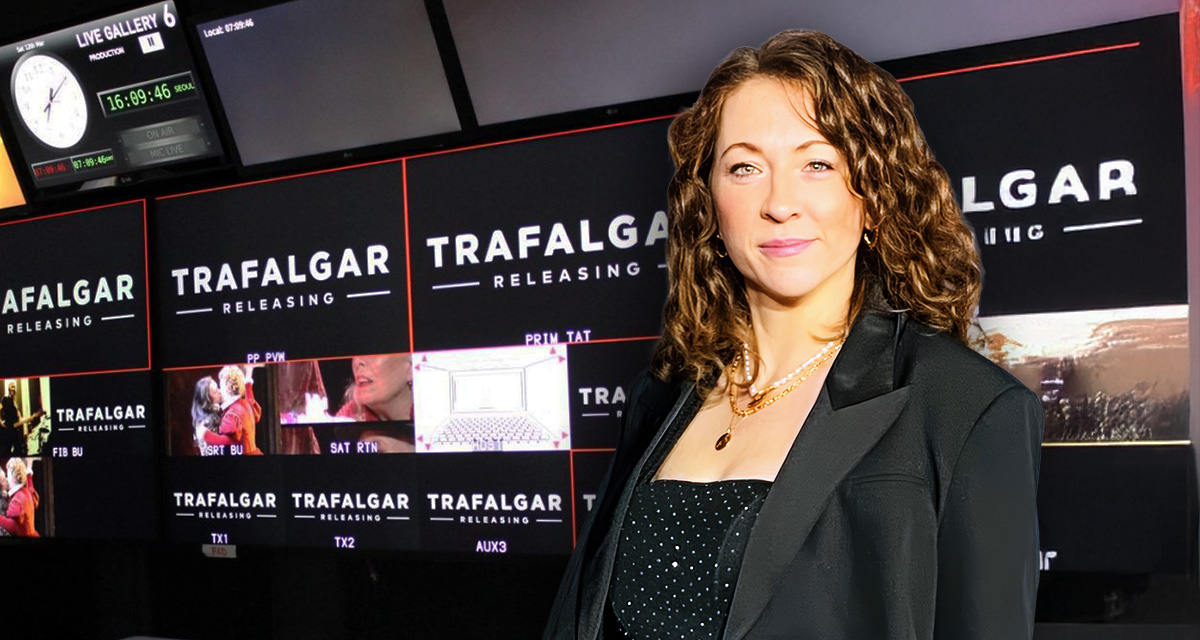
For the past decade, London-based distribution company Trafalgar Releasing (Trafalgar) has been a market leader when it comes to event cinema (also known as alternative content). Bringing live experiences to a wider audience via the cinema screen, whether it’s recorded productions of pop concerts, stage plays, opera or ballet performances or even live-streamed events, it’s been a lucrative, untapped area of theatrical distribution that few others have exploited quite as well as Trafalgar. And now the company is looking to further expand into production, an ambition reflected in the recent promotion of long-term Trafalgar employee, Emily Cecil-Dennett.
Cecil-Dennett has been with Trafalgar since 2014, starting as a production assistant when the company was formerly Picturehouse Entertainment, before working in various other roles. Last month, it was announced that she will now take up the role of director of production, following on from her previous role as head of production. Her new position ties in with “recognising what Trafalgar is doing,” she said, speaking to Celluloid Junkie over Zoom. “[It’s] not just taking finished films and taking them to market for distribution.” Instead, it’s about offering a more complete service, “which we’ve been doing already for a few films”.
Since her arrival at Trafalgar Releasing, Cecil-Dennett has seen a considerable escalation in audience appetite for live event cinema. Increasingly, the demand for seeing a live experience has been on the up, as anyone who scrambled for Oasis or Taylor Swift tickets on their recent tours can attest to. “There’s definitely a trend for people wanting real life experiences, because we live so much of our life online,” she reasoned. “People crave an in-person meeting. They crave actually seeing someone and making connections in certain ways.”
Of course, this rise in demand has led to inflated ticket prices, especially with the advent of the controversial dynamic pricing tactic inflicted on concert-goers by companies like Ticketmaster. Certainly, Trafalgar Releasing’s mandate of bringing the same event to cinema audiences, for a much more pocket-friendly price, accounts at least in part for why the company has been so successful, especially with its global reach now seeing films distributed in 15,000 theatres in a staggering 132 countries.
“I think the next best thing to going to a concert is seeing it in the cinema,” Cecil-Dennett said. “And even for a play. I think sometimes, in some ways, it can be better, because we take a different lens or a different angle. You literally have the best seat in the house because you do have the screen director’s view and their storytelling through the film.” As she pointed out, the company is increasingly collaborating with creatives, as they did with the recent screening of “Macbeth,” in February of this year, starring David Tennant and Cush Jumbo, filmed live at London’s Donmar Warehouse during its run in 2023.
Speaking to those involved with the production, Cecil-Dennett wanted to go beyond simply filming a live theatre production with a standard multi-camera set-up. “With some of these monologues, it feels like the characters are trying to talk straight to the audience. Why not break the fourth wall and talk straight to the camera?” she explained. This resulted in moments of Tennant doing exactly that. “We’re changing the narrative, but that meant the cinema audience had the best experience.”
Precision, Deadlines and Heavy Metal
Beyond her creative input, Cecil-Dennett has built a firm reputation for no-nonsense organisational skills, and working with artists who are at the top of their game. Behind her in her office, hangs a framed t-shirt created by the team behind heavy metal band Metallica in her honour. One of several Metallica projects that Trafalgar Releasing has worked on, Cecil-Dennett collaborated with the band on a ‘listening party’ for the band’s eleventh studio album, “72 Seasons,” which was released in 2023.
“It was one of the first that was done on that scale,” she explained. “And that was challenging, because the band had to release the music to us beforehand, which is unprecedented, because they were nervous about it leaking to audiences.” The project came with particularly strict deadlines, with each song accompanied by music videos that needed to be finalised.
“I kept repeating when the deadlines were, and we were getting closer and closer to them. And the management team went to Metallica and said, ‘Look, we really need this.’ And they said, ‘Who is this voice of doom who keeps telling us that there’s these deadlines?’ So they came back to me and went, ‘Well, you’ve just been called the voice of doom.’” This affectionate nickname is now emblazoned on Cecil-Dennett’s personalised t-shirt that hangs behind her.
Nevertheless, the experience with Metallica on “72 Seasons” turned out to be an amazing one. “It was incredibly successful for everybody in lots of different ways. Commercially. Technically. The fans… everybody loved it.” Subsequently, the band trusted Trafalgar to handle a two-night live broadcast from the AT&T stadium in Arlington, Texas, in August 2023, as part of the M72 World Tour, where they played two career-spanning concerts with unique set-lists.
A Complete Solution
That whole experience was typical of what Trafalgar is aiming to achieve now, offering artists and management teams a vertically integrated service. “We’re not inventing anything particularly new,” explained Trafalgar CEO, Marc Allenby, “but what we can do is offer any one part – or all – of that whole journey, from finance, from production, whether it’s live or a finished film, through to the cinema and the downstream, ultimately.”
With a wealth of experience, it’s hard not to imagine there being lots of takers, particularly for those not directly tapped into the cinema industry, said Allenby. “If your focus is music and you’re worried about touring and album sales and merchandise… how much headspace do you even have to apply to [the end-to-end process]? What we’re doing is demystifying that and offering a solution which people can choose to take or not. I think that applies to existing partners and lots of people we’ve worked with already, as well as new business.”

According to the CEO, the long-established relationships Trafalgar has carefully nurtured should lead to future projects where bands, artists, theatre impresarios and more trust the company to fully oversee the financing, recording and release of a live-to-cinema project. “I think Metallica, for example, speaks to that,” he added. “But there are others which are similar. We’ve done two Coldplay films, six Nick Cave films, and [the recent Memento Mori concert film with] Depeche Mode is our second film with them as well. By being a good partner, by doing the right things, you can build strong repeat business.”
The numbers are also stacking up, in particular with K-pop concerts. Back in 2023, Trafalgar released “BTS: Yet To Come,” a free show at Busan’s World Expo, which garnered USD $50 million+ around the world. Since then, there’s been collaborations with Japanese band Seventeen, and K-pop band BTS members, j-hope and Jin. Recently, the two-week cinematic event “BTS Movie Weeks” brought the band back into cinemas, a phenomenon that’s already hugely popular in Asian countries. “Every tour, every stop, is broadcast to cinemas, so there’s a real culture of going to see [recorded concerts] multiple times,” said Cecil-Dennett.
Trafalgar even collaborated on the juggernaut that was the Taylor Swift Eras tour, partnering with AMC Cinemas on what became the biggest concert movie of all time. “Our expertise from a global distribution perspective was called upon on that front,” said Allenby, who is understandably cautious when suggesting that Swift’s management team might return for the full package. “Taylor is a unique property, and the likelihood of that service being requested is probably quite slim, but for other artists, I think that’s exactly what we can do.”
Broadway Challenges and Next Steps
Ironically, despite excellent connections in London’s West End “theatreland”, the company has yet to fully crack the American theatre scene. “Broadway has some commercially significant challenges. Both filming on Broadway and the structures around it are very, very challenging,” said Cecil-Dennett. Logistically, shooting Broadway shows isn’t easy, and then there’s the issue of union organisations. “There’s different unions for the staff in the buildings… there are different fees you have to pay. So commercially, it doesn’t necessarily stack up.”
That aside, Cecil-Dennett promises the company’s “ears are close to the ground about what’s happening,” whether that’s upcoming concerts or stage productions. While she refused to confirm if Trafalgar will be involved in the Radiohead business, with the band currently performing twenty dates across Europe – their first concerts in seven years that were hugely in demand – she added: “I would be surprised if Marc hasn’t already sent a text message [to his contacts] about that.” She also hints that plans are underway for forthcoming theatre shows. “Some things have been announced for 2026… we are in conversations with them about filming it already.”
With Trafalgar on the cusp of taking the business into a much broader sphere, Cecil-Dennett felt it’s a great moment for the company. “I think it’s an exciting time because we are saying that we’re open, and available to help assist people create content. We’ve always been there, but we’re showcasing that and saying, ‘Look at these ones we’ve done in the past. Look at these ones we’ll do in the future.’”
In particular, the ability to help productions that might be struggling financially is being seen as a major boon. “We were in conversations quite recently for something we’re shooting in two weeks,” she added. “There came a point where the original plan didn’t quite work out financially and they had to go spend their money somewhere else. And we stepped in and were like, ‘Well, we can make it happen.’ So that is really exciting, that we can look at stuff in that way. Just because financing gets pulled doesn’t necessarily mean it doesn’t go forward. We can fill that gap.”
From voice of doom to voice of reason, you might say.
- Berlinale 2026: Political Strife, Homegrown Success Stories and An Uncertain Future - February 25, 2026
- Pearl & Dean Partner Emirates with Everyman for a First-Class Experience - February 5, 2026
- A Complete Service: Trafalgar Releasing’s End-to-End Offering - December 5, 2025