


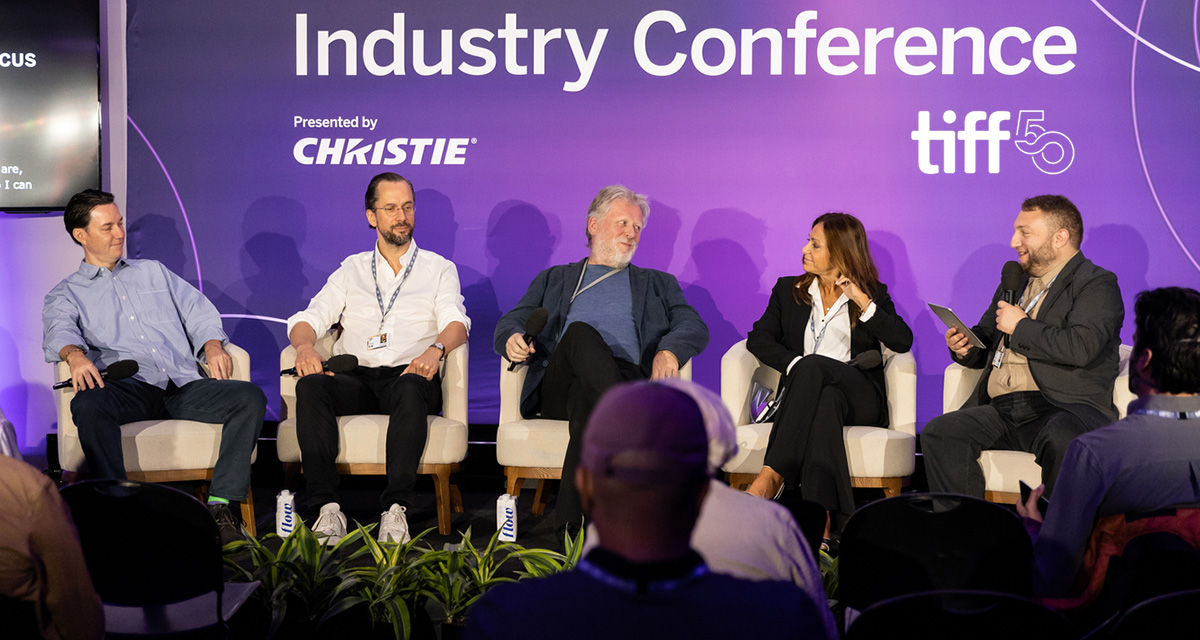
At the 2025 Toronto International Film Festival’s Buyers In Focus sessions, industry leaders from six territories revealed how they’re navigating streaming pressure, changing audiences, and TIFF’s rise as a market hub.
This year’s Toronto International Film Festival (September 4–14) hosted several Buyers In Focus sessions as part of the TIFF Conference at the CBC Centre in downtown Toronto. These conversations offered an inside look at the strategies, challenges, and ambitions of companies navigating the global film landscape. With TIFF set to evolve into a fully fledged market in 2026, the perspectives shared provided not just regional snapshots but also a collective sense of how film acquisitions, audience engagement, and festival networking may shape the next chapter of theatrical distribution.
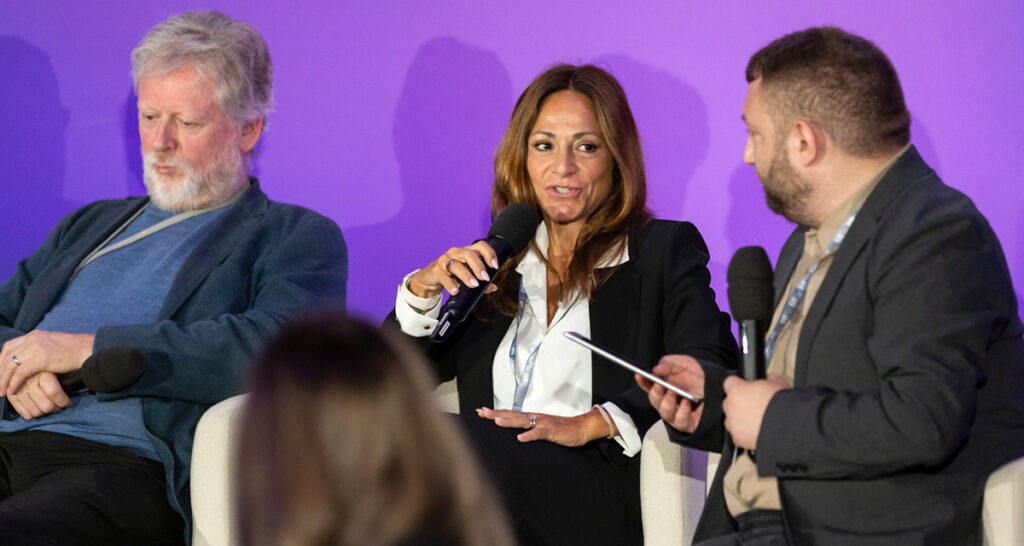
Antonella Canturi – Rai Cinema, Italy
Antonella Canturi has spent more than 25 years navigating Italy’s complex cinematic landscape, combining academic insight with hands-on experience. She began her career with an internship and a stint at New Line Cinema in New York before returning to Italy, where she quickly found work across various industry roles. Today, at Rai Cinema’s 01 Distribution, she manages international acquisitions for theatrical distribution as well as programming for TV and other channels.
Canturi outlined the dual focus of her acquisitions strategy: balancing authorial identity with commercial potential. “We buy everything from historical dramas like “The Wizard of the Kremlin” to K-pop thrillers such as “The Perfect Girl,” family dramas, and character-driven pieces. […] But the audience is very picky today. [Streaming] platforms offer everything, so we focus on distinctive projects,” she said, while stressing that Italian productions remain central to the company’s slate.
She also pointed to shifting consumption habits. “We’re trying to diversify as much as possible, but we must acknowledge the role of platforms and the competition they bring,” she explained. Italian audiences still expect strong domestic content, but engaging younger viewers has become critical. “Even though Rai is traditionally festival-oriented, we are focusing more and more on films suitable for younger audiences. That means creating events with actors and directors, insisting on promotion, and using the tools young people actually use,” she noted, underlining the role of Instagram, TikTok, and Rai’s own VoD platform, RaiPlay. “We have to move with the times, and this should be our main goal.”
Frank L. Stavik – AS Fidalgo, Norway
From Italy’s dual strategy, we move north to Norway, where Frank L. Stavik offered the perspective of a boutique arthouse distributor, Fidalgo. A veteran of the industry, his career began unexpectedly: after running a local film society, he and a friend took over a struggling video company in the late 1980s and pivoted it into theatrical distribution.
“We bought a Finnish film, Aki Kaurismäki’s “Leningrad Cowboys Go America,” which did 50,000 admissions, and suddenly we were in business. We thought, ‘easy peasy’ – of course it wasn’t,” he recalled. More recent selections include Sergei Loznitsa’s “Two Prosecutors,” the three-hour Chinese film “Resurrection,” and Paolo Genovese’s “Madly.”
“We’re a small boutique operation, so we buy and distribute high-end arthouse films,” Stavik explained. “Commercial titles are usually too expensive and require marketing power we don’t have, so we stick to the artsy ones — not where the money lies, but definitely where the fun is.”
He acknowledged that audiences remain a challenge. “Right now, our core audience is aged 50+, and without them we wouldn’t be in business,” he said. Festivals and markets, once seen as competition, are now vital to visibility. “For a while we feared festivals would eat into our box office in a country of just five million people,” he admitted. “But in recent years we’ve seen they actually help build visibility and audience numbers.”
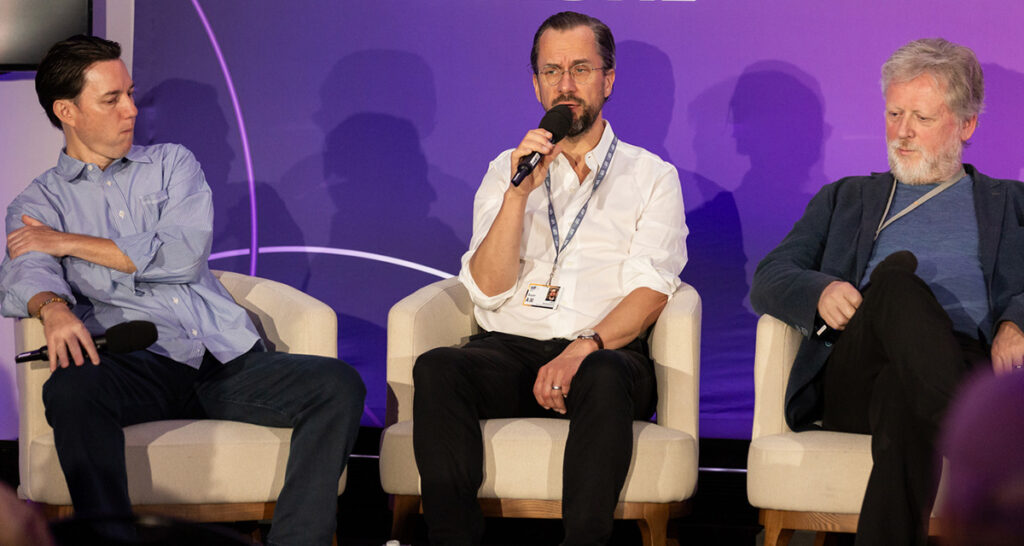
Jakob Abrahamsson – NonStop Entertainment, Sweden
Sweden’s Jakob Abrahamsson traced his journey from VHS-era film fan to CEO and co-owner of NonStop Entertainment, crediting formative experiences at the Stockholm Film Festival in the late 1990s.
At NonStop, he balances artistic ambition with commercial viability, acquiring both genre-driven titles like “The Substance” and “Terrifier 3” and auteur-driven features such as “If I Had Legs I Would Kick You” and “Pillion,” the latter starring Alexander Skarsgård. He also curates re-releases of classics including “Possession” and “Amélie,” while venturing into production through Mylla Films.
Abrahamsson pointed to a post-pandemic resurgence of younger audiences in Sweden. By courting cinephiles with classics and niche fare, NonStop has tapped into this renewed appetite for theatrical. Festivals, he stressed, remain essential: “A festival with a market is far stronger than a market alone,” he said, adding that these events provide critical insight into audience reception, the competitive landscape, and a film’s potential performance across Scandinavia’s specialized circuits.
Dylan Leiner – Sony Pictures Classics, USA
Dylan Leiner, Executive Vice President at Sony Pictures Classics, brought the perspective of a seasoned acquisitions executive with more than 30 years in acquisitions and production. Raised in Los Angeles by a family embedded in the arts, he initially resisted the industry before joining SPC, where he has since overseen films earning more than 150 Oscar nominations.
Leiner described the company’s approach as semi-independent curation, blending eclectic artistic and commercial projects. At Toronto this year, SPC’s lineup included Scarlett Johansson’s directorial debut “Eleanor the Great,” James Vanderbilt’s “Nuremberg,” Richard Linklater’s “Blue Moon,” and Nick Hytner’s “The Choral.”
“Even though we’re part of a big company, we operate at arm’s length, curating a mix of films,” he said. For Leiner, festivals and markets are crucial cultural hubs — places to observe trends, generate momentum, and allow exhibitors, journalists, and audiences to engage with films in meaningful ways.
Optimistic about the US box office post-pandemic, he noted a new demographic of twenty- and thirty-somethings rediscovering cinema. Yet challenges remain, particularly in balancing ticket pricing with the demands of social-media-driven engagement.
Eleonora Pesci – Curzon, United Kingdom
In the United Kingdom, Eleonora Pesci offered candid insights on the arthouse landscape. “Audiences’ habits differ across territories, but the underlying challenges for theatrical distributors are surprisingly similar,” she observed.
Pesci explained that Curzon Film remains committed to independent arthouse, balancing the traditional [Curzon distribution platform] Artificial Eye output — “often aimed at older audiences” — with younger-skewing titles and a steady stream of retrospectives and re-releases.
“This past year we’ve had great results with “Kneecap” and “Flow,” and our upcoming slate features directors such as Pedro Almodóvar, Julia Ducournau, and Robin Campillo,” she said. On festivals, she was emphatic: “A festival launch will always be the ideal platform to start a film’s journey. There’s a unique energy, buzz, and atmosphere that still drives most of us indie players.”
Still, she acknowledged domestic challenges. “Some films break out beyond expectations, but many arthouse titles struggle to connect with theatrical audiences — and that often carries over to TV and SVOD,” Pesci added.
Mette Schramm – Reel Pictures, Denmark
Mette Schramm of Denmark’s Reel Pictures highlighted the enduring challenges of distribution, stressing that “distribution is a risky business wherever in the world or whichever territory you are based and working in,” but she tempered this with optimism: “Luckily, there are people with passion for movies all over the world.”
At Reel Pictures, acquisitions are guided by both personal taste and market fit. “We try primarily to buy movies that supplement the cinemas we manage and/or something we really like and expect could have interest for a Danish audience,” Schramm explained. Among recent acquisitions is the aforementioned “Pillion,” a comedy directed by Harry Lighton, which the company screened at Cannes.
Festivals and markets, she stressed, are indispensable. “It is a very important place to find new acquisitions and to network.” On the domestic front, she noted that Denmark’s theatrical market is still recovering from Covid, the Hollywood strikes, and the expansion of streaming. Even so, she remains cautiously hopeful: “The ticket sales seem to be developing in a positive direction, let’s hope for the best.”
A Shared Set of Challenges
Taken together, these testimonies reflect both local particularities and common ground. From Italy to Scandinavia, the UK to the US, distributors are grappling with streaming competition, the urgency of reaching younger audiences, and the enduring role of festivals.
That repetition is instructive: theatrical distributors worldwide are wrestling with the same dilemmas. It also underscores why TIFF’s plan to become a full market in 2026 could be transformative. For independent players and major companies alike, a festival that combines discovery with deal-making may prove one of the few places where global strategies can still be forged — and theatrical’s future, however precarious, can continue to be written.
- Imperfect Is Beautiful: Shekhar Kapur and Tricia Tuttle on AI’s Role in Cinema’s Next Act - December 9, 2025
- Industry Panel at Tallinn Debates the Consequences of Europe’s Shrinking Theatrical Windows - December 2, 2025
- Moviegoers Return But Italian Cinema is Running Out of Stories, Say MIA Panellists - October 22, 2025