Tag Archives: CNET

Studios Are Fighting Movie Piracy On College Campuses

Piracy On College Campuses

A Warning To Copyright Infringers At Cornell

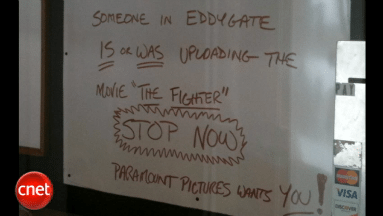
It looks as if the MPAA may be spying on college students, or at the very least monitoring their file sharing activity. Last week on CNET’s daily tech news podcast Buzz Out Loud the hosts read an email from a listener named Chris who explained how the MPAA has been leaving notes for students they believe are sharing movies online.

Illegal (and legal) file sharing is a constant topic of discussion on Buzz Out Loud as are the attempts of the MPAA and RIAA to prosecute those who participate in such activity. So Chris, a college student who lives in a dorm on the Cornell University campus, wrote in to pass along the news that the MPAA has identified his dorm as a den of illegal downloading. He writes (no emphasis added):

…my university (Cornell) has had run-ins with the MPAA and RIAA in the past over our school’s file sharing network. Everyday when I get back from class, I see a new notice on the message board in the lobby. About once a week there is a particular kind of message; this week’s reads:

‘Attention! Someone in Eddygate (my building) IS or WAS uploading the movie THE FIGHTER. STOP NOW!!! PARAMOUNT PICTURES WANTS YOU!!!

Last week it was ‘SONY PICTURES IS WATCHING YOU!’ for some other movie.

Are they now threatening college students specifically? … Are they possibly monitoring our specific building?… Are they really going through the effort to contact landlords and apartment managers to tell their residents to stop committing the ultimate evil?

Read More »

Popularity: 3% [?]

Q: Which 3D technology is best? A: Dolby’s!

All stereoscopic cinema technologies are not created equal, or rather, the presentations are not identical. But it is not just, say, the size difference between, say Imax and a RealD presentation that is noticeable, but even differences between different types of digital 3D presentations stand out (if you pardon the pun). cNet’s Stephen Shankland (NB: NOT the man in the picture above – that’s scary looking CrunchGear Guy sporting Dolby 3D specs) sat through three of the four different types of 3D cinema solutions available commercially today (NuVision/XpanD‘s active glasses screenings appear not to have been available to him in the US).

It turns out that it was not so much an apples, apples and oranges as Granny Smith, Golden Delicious and clementines type of experience. It is worth reading the whole article (Who shows the best view of 3D ‘Beowulf’?) for many interesting insights. For those who want to cut to the chase (and missed the headline of this item), the winner was the newest kid on the stereoscopic technology block:

Based on watching the movie start to finish three times, the 3D winner is Dolby 3D–and not just by a nose.

Dolby’s technology gave a sharp image that showed every beard bristle, the colors were relatively rich, flicker from moving objects was nonexistent, but most significantly, the sense of depth was strong. Even the subtle differences between a character’s facial features were perceptible, and group shots with a host of characters showed as true depth, not as a number of gradually more distant two-dimensional layers. I was truly impressed.

Now there are several things t be said about this comparison. The first is that it was a ‘comparison’ and not a ‘test’, let alone a ‘shoot out’. I cannot voucher for Mr Shankland’s vision, but chances are that he is not what Hollywood considers a pair of ‘Golden Eyes’. He is a knowledgeable and perceptive writer. So while I don’t doubt his judgment – and not having seen ‘Beowulf’ in ANY 3D form I’m in even less of a position to comment – it is important to remember that this was not a controlled experiment but an assessment of the average viewer’s experience.

As such, it is in some ways more important than a test in the old Pacific Theater that was the ETC’s Digital Cinema Lab. The writer says as much himself, so with all these caveats in mind it is interesting to dig deeper into his findings. The first is that artistic interventions have obviously been made in calibrating the 3D experience, particularly between Imax and digital 3D. This is an area that is just beginning to be understood and discussed Disney’s Howard Lukk has given several excellent presentations on this, talking about the ‘plane’ of the stereoscopic image.

Imax is ‘in your face’, whereas RealD is more the type of 3D that has been described as ‘surround sound for your eyes’, ‘box’ or ‘Doll House’ type of stereoscopics. Yet Dolby appears to have won out on the strength of the three ‘C’s (coherence, colour, clarity). This is surprising to industry observers, as the colour separation that underpins the Dolby (it was licensed from Germany’s Infitec) was long thought to cause it problems with accurate colour separation. Now the talk is instead that the struggle is to make the glasses that employ 16 or more layers of colour-separating film, cheap enough to manufacture in volume to compete with the disposable RealD circular polarized glasses.

Ultimately ‘Beowulf’ is not the best films to judge the merits of all three technologies (or even four or five, if you add active glasses and the Korean system under development) because it is CG-animation and mostly takes places in dark and dim caves, so the light-loss that all 3D systems suffer is masked. But this article is not just the first but a very, very good comparison that will hopefully stimulate more discussion and research around the subject.

Popularity: 46% [?]