


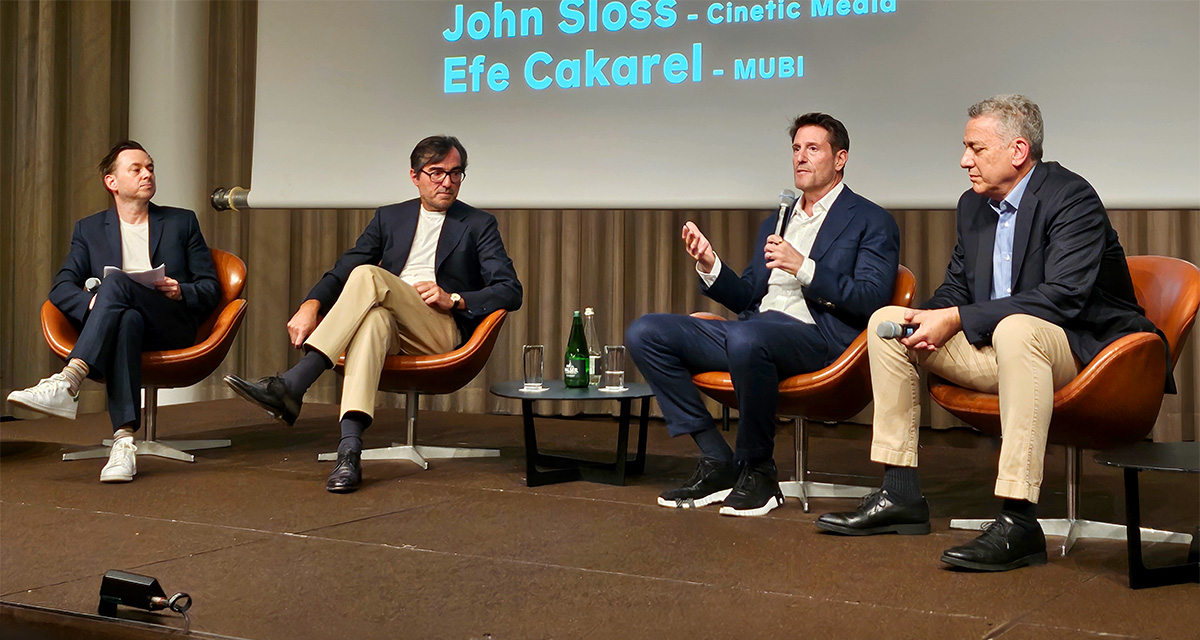
For MUBI’s Efe Cakarel, financing an Edward Berger film and releasing it around the world requires both capital and capabilities. Getting big enough to do that has taken years of putting brick upon brick into his vision. At the 2026 Zurich Summit, the challenge was how to build that capacity while remaining agile enough to respond to changing audiences and support distinctive films.
The discussion, “Building Resilient Media Companies in the Age of Disruption,” brought together Cakarel, MUBI’s Founder & CEO, Kevin Mayer, Co-Founder & Co-CEO of Candle Media, and John Sloss, Founder & CEO of Cinetic Media. Representing “quite a breadth of experience in their respective sectors,” as moderator Andreas Wiseman, Deadline’s Executive Editor for Film & International, put it, the executives considered what scale can deliver and what it cannot.
Scaling to Support the Films
When he created MUBI because he “just loved movies” almost 20 years ago, Cakarel was very much a beginner. “As an industry participant, I didn’t know a single person in the industry.” He learned quickly, however, “that this is a very conservative business that moves slowly. People are very traditional in their approach to all aspects of filmmaking, and they want to continue the way they’ve been doing things.”
Even so, Cakarel kept holding on to his vision for MUBI. “It took 15 years of putting brick upon brick into that vision,” he recounted. MUBI’s growth from 40 to 400 employees in the past four years was not about ambition for its own sake, he explained. “Scaling is necessary to become able to do the things that you want to do.”
Like working with “one of my heroes,” he said. “If you want to green light and fully finance an Edward Berger film, and release and distribute it globally, you need both capital and capabilities. Our goal was to get to that place as soon as possible,” Cakarel stated. “But not sooner. The road to growth and success is never a straight line.”
Adopting a Beginner’s Mind
For Candle Media’s Kevin Mayer, adapting to audiences starts with a “very fresh, beginner’s mind.” After leaving The Walt Disney Company to run TikTok, “I saw entertainment from an entirely different angle.”
At Disney, taking “fewer creative swings” and putting more behind each one created a better product for the audience, he observed. “Coalescing around brands” reduced the business risk as well.
TikTok, by comparison, relies on “a great recommendation engine that arranges tiny, atomized pieces of video in a certain way that is appealing.” Hugely appealing, he added, and “a shame in many ways” for long-form storytelling, as younger audiences devote more of their time and attention to short videos.
In building Candle Media, with its spectrum of storytelling from long-form to social media entertainment, Mayer and team need “to respect the traditions of storytelling.” Paying attention to those consumption dynamics “without losing your principles is super important,” he elaborated. In ever-changing times, “agility trumps scale, size; it trumps all of that. You really do need to be open to new things, react to them in the right way and embrace them.”
Looping back to the principles, he is “not saying, ‘Movies are going away.’ Nothing like that. But in the way they are made, and the way you market and deliver them to people, you must be open-minded and extremely agile. Take a beginner’s mind approach. That’s how you win it.”
Consolidation and the Theatrical Future
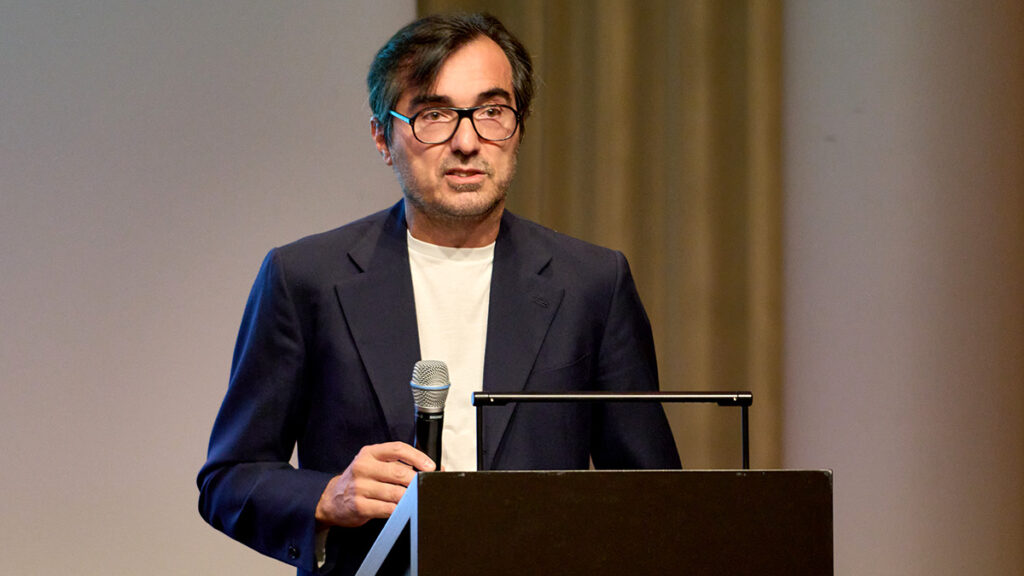
The debate over scale took on more immediate theatrical stakes with Paramount’s acquisition of Warner Bros. Discovery, which subsequently closed on October 6. Speaking before the deal’s completion, Mayer argued that consolidation could make the industry stronger than a future with “a larger number of very weak companies that are unable to define much of the future.”
“That is the future you’ve got to measure this consolidation against; not against some fanciful future where everything is as good as it was five to 10 years ago.”
“It’s basically physics at this point,” Mayer believes. In his view, one healthier buyer, able to finance and distribute films, could be preferable to two weaker ones. Necessary cost savings, however, have dire consequences. “$6 billion in synergies is a euphemism for a lot of layoffs,” he said.
Mayer expected David Ellison to keep his public promises about making movies and releasing them theatrically. He anticipated a five-year safety net for theatrical output, with the two studios operating somewhat independently. Beyond that period, he acknowledged, the outlook was much harder to predict.
Assuming there will be four or five global platforms for media consumption going forward, Sloss sees consolidation as a necessity too. He found it “interesting,” however, “that the industry seemed to be on the side of Netflix winning over Paramount in this transaction.” He did not understand that rationale because “with Netflix, there was very little opportunity for theatrical to survive from Warner Bros.” As for Ellison’s approach, “I guess we’ll see what’s coming,” Sloss said.
The Influence of Cultural Blockbusters
For Sloss, expanding the pool of film investors offers another route to supporting creative work. Cinetic Media’s newest initiative, Vertical Leap, aims to attract a “sector of potential investors that is incredibly attractive, wildly underserved” to invest and take ownership of film and media projects that they are passionate about.
“Athletes are very media curious people. There has never been an organized way to bring them into our space,” Sloss elaborated upon his plan. “And they will bring with them the ability to augment the projects they believe in with their public media following.”
Access to finance is one part of the picture. Discussing the health of independent filmmaking, Sloss also urged the industry to look beyond the size of theatrical returns. “There’s so much talk about scale and size of theatrical, but just not enough talk about cultural influence,” he said. “There is something you could call a Cultural Blockbuster that maybe doesn’t perform at the level of these tentpoles, but that influences in a disproportionate way the people who affect culture.”
Such films can have an extended shelf life, he argued, even if that influence is difficult to quantify. With a “creator centric company,” Cinetic is well positioned, he declared. Technology has democratized capital and delivery, but “the one thing that remains scarce is imagination, human imagination. Our purpose is to empower that scarce segment of the delivery chain.”
Cakarel recalled his own younger days when his mother would take him to the “beautiful” art house cinema in his hometown, now closed. He noted how that experience was being replaced by blockbuster IP in multiplexes, and with an addiction to immediate, short-form content today. Nonetheless, “I am observing that some younger audiences are quite discerning. They are not easily fooled, and they seek high-quality entertainment in a world where they can reach anything.”
And they value experiences, he added. “I think the experience of watching original, bold storytelling is here to stay, and it’s going to grow. As an industry we need to embrace it, continue to produce and finance these films that tell bold stories. And we need to try to find their audiences because they exist.”

- Financing Bold Films Takes More Than Money - October 12, 2026
- Cinema Owners Have Invested $2.7 Billion in Theatres. What Is That Money Buying? - October 1, 2026
- The Paramount-Warner Merger Is Permanent. The Guardrails for Movie Theatres Are Not - September 22, 2026