


For decades, the independent film industry has operated according to a familiar hierarchy. A filmmaker completes a project, premieres at a major festival, secures a distributor, launches a theatrical run, and hopes that audiences discover the film through cinemas, home entertainment releases or – more recently – streaming platforms. Such success depends heavily on gatekeepers: festival programmers, sales agents, distributors, exhibitors, and broadcasters.
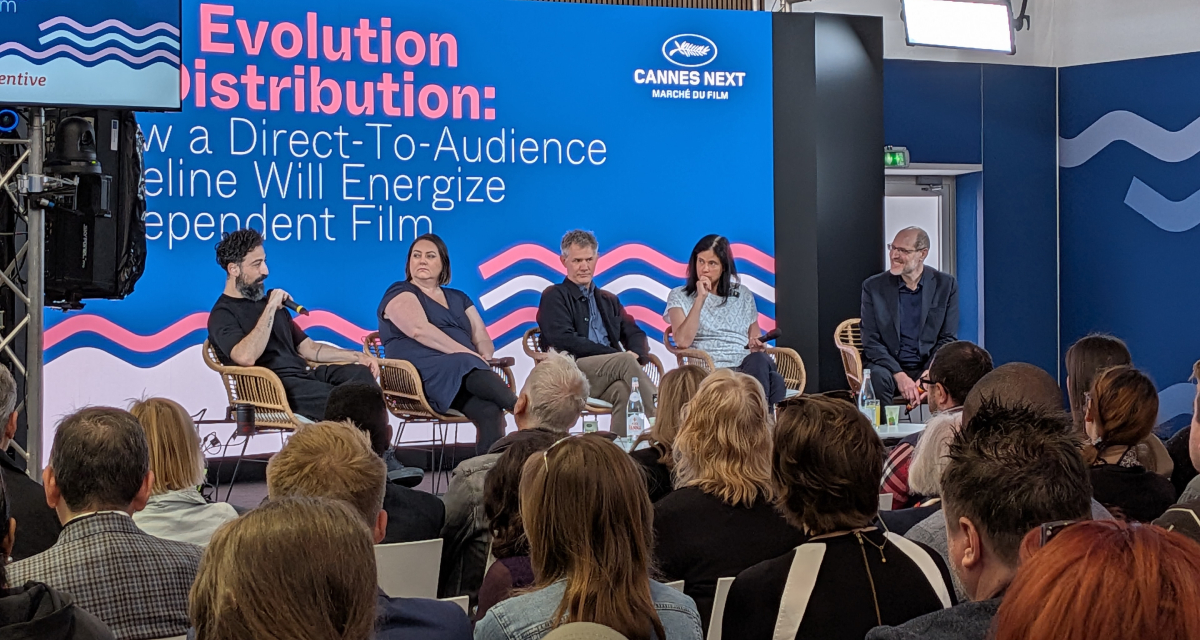
That system is no longer the only path – as filmmakers, distributors, festivals, and technology companies increasingly embrace a direct-to-audience pipeline. At this year’s Cannes Film Festival, the panel “The Evolution of Distribution: How a Direct-To-Audience Pipeline Will Energize Independent Film” set out to explore this model, one that allows creators to build communities, market films, sell tickets, and distribute content directly to viewers long before a traditional distributor enters the picture.
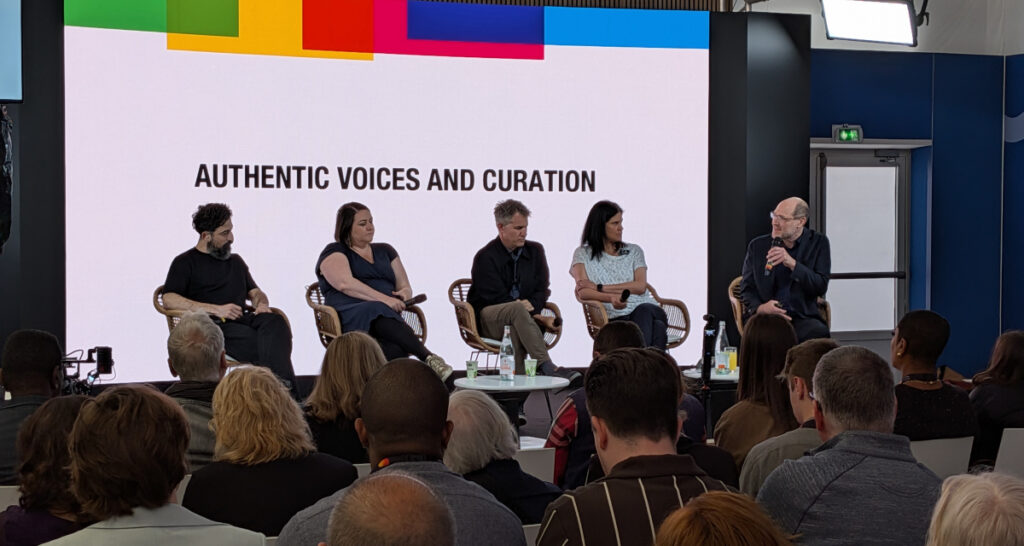
Held on 16 May, at Village Innovation as part of the Marché du Film (Cannes Film Market), the panel was hosted by Iddo Patt, co-founder and CEO of Eventive, a company that provides ticketing, streaming, and audience management tools for festivals, cinemas, and filmmakers. Working with festivals for the past decade – 6,000 festival editions across 50 countries – Patt reported that over 16 million tickets have been issued through the Eventive platform. “So we’ve developed a lot of ideas, a lot of data, around how people are interacting with movies today,” he said.
Joining him on stage was a diverse slate of guests from different parts of the independent film spectrum: John Nein, senior programmer and director of strategy at the Sundance Film Festival; producer and sales agent Sarah Mosses, CEO and founder of the UK-based Together Films; Daniel Berger, president of Oscilloscope Laboratories, a US-based distribution and media company; and Sharon ‘Rocky’ Roggio, founder and creative director of 1946 Studios, and also the director of the documentary “1946: The Mistranslation that Shifted a Culture.”
The Tension Between Old and New Models
As Berger noted, there is still a great deal of “antiquated thinking” in the exhibition and distribution sector. Not least, who works in the exhibition realm. “A lot of theatre programmers… It’s the same old white men that have been programming those same theatres for decades,” he said. “You talk about reaching a younger audience… These are not the people to do that, they don’t understand it.”
Mosses added that defining success in terms of gaining traditional distribution was also an outdated way of thinking. “The second an audience member has watched it, you’re in a form of distribution,” she argued, “and your success should start from that metric, rather than ‘Did I get a formal offer from a traditional partner? Did I get the streaming deal? Did I get the broadcast offer?’ They’re all different forms of consumption.”
The rise of virtual communities as an in-built audience for a film is another exciting development, remarked Nein. Take those who have built a YouTube following, like Danny and Michael Philippou, whose feature debut “Talk To Me” was launched at Sundance in 2022 and went on to gross $92 million worldwide, or more recent hits like “Obsession” and “Backrooms,” made respectively by Curry Barker and Kane Parsons, who also started cultivating fans for their work online.
“There is something exciting about virtual communities,” continued Nein. “To me, it has to do with this idea of how do you expand the audience? How do you bring people who don’t normally go to a film festival or go to a theatre that’s playing an independent film? Are they coming to a new place for them? And we often talk about that in terms of young audiences. People who might become interested in independent feature work by virtue of some other means, right? And I think that that’s what I see being different today, as opposed to twenty years ago.”
“1946” as a Direct-to-Audience Case Study
As Patt noted, with traditional distribution channels now turning upside down, “It makes a lot of sense for filmmakers to build an audience in a community before a film even plays at a festival.” Roggio’s success is the perfect case study in exploring the direct-to-audience pipeline. Released in 2022, “1946…” explored how the word ‘homosexual’ first appeared in the Bible during the 1946 translation of the Revised Standard Version, arguing this was a mistranslation of Greek texts – a mistake that inadvertently fuelled decades of anti-LGBTQ+ rhetoric.
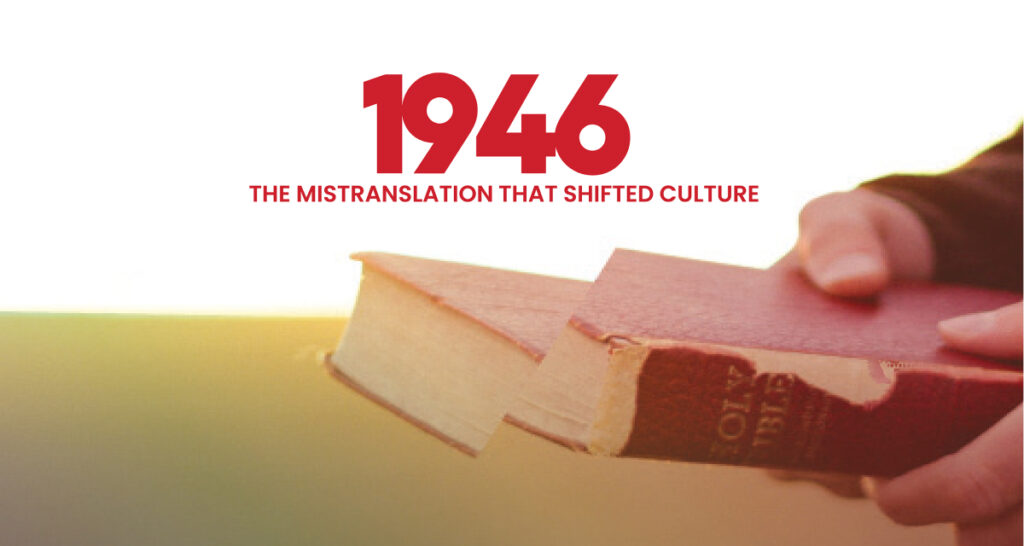
The controversial content immediately attracted viewers. “Before the movie even came out, we had hundreds of people telling us how much our movie was dumb, stupid, wrong,” Roggio recounted. With “pastors losing their minds” in Sunday morning sermons, on radio shows and podcasts, “1946…” was on everyone’s lips. “That was already a big win for us,” he said. An even bigger win came when an Australian TikTok user posted the film’s trailer, and it went viral – gaining 2 million views. When the film premiered at the 2022 Doc NYC festival, it won the Audience Award, the first of 25 awards.
The question remained: what next? “We wanted distribution,” said Roggio. “And if you sell too many tickets at a festival, are you going to get distribution? But I had an audience waiting to see this film, so I really wanted them to see the film. We ended up selling over 5,000 digital tickets at Doc NYC. We’re still the most viewed film in their festival history at the virtual end. They ended up opening an additional screening for us in person, which was huge, and we took a risk doing that, but it paid off.”
Despite employing publicists 42West, who helped ensure visibility, the reaction was disappointing from traditional distributors. “They said, ‘Love the film, can’t help you,’” said Roggio. As she previously explained at a Berlinale EFM talk, the film was considered risky – either “too gay or too Christian”. At this stage, Eventive stepped in. “Eventive contacted us,” said Roggio, “and said, ‘Listen, you obviously have an audience for this, so why don’t you do self-distribution?’”
Released in theatres in the US in December 2023 – to ensure qualifying for BAFTA and Oscars – Roggio also launched a virtual release, via Eventive, to help pay for the costs of entering the awards season. Turning the traditional distribution paradigm upside down was exactly the right strategy. In six months, “1946…” made $118,000 net profit from 500 watch parties – simultaneous virtual watch-along events – across 25 countries.
Crucially, Eventive also provided data: who watched the movie, how many times they watched the movie and for how long – and viewer’s email addresses. The production now has 15,000 subscribers on the film’s Mailchimp account. “I am excited, because we haven’t even hit our potential,” added Roggio. “I think maybe 100,000 people have seen the movie over watch parties, maybe 200,000. We need millions of people to see this movie, so we have a lot of work to do.”
The Three Rs: Reach, Revenue, and Reaction
During the panel, Sarah Mosses, founder and CEO of Together Films, suggested that filmmakers must begin every project by defining their primary intention. According to Mosses, most distribution goals fall into three categories:
- Reach
- Revenue
- Reaction
Some filmmakers prioritise prestige and awards recognition, which due to the expense of mounting an awards campaign will have an impact upon revenue. Others prioritize financial return. Others want to maximize social impact and audience engagement.
“Each film really is going to have a combination of all three, and you should have a combination,” said Mosses. “I advocate for everybody trying to make some form of money, that should be there. It should be the compounding of it, but you have to understand which of those things you’re aiming for to define your own success metrics within that process.”
A More Practical Way to Think About Audiences
Mosses also proposed a framework called CAST to help filmmakers think more strategically about audience segmentation.
- Commercial audiences
- Affected audiences
- Supportive audiences
- Tactical audiences
Commercial audiences are viewers most likely to buy tickets in traditional theatrical settings. Affected audiences are communities directly connected to the film’s subject matter or lived experience. Supportive audiences include advocacy groups, nonprofits, educational organizations, religious institutions, and community organizations that may organize screenings because they care about the issue. Tactical audiences are smaller groups — politicians, policymakers, corporate leaders, or influencers — whose engagement could create broader institutional change.
“We need to really think differently about how we categorize our audiences, so that we can plan distribution efforts that match who needs to see this,” Mosses added. “Because if we only solidly focus on a primary audience for theatrical, we might miss so many different windows that come around that.”
The Future
Mosses concluded by noting that further transparency is needed, including box office reports for each film playing at a festival. “That’s a level of success. How many people showed up to the festival? What was my total box office gross?” She also called for a more uniform way of looking at data in the industry.
Daniel Berger concurred: “You look at box office in Europe, and they tell you how many admissions there have been, how many people saw it. You look at box office in the US, they tell you how many dollars it made.” Given the vast array of ticket prices, it’s impossible to calculate admissions via the current US model. “I don’t know how many people see our films. I’ll never know, there’s no way to know.”
Overall, the panellists agreed that the direct-to-audience pipeline does not eliminate the need for festivals, distributors, or theatres. Festivals remain essential spaces for discovery, legitimacy, and communal viewing experiences, while distributors still provide expertise, relationships, marketing infrastructure, and access to broader markets.
Yet wider thinking is required. As Patt noted, “Ninety per cent of the films that are playing festivals overall are not getting formal or traditional distribution, even though they’ve been curated in a meaningful way. They’ve been selected for important reasons, they’re seen by a lot of people… and that’s part of what is driving this need for direct-to-audience opportunities that can then turn into theatrical.”
- Venice 2026: Defiant Documentaries, Female Filmmakers and a Scaled-Back Studio Offering - September 17, 2026
- How the Mediterrane Film Festival in Malta Is Putting the Island on the Map for Filmmakers - July 10, 2026
- Can Direct-to-Audience Distribution Give Indie Films a New Path to Theatres? - June 18, 2026