


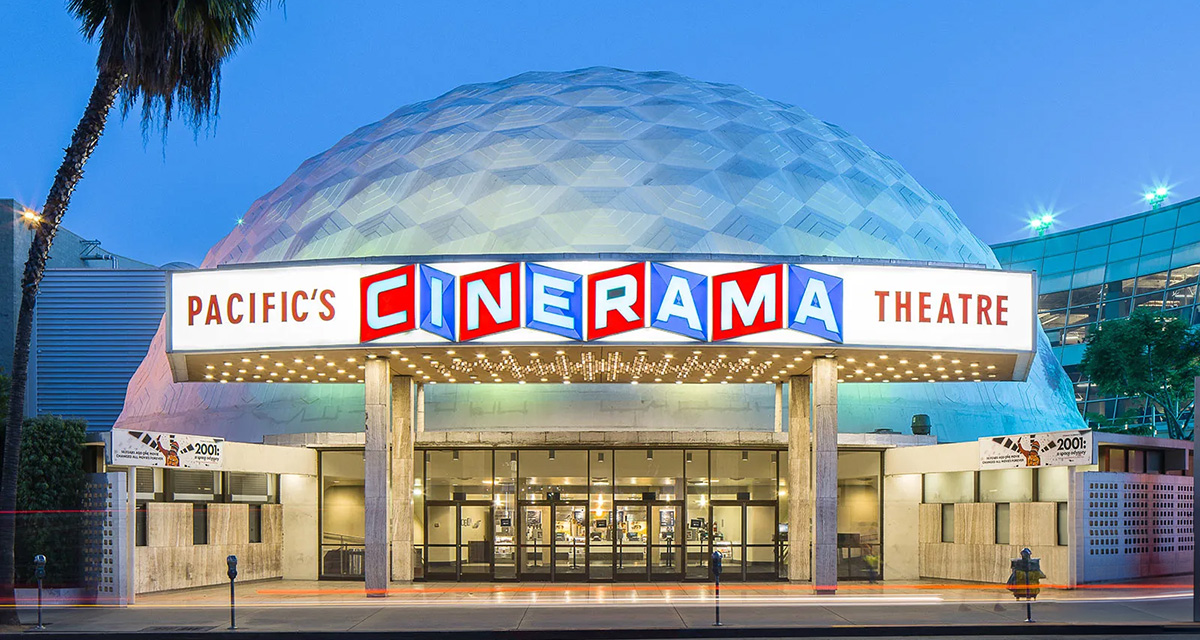
Sony Pictures and Alamo Drafthouse will restore the landmark cinema and reopen the adjoining ArcLight complex in early 2028, returning a major moviegoing hub to Los Angeles while giving Sony’s growing experiences business its most recognizable venue yet.
For six years, Hollywood’s Cinerama Dome has sat dark on Sunset Boulevard, its familiar red-and-blue marquee offering moviegoers a daily reminder of what Los Angeles lost when Pacific Theatres and ArcLight Cinemas shut down during the COVID pandemic.
Now, the landmark finally has something it has lacked since March 2020: a credible path toward reopening.
Sony Pictures Entertainment and its wholly owned cinema chain, Alamo Drafthouse Cinema, announced Wednesday that they will restore the Cinerama Dome and reopen it in early 2028. Renovation work is scheduled to begin next month, with Alamo operating both the Dome and the adjoining 14-screen complex formerly known as ArcLight Hollywood.
Cinema United President and CEO Michael O’Leary welcomed the announcement on behalf of the exhibition industry, describing Sony Pictures and Alamo Drafthouse as “two of exhibition’s strongest champions.” He added that “the timing could not be better, with moviegoers making clear this year that they love the unique experience of seeing a movie on the big screen.”
The announcement is also good news for anyone who feared that one of the world’s most recognizable cinemas might remain permanently stranded between Hollywood history and Los Angeles real estate economics. It is also about considerably more than rescuing a beloved building.
The Cinerama Dome gives Sony something more valuable than another cinema location. It gives the studio a globally recognizable centerpiece for an exhibition and experiential-entertainment strategy that has begun taking shape remarkably quickly.
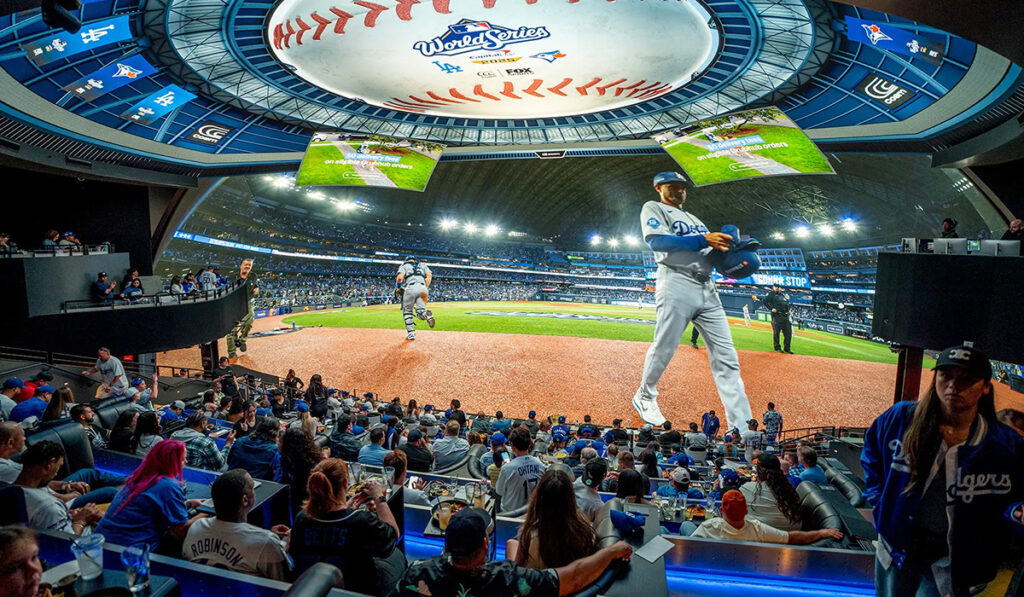
Sony acquired Alamo Drafthouse in 2024, placing the circuit inside a newly established Sony Pictures Experiences division. In June, the company made a USD $100 million strategic investment in Cosm, the immersive entertainment company whose Shared Reality venues combine large-scale visual technology with live sports, entertainment and social hospitality. The Dome deal now adds one of cinema’s most famous physical venues to that portfolio.
The deal therefore provides the clearest answer yet to a question that followed Sony’s acquisition of Alamo: What does a major studio actually intend to do with a cinema circuit?
Apparently, restoring the Cinerama Dome is part of the answer.
Preserving the Dome, Reimagining the ArcLight
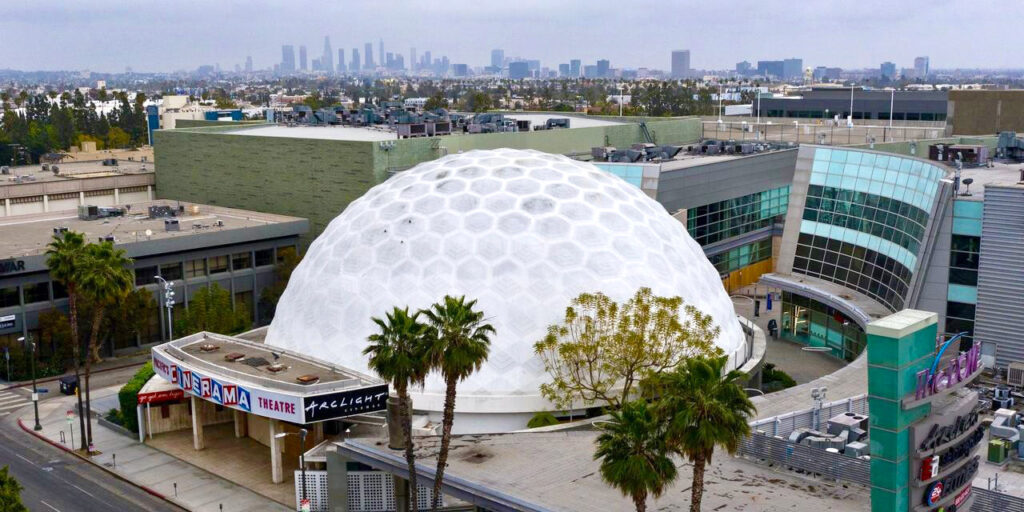
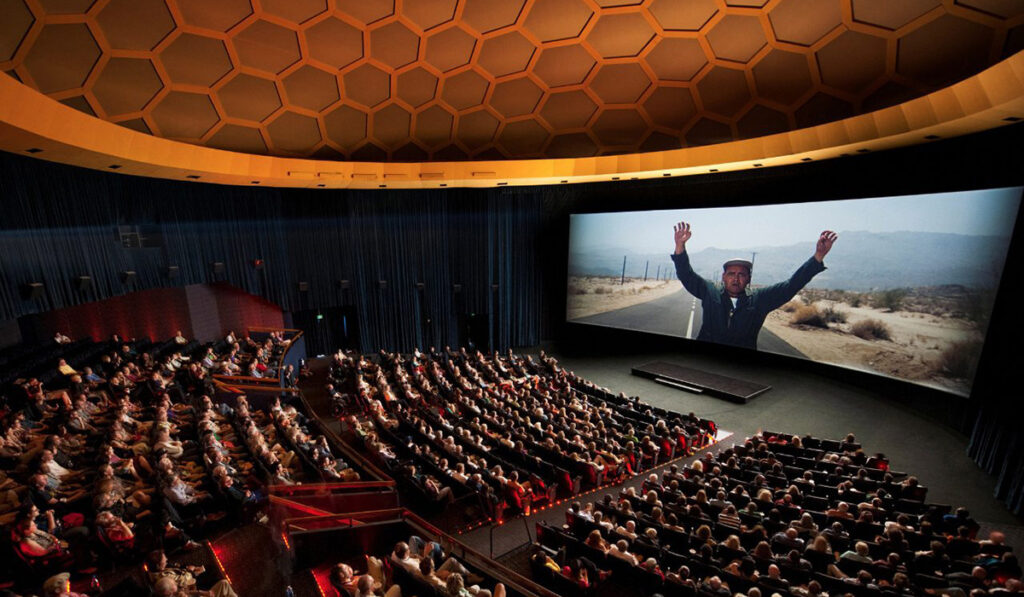
Sony says the approximately 86-foot-wide, deeply curved screen inside the Dome will remain central to its large-format presentation, while the Cinerama name and exterior branding will be preserved. The auditorium will not be converted into an Alamo-style dine-in cinema. Instead, it will maintain a traditional concession operation while adding Alamo’s repertory programming, filmmaker series, premieres and special events.
That is probably the right decision. Moviegoers have waited long enough to return to the Dome without also wondering whether a server will cross in front of them during the chariot race in “Ben-Hur.”
The adjoining 14-screen multiplex will operate very differently. It will become a full Alamo Drafthouse with dine-in service and curated programming. Sony says the complex will retain 35mm capabilities for archival prints and include premium auditoriums with immersive audio, 4K laser projection and 70mm presentation.
That split creates a potentially powerful hybrid.
The Dome can remain the architectural landmark and prestige event venue, while the former ArcLight becomes the larger commercial engine: a modern Alamo capable of playing mainstream releases, independent films, repertory titles and premium-format engagements across multiple auditoriums.
The famous white geodesic roof will inevitably attract most of the attention, but the adjoining multiplex may be just as important to the long-term viability of the project. Without it, Sony and Alamo would be restoring a historic single-screen venue. With it, they are creating a fully functioning Hollywood cinema complex.
Michael Kustermann, CEO of Alamo Drafthouse and head of Sony Pictures Experiences, called the location the circuit’s “new West Coast flagship.” That description is not marketing hyperbole. Alamo currently operates only one other Los Angeles venue, a 10-screen cinema in Downtown Los Angeles.
Variety reports that Decurion’s Robertson Property Group will retain ownership of the Hollywood real estate, with Sony operating the cinemas under a lease agreement.
For Alamo, the location solves a particularly Los Angeles problem.
Its Downtown cinema has built a devoted following, but Downtown is not equally convenient for moviegoers scattered across a city where a short distance on a map can turn into a considerable block of one’s afternoon. Los Angeles cinephiles will cross town for the right film, of course. That does not mean they enjoy doing it.
A Hollywood location gives Alamo a more central and visible presence near a large concentration of film enthusiasts, filmmakers, studios and entertainment-industry professionals. For a circuit built around distinctive programming, presentation standards and treating movies as events, there may be no more appropriate address.
The city’s cinephile population is likely to greet the arrival of Alamo in Hollywood with something close to jubilation; assuming everyone can remain patient until 2028.
More Than a Multiplex
What disappeared in 2020 was not simply a 15-screen cinema complex.
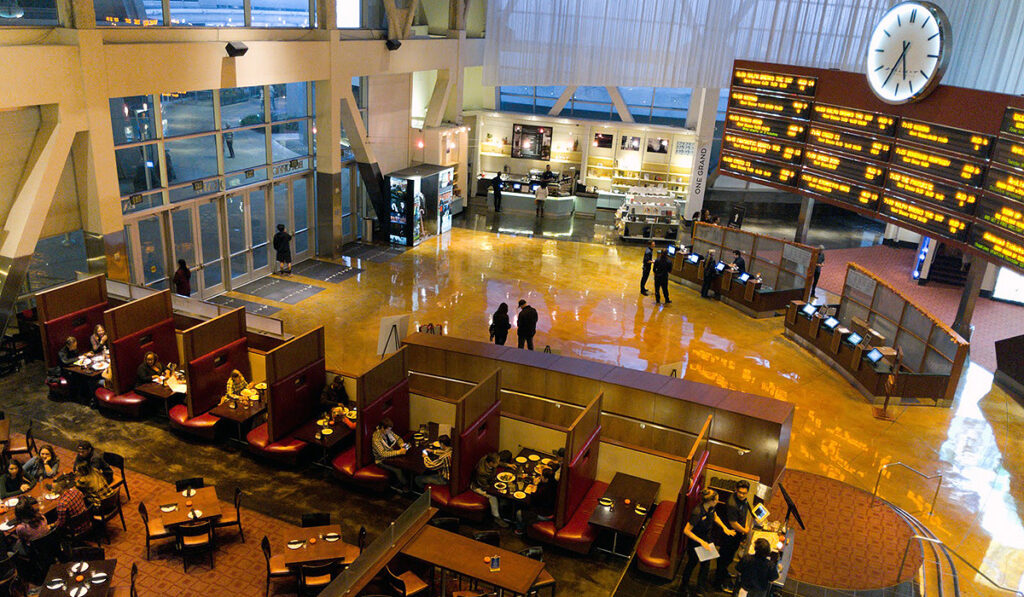
ArcLight Hollywood functioned as one of Los Angeles’ principal moviegoing town squares. It hosted premieres, press screenings, filmmaker appearances, festivals, industry events and awards-season gatherings. Its enormous lobby and adjoining café gave people somewhere to meet before a film, continue arguing about it afterward or discover that the person standing beside them in the concession line had directed it.
When Celluloid Junkie selected ArcLight Hollywood as its Cinema of the Month in 2017, we noted that the complex was important not because its amenities still seemed revolutionary, but because so many of them had become commonplace precisely because ArcLight helped popularize them.
When the multiplex opened in 2002, reserved seating was not yet standard across North America. Neither were spacious lobby bars, full-service cafés, cinema retail areas or the idea that audiences might arrive early and remain after the credits. ArcLight also became known for refusing late seating, eliminating most preshow advertising and having staff members personally introduce each feature before it began.
These details helped create a cinema designed less around processing customers and more around people who cared deeply about what was being shown and how it was presented.
“For many Angelenos,” we wrote at the time, “if they couldn’t see a new release at the ArcLight, then it wasn’t worth seeing.”
That may have been an exaggeration, but only slightly.
The loss was particularly acute for the local film community. ArcLight Hollywood was close enough to the studios to be useful, large enough to accommodate major events and prestigious enough that audiences actually wanted to attend them. Festivals could take over multiple auditoriums while using the lobby, bars and surrounding spaces for receptions and filmmaker gatherings.
The Dome gave the complex its iconography, but ArcLight gave it daily relevance.
That distinction is important as Alamo prepares to take over the site. The question is not simply whether Alamo can reopen the auditoriums. It is whether the circuit can restore the complex’s role as a gathering place while introducing its own programming culture and operating model.
Alamo is one of the few exhibitors whose brand is strong enough to make that transition plausible. Its identity has always extended beyond dine-in food service. The circuit grew out of repertory programming in Austin, operates Fantastic Fest and the American Genre Film Archive, and has spent nearly three decades cultivating audiences around themed screenings, filmmaker events and a deliberately theatrical approach to moviegoing.
Still, ArcLight Hollywood was not simply an empty multiplex waiting for a new sign. It had its own culture, rituals and loyal audience. The strongest version of the new complex will combine Alamo’s programming instincts with the presentation discipline and social character that made ArcLight influential in the first place.
Sony’s Experiences Strategy Becomes Visible
Sony’s acquisition of Alamo was initially notable because it placed a major Hollywood studio back in direct ownership of a significant cinema circuit.
Sony was not new to exhibition. It previously owned Loews Theatres and later held a substantial stake in Loews Cineplex. But the Alamo deal marked its return to the sector after more than two decades.
At the time, Sony said Alamo would remain open to films from every studio and distributor while becoming the foundation of Sony Pictures Experiences, a division focused on engaging entertainment fans outside the home.
That mandate was broad enough to mean almost anything.
The company’s Cosm investment made the direction clearer. Sony described Cosm as sitting at the intersection of technology, fandom and physical entertainment, with potential to extend film, television, music and gaming properties into immersive shared experiences. Cosm primarily presents live sports and other events inside large domed environments rather than operating conventional cinemas.
The Cinerama Dome occupies a different end of the experiential spectrum. It does not require inventing a new entertainment format because the experience already exists. Its value comes from being singular, historic and impossible to duplicate through an app or home-entertainment system.
Together, Alamo, Cosm and the Dome suggest Sony is assembling a portfolio rather than following a single model. Alamo provides a national cinema circuit and dedicated audience community. Cosm provides immersive technology and large-scale live experiences. The Cinerama Dome supplies history, prestige and a physical connection to Hollywood itself. The Los Angeles Times also placed the Dome deal within that sequence of Sony’s Alamo acquisition and USD $100 million Cosm investment.
For Sony, the value lies in having a permanent Hollywood venue through which its theatrical, television, anime, gaming and other entertainment businesses can connect directly with audiences. The complex can host studio premieres and fan events without becoming a Sony-only showcase, while its everyday operation remains grounded in Alamo’s broader programming identity.
That distinction matters.
The circuit’s credibility depends on programming films from throughout cinema history and supporting releases from every distributor, not merely filling screens with Columbia Pictures catalog titles. Turning the complex into a permanent Sony promotional pavilion would undermine much of what made Alamo attractive in the first place.
Sony now possesses a highly visible platform through which it can demonstrate what it means by “experiences” without abandoning the core theatrical business.
Six Years Is a Long Time for a Cinema to Sit Dark
For all the understandable celebration surrounding the announcement, early 2028 remains some distance away.
The extended renovation schedule suggests the project involves considerably more than replacing carpets and testing the popcorn machines. Cinemas do not generally improve while sitting unused, and the Dome and ArcLight complex have been dormant since March 2020.
Sony has not disclosed the renovation budget, the current condition of the auditoriums or which projection and sound systems remain onsite. It has also not said whether the Dome’s deeply curved screen can be restored or must be replaced, nor whether the venue will retain its ability to present three-strip Cinerama.
Those questions matter because the Dome was once equipped to handle an unusually wide range of formats.
During CJ’s 2017 visit, the auditorium had Christie Mirage 4K digital projection, Dolby Atmos, Kinoton film projectors capable of screening 35mm and 70mm, and a restored three-projector Cinerama installation with seven-channel stereophonic sound. What remains of that equipment nearly a decade later, and after six years without regular operation, is unknown.
The building’s designation as a Los Angeles Historic-Cultural Monument adds another layer of complexity. The landmark status protects the exterior rather than every interior element, but any substantial restoration of a venue this distinctive will still require balancing preservation, modern building standards and contemporary audience expectations.
Sony has promised to preserve the Dome’s aesthetic character, curved-screen presentation and traditional concession experience. That is encouraging. The real test will be whether the company can retain the qualities that make the auditorium unique while delivering the comfort, accessibility, projection brightness, sound quality and operational reliability expected of a modern marquee venue.
There will be ample opportunity to examine those decisions as the restoration moves forward. For now, the length of the schedule may be the clearest indication that Sony and Alamo recognize the scale of what they have taken on.
Los Angeles Reinvests in Its Historic Cinemas
The Cinerama Dome is also part of a broader wave of investment in Los Angeles’ historic movie palaces and landmark cinemas.
In Westwood, the Village Theatre is preparing to close for a year-long restoration under the ownership of the Village Directors Circle, a filmmaker group that includes Jason Reitman, Christopher Nolan, Emma Thomas and Steven Spielberg. The American Cinematheque is expected to operate the venue, with plans for new releases, retrospectives, filmmaker conversations, awards events and festival programming when it reopens.
The cinema recently received a 70mm send-off with Christopher Nolan’s “The Odyssey” before beginning the renovation
In Hollywood, Netflix completed a reported USD $70 million restoration of the Egyptian Theatre before reopening it with the American Cinematheque in 2023. The venue temporarily closed again this summer for further technical upgrades and is expected to return in the fall.
The ownership and operating models differ, but all three projects rest on the same premise: historic cinemas are not merely sentimental artifacts.
Properly operated, they can be strategic cultural assets; venues for premium presentation, premieres, repertory programming, festivals, fan engagement and events that ordinary multiplexes cannot easily reproduce.
That distinction may be increasingly important as exhibitors search for experiences capable of competing not only with home entertainment, but with every other use of an audience’s time and money.
The Village does not need to compete with a suburban multiplex on convenience. The Egyptian does not need 14 screens. The Cinerama Dome does not need recliners, mobile ordering or an endless menu.
Each needs to offer something audiences cannot get anywhere else.
In Sony and Alamo’s case, the adjoining multiplex may provide the commercial foundation that allows the Dome to remain singular.
Tom Rothman, chairman and CEO of Sony Pictures Motion Picture Group,thankfully summarized the enthusiasm less formally than most corporate announcements tend to allow: “Hot damn! We’re bringing the Dome back, baby.”
For once, the exuberance seems justified.
Sony is not simply adding another Alamo Drafthouse to its circuit. It is reviving a missing piece of Los Angeles movie culture, creating a showcase for its expanding experiences strategy and returning an important gathering place to one of the world’s most cinema-obsessed cities.
For a city built on movies, Hollywood has spent six years without one of its most important places to see them.
The wait is not over, but at least there is finally a date on the marquee.

- Cinema Owners Have Invested $2.7 Billion in Theatres. What Is That Money Buying? - October 1, 2026
- The Paramount-Warner Merger Is Permanent. The Guardrails for Movie Theatres Are Not - September 22, 2026
- Cinemas Aren’t Just Marketing Movies Anymore. They’re Marketing Auditoriums - September 15, 2026