



As consolidation, shifting release windows and funding pressure reshape the film business, IND/EX 2026 showed independent exhibitors and festivals organizing around community value, operational resilience and a stronger collective voice.
While much of the global exhibition business gathered in Barcelona for CineEurope, independent cinema operators, art house leaders and film festival allies from across North America met in Chicago for a very different kind of industry conversation.
Organized in partnership, and in something close to spiritual kinship, by Art House Convergence (AHC) and Film Festival Alliance (FFA), IND/EX 2026 brought together the independent exhibition and festival communities for four days of “community education, networking, and industry advancement.” Presented by marquee sponsor Filmbot, the event marked the partners’ second Independent Film Exhibition Conference, following the inaugural edition in 2024 and a standalone Art House Convergence meeting last year.
This year’s event drew 788 registered delegates, up from 728 in 2024, and reflected a sector increasingly focused not only on programming and audience development, but also on sustainability, advocacy, accessibility, staffing, funding and the role independent cinemas play in their communities.
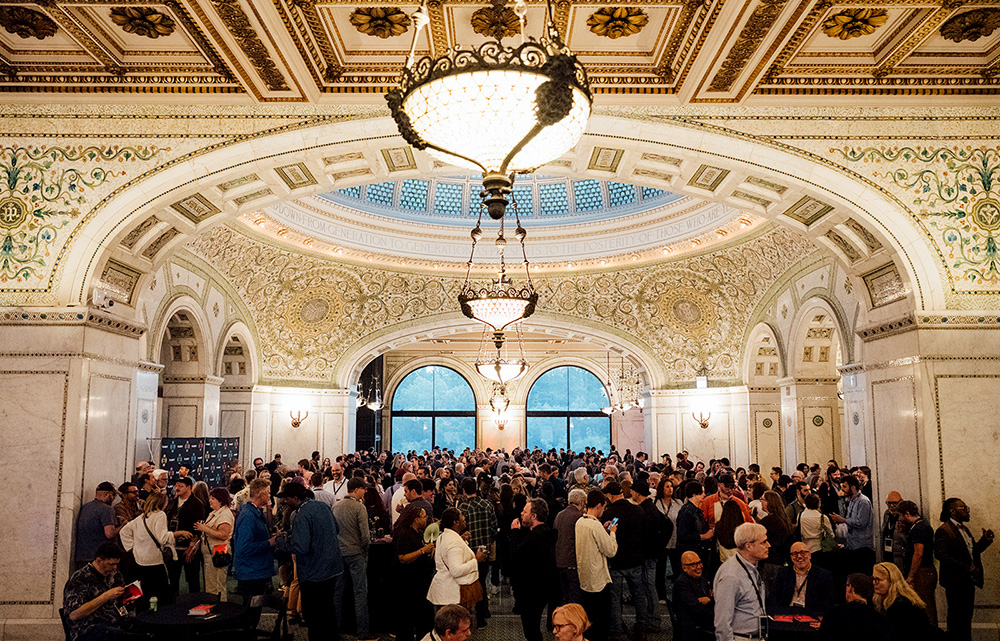
“This conference is not simply another industry gathering,” Natasha Olguin, deputy commissioner of the Chicago Film Office, told delegates during opening night at the landmark Chicago Cultural Center. “IND/EX represents something far more significant. It is where the leaders, visionaries and builders who sustain independent cinema come together to shape its future.”
A Conference Built Around Practical Survival
According to the conference program, IND/EX 2026 was “dedicated to advancing the reach, impact, and sustainability of independent exhibitors and film festivals.” Across its sessions, workshops and networking events, the program reflected the practical realities facing organizations that often operate with limited staff, complex missions and deep community expectations.
The language of IND/EX was notably different from the product pitches and studio presentations that define many larger exhibition gatherings. Its sessions promised “Allies in Audience Building,” “Turning Conversations into Connection,” “Making Membership Mutually Beneficial” and, before everyone headed back into the daily work of keeping independent cinemas and festivals alive, “a collective exhale.”
Sessions covered marketing, programming, operations, accessibility, development, leadership and education, with topics ranging from “Demystifying Grants” and “Real-Time People Management Solutions” to professional biography crafting, media training and improving your improv skills. Other workshops focused on “Thinking Beyond the Gala” for fundraising — valuable for the primarily non-profit organizations in attendance — as well as strategic planning and programming beyond traditional theatres through pop-up cinema and non-traditional exhibition spaces.
IND/EX workshops guided participants all the way from “How to Open an Art House” (case study with plans for the Uptown Film Center in Manhattan through “A Well Planned Future,” and right “Back to the Heart of Cinema.”
The breadth of the program reflected the reality of the independent sector: programming remains central, but running an independent cinema or festival today also means understanding fundraising, data, community engagement, staff development, government relations and audience care.
Ethics, Access and Audience Care
Special emphasis was given throughout the conference to what IND/EX framed as “The Ethics of Exhibition,” including presentation integrity, labor, accessibility and community accountability.
One session asked what the film industry could learn from health and human services, particularly around empathy, safety and awareness in cinema programming and the moviegoing experience. Another addressed immigration concerns, offering best practices for organizations that may need to understand the rights of their businesses, employees and attendees in uncertain situations.
These conversations reflected a broader shift in how many independent cinemas and festivals define their role. If CineEurope often speaks in the language of investment, technology and market share, IND/EX frequently spoke in the language of care: empathy, safety, access, labor, accountability and enrichment. None of this made the gathering any less practical. It simply made clear that, for many organizations rooted in local communities, exhibition is not only a transactional business. It is also a public-facing civic and cultural space.
That theme carried into a session on “The Ecology of Enrichment,” where panelists explored how art house cinemas and film festivals can move beyond the “cold, transactional nature of commercial entertainment.”
Equally indicative, one workshop suggested “To Write That Down: Refinement for Immigration Concerns.” Such best practices were shared throughout the convention, and not only for “dealing with unexpected agents in your spaces and understanding the rights your business, employees, and attendees have.”
During CineEurope, the same subject would likely have been framed differently. Nonetheless, the more business-oriented people in Barcelona would likely agree with IND/EX participants on the importance of audience feedback, participation and creating enriching cinematic experiences that support long-term sustainability.
Whether framed as art, commerce or community service, the answer increasingly points in the same direction. Cinemas have to give audiences a reason to feel connected to the cinema itself.
Can Mission Drive Revenue?
That tension between mission and revenue surfaced directly in a discussion among leaders from programming, finance and development. The premise was familiar to many in the room: mission and revenue goals do not always point in the same direction.
Emelyn Stuart, an AHC board member and owner-operator of Stuart Cinema & Café in Brooklyn, New York, offered a different view.
“The mission brings in the money,” Stuart argued. The key, she explained, is to answer a simple question: “What does the community need?”
For Stuart, that approach includes listening to the community, keeping prices accessible and treating the cinema as more than a place to sell tickets. During the pandemic, Stuart Cinema & Café was declared an “essential” resource hub by the Governor, after supporting neighborhood residents in ways that included giving away leftover food and helping facilitate virtual viewings of burials across the country.
Today, that community commitment extends to affordability, including a full menu where every item is priced below USD $10, and a taste for conviviality that includes evenings with a free shot of whiskey for filmgoers.
“I believe that you can be a for-profit business and do good — and still make money,” Stuart observed.
The Numbers Behind Independent Cinema’s Resilience
The latest audience data presented at IND/EX suggests that Stuart’s point is more than anecdotal.
Feedback collected from more than 27,000 moviegoers for Art House Convergence found that more than 70% of respondents say their preferred art house destination is “very” or “extremely valuable” to their overall quality of life. Meanwhile, 91% agree that their theatre “elevates the experience of being in this community.”
The survey was conducted for AHC by independent market researchers at Avenue ISR, with additional field data from Rentrak.
“Independent theatres show impressive revenue-generating horsepower,” Paul Dergarabedian, head of marketplace trends at Rentrak, noted. “Put into circuit terms, they would collectively represent the 13th largest grossing group of cinemas year-to-date in the United States. Independent cinemas that are part of Art House Convergence have seen an 8.8% uptick in year-over-year grosses, and an impressive 38% over 2019.”
The survey also showed that respondents attend more than 10 films annually at their preferred art houses, which represents 55% of their overall moviegoing habit. While that figure has remained steady over the last two years, art houses continue to attract new and younger guests. Nearly a quarter of respondents, 24.9%, first began attending their preferred art house within the last three years. Their average age is 40, compared with the overall respondent average of 51, and 68% of recent attendees are younger than 45.
“Art house cinemas are vital gathering spaces, and an essential component of today’s independent film ecosystem,” Lela Meadow-Conner, AHC’s interim executive director, remarked during the presentation of the results. “Our latest survey proves that audiences continue to rally around their local independent theatres, and despite current challenges, like shifting theatrical windows, media consolidation and arts funding pressure, moviegoer support for art houses continues to grow.”
Film festival attendance is also showing signs of durable growth. Eventive, the independent film ticketing and streaming provider and an IND/EX sponsor, shared five years of sales data covering 15 million tickets since 2020. According to the company, the “post-COVID bounce” has settled into a higher baseline for the sector, defined by deeper engagement.
Average revenue per ticket climbed to its highest level yet, exceeding USD $13 in 2025, while capacity utilization has consistently surpassed pre-pandemic benchmarks, averaging in the mid-50% range.
“Audiences are not merely returning; they are placing a higher value on the shared cinematic experience than ever before,” Iddo Patt, Eventive’s co-founder and CEO, stated. “Whether it’s at the movie theatre and in-person events, virtual screenings, or the intelligent application of new technology, our common goal remains the same: bringing people together around the power of film.”
A Collective Voice for Independent Cinema
For Deirdre Haj, president of AHC, one of the primary goals of the gathering was simple: to recognize the people doing the work.
The conference, she explained, was a way “to say thank you to all the people that work in the cinemas. Without them we do not know who we are as an organization.”
Haj, who also served as the first vice president of FFA at its founding, said the partnership between independent cinemas, festivals and distributors has become increasingly important at a time when independent distributors remain under pressure.
“When we see independent distributors under pressure, getting bought and disappearing, it is incredibly important to bring them closer to the cinemas,” Haj urged. “We must work to shorten the distance between the cinema and the independent filmmaker, who may or may not have distribution.”
Haj also emphasized the need for independent cinemas and festivals to speak with a more unified voice, particularly as the broader media and entertainment business continues to consolidate. Government officials, she argued, often understand the for-profit theatrical model better than they understand independent cinema.
“Those big chains, they have customers,” Haj stated. “We have communities. That’s who we are.”
That distinction, she suggested, matters when policymakers are considering issues that affect film access, repertory programming, independent distribution and the future shape of the film ecosystem.
The more AHC and FFA members contribute to their organizations, Haj encouraged her colleagues, the better those organizations can advocate on behalf of the sector. “We need more movies, not fewer. We need more partner companies, not less. Corporate mergers do not help the public.”
Karen Cardarelli, president of the FFA board and executive director of Facets Film Forum in Chicago, made a similar case for continued collaboration.
“When festivals and cinemas unite, our influence rises, our advocacy strengthens, and our collective voice becomes impossible to ignore,” Cardarelli noted during her opening night remarks. “Not long ago, many of us were wondering what the future of our organizations was going to be. But today, we are not just celebrating a recovery. We are celebrating a remarkable comeback.”
For independent cinemas and festivals, IND/EX 2026 was not simply a conference about survival. It was a signal that the sector is increasingly organizing around a broader proposition: community is not just the emotional value independent cinemas provide. It may also be their strongest business argument.
