


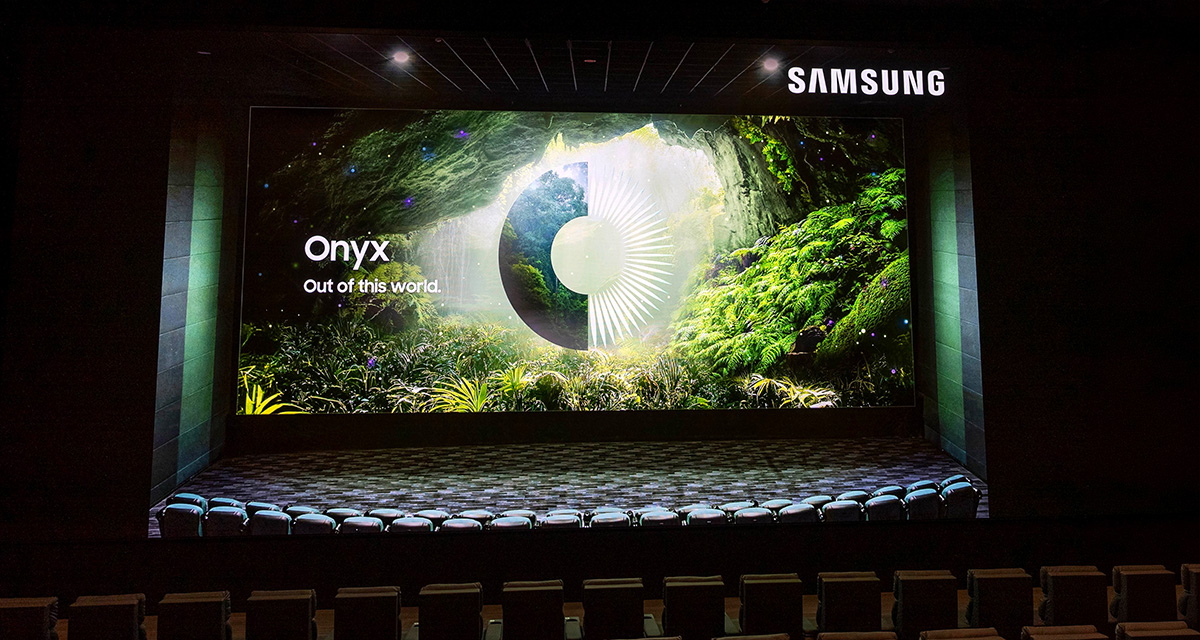
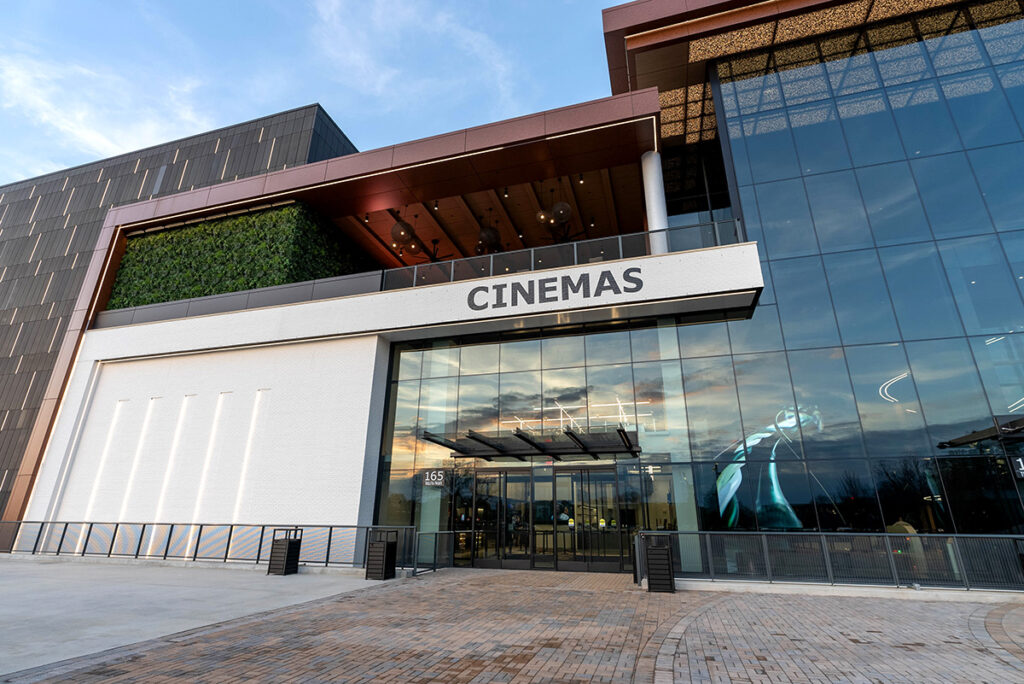
There is something almost too tidy about the geography of Samsung’s latest cinema showcase. Directly across the street from Trilith Studios in Fayetteville, Georgia — one of the largest production facilities in the United States outside Hollywood — sits Trilith Cinemas, a new nine-screen luxury complex where Georgia Theatre Company has made a substantial bet on Samsung’s Onyx direct-view LED technology.
On one side of the road, content is made. On the other, Samsung would very much like the industry to believe it is showing exhibitors and filmmakers how that content should be seen.
The theater quietly began operating in December 2025 with a grand opening in February as part of the broader Trilith Live entertainment development, bringing a premium multiplex to a community increasingly associated with film and television production. But the real story inside the complex is not the recliner seating or the luxury lounge. It is Samsung’s direct-view LED cinema technology installed across multiple auditoriums — including a flagship 14-meter (approximately 46-foot) Onyx screen — representing one of the most ambitious deployments of the format in the United States.
For Samsung, the point is not simply that Onyx looks impressive. That argument has been made before. The more important message is that the company believes cinema LED has moved from an intriguing premium outlier toward something that can scale in more practical ways across exhibition.
Samsung first introduced Onyx in 2017, positioning the system as the world’s first cinema LED display designed to replace traditional projection entirely. Instead of projecting an image onto a reflective surface, the screen itself produces the picture through millions of LED pixels. The result is striking — higher brightness, deeper blacks and color reproduction that conventional projection systems struggle to match.
But the earliest installations also revealed the challenges. The systems were expensive, installation requirements were complex and the industry had yet to develop technical standards tailored specifically to LED cinema screens. In practice, the technology often appeared as a technological showcase rather than a realistic platform for widespread exhibition.
Nearly a decade later, Samsung believes the equation has changed.
Trilith offered Samsung a particularly fitting proving ground. The cinema sits within the broader Trilith development, a rapidly growing production hub that has hosted major film and television projects ranging from Marvel productions to independent features. For Georgia Theatre Company, the proximity to working filmmakers made the idea of showcasing a next-generation presentation format especially appealing. If cinema LED is meant to represent the future of theatrical image quality, there are few places where that argument carries more symbolic weight than across the street from where many of those images are created.
From Showcase Screen to Multiplex Platform
When Onyx first appeared in cinemas, it was often installed as a single flagship screen intended to demonstrate what LED presentation could achieve. But multiplex operators rarely have the luxury of designing a theater around a single technology.
Auditoriums vary widely in size, layout and structural limitations. A premium format that can only function in a narrow set of circumstances will struggle to move beyond niche installations.
That reality is one reason Samsung redesigned the Onyx platform in recent years. The latest generation is offered in standard configurations — including 5-meter, 10-meter and 14-meter screens — but now extends beyond fixed sizes. The new scalable options allow exhibitors to fit screens from 5 to 20 meters and adapt the technology to different auditoriums within the same complex.
Samsung says that flexibility was a direct response to what the company learned from early installations.
“We started with Onyx about six or seven years ago,” said Jonathan del Rosario, Head of Product for Display Solutions at Samsung Electronics America. “What we learned is that installations have very different requirements depending on the space. With the newer generation we made it more scalable and lighter weight so it can be installed in more theaters.”
The approach reflects a subtle shift in Samsung’s strategy. Instead of positioning Onyx as a singular “hero screen,” the company increasingly frames the technology as a platform that could operate across multiple auditoriums within a multiplex.
Trilith Cinemas offers a glimpse of what that might look like in practice.
The Standards That Made It Possible
Another development quietly reshaping the cinema LED conversation is the emergence of Digital Cinema Initiatives (DCI) specifications tailored precisely to the technology.
When the first direct-view LED screens arrived, they were evaluated using standards designed for projection systems — an imperfect fit that created uncertainty among exhibitors and studios alike.
In recent years, however, DCI introduced formal requirements for cinema LED displays, bringing the format into closer alignment with the technical framework governing digital cinema distribution.
Tony Adamson, senior vice president of strategic planning at GDC Technology, says the lack of standards was a major barrier in the early years.
“There were no specifications for this screen when they first came out,” Adamson said. “Now there are very strict specifications that Samsung needs to meet.”
Samsung’s latest Onyx systems meet those requirements, something exhibitors increasingly view as a prerequisite for serious consideration.
Bo Chambliss, president of Georgia Theatre Company, said that factor was critical when evaluating the technology.
“We wanted the LED screen, if we were going to put it into a cinema, to be DCI compliant,” Chambliss explained.
From a technical standpoint, the current Onyx platform delivers performance specifications consistent with modern digital cinema, including a DCI-P3 color gamut and standard brightness levels of 14 foot-lamberts. The system is also capable of significantly higher brightness levels for high dynamic range presentation meeting the HDR-1 specification..
More importantly, the technology now operates within the same standards framework that governs traditional projection.
For many exhibitors, that shift marks the point where cinema LED begins to move from curiosity to legitimate alternative.

Rethinking the Projection Booth
Beyond image quality, cinema LED may eventually influence the architecture of movie theaters themselves.
Traditional projection systems require a dedicated booth positioned above or behind the auditorium. Direct-view LED displays generate the image directly on the screen surface, eliminating the need for a projector altogether.
For William J. Stembler, founder and chairman of Georgia Theatre Company, that change carries implications that extend beyond the picture itself.
“The booth does not have to be as elaborate as it once was,” Stembler said, reflecting on how new presentation technologies are beginning to reshape the physical design of cinemas.
The impact is not necessarily immediate. Existing buildings were designed around projection systems, and LED installations can require significant infrastructure of their own.
Christopher Simpson, senior business development manager at Samsung Electronics America, says the installation process remains more involved than simply swapping out a projector.
The infrastructure to put it in is a little more extensive and the time to install it is longer,” Simpson said. “But once installed, the product’s longevity is strong and maintenance needs and cost are minimal, helping reduce the total cost of ownership over time.”
Samsung points to early Onyx installations that have operated for years with minimal maintenance as evidence that the technology could eventually offer operational advantages over traditional projection systems.
For exhibitors accustomed to lamp replacements and projector servicing cycles, that durability could become a meaningful factor in the long term.
The Sound Question That Won’t Go Away
For all the progress Samsung has made with Onyx, one issue continues to generate debate within the industry: audio.
Traditional cinema screens are perforated, allowing speakers to sit directly behind the image. Direct-view LED screens are solid structures, meaning speakers must be positioned around the display instead.
That difference has led to ongoing discussions among engineers and exhibitors about how best to maintain accurate sound localization.
Del Rosario acknowledges that this remains an area of active development with growing interest.
“We continue to work closely with our partners to refine how high-quality audio can be delivered alongside the LED screen to provide a more immersive experience,” del Rosario said.
Exhibitors have addressed the challenge in different ways, typically through specialized speaker placement and careful acoustic design.
For most audiences the difference may be subtle, but for filmmakers and sound designers accustomed to traditional cinema audio layouts, the question of acoustically transparent LED displays remains unresolved.

The Economics of a Premium Experience
The debate around cinema LED is unfolding at a moment when exhibitors are increasingly focused on premium experiences as a way to differentiate theatrical presentation from streaming. Across the industry, formats that offer brighter images, larger screens or more immersive environments have become central to cinema operators’ efforts to bring audiences back into theaters.
Ultimately, the adoption of any new exhibition technology comes down to economics.
Despite the cost decreasing by over 50% since first being introduced, Samsung is not presenting Onyx as a cheaper alternative to projection. Instead, the company positions the technology as a premium format capable of generating additional revenue through enhanced presentation and differentiated experiences.
That strategy aligns with a broader shift across the exhibition industry. As streaming platforms continue to compete for audiences at home, cinemas have increasingly leaned into premium formats that offer something viewers cannot easily replicate in their living rooms.
Chambliss believes the technology could eventually play a role in that evolving landscape.
“I do believe that other exhibitors are going to want to do direct-view LED once they see what this experience offers,” he said.
Samsung tends to frame the opportunity in similar terms.
“It’s less about the savings for Onyx and more about the excitement and revenue generation for the theater,” del Rosario said.
In other words, the company views LED not as a replacement for projection in every auditorium, but as another tool for exhibitors seeking to differentiate the theatrical experience.
A Showcase, If Not Yet a Verdict
The installation at Trilith Cinemas represents an important milestone for Samsung’s cinema ambitions. It places Onyx inside a modern multiplex environment, across multiple auditoriums, and in a market closely tied to film production.
But one installation does not define a technological future.
Cinema LED remains expensive, installation can be complex and the installed base worldwide remains small compared with the tens of thousands of projection systems currently operating in theaters.
What Trilith demonstrates, however, is that the conversation around the technology is beginning to shift.
Direct-view LED is no longer confined to experimental showcases or trade-show demonstrations. It is starting to appear inside real multiplex environments, positioned alongside established premium formats and competing directly for audience attention.
Whether cinema LED ultimately becomes a widespread replacement for projection remains uncertain. The industry has seen many technologies arrive with similar promises.
But if Samsung succeeds in turning installations like Trilith into repeatable models for exhibitors, the company may finally have moved the format beyond novelty.
And for a technology that has spent nearly a decade searching for its moment, that shift may matter more than any single installation.

- Can Cinema LED Scale? Samsung Bets Trilith Cinemas Can Help Prove It - March 24, 2026
- A Quiet Player Makes a Big Move: Qube Cinema Acquires Arts Alliance Media - February 23, 2026
- As Sundance Says Goodbye to Park City, Its Films Look Forward - January 21, 2026