


Under the winter sun in Panaji, Goa, where palm trees and festival banners spill out along the Mandovi River, the 56th International Film Festival of India (IFFI), which took place 20–28 November, once again felt like one of Asia’s most vital A-list gatherings. The industry-focused Waves Film Bazaar, held nearby at the Marriott Bonvoy and “powered” by Netflix, added its usual caffeine of micro-dramas, AI chatter, VFX demos and shifting market forecasts. The atmosphere was warm, organised and just glamorous enough — a place where serious conversations manage to feel surprisingly approachable.
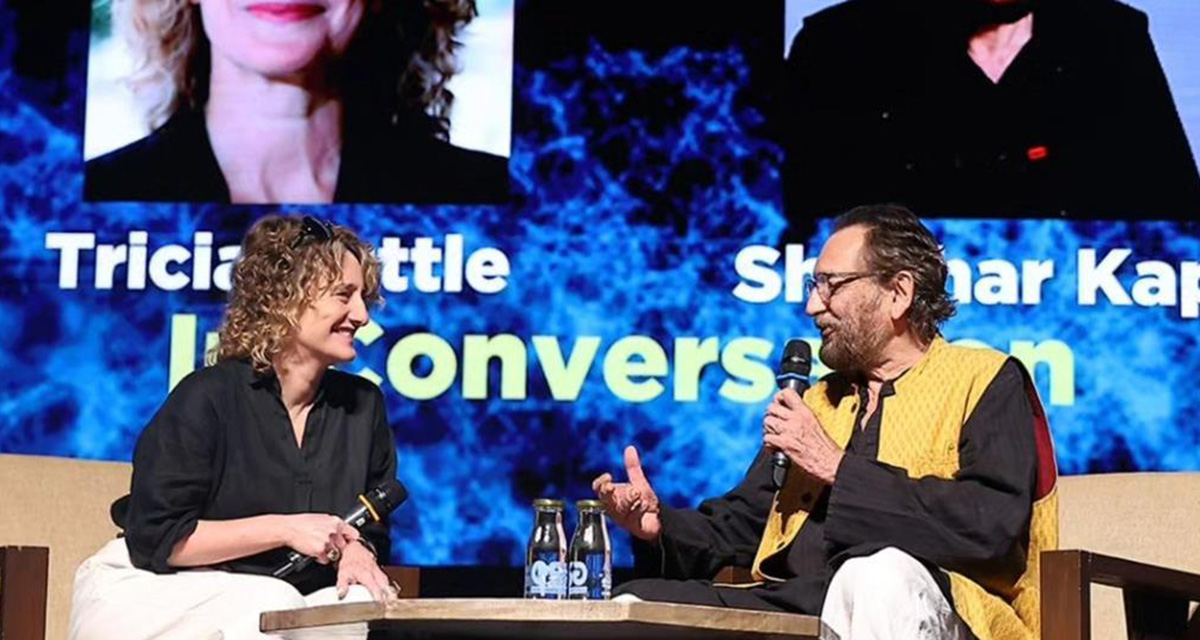
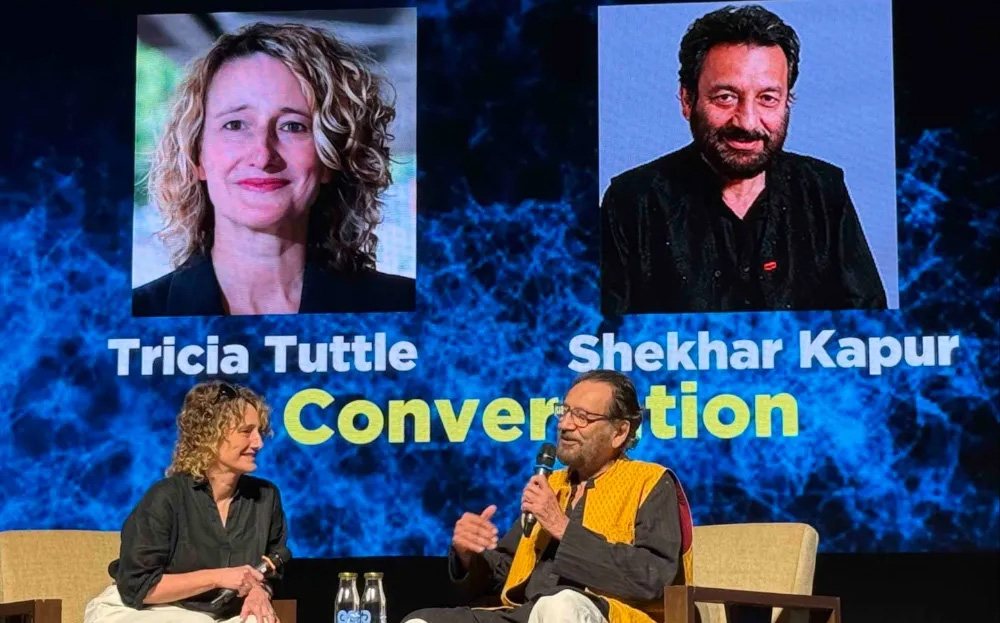
One of the most anticipated of those conversations took place on 22 November at the Kala Academy. Filmmaker and IFFI festival director Shekhar Kapur sat opposite Berlinale head Tricia Tuttle for a candid, often provocative exchange on storytelling, technology and how festivals and exhibitors might survive the next decade.
AI’s Disruption Cycle
Kapur began by placing AI within a familiar cycle of disruption. Resistance to digital once felt existential, he reminded the audience, yet “we never had reality. It was the film look, and we loved it. Now we’ve got AI and it will very soon go into an art form, like digital did.”
His most striking claim was financial. According to Kapur, AI will collapse production budgets to an extent that could change who gets to make films in the first place. “A film that cost $300 million will now cost $3 million. And if you do it in AI, it’ll probably cost half a million or even less. It’s so democratic right now.”
The argument is compelling — but also incomplete. Yes, cheaper tools widen the entry point. Yet the industry has barely begun to address what that democratization means for the thousands of artists, VFX workers and craftspeople whose jobs rely on the very processes AI seeks to streamline. It’s a paradox that hovered over the panel but never quite landed: the technology that opens a door for some may close it for many others.
Tuttle shared Kapur’s sense of possibility while injecting a dose of curatorial realism. Lower barriers to entry do not automatically yield better films. “It doesn’t mean all of a sudden that we’re going to get 2,000 better films,” she said. “The tools are not what make a film good. It’s the ideas, the craftsmanship.”
Her vantage point is particularly revealing. “At the Berlinale, we see 8,000 submissions and we choose 200 films… We see a lot of very bad films.” With AI accelerating output, she warned, festival programmers could soon face an incoming wave that overwhelms even the most resilient selection teams. In such an environment, the role of critics — and increasingly, influencers and platform algorithms — may become crucial filters in a landscape overflowing with content.
Kapur later summed up his wariness of AI-polished perfection with a line that became the evening’s unofficial refrain: “Imperfect is beautiful. Perfect is very boring.” For him, the value of storytelling still lies in intuition, risk and what he called “the thrill of failure,” qualities he believes AI cannot replicate.

Kapur’s AI Project: “Warlord”
To illustrate the creative upside of AI, Kapur spoke about “Warlord,” an AI-generated series he has nurtured for a decade but only recently found a way to complete. “It took me 10 years to write that story,” he said, “but it took 10 days to put it together with AI tools.” Its jellyfish-inspired, self-healing spaceships became his shorthand for how fast world-building can evolve.
More radical still was his plan to release the project as open source. “You can take my story, my images and use them — create your own story out of it, adapt it. Could this become a seed that creates a rainforest?”
It’s a utopian sentiment, but also one that exposes an enormous blind spot. In a global environment where copyright laws are inconsistent and often unenforceable, open-sourcing a major cinematic property essentially means abandoning traditional notions of ownership. The legal and economic implications for filmmakers — especially those who rely on IP to sustain their careers — remain practically uncharted territory.
Kapur’s ambivalence about where such work might ultimately live — Netflix, Amazon, or an as-yet-unimagined AI-native platform — echoed a prediction heard elsewhere at Goa. Cannes Next head Sten-Kristian Saluveer suggested that AI will dominate not just high-concept experiments but also low-end, fast-turnover formats: commercials, shorts, previsualizations and even office romances and melodramas. The explosive rise of microdramas across Asia, some made for as little as USD $50–60k, signals how quickly that shift is already underway.
Exhibition’s Structural Limits
When talk turned to exhibition, Kapur highlighted India’s long-standing screen shortage. “Here, we only have 7,000–8,000 working screens. China has 90,000… The exhibition problem is real estate.” His conclusion was simple: without investment in distribution and bricks-and-mortar sites, no amount of AI-powered storytelling will reach its audience.
Tuttle, speaking from a European auteur-festival perspective, echoed the concern. Too few screens for risk-taking cinema; too much pressure from bigger titles. She praised Mumbai’s Regal cinema on their recent initiative to reintroduce classics to rebuild communal viewing — a reminder that innovation sometimes means looking backwards as well as forwards.
Yet any ambitious exhibition strategy now hangs over a broader industry shockwave: Netflix’s pending acquisition of Warner Bros, a deal that — if approved — could reshape global windowing entirely. More moves of similar scale cannot be ruled out. For exhibitors already fighting to maintain margins, such consolidation introduces yet another variable in an already fragile ecosystem.
AI at Festivals
Asked how a festival like the Berlinale intends to handle AI-assisted work, Tuttle said there is currently no plan for separate programming strands. The festival has begun asking filmmakers whether AI was used in any part of a submission, an early attempt to map usage patterns.
But mapping alone feels like a temporary fix. The industry still lacks a workable definition of what constitutes an “AI film.” A feature with minor AI-generated previz sits on the same spectrum as a fully synthetic production, yet the two present vastly different regulatory, artistic and ethical questions. Without clearer categories, any future rules risk becoming unenforceable.
For Tuttle, the core challenge remains discovery. “How will we, in a content-flooded market, find good-quality storytelling?” she asked, a dilemma made sharper by the fact that attention today is increasingly finite. Platforms shape audience habits as much as they respond to them, often pushing shorter, more hyper-stimulated formats that may not resemble what most festivals would recognize as cinema.
Kapur added his own sobering statistic, noting that in the US, “90–92% of viewership is TikTok, gaming and YouTube.” Traditional cinema and television, in other words, now command only a sliver of the attention economy.
Likeness Rights and Ethics
The session concluded with questions about personality rights and AI-resurrected actors. Kapur said many performers are already taking legal precautions. “Most of the actors I know are already dealing with lawyers and copyrighting themselves… and you should copyright yourself if you’re a star.”
Denmark has been an early mover in granting individuals copyright over their likeness, though how long such rights should last after death remains unsettled. Tuttle was clear about her own discomfort: “I love Paul Newman. I don’t want to see a Paul Newman film made with an AI version of Paul Newman.”
The ethical terrain here is vast. Resurrecting dead performers, making them speak or act without consent — even hypothetical consent via approval from a performer’s estate — touches on every fraught intersection of art, law and morality. AI-generated performers, entirely synthetic from the beginning, may sidestep some of these issues, but it’s unclear whether audiences would embrace them with the same affection they hold for human stars.
An Unresolved Future
For a conversation that ranged widely, optimism remained the prevailing mood. Yet some of AI’s most disruptive implications — labour displacement, enforceable copyright, content overload, and the structural weakness of global exhibition — were more acknowledged than interrogated. That may reflect the limits of a festival panel rather than a lack of interest, but the gaps were palpable.
Still, Kapur’s opening provocation lingered: cinema has weathered every major technological shift — from sound and colour to the jump from celluloid to digital. Each change brought panic and promise in equal measure. And history is equally clear that not every new tool rewrites the medium. Some innovations rise, shimmer briefly and vanish (NFTs, Odorama, and the many cycles of 3D among them).
Whether AI becomes another brief fashion or a fundamental redefinition of cinema is still impossible to say. For now, the debate continues — still imperfect, still searching, and perhaps, as Kapur insisted, beautiful precisely because of that.

- Imperfect Is Beautiful: Shekhar Kapur and Tricia Tuttle on AI’s Role in Cinema’s Next Act - December 9, 2025
- Industry Panel at Tallinn Debates the Consequences of Europe’s Shrinking Theatrical Windows - December 2, 2025
- Moviegoers Return But Italian Cinema is Running Out of Stories, Say MIA Panellists - October 22, 2025