



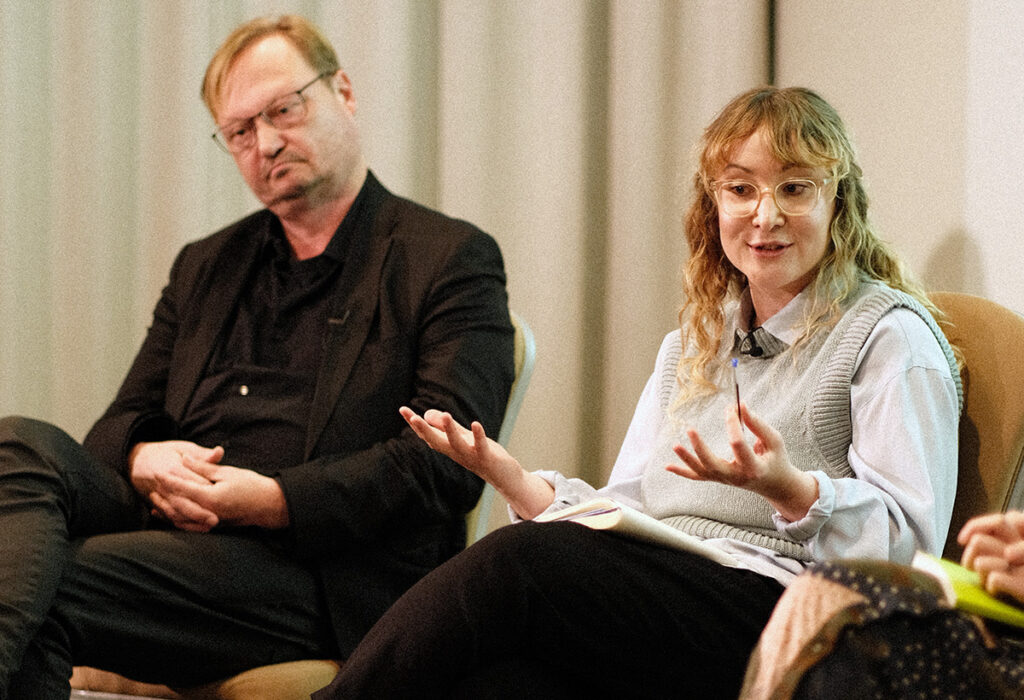
At this year’s Just Film Industry Days, held 19–21 November as part of the Tallinn Black Nights Film Festival, a panel of European industry professionals examined how rapidly shrinking theatrical windows are reshaping distribution models, audience expectations and the long-term health of cinema exhibition. Moderated by Alasdair Satchel, Co-Manager of the Youth Film Industry Days, the discussion brought together Anne Schultka (KidsRegio), Rebecca Hartung (Pluto Film) and Torsten Frehse (Neue Visionen).
The conversation, dubbed “The Shrinking Gap Between Theatrical and Streaming Releases,” already reflected an industry anticipating further disruption, with Warner Bros. Discovery up for sale and rumors swirling that the legacy studio might be acquired by a streaming giant such as Netflix. In fact, panelists focused on how the compression of theatrical-to-streaming windows is forcing distributors, especially independents, to rethink strategies that had remained stable for decades.
Windows Are Collapsing Faster Than Expected
Satchel opened by observing that in many European territories the theatrical window has narrowed to about 30 days, with even shorter holds increasingly common. What once felt like an exception is quickly becoming the rule.
Frehse said theatrical revenue remains the backbone of his company’s business. “Eighty percent of our revenue still comes from cinema,” he stressed, adding that the cinema window “matters” not only for admissions but for everything that follows. He added that titles which bypass cinemas or receive only a token run tend to be disadvantaged later on. “After the pandemic, we saw that films without a real theatrical run perform poorly even on streaming platforms,” he noted.
The disappearance of ancillary markets has only magnified the problem. Frehse explained that “VHS, DVD, TVOD — gone,” while SVOD revenue is nowhere close to the levels once generated by DVDs. He warned against relying on the internal metrics offered by major platforms: “They publish charts with no numbers. It’s propaganda.”
Schultka approached the issue from a cultural vantage point. She said cinemas risk disappearing as rapidly as brick-and-mortar retail did when online shopping took over. “Once they’re gone, they’re gone,” she said, cautioning that symbolic theatrical releases could weaken the communal experience that underpins cinema culture, especially outside major urban centers.
The Narnia Case and Diverging Strategies
The panel then turned to recent windowing experiments by major streamers, including the upcoming IMAX-only release for Greta Gerwig’s adaptation of “The Lion, the Witch and the Wardrobe,” followed by an immediate streaming debut. Prior to Tallinn, Vue International CEO Tim Richards had criticized the move, but the speakers in Tallinn took a more measured view.
Schultka cautioned against judging the strategy without understanding the film’s positioning. “European arthouse? European blockbusters? American studio films? Streaming originals?” she asked. “They each follow different rules.” Without clarity on that point, she added, “it could be the best or the worst release strategy.”
Hartung highlighted the gap between studio experiments and independent realities. “For arthouse cinema, a two-week limited release would kill the film,” she said, noting that indies rely on time, reviews and gradual audience build-up.
Frehse was more decisive in his interpretation of the IMAX-only approach. Releasing a wide-appeal title on “just one percent of screens makes little sense,” he said. To him, the move appeared to be “more of an ideological stance from Netflix, almost a kind of revenge on cinema.” He reiterated that weak theatrical starts often depress a film’s later life on streaming, contrary to common assumptions.
The example illustrated how fragmented windowing strategies have become — with major platforms experimenting aggressively, while independent distributors remain tied to a value chain dependent on sustained theatrical exposure.
Discoverability, Marketing and Youth Audiences
Satchel then steered the conversation toward how younger audiences encounter films today. Citing viral dress-up trends around “Despicable Me” or “Minecraft”-themed outings, he asked whether such phenomena emerge organically. Hartung responded that “it’s planned marketing, not spontaneous,” while acknowledging how effective it can be when deployed strategically.
Schultka explained that most European children’s films cannot compete with such US studio campaigns and that this partly explains why book adaptations dominate the sector. “Parents know the books, so the marketing is easier,” she said. “Original scripts face a harder path.”
Satchel described what he called “instant nostalgia” among teens — the desire to rewatch a film immediately on streaming after seeing it once. The panelists agreed it reflects a shift in expectations around access. While it does not eliminate interest in theatrical outings, it does reshape how quickly audiences expect to revisit films and where that second viewing takes place.
Festivals and the Future of Public Support
The panel then explored the role of festivals and public funding in sustaining circulation of films of all types, including children’s movies. Hartung said festivals increasingly serve as essential hubs. “Festivals create a global life for children’s films,” she explained, adding that they provide not only visibility but opportunities for school screenings, workshops and community engagement.
Schultka noted that up to 2017, Creative Europe rules once guaranteed support for at least one children’s title festival cycle but this mechanism was abolished in 2018. She argued that stronger dubbing support is essential for reaching younger audiences. “We need better dubbing support,” she said, emphasizing that accessibility determines whether children can engage with a film at all.
The restructuring of Creative Europe under the new AgoraEU umbrella (which helps finance cultural and artistic projects) has raised questions across the sector. Despite a promised increase in funding for the MEDIA+ strand, both Schultka and Hartung worried that smaller initiatives, including those geared toward children’s content, might struggle for visibility.
Frehse added a comparative example, noting that Thailand and Vietnam hold domestic market shares of about 65% “with almost no subsidies.” His point was not to advocate for reducing European subsidies but to underline how differently national ecosystems can function — and how Europe may need to reassess how resources are distributed across production, distribution and exhibition.
Multiple Pathways Into Cinema
Audience comments moved the conversation back to the interaction between streaming and theatrical exhibition. Rights Stuff founder Wendy Bernfeld said streaming often acts as a “vetting mechanism,” where children sample films at home before organizing cinema outings if the film resonates. Several panelists agreed that platforms and theatres can complement each other when windows are structured sensibly.
Speakers also highlighted that smaller regional streamers do still acquire independent titles and that some territories maintain contractual windows that protect exhibitor revenue. For instance, media chronology rules in France require a 17 month before a film that debuts in cinemas can appear on a streaming service. Of course, Hartung noted that festivals themselves remain important revenue and career pathways for filmmakers working in shorts or niche formats.

Has Storytelling Shifted?
When asked whether shorter windows or streaming-first strategies have altered film storytelling, the panelists were cautious. Hartung rejected the idea that platforms had reshaped narrative structure, saying the diversity seen in contemporary children’s films reflects society more than any algorithmic influence.
Schultka referenced research from 12 European countries showing that children increasingly connect with characters on a deeper emotional level and argued that this is “not a streaming effect — it’s a general evolution.”
Frehse identified franchise dominance as a more significant concern. “The real storytelling shift is the dominance of franchises,” he said. “Endless sequels and remakes undermine originality.” Schultka added that algorithms tend to reinforce what already works, warning that public funders could inadvertently fall into the same pattern.
Hartung closed the point sharply: “Right now, there’s huge money for production — but almost none for distribution. We’re making too many films that cannot be properly released.”
Looking Ahead
As the session concluded, Satchel stressed that audience considerations must begin at development. Schultka said filmmakers sometimes rely on memories of their own childhood rather than the realities faced by today’s young audiences, despite the availability of tools and organisations such as KidsRegio’s research and the European Children’s Film Association. She argued that more active use of these resources could help bridge the gap.
While the reduction of theatrical windows dominated the discussion, the panelists agreed that it sits within a wider transformation involving marketing, funding, circulation and discoverability. The path forward, they suggested, will require not only adapting windowing strategies but ensuring that audiences — especially younger ones — remain connected to the cinema experience at every stage.

- Imperfect Is Beautiful: Shekhar Kapur and Tricia Tuttle on AI’s Role in Cinema’s Next Act - December 9, 2025
- Industry Panel at Tallinn Debates the Consequences of Europe’s Shrinking Theatrical Windows - December 2, 2025
- Moviegoers Return But Italian Cinema is Running Out of Stories, Say MIA Panellists - October 22, 2025