


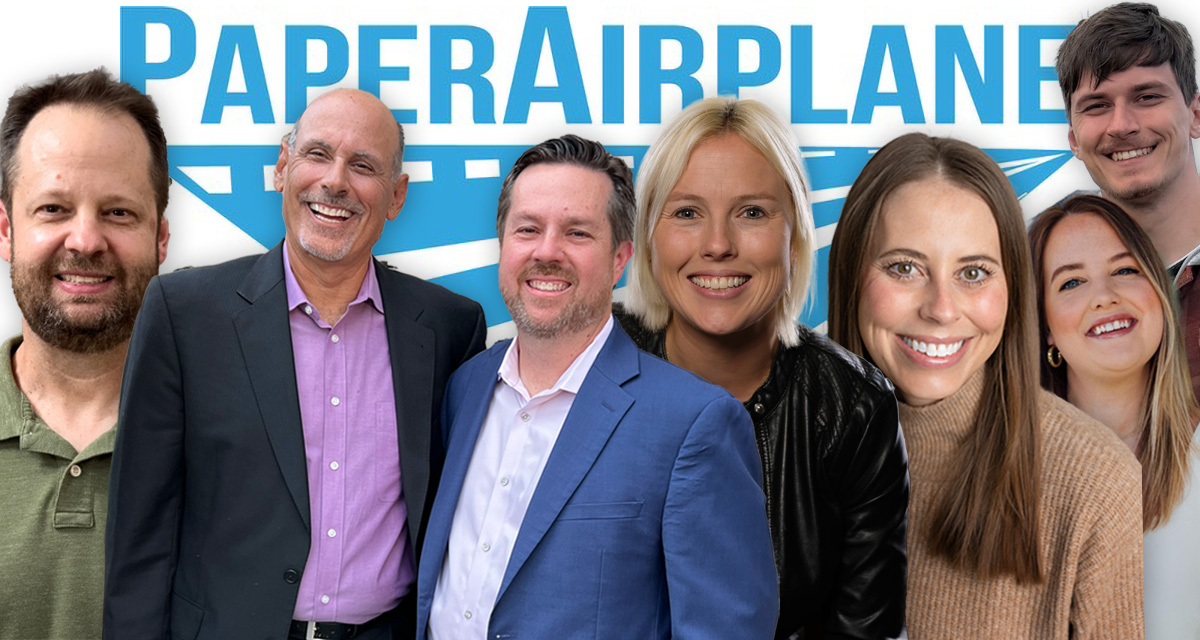
Born in the depths of the pandemic, PaperAirplane Media rewired the connection between studios and cinemas. Now, as nearly every cinema operator in North America depends on its digital asset management solution, the PaperAirplane team is preparing for takeoff overseas.
When Mike Polydoros decided to start a cinema marketing company in the summer of 2020, every movie theatre in the world was closed due to the COVID-19 pandemic. Box office numbers had evaporated, release calendars were shredded, and the industry was fighting for survival.
“Nothing like starting a cinema marketing company when every theatre in the world is shut down,” Polydoros said with a laugh. “But you’ve got to start somewhere.”
Polydoros, the co-founder and chief executive officer of PaperAirplane Media, had spent more than two decades at Lionsgate after cutting his teeth at Trimark Pictures. His transition to PaperAirplane wasn’t an act of reinvention so much as a reaction to a structural problem he had watched grow for years. The process of getting marketing materials from distributors to cinemas — a task once handled with print ad slicks, poster mylars, and trailer reels — had become a digital nightmare.
From Ad Slicks to Endless Log-ins
It used to be that getting marketing materials to theatres meant shipping ad slicks and mylars, physical poster sheets and all the trailer reels that could squeeze into a FedEx truck. Sometime over the past 20 years, the same process had migrated to cloud servers and metadata fields, scattered across at least a dozen studio portals.
“Fifteen years ago, exhibitor marketing was basically, can you play my trailer and put up my poster?” Polydoros recalled. “Then exhibitors became real media partners. They had loyalty clubs, social feeds, and newsletters, and every studio wanted a presence across those channels.”
As everything moved online, each studio built its own digital portal. A single marketing manager at a cinema chain might need to log into 15 different drives or platforms to find trailers, banners, and synopsis copy for the week’s films. “From the studio side we’d ask, who’s downloading what? And the team would shrug — it’s a Dropbox link, we don’t know,” he said. “It was chaos.”
That inefficiency, and the lack of visibility behind it, was the problem Polydoros set out to solve when he and longtime colleague Will Preuss launched PaperAirplane Media in mid-2020, an agency dedicated entirely to what he called cinema-channel marketing: the connection between content owners and movie theatres.
Building the Hangar
The company’s first project became its calling card. The Hangar, a secure, cloud-based warehouse for movie marketing materials, allowed studios, distributors, and technology partners to store and distribute everything a theatre might need — from DCP trailers and key art to point-of-sale graphics and PDF ad sheets.
“Every PaperAirplane needs a hangar,” Polydoros joked during an early presentation.
Off-the-shelf asset-management systems proved inadequate — “clunky and not intuitive” — so the team built their own from scratch with developers from the entertainment marketing firm iMoxie. One of those developers, Eric Marti, has since joined PaperAirplane as Chief Technology Officer.
The platform was then tested with major, regional, and independent exhibitors as they reopened after the pandemic to ensure it matched how theatre marketers actually worked. In fact, the pandemic may have helped PaperAirplane overcome the film industry’s resistance to change. “With everyone working remotely and using all sorts of new technology like Zoom, studios and exhibitors were more willing to give us a chance,” recalled Preuss. “Plus, I think we were uniquely positioned, just because of our background, to be able to pull it off.”
Five years later, the Hangar has become the domestic industry’s central marketing nervous system. Nearly every major studio and distributor in North America; 99.9% of the content available to theatres is hosted on the platform. It has logged more than 1.5 million downloads from over 4,500 unique users representing every circuit and roughly 2,500 independent venues, and currently stores more than three terabytes of live materials.
For AMC Theatres, that reach turned the system into what Senior Vice President & Chief Content Officer Nikkole Denson-Randolph called an “invaluable partner, helping us navigate challenges with innovation and efficiency,” thereby bringing real value across the circuit’s teams.
Warner Bros. Pictures’ President of Global Distribution, Jeff Goldstein, agreed that the service “skillfully and successfully filled a specific need for exhibitors, both big and small, by creating a one-stop shop across all studios for approved digital assets.” He added that it had become “a great tool to help augment our marketing efforts with exhibitors and their co-marketing of our films.”
Polydoros stressed that the Hangar’s greatest impact wasn’t convenience; it was insight. Because every download left a digital breadcrumb, both studios and exhibitors could see which assets were used, when, and by whom. “Sometimes the most important information is what’s not being used,” he said. “If a banner size shows zero downloads, a studio knows not to waste resources creating it next time.”
Those analytics quietly reshaped how campaigns were planned, turning the Hangar into what many now view as an industry utility, rather than a vendor service. “We never looked at this as a get-rich-quick business,” Polydoros said. “The goal was to make everyone work smarter.”
A Broader Ecosystem
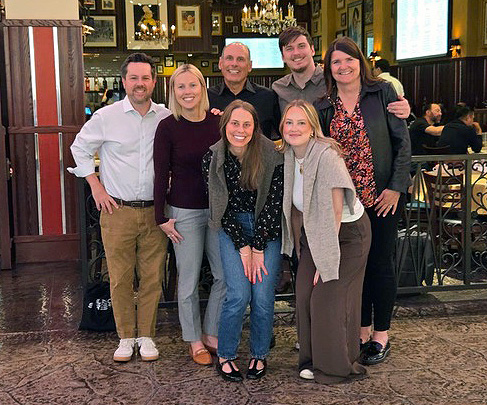
PaperAirplane now manages asset creation for several studios; resizing, versioning, and delivering full suites of digital materials. It also oversees campaign management and media buying across exhibitor platforms to ensure consistent messaging from website to mobile app to lobby screen.
Lionsgate’s President of Global Distribution, Kevin Grayson, said the PaperAirplane team had “put in place a strategically designed ecosystem of out-of-the-box solutions in an ever-changing marketing environment,” crediting the company for helping distributors and exhibitors “anticipate and adapt, rather than react.”
That adaptability attracted more than just studios. IMAX, Dolby, RealD, Barco, and even Coca-Cola began using the Hangar to deliver branded materials directly to theatres. “For smaller exhibitors especially, it’s a lifesaver,” stated Meggie Isom, PaperAirplane’s first official employee and current Vice President, Account Services. “They can grab approved creative and know it’s correct — no more pulling artwork off IMDb or Wikipedia.”
At NEON, Vice President of Exhibitor Relations, Kim Kalyka, agreed that PaperAirplane’s platform gave the indie distributor “a single, easy way for theatres of any size to access official marketing materials.” Ensuring its films were accurately represented across venues and digital channels was a struggle for some of their arthouse titles.
For exhibitors, the payoff was time. Marcus Theatres’ marketing head Ken Thewes noted that his team could “spend more time on strategy and ideation because PaperAirplane handles so many of the executional details.” The result, he said, was a “streamlined operation that keeps everyone focused on audience engagement rather than asset hunting.”
The Tower: Group Sales, Rebuilt from Scratch
PaperAirplane’s second major solution, the Tower, arose from a different industry headache; group sales management. Faith-based and community-driven releases often depend on bulk ticket orders from churches, schools, or organizations, yet studios and exhibitors had no efficient way to coordinate those sales.
“We were enlisted by Warner Bros. for ‘The Color Purple,’” Polydoros said. “They had an ambitious group-sales program involving Oprah Winfrey reaching out to her fan base. But the process was all manual — emails, spreadsheets, no visibility.”
Warner Bros.’ Goldstein described PaperAirplane’s new group sales program as serving “a component of our business that has not been fully realized yet,” adding that “PaperAirplane is equipped to assist in achieving that goal.”
The Tower automates that system from top to bottom. Groups submit requests through a public form; studios approve them; exhibitors are notified instantly, with information either feeding directly into their CRM and point of sale systems or appearing in a secure online dashboard. Each request is visible only to the relevant exhibitor — AMC sees AMC data, Regal sees Regal — eliminating duplication and confusion.
Amanda Rufener, a vice president and account executive on the PaperAirplane team, served as architect to the Tower project, building the interface to suit both sides. “As with the Hangar,” Rufener explained, “we started by listening to users, then designed the technology around their workflow.”
The result has already been adopted for projects with Amazon MGM, Bleecker Street, Fathom Entertainment, Lionsgate and Walt Disney Studios, among others, giving studios real-time visibility into ticketing and local outreach. “Everything we roll out is about solving a specific problem,” Polydoros added. “There’s no cookie-cutter approach.”
Landing Abroad
Having achieved near-total penetration in North America, PaperAirplane began to look overseas. After a soft launch in Latin America in 2023, the company quietly entered the United Kingdom this year. Roughly 100 users representing a cross-section of exhibitors have already signed on.
“Anytime you go into a new market, it’s a process,” Polydoros said. “You listen first and adapt to how that market works.” In the UK, that meant tackling region-specific challenges such as “coming soon” carousels and artwork integration with POS systems. The company is already collaborating with British partners on localized solutions.
Goldstein noted that with customization, the PaperAirplane platform “could be a helpful tool in many territories, just as it has been for the domestic [market].”
At home, CTO Eric Marti is leading a full refresh of the Hangar following its annual user survey. “About 80 percent of users said they love the platform,” Polydoros noted. “We’re adding features the independents asked for — more intuitive navigation, faster search, and easier asset previewing.”
A Utility, Not a Vendor
What stands out in conversation with Polydoros is how rarely he talks about sales or revenue. “We’ve never wanted to [price] gouge anyone,” he explained. “We view this as an industry asset.”
PaperAirplane now employs nine people — lean by design — and keeps participation costs minimal for theatres. The company also uses its verified exhibitor database, encompassing every major circuit, as a communication channel for studios needing to distribute operational updates.
“We probably have a better direct line to exhibitors than anyone else,” Polydoros said. “If a studio needs to alert theatres about a new accessibility card or a change in deliverables, we can get that information out quickly, but we’re very careful not to spam anyone.”
That philosophy of service over selling has helped PaperAirplane maintain credibility in an industry often skeptical of outside vendors. Its tools may sit quietly in the background, but for those working in theatrical marketing, they have become as essential as trailers and showtimes.
From Lionsgate to Launchpad
Five years in, PaperAirplane Media has evolved from an experiment born of crisis into the backbone of theatrical marketing. At CinemaCon 2024, Polydoros realized how deeply that transformation had sunk in.
“The first couple of years people would see my badge and say, ‘Oh, Mike from Lionsgate,’” he said. “Then one day someone looked at it and said, ‘PaperAirplane? We use you guys all the time.’ That’s when I knew we’d made the leap.”
Today, mention PaperAirplane in any cinema marketing department across North America and heads nod. The company has become the invisible support system that keeps the exhibitor–studio relationship running; a quiet infrastructure success story in an industry that rarely stops to examine its plumbing.
“I look at what we’ve built and think, we created this out of nothing,” Polydoros said. “And now, if you mention our name in the industry, people know exactly who we are.”
What Polydoros and his team have proven is that while every PaperAirplane may need a Hangar, it’s the people piloting it who have learned how to fly.

- Can Cinema LED Scale? Samsung Bets Trilith Cinemas Can Help Prove It - March 24, 2026
- A Quiet Player Makes a Big Move: Qube Cinema Acquires Arts Alliance Media - February 23, 2026
- As Sundance Says Goodbye to Park City, Its Films Look Forward - January 21, 2026