


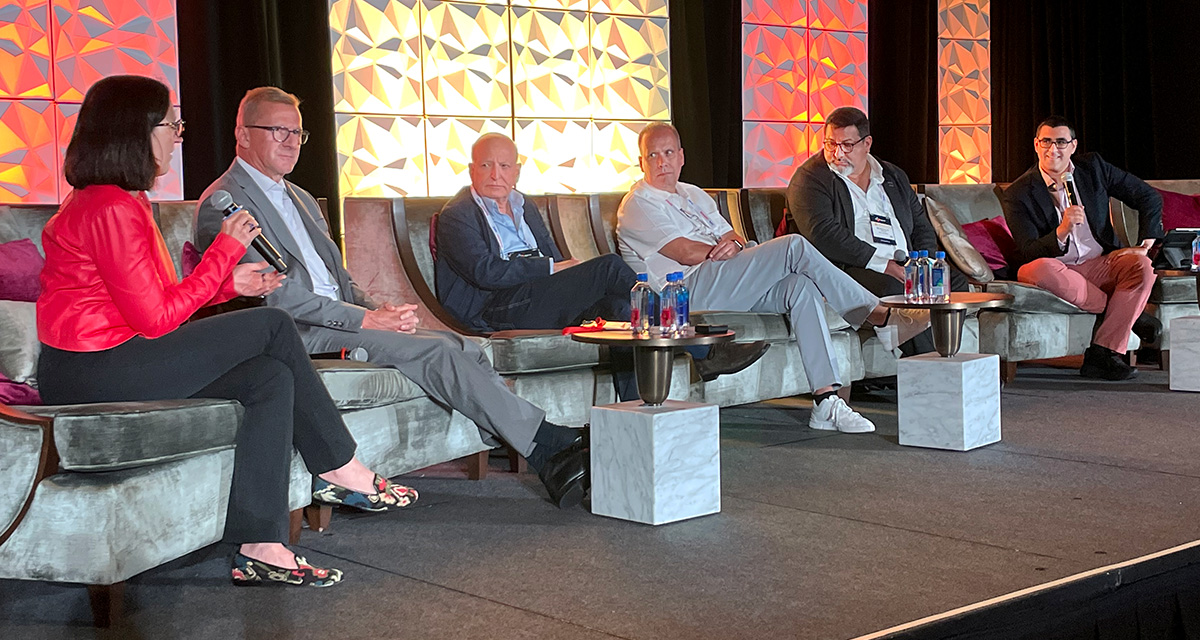
At CineLATAM 2025, exhibitors, manufacturers, and technology leaders from Caribbean Cinemas, RealD, Multicines, Barco, and Lumma 4D E-Motion shared how Latin America’s cinema market is investing wisely in premium formats and immersive experiences to drive attendance.
If CineLATAM 2025’s overall theme was about resetting the conversation around Latin America’s theatrical future, the Industry Investments Panel, held on the Tuesday, September 16, drilled into the mechanics of how that future will be financed — and experienced.
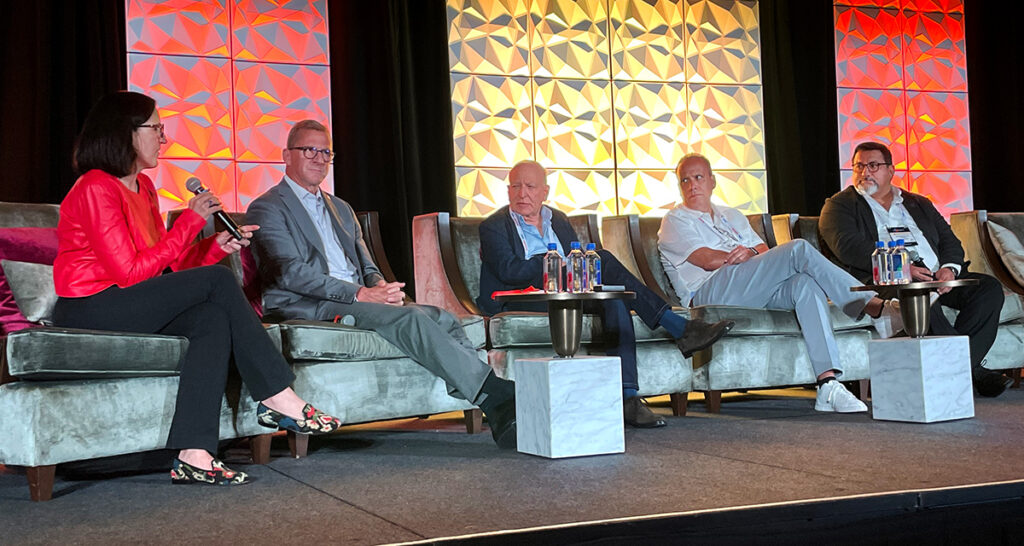
Moderated by Daniel Loria, SVP of Content Strategy and Editorial Director at Boxoffice, the session gathered a powerhouse lineup of executives spanning exhibition, manufacturing, and technology: Robert Carrady (President, Caribbean Cinemas), Elizabeth Frank (CEO, RealD), Gonzalo Lopez (CEO, Multicines Ecuador), Serge Plasch (Senior Vice President of Global Sales Cinema, Barco), and Rolando Rodriguez (Partner, Lumma 4D E-Motion / Magnify 8).
It was a lively, often technical discussion that captured a single shared reality — premium formats have moved from “optional upgrade” to “core strategy.” In a market still recovering from the pandemic and facing rising costs, exhibitors are investing carefully but decisively in technologies that make the theatrical experience impossible to replicate at home.
The Premium Imperative
Loria opened by acknowledging the elephant in the room: “This is a difficult time for CapEx,” he said, “but premium formats have shot up the list of must-haves.”
Carrady agreed. “We’re doing PLFs because our customers want them — they expect them,” he said. “Post-COVID, bringing people out of their homes means giving them something they can’t get anywhere else.” Caribbean Cinemas, the largest exhibitor in the Caribbean, has seen premium formats account for over 40% of market share on major titles, particularly in 4D auditoriums.
Lopez, whose Multicines circuit operates 23 sites across Ecuador, echoed the sentiment. “We’re betting on premium formats because that’s how you differentiate,” he said. “The Latin American audience is a 4D fan.” His circuit offers nearly every kind of premium configuration imaginable — 4D, D-Box, Dolby Atmos, ICE Theaters, and its own PLF brand, MCX.
Frank, who took over as RealD’s CEO earlier this year, reminded attendees that 3D remains the broadest premium format worldwide. “While overall Latin American box office was down about six percent this summer, 3D box office was flat,” she said. “That tells you audiences still respond when the experience delivers.”
Immersion as Differentiation
For Rolando Rodriguez, the line between cinema and theme park has blurred — and that’s a good thing. “We started Lumma 4D E-Motion in Argentina,” he said. “The next evolution of moviegoing is exactly what you see in amusement parks: sight, sound, motion, total immersion.”
Rodriguez noted that Latin American audiences, especially younger ones, have embraced 4D formats with enthusiasm. “Our biggest challenge as an industry isn’t box office, it’s attendance,” he said. “Premium experiences bring people back. That’s how we win.”
Lumma recently introduced its Magnify 8 system, a modular motion-seat platform designed to fit inside large-format auditoriums at a lower cost. “You can install 40 Magnify 8 seats in the center of a premium auditorium,” Rodriguez said, “and elevate the experience without closing down the room for a major retrofit.”
He described the company’s ROI model as a critical selling point: “With revenue share, exhibitors can see returns in as little as three months; with purchase, nine months. For our 4D E-Motion systems, about two years.” In a region where financing and import duties can complicate expansion, those economics matter.
Cinema’s Bright and Dynamic Future
Barco’s Serge Plasch brought the manufacturer’s perspective, describing Latin America as “a dream market.” The region, he said, now represents nearly 11,000 of Barco’s 50,000 projectors worldwide, with laser installations accounting for almost 5,000. “Latin America leads the world in market penetration,” Plasch said.
The next step, he argued, is upgrading that installed base with HDR by Barco, a technology introduced just a year ago. “We launched in the US last September and already have about 60 auditoriums in operation,” he said. “By the end of next year, we’ll pass 300.”
Plasch described HDR projection as “the new standard,” not a niche. “It delivers richer blacks, brighter highlights, and a sense of depth that feels like 3D — even when it’s not,” he explained. “When it’s combined with 3D, it’s breathtaking.”
More importantly, HDR aligns with exhibitors’ economic priorities. “Every investment must come with operational savings,” he said. “Laser and HDR bring energy efficiency, lower maintenance, and sustainability benefits. That’s as much a financial decision as a visual one.”
Smarter Spending, Better Marketing
One recurring theme was the need for coordination — between exhibitors, vendors, and studios — to ensure that premium investments actually pay off. Frank pointed out that many cinemas still struggle to present or promote premium formats effectively. “Our industry grew up with one flavor,” she said. “Now there are dozens, and that complexity can lead to missed opportunities.”
As an example, she mentioned a common oversight: special-event screenings that don’t appear properly on cinema websites. “You’ll see Wednesday night 3D events that vanish when searched for because the site wasn’t designed for multiple formats,” she said. “That’s the kind of coordination we need to fix to fill seats.”
Lopez added that Multicines tailors marketing by format and genre. “Horror and action films are amazing in 4D,” he said. “Romance? Not so much.” The approach, he said, has become part of the circuit’s identity: “We promote by experience as much as by title.”
Carrady agreed. “PLFs are also an upcharge,” he said. “Customers are willing to pay it — and they want it. We just have to communicate the value.” He noted that 4D screenings of “The Conjuring” performed far better than 2D versions. “The word-of-mouth alone kept it running longer than expected,” he said.
Every Auditorium a Premium
Plasch predicted that by 2030, “every single auditorium will need to be special.” Not necessarily a branded PLF, but unique in some way — design, technology, or ambience. “You can already see this in Korea,” he said. “Twenty screens, and each one offers something different. Sometimes it’s the lighting, sometimes it’s the atmosphere, but the customer chooses the auditorium as much as the movie.”
Rodriguez agreed, recalling the evolution from stadium seating to recliners to dine-in service. “We’ve been reinventing ourselves every decade,” he said. “The next reinvention is motion, light, and immersion. Consumers don’t just want to watch — they want to participate.”
Still, the panel warned against overextension. Carrady reflected on earlier upgrade cycles, like the rush into stadium seating. “It created momentum but also peril for exhibitors that dove in headfirst,” he said. “You can’t chase every new technology — you have to make sure the ROI works.”
For him, balance is the watchword. “Technology is moving faster than ever, and it’ll never move this slowly again,” he said. “That’s exciting — and a little scary.”
The Path Forward
As the discussion wound down, the panelists converged on a simple truth: the future of cinema is premium — but premium done smartly.
Frank called it “a partnership business.” “No one can do this alone,” she said. “Exhibitors, vendors, and studios have to coordinate so that technology, content, and marketing all align.”
Rodriguez added that the industry’s resilience will depend on rethinking CapEx not as cost but as investment in the experience. “Our challenge isn’t box office gross — it’s attendance,” he said. “Premium experiences are how we bring people back.”
Loria closed the session by noting how far Latin America has already come. “From family-owned circuits to world-leading technology adoption, this region has shown again and again that innovation isn’t just for the biggest markets,” he said. “It’s for the hungriest ones.”
At CineLATAM 2025, that hunger was on full display. And if the executives on stage are right, the next decade of Latin American exhibition won’t just be brighter — it’ll be smarter, more immersive, and more profitable than ever.

- Can Cinema LED Scale? Samsung Bets Trilith Cinemas Can Help Prove It - March 24, 2026
- A Quiet Player Makes a Big Move: Qube Cinema Acquires Arts Alliance Media - February 23, 2026
- As Sundance Says Goodbye to Park City, Its Films Look Forward - January 21, 2026