


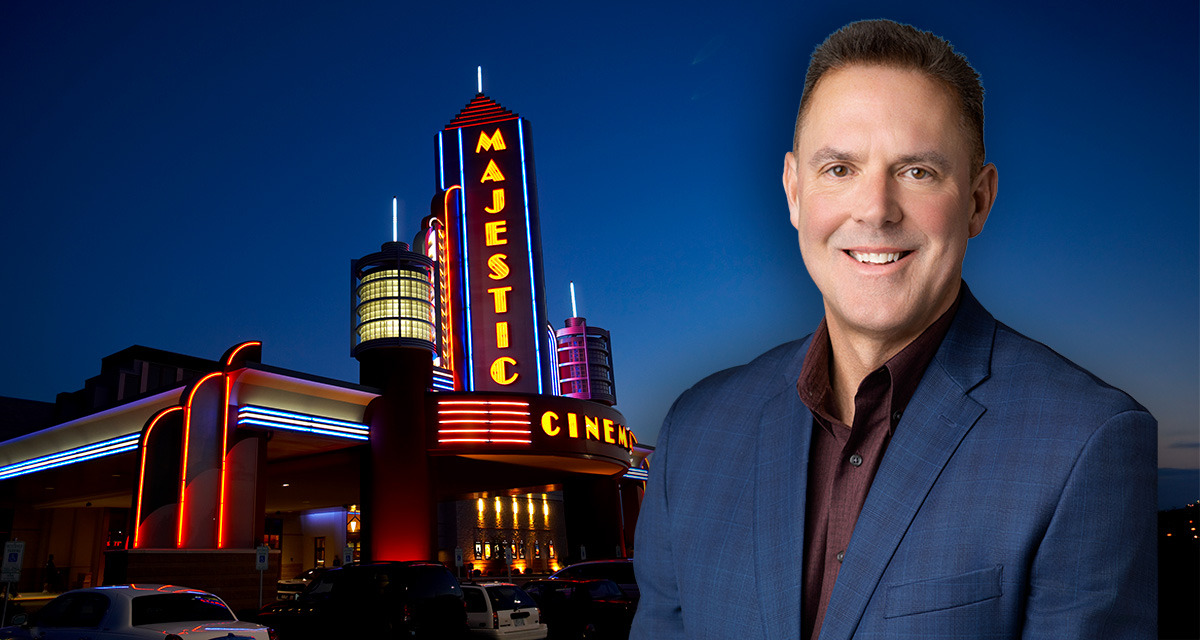
From premium formats and sports screenings to concessions and acquisitions, Marcus Theatres’ new president is taking a measured approach to growth.
Talk about a company man! Jeffry Tomachek became president of Marcus Theatres in May, but he’s been with the company for nearly three decades. Ask him about one of his earliest moviegoing memories, though, and it turns out his connection to Marcus goes back even further.
“Moby Dick!” said Tomachek, referring to the Gregory Peck adaptation from 1956 he saw years later. “We didn’t come from a lot of money and it was playing for a quarter. My father gave my sister and I a quarter [each] and we jumped on our bikes, drove five miles to the closest Marcus movie theater and had an incredible time. Our business is about making memories. And that is a memory that will stick with me for the rest of my life. I still talk to my sister about that.”
Today, an epic adventure like “Moby Dick” might be shown on a premium large-format (PLF) screen, such as Marcus’ UltraScreen DLX, with a collectible popcorn bucket to match. The possibilities have expanded considerably since Tomachek’s quarter-priced matinee.
Marcus has pushed well beyond the moviegoing experience of Tomachek’s childhood. Of its nearly 1,000 screens across 17 states, more than 13% are PLF auditoriums — the highest proportion in the country, according to Tomachek. Some 60% to 70% of its locations have bars; 96% serve alcohol, and 88% offer food and beverage beyond traditional concessions.
Yet for all the changes, Tomachek believes audiences still want the same essentials: a great picture, great sound and a clean theatre.
“One of my founding principles is cleanliness,” said Tomachek, who is 62. “People notice cleanliness. And so it’s a huge focus for us right now. We will have the cleanest circuit in the country in a very, very short period of time, because it’s something that matters to guests.”
Of course, any theatre chain worth its (popcorn) salt knows cleanliness matters. But Tomachek is setting a higher bar: the cleanest circuit in the country. It’s an unglamorous priority for a new president, but after nearly three decades at Marcus, he hardly needs to shake things up with a flashy initiative.
The news for the company is good. Very good. Marcus Theatres posted a third-quarter record $145 million in revenue, up nearly 21% from a year earlier, and a record $22.2 million in operating income. Along with strong results from its hotels division, that helped parent Marcus Corporation reach its highest quarterly revenue ever. Its stock also reached a five-year high earlier this year.
Like most exhibitors, Marcus is still feeling the effects of COVID and an uneven release calendar from Hollywood’s four remaining major studio groups. But a record summer — and a promising holiday slate — give Tomachek reasons to be optimistic.
Tomachek is definitely a numbers guy. With a degree in finance, he served as chief financial officer of Marcus Theatres before becoming president. But over nearly three decades with the company, he’s worked in almost every corner of the business, from construction and marketing to concessions.
“Another thing that we take a lot of pride in is our food and beverage,” said Tomachek. He called Rob Novak, Marcus’ executive vice president of operations and food and beverage, a “smart guy.”
“I would put up our food and beverage offerings against any exhibitor in the industry, and I’d put it up against most local restaurants around us,” he said. “I believe 88% of our locations have expanded food and beverage, and it’s not, you know, microwave stuff. This is real food, this is pizzas coming through deck ovens. And we make our own smash burgers.”
Numbers guys are often accused of boosting profits by squeezing costs. But Tomachek seems more interested in getting the fundamentals right while carefully weighing the merits of new investments.
Take motion seating. Marcus has embraced it cautiously, evaluating both its performance and customer demand before committing to a broader rollout.
“In October, we did our first D-BOX rollout at two locations,” said Tomachek. Marcus isn’t jumping feet first into the latest trend, but testing the waters before committing more broadly. The circuit also has one location featuring 4DX, the first in the Midwest.
Premium popcorn buckets? I expected a little dissatisfaction. After all, exhibitors take on considerable risk with these collectibles, and seemingly every wide release now has one of its own. Surely it’s just…too much? Not for Marcus. Despite the risks, Tomachek said the buckets are still a winner… for now.
“It’s like the movies,” said Tomachek. “Some of them work really well and some don’t. The challenge is we have to commit to these six months out. We’re looking at their fan bases, right? Are these fans that are going to come in and spend 50 or 60 bucks on a popcorn bucket or some unique piece of merchandise?
“But I’ll tell you, our guests have really embraced this merchandise at a level that is much higher than I ever expected, especially given some of the price points. That ‘Devil Wears Prada’ red purse? Man, that thing sold out in two seconds. It has been an additional stream of revenue for us. The question is, what’s the long-term appetite of our customers going forward for this kind of merch? But they’ve really embraced it this year.”
Another interesting experiment the company is tackling is “The Wall,” a sports-viewing concept at Marcus’ Gurnee Mills cinema in Gurnee, Illinois, where you’ll also find 4DX. Marcus has devoted one of its auditoriums to live sports to fulfill a liquor-license requirement, taking the sports bar concept to a cinematic level.
Lessons were quickly learned. Fans don’t want recliners; they want booths where they can watch games side by side with friends. (It’s hard to high-five when lying down.) And if Marcus builds another Wall—still an open question—Tomachek knows it will need to offer more than simply watching sports in a movie theatre.
“The NFL rules the day,” said Tomachek. “You know, anything NFL, I’ll tell you, it’s standing room only and the overflow is outside of that auditorium. The NCAA, World Cup, things like that bring people out. They want to have a communal experience.
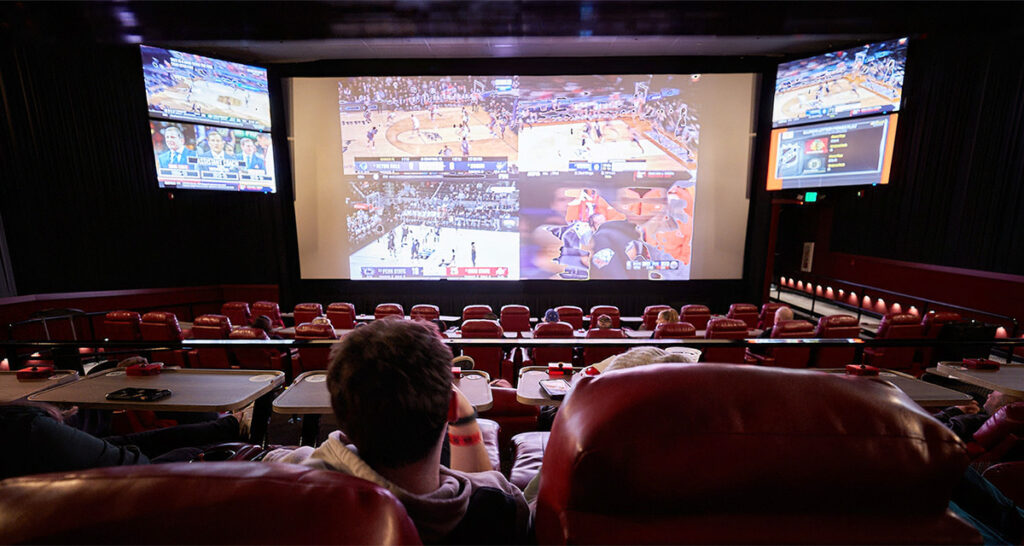
“We’re looking at potentially other locations where it might make sense. But we would build it a little bit differently. I would probably open it up. Right now, you’re going through a normal auditorium door and so you can’t kind of see what’s inside of it. The next time I’m going to blow out the back. So when you come in, you see it right away. You understand what that experience is.”
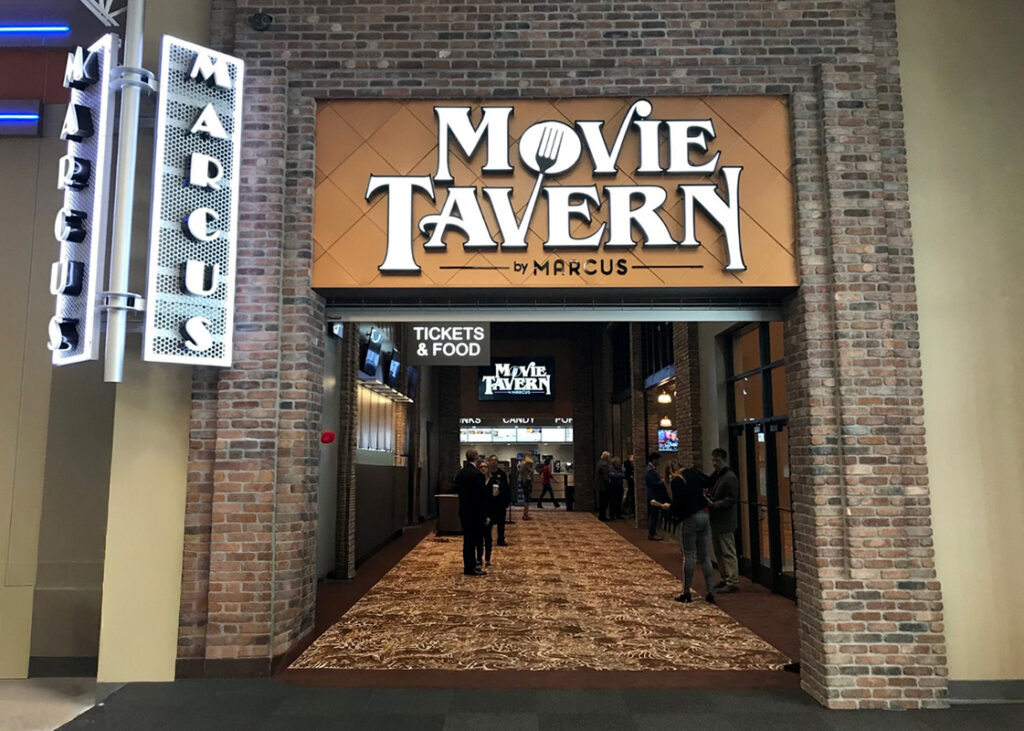
Speaking of other locations, acquisitions have long been part of Marcus’ growth strategy. The company bought seven Douglas Theatre locations in Nebraska in 2008, added fourteen Wehrenberg cinemas in 2016 and expanded significantly with the twenty-two-location Movie Tavern acquisition in 2019.
Then came COVID. Although Marcus began reopening cinemas in June 2020, the road back was anything but quick. One distinctive part of its business model has been its longstanding preference for owning the real estate beneath its theatres.
That growth means Marcus has a toehold in states beyond the company’s traditional Midwest base. To be specific, it now has two or fewer locations in seven states. Five of them have just one Marcus Theatre: Arkansas, Colorado, Kentucky, New York and Virginia.
And that means it could make sense for a business sitting on strong financials to do more deals. Besides, those theatres might feel a little lonely and be looking for some friends. So nearly eight years after its last major acquisition, the fourth biggest chain in the country is open to getting bigger—provided the economics make sense.
“We don’t have a problem with leasing as long as the lease makes sense and the rents make sense,” said Tomachek. “But our preference is always to own our real estate and that’s been our foundation since the beginning.
“We definitely want to continue to grow our circuit. With the Movie Tavern acquisition, we moved into a number of new states. And so we’ve got theaters in Atlanta now, we’ve got theaters in Dallas, we’ve got theaters in Pennsylvania. We’ve migrated our circuit south and we’ve migrated a little bit east. Those weren’t necessarily on our radar, but we were excited about what we could bring to the Movie Tavern acquisition, given our extensive experience in food and beverage.
“So we’ll see what becomes available,” he said. “But you’re exactly right. If we’re in a market, we’re always looking to potentially expand in that market if the economics make sense.”
He knows different regions mean different tastes. The NFL rules everywhere, but the NCAA is even more important in the South. And movie tastes are a little different, too. I pointed out that the film lineup at some Marcus multiplexes is pretty much what you’d see in any major city.
But Tomachek said some of that variety comes down to the challenge of finding enough content to fill 20 screens. And if he were building a cinema from scratch?
“I would not have 20 screens,” said Tomachek. “I’d probably have 12 screens, depending on density and things like that. But I would say on average, if I was building a theater ground up, it would have 12 screens and it would have at least two PLFs and a lounge.”

- After a Record Summer, Marcus Theatres President Jeffry Tomachek Looks to the Future - November 23, 2026
- It’s Elemental: Pixar Is Not Floundering - August 28, 2025
- Looney Tunes: Animated Movies Are Still Box Office Gold - August 5, 2025