


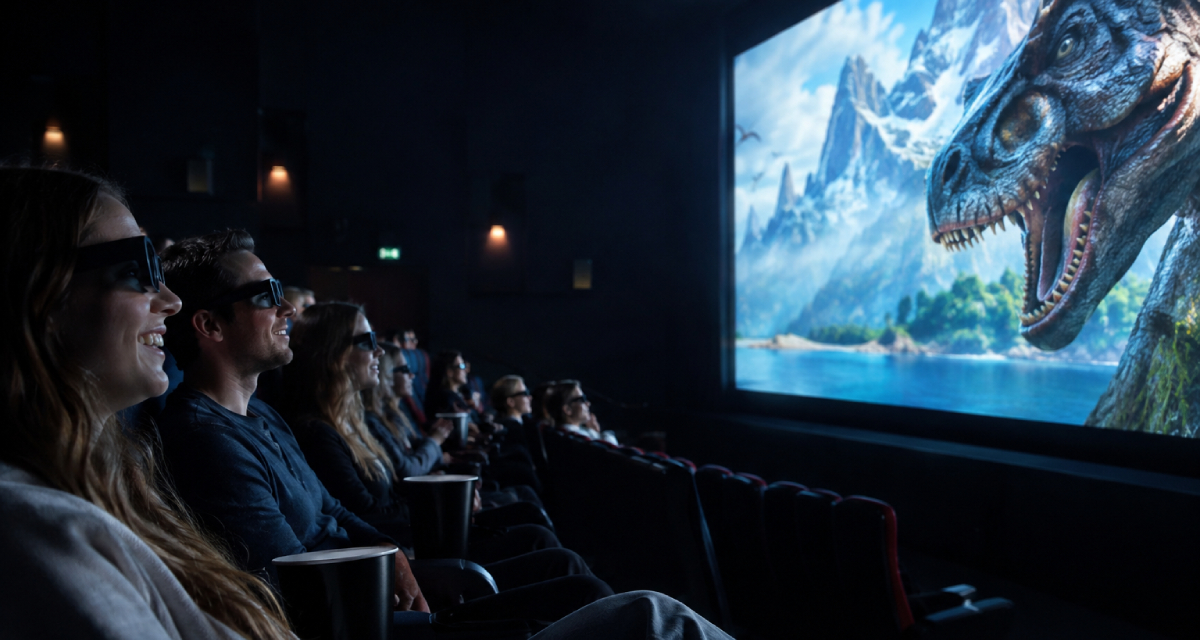
There’s a moment that every projectionist dreads. The lights fade, the feature begins, and within minutes, you can feel it in the room. The image is flat. Colors are muted. Dark scenes are murky.
I remember an afternoon screening of “Harry Potter and the Deathly Hallows Part 2.” The final battle sequence, set mostly in darkness, looked like it had been filmed through a fog filter. The duty manager had received a dozen complaints about the brightness throughout that opening weekend. The projector was running at full capacity with a brand new xenon bulb, but by the time the light passed through the 3D system and the glasses, barely 30 percent of it reached the audience.
If you’ve sat through a dim 3D screening and thought, “Something doesn’t look right,” you’ve witnessed evidence for one of the most enduring debates in modern cinema technology: single versus dual projectors.
For most cinemas, a single laser or xenon projector does the job perfectly. But for large screens, high-gain 3D, or premium formats, a single projector sometimes can’t deliver the brightness, uniformity, and redundancy that today’s audiences expect.
The Basics: What are Single and Dual Projectors?
A single-projector system is standard in almost every cinema. One projector, one light source, one image on screen.
For 3D, that projector alternates between left-eye and right-eye images at high speed, using polarised filters or active-shutter glasses to separate the perspectives. It works. It’s reliable. And for most applications, it’s sufficient.
A dual-projector system uses two matched projectors running in perfect sync. In 3D, each projector is permanently assigned to either the left or right eye. The two beams are optically stacked, aligned with sub-pixel precision, and projected through polarising filters.
The catch? That alignment must be near-perfect. If the beams drift even slightly, you’ll see ghosting, double edges, or color fringing. And once the audience notices, they can’t unsee it.
Brightness: The Light That 3D Steals
Every time you put light through a 3D system, you lose 60 to 70 percent of it. The DCI minimum for 3D is 3.5 foot-lamberts (ft-L). Many single-projector setups struggle to hit 7 ft-L, especially on larger screens.
Dual projection solves this by doubling the light. Each projector contributes its full output to its respective eye, so instead of dividing one projector’s light between two eyes, each eye gets a dedicated light source.
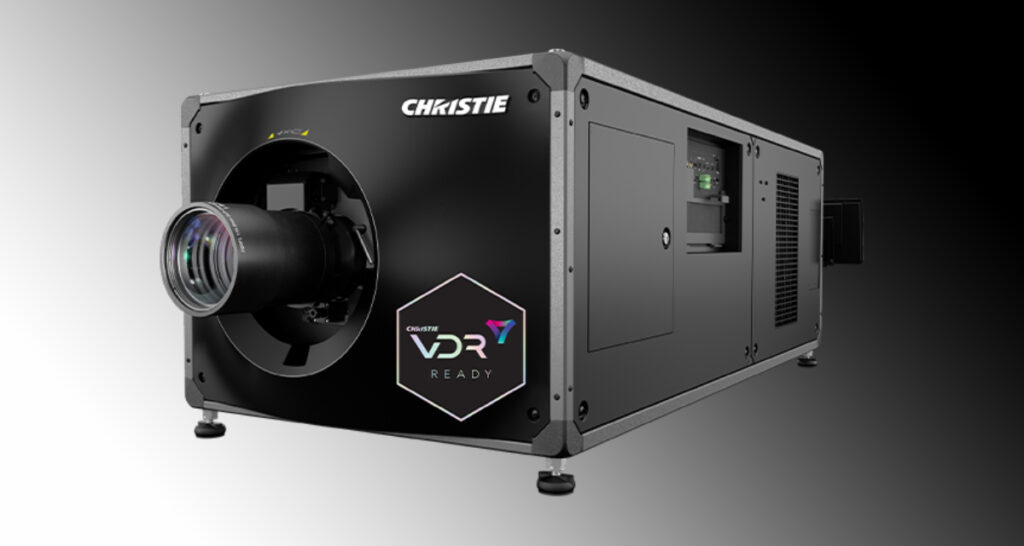
Dolby Cinema is the prime example. Their installations use dual Christie 4K RGB laser projectors achieving peak brightness up to 108 nits (31 ft-L) in Dolby Vision HDR mode. That’s roughly three times standard 2D brightness and miles ahead of most single-projector 3D setups.
For 2D, dual setups can improve brightness uniformity and reduce hotspotting, but the difference is less dramatic and harder to justify economically.
Alignment, Calibration, and Perfect Sync
Running two projectors in sync requires precise alignment in X, Y, and Z axes. Every pixel from Projector A must land exactly on top of its corresponding pixel from Projector B.
Over time, things drift. Vibration, temperature changes, even building settlement can cause misalignment. Lens creep is another common culprit.
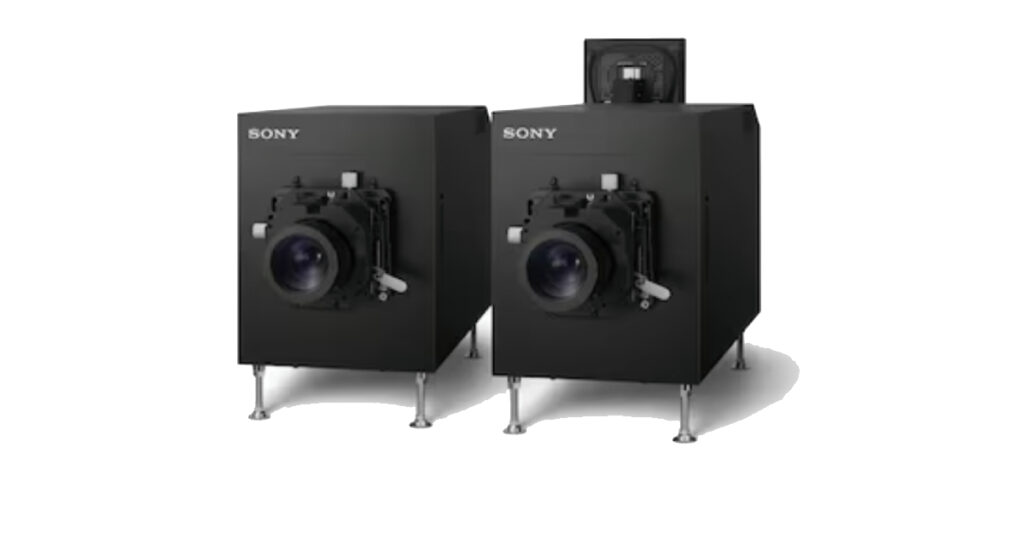
Modern systems have simplified this. Christie’s Mystique uses cameras to detect misalignment and applies digital corrections automatically in minutes. Barco’s auto-alignment software adjusts color balance and geometric alignment without manual intervention. On a Sony Dual Projector installation I worked on, a scheduled playlist would run automatically every morning. The system used a uniformity camera to check both projectors were still aligned before each show.
But dual projection still doubles your maintenance workload. Twice the optics to clean, twice the light paths to monitor, twice the cooling systems to maintain. For smaller sites without full-time technicians, a single-chassis system will always be simpler.
Reliability and Redundancy
Imagine a Saturday night, packed auditorium, and the projector fails mid-show. In a single-projector setup, that’s it. Show’s over. Refunds issued.
In a dual-projector setup, the other projector keeps running. The audience might notice a brightness drop, but the film doesn’t stop. For premium venues or one-night events, that redundancy is priceless.
That said, modern laser projectors have incredible reliability. Mean Time Before Failure figures exceed 30,000 hours. For most sites, redundancy isn’t essential, it’s insurance. Expensive insurance.
Cost and Total Ownership
Dual projection isn’t just two projectors. It’s two of everything. Two lenses, two mounts, two power feeds, often two cooling systems. That doubles capital cost and increases energy consumption.
Installation is more complex. You need booth space, structural support, and cooling capacity. For older cinemas with tight booths or limited HVAC, that can mean significant infrastructure upgrades.
Single-projector systems are cheaper to install and maintain. But to match dual-stack brightness on large screens, you’ll need a higher-output model, a single Barco SP4K-60 instead of dual SP4K-25s, for instance.
The deciding factor is often screen size and format. For a 12-meter screen running mostly 2D, single is ideal. For a 20-meter premium auditorium running 3D and HDR, dual may still win on total cost of ownership.
Use Cases
Single Projector Systems:
- Small to mid-sized auditoriums (up to 12–14 meters)
- 2D presentations and occasional 3D
- Lower running costs, simpler operation
- Perfect for multiplexes with limited technical staff
Dual Projector Systems:
- Large screens (14 meters and above)
- High-gain or polarised 3D where brightness is critical
- Dolby Cinema, IMAX, and PLF auditoriums
- Venues where redundancy is non-negotiable
Future Trends
The gap is closing fast. New modular laser architectures like Christie’s RealLaser and Barco’s Series 4 RGB arrays contain multiple independent laser modules inside a single chassis. If one fails, the others keep running. You’re getting dual-system redundancy in a single projector.
Dolby Vision systems are already pushing this concept to the extreme, using two custom made Christie 4K RGB projectors. They each have dual light engines to deliver four separate light paths. This design not only boosts peak light performance but also provides exceptional redundancy and black-level performance.
We’ll likely see more hybrid systems where multiple laser banks provide seamless redundancy and automated recalibration, eliminating the need for traditional dual stacks in all but the largest installations.
The Bottom Line
Whether you’re running a boutique screen or a flagship auditorium, the right choice depends on what you’re trying to deliver and what you can realistically support.
Single projectors are simple, efficient, and powerful enough for most applications. They’re easier to install, cheaper to maintain, and perfectly capable of stunning image quality.
Dual systems remain the gold standard for large-format, high-contrast, fail-safe operation. They’re the territory of Dolby Cinema, IMAX, and premium presentations where audiences expect the absolute best.
Ultimately, it’s not about how many projectors you have. It’s about how much light, consistency, and confidence you can put on the screen.
Because when the lights fade, the audience doesn’t count projectors. They see the image. And if it’s bright, sharp, and immersive, you’ve done your job.

- CJ Tech: Single vs Dual Projectors - October 29, 2026
- CJ Tech: RGB Laser vs Phosphor Laser – Understanding the Difference - March 25, 2026
- CJ Tech: Choosing the Right Projection System: Xenon vs Laser Projection - January 20, 2026