


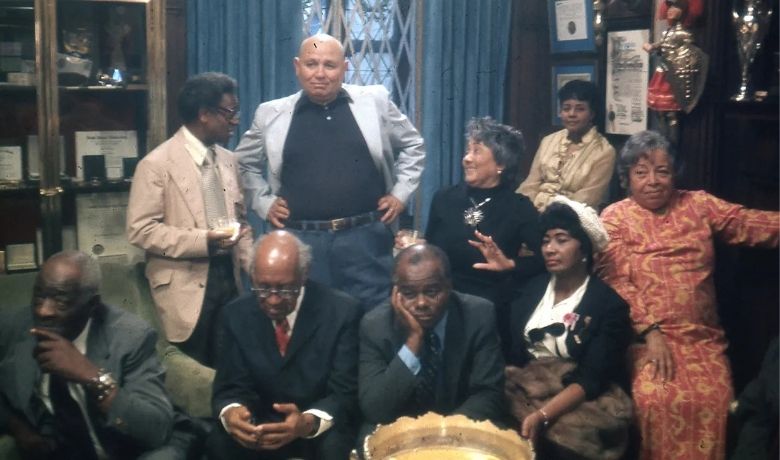
After nearly fifty years under wraps, the film conceived and filmed by the legendary William Greaves and directed by David Greaves, spotlights footage from a 1972 gathering of luminaries of the Harlem Renaissance
Neon, the award-winning studio behind some of the most daring and celebrated films of the last nine years, announced today that it acquired U.S. rights to “Once Upon a Time in Harlem,” conceived and filmed in 1972 by the late William Greaves and restored and directed by his son David Greaves. This monumental film premiered at this year’s Sundance Film Festival, where it earned widespread critical acclaim. Neon is planning a theatrical release later this year.
A decade after his death, genre-defying filmmaker William Greaves has one last trick up his sleeve with what he considered the most important event he captured on film: a 1972 party he engineered with the living luminaries of the Harlem Renaissance. For four hours, this extraordinary group – many of whom had not seen each other in fifty years – reminisced, critiqued, argued, laughed and drank while wrestling with their place in a rapidly shifting cultural landscape.
Shot on 16mm film, this landmark film is at once a self-exploration and an inquiry into the heart of the critical mass of energy called the Harlem Renaissance. William Greaves’ intent was not only to document these artists and intellectuals as they spoke about their lives and work but also to plumb the meaning of the extraordinary creative period in which they lived to help us better understand how culture has been passed on from one generation to another and the role that the artist plays in keeping it alive.
The film had an epic journey to completion. Over 50 years later, David Greaves, one of the original cameramen – who was guided by his father’s notes and workprints to create a new film that embodies William’s unique use of cinema. It is produced by his granddaughter, Liani Greaves. David and Liani serve as William Greaves Productions’s President and Vice President of Production, respectively. Louise Archambault Greaves, William’s wife and creative partner of 55 years, co-founded the company in 1963. Following his death in 2014, she worked tirelessly to restore his films and to ensure this landmark project would finally be realized. Producer Anne de Mare worked with Louise to preserve and digitize over 60,000 feet of previously unseen 16mm footage shot by Greaves in 1972. The preservation was overseen by multi-disciplinary artist and preservationist Bill Brand. Louise passed away in 2023. The deal was negotiated by Sarah Colvin, VP of Acquisitions for Neon and Jason Ishikawa and Isadora Johnson of Cinetic Media on behalf of the filmmakers.
“Once Upon A Time In Harlem” was one of the breakout films of the Sundance Film Festival. It was named as the Best Documentary at Sundance in the Indiewire Critics Poll and appeared in numerous best of the festival lists including The Hollywood Reporter, Indiewire, Los Angeles Times, Rolling Stone and Variety. At the premiere, Academy Award winner Barry Jenkins was in the audience and commented during the Q&A that “It was one of the most moving things I’ve seen in my life. I’m going to tell everybody to see it.” The New Yorker’s Richard Brody touted it as “one of the greatest cinematic works of creative nonfiction that I’ve ever seen.” Bilge Ebiri called it “A masterpiece. A truly monumental work of art.” Robert Daniels of RogerEbert.com wrote about it, “an intellectual fairytale whose occurrence remains incredible and whose existence feels like a miracle.”
Neon has established itself as a powerhouse in the documentary space, consistently bringing bold, culturally resonant nonfiction films to wide audiences. Its releases include the Sundance breakouts “Apollo 11” and “Three Identical Strangers,” which became box office and cultural phenomenons; “Flee,” which made history as the first film nominated for Academy Awards in Documentary Feature, International Feature, and Animated Feature; “Honeyland,” which was nominated for Academy Awards for Best Documentary and Best International Feature, “All the Beauty and the Bloodshed” and “Fire of Love,” both nominated for Academy Awards; “Moonage Daydream,” which won two Emmy Awards; and “Orwell: 2+2=5.”
Also out of Sundance, Neon recently acquired the worldwide rights to writer/director Adrian Chiarella’s feature-length directorial debut “Leviticus,” a queer horror film starring Joe Bird, Stacy Clausen, Jeremy Blewitt, Ewen Leslie, Davida McKenzie, Nicholas Hope, Zahra Newman, and Mia Wasikowska.
Last month, Neon received 18 Oscar nominations as part of the 98th Academy Awards, the second most for any motion picture studio. Building on this momentum, Neon’s 2026 slate of recent and upcoming releases include Oliver Laxe’s “Sirat” releasing February 6, Matt Johnson’s “Nirvanna the Band the Show the Movie,” releasing February 13; Baz Luhrmann’s “EPiC: Elvis Presley in Concert,” releasing February 20; Genki Kawamura’s “Exit 8,” releasing April 10, Steven Soderbergh’s “The Christophers;” Boots Riley’s “I Love Boosters,” which is set to open SXSW this year; and Damian McCarthy’s “Hokum” starring Adam Scott.
About Neon
In only nine years, Neon has garnered 57 Academy Award nominations (18 this year), 11 total wins (5 last year), including two Best Picture wins, and this year earned a historic 21 Golden Globe nominations, the most of any motion picture studio this year. The company continues to push boundaries and take creative risks on bold cinema such as Sean Baker’s Anora, which recently took home five Academy Awards including Best Picture, and was released in theaters to the highest per-screen average of 2024; as well as Bong Joon Ho’sParasite, which made history winning four Academy Awards, becoming the first non-English-language film to claim Best Picture, and grossed over $54M at the domestic box office.
Neon has built an impressive streak winning the coveted Palme d’Or at the Cannes Film Festival, with six consecutive wins, including this most recent year’s winner “It Was Just an Accident” from Iranian filmmaker Jafar Panahi, as well as “Anora,” “Parasite,” “Anatomy of a Fall,” “Titane,” and “Triangle of Sadness.” In 2024, Neon was named The Hollywood Reporter’s Independent Studio of the Year and received the Clio Award for Studio of the Year.
As a burgeoning leader in the production space, Neon’s recent and upcoming in-house productions include: David Robert Mitchell’s “They Follow” starring Maika Monroe; the highly anticipated “Boots Riley feature I Love Boosters” starring Keke Palmer, Naomi Ackie, LaKeith Stanfield, Demi Moore, and Eiza González; “The Wrong Girls” starring Kristen Stewart and Alia Shawkat; Tilman Singer’s “Cuckoo” starring Hunter Schafer; and Brandon Cronenberg’s “Infinity Pool.” Neon’s international sales outfit handles the company’s in-house titles as well as third party projects.
Neon has amassed a library of over 120 films, with a noteworthy selection of Academy Award nominated films including: Mohammad Rasoulof’s “The Seed of the Sacred Fig”; Wim Wenders’ “Perfect Days”; “Robot Dreams” from Pablo Bergfeer; documentaries “All the Beauty and the Bloodshed,” “Fire of Love,” “Moonage Daydream,” and “Flee,” which made history becoming the first film to score an impressive trifecta of Oscar nominations; Joachim Trier’s “The Worst Person in The World”; and Craig Gillespie’s “I, Tonya.”