


When London-based Arts Alliance Media entered administration in November 2025, it sent a quiet but genuine shockwave through the global cinema industry. Quiet, because AAM is not exactly a household name among general audiences, or even among many cinema professionals who depend on its products every day without necessarily thinking about them. Genuine, because the company’s footprint is enormous.
Arts Alliance Media describes itself as the global leader in cinema software and services and that is not mere marketing copy. Its software reaches more than 42,000 digital screens worldwide. Its Network Operations Centre supports several thousand more. Its clients include some of the largest and most recognizable cinema chains on the planet: AMC, Regal, Cineworld, HOYTS, National Amusements, Alamo Drafthouse, Cinema City and others.
When a company of that scale enters administration, operators, distributors and technology partners across the industry find themselves asking a very uncomfortable question: what happens now?
For some, the anxiety was about continuity of service. For others — particularly exhibitors already running AAM’s Theatre Management System (TMS) — it was more existential: what does this mean for the long-term viability of the software that keeps their cinemas running?
The answer has now arrived and it comes from a company few industry observers initially had at the top of their shortlist of potential acquirers: Qube Cinema.
What Is a TMS, and Why Does It Matter?
For those less familiar with the operational side of cinema technology, a Theatre Management System is exactly what it sounds like: the software backbone that ties a cinema’s digital operations together.
A TMS communicates with digital cinema servers and projectors to automate show scheduling and playback, manages content ingestion and key delivery for DCP titles, monitors equipment health, and, in more sophisticated implementations, coordinates everything from screen automation (lights, curtains, audio) to reporting and circuit-wide analytics.
In the early years of digital cinema, when the industry was transitioning away from 35mm film, TMS platforms were deeply embedded in the Virtual Print Fee (VPF) infrastructure. When VPFs wound down, the category commoditized somewhat, but the operational dependency never disappeared.
Today, a modern multiplex without a functioning TMS is a significantly more labor-intensive operation. For cinema chains managing dozens or hundreds of sites remotely, it is essentially non-negotiable.
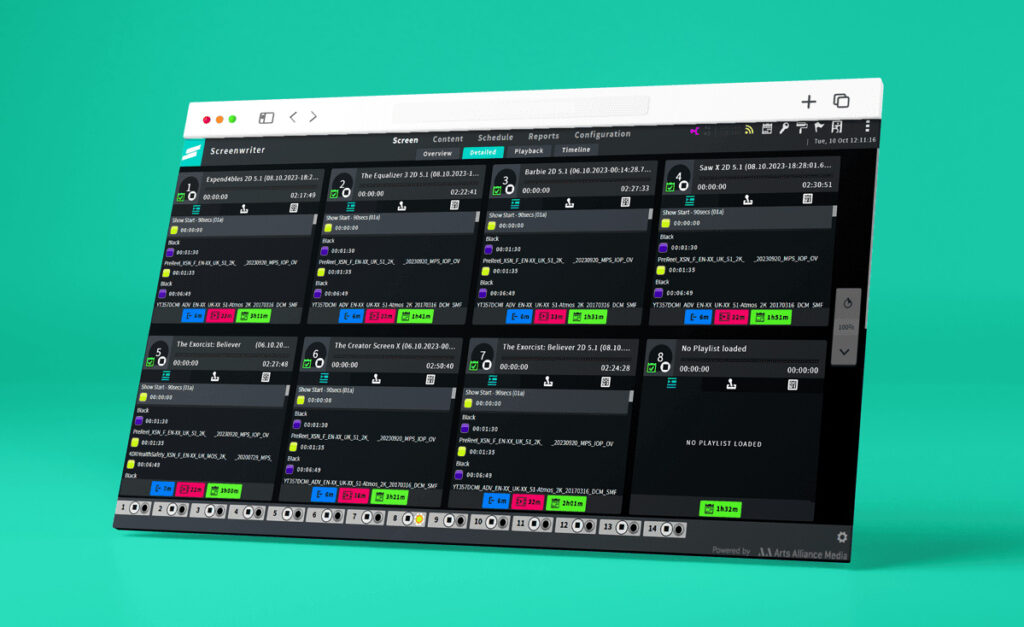
AAM’s flagship TMS product, Screenwriter, has long been considered one of the most capable in the market. Its enterprise-level counterpart, Producer, enables cinema chains to manage and monitor their entire circuit from a single head-office interface.
The Monopoly Concern
One of the more acute anxieties that ran through the industry following AAM’s administration was the question of who might acquire it and what that would mean competitively.
The TMS market is not crowded. AAM and Unique X are the two dominant global players in cinema operations software, with GDC holding meaningful share in certain territories.
Had Unique X acquired AAM, it would have consolidated an uncomfortable proportion of the global cinema software market under a single owner. That scenario, effectively reducing meaningful choice for exhibitors running at scale, made operators nervous.
When one provider becomes too dominant, innovation tends to slow. Pricing leverage shifts. Upgrade negotiations begin to feel less like partnerships and more like inevitabilities. In exhibition technology, monopolies age about as well as milk left under a xenon lamp.
Other names circulated as potential buyers, including Vista Group and GDC. In the end, the company that stepped forward and prevailed was one few observers would have predicted: Qube Cinema.
Meet (or Re-Meet) Qube Cinema
Here is the honest truth about Qube Cinema: it has been building one of the most comprehensive end-to-end digital cinema technology stacks in the world for over two decades and in recent years has steadily expanded its global presence through platform scale, partnerships and acquisitions. They have done this so quietly that a significant portion of the global cinema industry isn’t even aware.
Qube Cinema is an Indian company in the fullest sense. It was not a Western brand that relocated operations to India for cost reasons. It was conceived, built and scaled from India, a distinction that Rajesh Ramachandran, Qube’s Chief Technology Officer, is quick to make.
“We started from India, and then we took it out to the world,” Ramachandran told me. “This is a brainchild of our team in India. For us, engineering from India is not outsourcing, it is insourcing. It is our natural posture.”
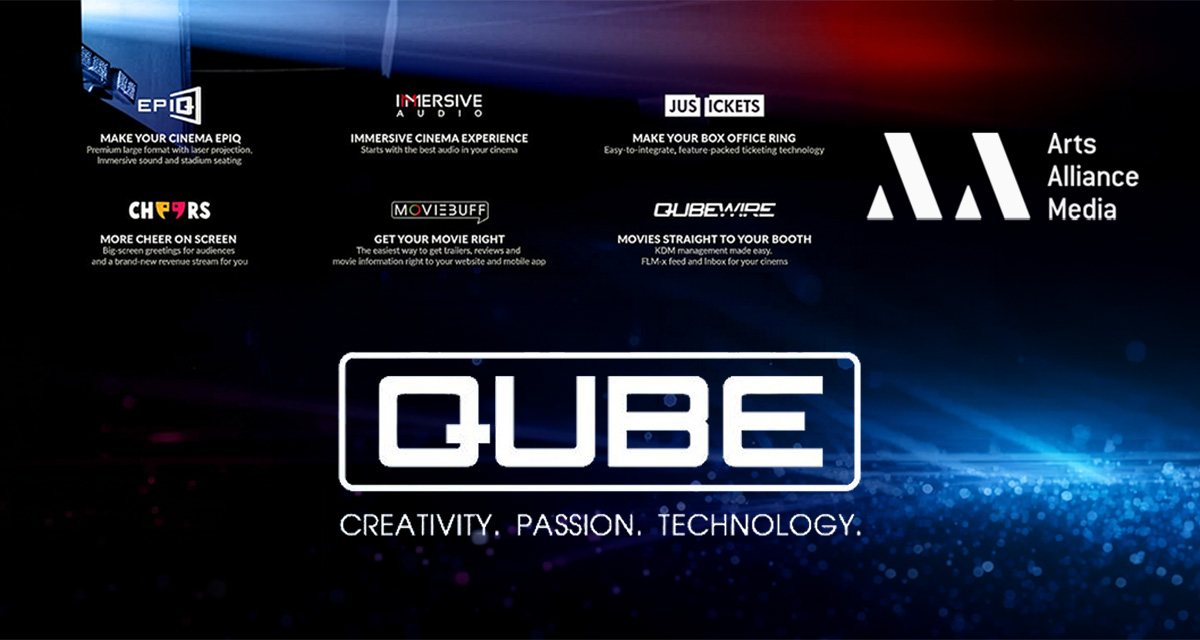
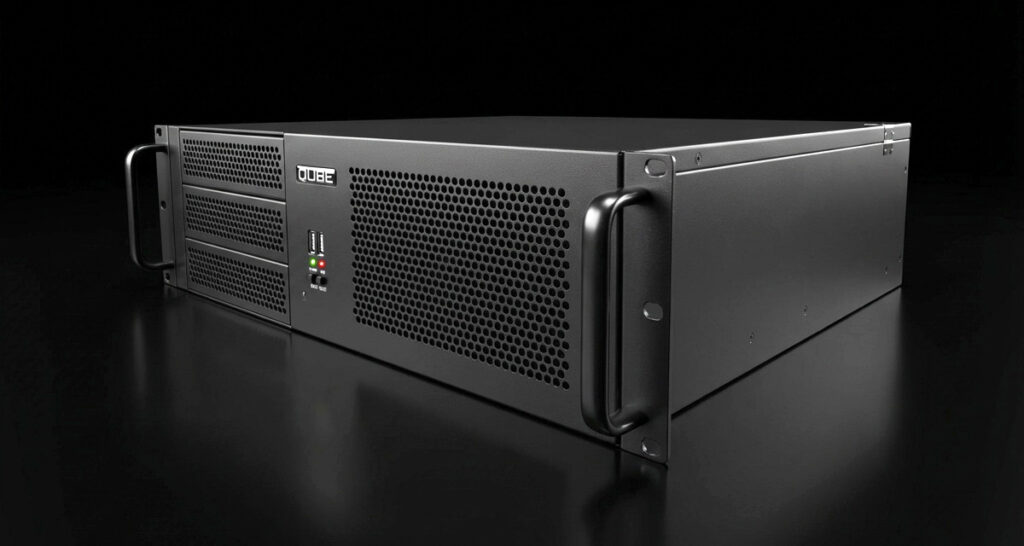
Today, Qube employs over 1,000 people globally. It manufactures DCI-compliant digital cinema servers — now in their fourth-generation Qube XP line — and operates what it believes is the largest mastering service in the world by volume, processing roughly 2,000 titles per year. Under its EPIQ brand, the company has entered the premium large format (PLF) space, while JusTickets serves as its cloud-based SaaS ticketing platform and Moviebuff operates as a widely used movie information service in India. This is also where Qube operates one of the country’s largest digital cinema advertising networks — Qube Cinema Network (QCN) — powered by its proprietary Qube Slate platform, giving it centralized control of on-screen advertising across thousands of screens.
Most notably, Qube runs Qube Wire; a global content delivery platform that services 135 countries. In the United States, Qube Wire is now directly connected to more than 1,200 theatres, and globally, Qube Wire reaches over 6,200 theatres. That translates to a distribution footprint touching over 33,000 screens around the world.
“Box selling can only get you so far,” Ramachandran acknowledged. “What you really want to be is in a service business, because that’s where you have recurring revenue and a network. It means that with one API you can reach over 33,000 screens. You have to be very precious about that customer base and screen base, and build upon it.”
The Missing Piece
For all of Qube’s breadth, there was one conspicuous absence: a Theatre Management System.
That absence reflected the market reality Qube grew up in. In India, and in many high-growth markets where Qube first established its server business, the labor economics of cinema operations did not create the same urgency for automation seen in Western circuits. As Ramachandran explained, “For the license price of a TMS, you could get a human being to operate.”
Qube compensated with clever engineering. Its servers were among the first to feature a web-based user interface, eliminating the need for a dedicated monitor at every screen. Central, browser-based control substituted for some of what a TMS would otherwise provide.
Qube Wire, meanwhile, was built on a fundamentally different architectural assumption than most legacy TMS products. Early digital cinema systems were designed for a disconnected world. Qube Wire assumed connectivity as a given.
“You can’t blame Arts Alliance or Unique for building the way they did,” Ramachandran said. “Ten or twenty years ago, that was a very practical model. But the connected scenario we are in today changes a lot of things.”
Rather than build a conventional TMS from scratch in an already crowded category, Qube began layering TMS-like functionality into its Qube Wire exhibitor portal, moving toward the space without formally entering it. The AAM acquisition gives Qube something far more efficient: established IP, a proven product, active contracts, and a global installed base.
One of Ramachandran’s more telling observations was not about cloud or AI, but about priorities.
“An exhibitor only has one model of server and one model of projector,” he said. “They’re looking for depth, whereas the typical TMS manufacturer is busy building breadth.”
Compatibility matrices matter. But exhibitors ultimately care about reliability, responsiveness, reporting flexibility and how quickly their vendor can adapt to operational realities.
If the TMS category has felt stagnant in recent years, it is not because it lacks features. It is because the pace of meaningful workflow innovation has lagged.
Platform Vision, Not Just Product Rescue
The current TMS buying and implementation experience remains remarkably heavy for what is fundamentally a software product. Hardware procurement, compatibility validation, site configuration and extended implementation timelines make it feel more like enterprise ERP deployment than modern SaaS.
Qube’s ambition is to change that trajectory.
“Somebody just goes on the website, just like you would get any SaaS product — that’s the direction we want to go,” Ramachandran said.
More ambitious still is the platform layer.
“Regal has a need for a different kind of report than AMC,” he said. “Today, that means negotiating a custom development project. If they are working on a platform where they can describe the report they want in plain language, and the platform has all the underlying data to support it, the report generation code can be generated.”
This is not about closing ecosystems. Digital cinema operates within established DCI and SMPTE interoperability standards, and that open architecture is not going anywhere. The opportunity is not vertical lock-in. It is workflow acceleration inside a connected framework.
Stability, Structure and What Comes Next
Technically, Qube acquired AAM’s intellectual property, contracts and operating personnel rather than the corporate entity itself. The Arts Alliance Media name will be retained, at least for the time being, to preserve continuity for clients.
Approximately 19–20 people are coming with the acquisition — roughly 14 in the UK and about five in the US — who will now operate under the Qube umbrella. Qube’s US operations are based in Hawthorne, California, just outside Los Angeles.
For exhibitors, the immediate message is stability. Support teams remain in place. Contracts remain intact. The platform remains operational.
Innovation, however, is the longer-term test.
Over the next 6–12 months, the signals that matter most will be:
- Release velocity: Are meaningful updates arriving faster?
- Implementation simplicity: Does deployment become lighter and less resource-intensive?
- Workflow innovation: Are reporting, analytics and integration capabilities materially improving?
- Communication clarity: Are exhibitors getting transparent roadmaps and consistent support messaging?
“Beyond stability and continuity, there is a lot of innovation that needs to come into this space,” Ramachandran said. “That is what we are excited about. That is the real story here.”
Qube Cinema has spent two decades building cinema infrastructure quietly in the background. Servers. Mastering services. Content delivery. A PLF format. A ticketing platform. One of the widest-reaching cinema technology networks on the planet.
Now the company that was always there has just made itself impossible to ignore.

- Cinema Owners Have Invested $2.7 Billion in Theatres. What Is That Money Buying? - October 1, 2026
- The Paramount-Warner Merger Is Permanent. The Guardrails for Movie Theatres Are Not - September 22, 2026
- Cinemas Aren’t Just Marketing Movies Anymore. They’re Marketing Auditoriums - September 15, 2026