


Back when xenon lamps ruled the booth, life had a certain rhythm to it. You’d climb the ladder, unscrew the lamp housing, feel the residual heat radiating through your gloves, and carefully extract a bulb that had given its last flicker somewhere during the third act. The replacement cost stung, the downtime hurt worse, and if you were unlucky enough to have a bulb blow mid-screening, you’d hear about it from management, the audience, and occasionally the local press.
When laser projection arrived, most of us thought the debate was settled. Laser beats xenon. Job done. No more bulbs to change, no more sudden failures, no more watching the brightness fade week by week like a tired old streetlamp.
But, as with everything in the booth, things are never quite that simple.
There isn’t just one type of laser projector. There are two main breeds: phosphor laser and RGB laser. And while they might look identical from the outside, bolted to the same ceiling mounts and fed by the same digital cinema servers, what’s happening inside the light engine couldn’t be more different.
Choosing between them isn’t about brand loyalty or chasing buzzwords. It’s about matching the technology to your site’s screen size, content mix, and long-term operating budget. If Part 1 of this series was about deciding whether to go laser at all, this part is about deciding which laser to go for.
How Laser Projectors Actually Work
Let’s strip it back to basics. How does each type produce light?
Phosphor laser projectors use a blue laser diode to excite a spinning phosphor wheel, usually coated in yellow phosphor material. The blue laser hits the wheel, which converts some of that blue light into yellow. The yellow is then split into red and green components using dichroic filters, while the remaining blue passes through untouched. The result? A full RGB spectrum, indirectly created.
Think of it as laser-assisted light. The laser isn’t directly creating all the colours; it’s generating one (blue) and chemically converting the rest via phosphors.
RGB laser projectors, on the other hand, use three separate laser sources: one red, one green, one blue. Each operates at a specific wavelength, and they’re combined optically to create a full-spectrum image directly on the DLP (digital light processing) chip or SXRD (Sony’s Silicon X-tal Reflective Display) panel.
Think of it as pure laser light. No wheels. No conversion. Each colour is its own dedicated laser channel.
So while both carry the “laser” badge on the spec sheet, one’s a hybrid workaround (phosphor), and the other is the full monty (RGB).
Colour Performance: Where RGB Earns Its Keep
Here’s where RGB systems start to flex. Colour accuracy, saturation, and brightness consistency are noticeably different.
RGB laser systems produce spectrally pure colours because each laser operates at a very narrow wavelength. Red is red. Green is green. Blue is blue. No mixing, no approximation. That translates to a much wider colour gamut, often exceeding the DCI-P3 standard used in digital cinema and edging into Rec. 2020 territory, which is what HDR content is mastered for.
You’ll notice it most in animation, high-contrast scenes, and HDR playback. Reds are deeper, greens are more vibrant, and skin tones look natural even in tricky lighting. The image has a clarity and punch that’s hard to describe until you’ve seen it. It’s like lifting a veil you didn’t know was there.
Phosphor laser, by comparison, produces a broader, less precise spectrum. The colours are still strong and stable, far better than xenon ever was, but they lack the depth and saturation of RGB. Blacks can look slightly elevated, especially on large or high-gain screens. Phosphor is perfectly adequate for most 2D content on smaller screens, but it starts to show its limits in premium environments where colour fidelity matters.
If you’ve ever seen an RGB projector side-by-side with a phosphor one, you’ll know that the difference is immediately clear.
Brightness, Longevity, and the Reality of Maintenance
Brightness is where the two technologies start to diverge in practical terms.
Phosphor laser systems typically top out around 30,000 to 35,000 lumens, depending on the model and configuration. They’re efficient, certainly more so than xenon, but the phosphor wheel creates some inherent light loss. The conversion process isn’t perfect, and over time, the phosphor material degrades. You won’t notice it day-to-day, but after a few years, the colour output can drift slightly, especially in the yellows.
RGB laser systems can scale well beyond that, reaching 60,000 lumens and higher for giant screens or premium large format (PLF) auditoriums. Because there’s no phosphor wheel to lose light through, more of the laser energy ends up on the screen. That means brighter images, even at lower power settings.
Lifespan is another key difference. Both technologies claim long operational hours, 20,000 to 30,000 hours for phosphor, and 30,000 to 50,000-plus hours for RGB, but the fine print matters.
Phosphor systems experience gradual colour drift as the phosphor wheel ages. It’s not catastrophic, but it does mean occasional recalibration or, in some cases, phosphor wheel replacement. The cooling systems are simpler, usually air-cooled with a sealed light engine, but filters still need cleaning and fans still wear out.
RGB systems are extremely stable. Because each colour channel is independent, there’s no drift caused by phosphor degradation. The trade-off? The cooling systems are more complex, often using multi-loop liquid cooling to keep the laser diodes stable. That adds to the upfront complexity and cost, but in a controlled environment, RGB projectors are effectively maintenance-light once installed.
For a busy multiplex running back-to-back screenings or a 24/7 venue, that predictability is invaluable. Fewer service calls, fewer unexpected shutdowns, and more consistent image quality over the projector’s lifespan.
Heat, Dust, and the Little Things That Add Up
Here’s something that doesn’t always make it into the glossy brochures: dust sensitivity.
Phosphor laser projectors have moderate dust sensitivity. The phosphor wheel is a moving part, and dust can accumulate on the filters or settle inside the light engine over time. It’s not a deal-breaker, but it does mean regular filter changes and occasional cleaning, especially in older booths with poor air filtration.
RGB laser systems, particularly the sealed-module designs, have low dust sensitivity. The laser modules are often hermetically sealed, meaning dust can’t get in. That makes them ideal for sites where maintenance windows are tight or where the projection booth doubles as storage for half of the cinema’s spare kit.
Power efficiency is another quiet win for RGB. Phosphor systems are more efficient than xenon, no question, but RGB lasers are typically the most efficient of all, especially at higher brightness levels. You’re getting more usable lumens per watt, which adds up over thousands of operating hours.
Cost and Suitability: Horses for Courses
Let’s talk money. Because while we’d all love to fill every booth with top-spec RGB projectors, the reality is that budgets exist and choices have to be made.
Phosphor laser systems are the more affordable option. They deliver laser reliability, improved efficiency over xenon, and excellent image quality for most standard applications, all without the premium price tag of RGB.
They’re ideal for small to mid-size screens, up to 12 to 14 meters wide. Perfect for independent cinemas, community venues, and arthouse sites where the content is mostly 2D and the audience isn’t expecting HDR wizardry. Upgrades from xenon are often straightforward, reusing existing power supplies and HVAC systems without major infrastructure changes.
RGB laser systems sit firmly in the premium category. They’re designed for large-format screens, PLF auditoriums, and sites where HDR, 3D, and colour accuracy are non-negotiable. The upfront cost can be more than double that of a phosphor equivalent, but the long-term operational costs are lower. Fewer maintenance visits, longer lifespan, and better energy efficiency mean the total cost of ownership starts to look more attractive over a 10-year period.
Here’s a rough rule of thumb: if you’re running a 12-meter screen showing 2D content four times a day, phosphor laser will likely hit the sweet spot. But if you’ve got a 20-meter screen running dual 3D, HDR, and back-to-back showings, RGB becomes the clear winner.
It’s not about one being “better” in absolute terms. It’s about matching the tool to the job.
Real-World Examples: What’s Actually Out There
Most major manufacturers now offer both phosphor and RGB lines, and knowing which is which can save you from expensive surprises.
Barco has been a dominant player in both camps. Their Series 4 Laser Phosphor projectors are modular, efficient, and widely used in standard auditoriums. On the RGB side, their flagship laser series, SP4K, offers full-spectrum colour with sealed optics and extended gamut performance.
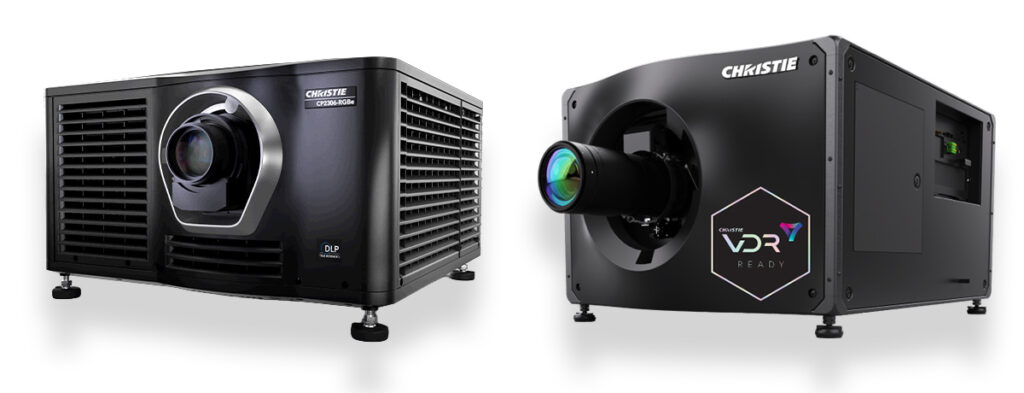
Christie offers the CP2306-RGBe, an affordable RGB option for smaller sites, and the CineLife+ RGB Pure Laser for ultra-bright, large-scale applications. Their phosphor models, like the CP2320, remain popular for mid-size venues.
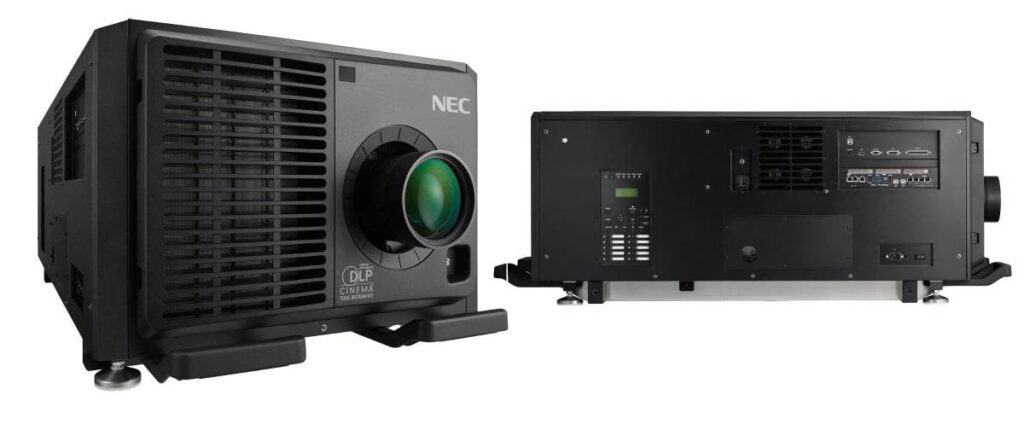
Sharp (formerly NEC) provides the NC1202L, a compact phosphor laser ideal for small independent cinemas, and the NC3541L, a high-output RB laser for premium large-format screens. These projectors sit somewhere between phosphor and full RGB, using dedicated red and blue laser diodes while keeping a phosphor wheel for green channel generation.
If you’re unsure what’s in your booth, check the projector label or model number. “Phosphor” will usually be listed in the specs, or you’ll see “RGB pure laser” clearly marked.
The Technical Comparison: Side by Side
Let’s lay it out in plain terms:
| Phosphor | RGB | |
|---|---|---|
| Laser Lifespan | 20,000 to 30,000 hours | 30,000 to 50,000+ hours |
| Colour Stability | Can drift slightly over time due to phosphor ageing | Extremely stable across the projector’s lifespan |
| Cooling System | Simple, fewer moving parts, typically air-cooled | Complex, multi-loop cooling, often liquid-cooled |
| Dust Sensitivity | Moderate, requires filter changes | Low, sealed modules reduce contamination |
| Service Requirements | Occasional phosphor wheel or filter changes | Minimal, if ambient temperature is stable |
| Contrast and Black Levels | Moderate, adequate for most content | High, excellent for HDR and premium formats |
| Maintenance | Filters, phosphor wheel, regular checks | Minimal ongoing maintenance required |
| Power Efficiency | High, better than xenon | Very high, best-in-class |
| Cost | Affordable, strong value proposition | Premium pricing, long-term savings |
| Best For… | Small to mid screens, 2D content, independent venues | Premium screens, HDR, 3D, PLF auditoriums |
*Note: Hybrid laser systems (like the NEC NC3541L) sit between these two categories, offering most of RGB advantages, particularly in performance and lifespan or keeping cost closer to phosphorus systems. For the purpose of this comparison, they lean closer to RGB in performance characteristics.
What This Means for Your Site
If you’re running a single-screen independent cinema, phosphor laser will likely deliver everything you need. It’s reliable, efficient, vastly superior to xenon, and won’t require a complete electrical or HVAC overhaul to install.
If you’re operating a flagship auditorium, multiplex, or PLF screen, RGB laser becomes the obvious choice. It delivers superior image fidelity, true HDR support, and future-proof colour performance, exactly what modern premium audiences expect and are willing to pay for.
And if you’re still unsure? Many integrators now recommend phosphor for screens under 14 meters and RGB for anything larger, or where HDR and 3D are key revenue drivers. It’s a sensible guideline, though every site has its quirks.
The Bottom Line
Laser technology has come a long way since its early days, when it felt more like science fiction than projection reality. What started as a “wow factor” at trade shows is now the industry standard, and the question isn’t if you’ll go laser, it’s how far you’ll go.
RGB gives you the full canvas. Purer light, wider colour gamut, and future-proof brightness. Phosphor, meanwhile, is the workhorse: practical, affordable, and perfectly capable for the vast majority of everyday cinema.
Either way, both represent a massive step forward from xenon, and both can deliver stunning results when properly calibrated and maintained.
Because at the end of the day, whether you’re running phosphor or RGB, the mission stays the same. The audience sits down, the lights fade, and the screen comes to life. They don’t see the cooling loops or the laser modules. They don’t care about wavelengths or phosphor wheels.
They see the story. And that’s what we’re here for.

- CJ Tech: RGB Laser vs Phosphor Laser – Understanding the Difference - March 25, 2026
- CJ Tech: Choosing the Right Projection System: Xenon vs Laser Projection - January 20, 2026
- CJ Tech: What a Modern Cinema Projection Toolkit Looks Like - September 3, 2025