


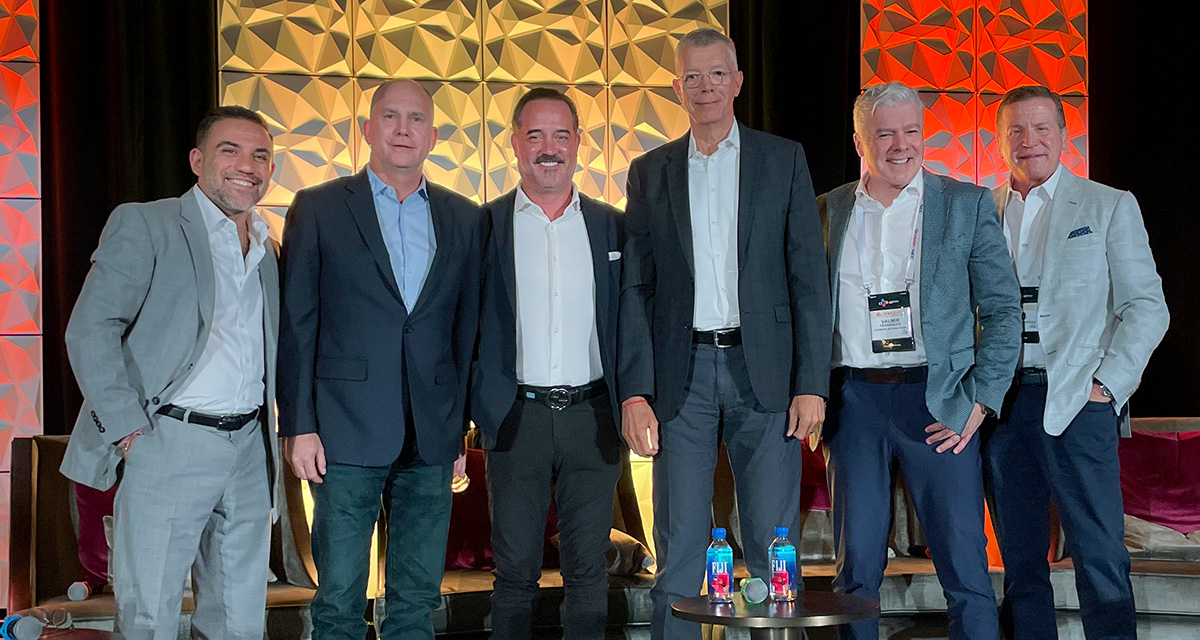
At CineLATAM 2025, global and regional executives from Paramount, Disney, Cinépolis, Cinemark, and CJ 4DPlex chart a path forward for Latin America’s exhibition market, anchored in content, collaboration, and a renewed focus on the moviegoing experience.
By the time Paramount Pictures unveiled its 2026 theatrical slate at CineLATAM 2025, Mark Viane had already set the tone for the week. Speaking to attendees before the presentation, the studio’s President of International Theatrical Distribution remarked that a single dedicated trade show for Latin America was long overdue. While he didn’t say it outright, the implication was clear: Paramount would be all in on CineLATAM as the region’s flagship industry event.
The subtext landed loudly. For years, studios and vendors have been quietly frustrated by the proliferation of cinema conventions across Latin and South America — each serving overlapping markets but competing for the same travel budgets and attention spans. “As much as we’d like to, we simply can’t go to or support five different trade shows,” one studio executive confided offstage. CineLATAM’s debut in Miami thus represented more than another industry gathering; it was a bid to consolidate a fragmented region under one roof, even if that roof is in Miami.
That ambition carried into the executive roundtable, moderated by Comscore’s Luis Vargas. The panel brought together some of the most influential names in the business: Valmir Fernandes, President of Cinemark International; Miguel Mier, COO of Cinépolis; Don Savant, CEO of CJ 4DPlex Americas; Andrew Cripps, Head of Global Distribution at The Walt Disney Studios; and Viane himself.
While Cripps and Viane operate from Hollywood with global purview, their comments underscored a shared recognition that the health of Iberoamerica’s theatrical market is critical to the worldwide ecosystem.
A Region on the Rebound
Overall the mood was cautiously optimistic. After years of pandemic disruption and the dual Hollywood labor strikes that delayed much of 2024’s content pipeline, the region is finally seeing the outlines of recovery. Viane confirmed that, now fully merged with Skydance, Paramount will nearly double its global releases next year to fifteen, reaffirming a “theatrical-first” strategy. “This region continues to perform very highly,” he said, adding that the increased output from Paramount, Amazon, and other major players will give exhibitors the steady flow of content they’ve been missing.
Mier, whose Cinépolis circuit spans more than a dozen countries, said the post-COVID landscape demands decisions grounded in data. “In these times, we need to rely as much as possible on facts and analysis,” he urged. He pointed to research from the Global Cinema Federation showing that markets less dependent on Hollywood have recovered faster, thanks to a steady diet of local productions. “India, Indonesia — these markets bounced back quickly because audiences saw themselves on screen,” he said. Latin America, he argued, must strengthen its own storytelling pipeline, treating theatrical success as the launchpad for broader IP ecosystems.
Cripps agreed. “Audiences want to see stories they can relate to,” he said. He highlighted how Disney’s global releases, “Inside Out 2” and “Lilo & Stitch” among them, continue to over-index in the region; not because they are local productions, but because Latin American audiences connect deeply with family-centric storytelling and high-quality local dubbing. “Localization matters,” he noted. “The right voice talent and cultural nuance can make the difference between a good movie and a great experience.”
Surviving Volatility, Protecting Value
Still, optimism in Latin America is never detached from reality. Economic volatility remains a constant challenge, especially in markets where inflation and exchange-rate swings can undo months of careful planning. Fernandes, who has spent three decades managing Cinemark’s operations across the region, put it bluntly: “People who don’t want to be subject to FX shouldn’t be in Latin America.”
The key, he added, is to protect the perceived value of cinema even amid pricing pressures. “You cannot find anything cheaper for a couple of hours than cinema,” Fernandes said. “We need to keep up with inflation without eroding the experience.”
Mier echoed the sentiment, warning against discounting as a reflex. “We must never confuse affordability with devaluation,” he said. “If we treat cinema as cheap, audiences will too.”
That thread — value, not price — ran throughout the session. Whether expressed in box-office terms or audience loyalty, all agreed that the future hinges on sustaining cinema’s emotional and experiential premium.

The Experience Equation
“Content is king, but experience is queen,” moderator Vargas said at one point, distilling the mood into a single phrase that rippled through the room. It wasn’t just a clever line — it was the day’s defining mantra.”
Viane picked up the thought. “It’s not just about a great movie or a great seat,” he said. “It’s the pre-show, the energy, the way guests are welcomed — it all adds up.” A cinema with poor service or tired presentation, he warned, can undo the work of the biggest marketing campaign.
Savant, whose company CJ 4DPlex powers immersive experiences like 4DX and ScreenX, agreed. “Our entire mission is to create something you can’t replicate at home,” he said. “When audiences feel the wind, the motion, the depth of sound — it’s pure engagement.”
On the last day of CineLATAM, CJ 4DPlex demonstrated that point with the world premiere of “KYGO: Back at the Bowl,” a concert film shot specifically for ScreenX’s 270-degree panoramic format. “That’s the kind of event that reminds people why cinema exists,” Savant said. “You can’t stream that experience.”
Fernandes cautioned, however, that the push for premium shouldn’t create a two-tiered industry. “We can’t push everyone to a single format,” he said. “Every auditorium has to offer something special, even if it’s not branded premium.”
Cripps added a valuable studio perspective, stating, “When we put IMAX or Dolby on the poster, it tells audiences this movie is theatrical — it’s an event.” Premium formats, he said, serve as shorthand for quality, signaling to consumers that what awaits them is worth leaving home for.
Generations in Transition
When conversation turned to audiences, the panel struck a surprisingly hopeful tone. Mier referenced a recent National Research Group study titled Will Gen Alpha Save the Box Office? “We may have lost some of Gen Z to their phones,” he said, “but kids between six and twelve are craving live experiences.” He described this cohort as “the anti-Z generation — less tethered to streaming habits, more eager for shared entertainment.”
The task for exhibitors, he said, is to meet that enthusiasm with “tidy cinemas, great concessions, and well-run operations that feel alive.”
Savant backed him up: “Younger audiences are telling us they want to feel movies again. If we can deliver that sense of wonder, they’ll keep coming back.”
A Global Perspective on a Regional Future
Both Cripps and Viane acknowledged that, despite their global portfolios, Latin America represents one of the most dynamic theatrical regions in the world. “It’s under-screened, yes,” Cripps said, “but also under-appreciated in how consistently it delivers.” Fernandes agreed, calling the region’s exhibitors “fighters by necessity.”
What unites them now is a common cause: stabilizing the business model through collaboration rather than fragmentation. CineLATAM, in that sense, was both a trade event and a statement of intent. As Viane’s early remarks implied, consolidation isn’t just about convenience, it’s about credibility. However, while studios want a single platform to engage Latin America efficiently, the region must ensure that inclusivity doesn’t suffer as a result. Many smaller operators across South and Central America, after all, can’t easily make the trip to Miami.
That tension — between global consolidation and regional accessibility — hangs over CineLATAM’s bright debut. If the event can balance both, it could become the regional connective tissue Latin America’s cinema sector has long lacked.
Moderated Optimism
As the roundtable concluded, Fernandes offered a reality check wrapped in hope. The industry, he said, is still paying down pandemic-era debt and navigating unpredictable valleys between major releases. But with more content coming, a stronger slate, and renewed emphasis on experience, the path forward looks promising. “We may not return to 2019,” he said, “but we are moving in the right direction.”
Mier’s closing thought captured the room’s mood. “We don’t need to be saved,” he said. “We just need to realign to a different reality.”
In that different reality, the formula seems clear: great stories told locally and globally, delivered through an experience that feels worth the trip. CineLATAM 2025 marked the beginning of that conversation — one where content remains king, but experience reigns alongside it.

- Can Cinema LED Scale? Samsung Bets Trilith Cinemas Can Help Prove It - March 24, 2026
- A Quiet Player Makes a Big Move: Qube Cinema Acquires Arts Alliance Media - February 23, 2026
- As Sundance Says Goodbye to Park City, Its Films Look Forward - January 21, 2026