





If theatrical exhibition and distribution had their own version of Oscar night, the Pioneer of the Year dinner would be a pretty good candidate.
If you were to walk into the Beverly Hilton on 30 September for the event the comparison makes sense. Executives from most of North America’s major cinema circuits are there, joined by studio distribution chiefs, technology companies, vendors and others from across the theatrical business. Everyone has traded the usual trade-show uniform for their Sunday best.
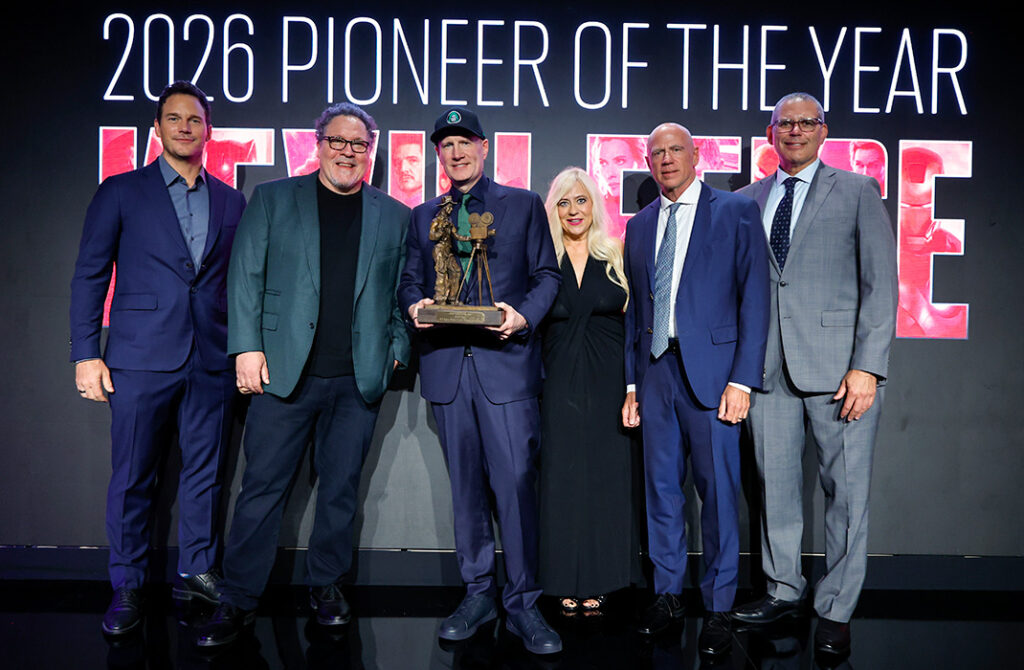
This year’s honoree was Kevin Feige, president of Marvel Studios and the most commercially successful film producer in history. Appropriately, Marvel costumes and a display of Feige’s trademark baseball caps framed the room.
The timing was certainly interesting. Earlier that same day, a federal judge approved the settlement clearing the way for Paramount to acquire Warner Bros. Discovery. It was one of the most consequential Hollywood transactions in decades, with obvious implications for many people in the room.
For a few hours, though, you would hardly have known it.
There were whispers, certainly. There are always whispers at industry dinners, even when nobody has just bought Warner Bros. But publicly, the merger was put aside while the business gathered to honor Feige and raise money for people working in theatrical exhibition and distribution who need help.
By the end of the evening, the Pioneer of the Year dinner had raised USD $1.9 million for the Pioneers Assistance Fund, the most in more than 20 years.
My own relationship with the organization goes back several decades (sort of). As a teenager in the 1980s, I worked as an usher at a Cineplex Odeon theatre in Paramus, New Jersey. Before the trailers, the Will Rogers Institute PSA would play. When it ended, ushers walked through the auditorium carrying collection canisters so moviegoers could donate.
For anyone wanting a genuine 1986 time capsule, there is a Will Rogers PSA on YouTube featuring enough famous faces, hair and wardrobe choices to make you wonder how any of us survived the decade.
The mission was serious. The Will Rogers charitable effort traces its roots back 90 years to the fight against tuberculosis and later expanded into public-health causes including AIDS awareness. Today, the Pioneers Assistance Fund helps people in the theatrical exhibition and distribution community facing financial crises caused by serious illness, family emergencies, natural disasters and other hardships.
The continuity became even clearer when Todd Vradenburg of Cinema Association of California/Nevada reminded the room that Kyle Davies, now with Leawood Films and co-chair of the Pioneers Assistance Committee, had also started in a movie theatre carrying the Will Rogers collection canister through auditoriums.
Apparently neither of us realized there was a career path from carrying those cans to sitting in the Beverly Hilton raising millions of dollars.
Then Feige took the stage. He could have spent the evening talking about Marvel’s 39 films and record-setting box office. Instead, he kept returning to something much simpler: going to the movies. “I’m honored to be in this room tonight with so many people who champion theatrical exhibition,” he said. “That experience is sacred to me.”
Feige recalled growing up in New Jersey, sitting in the Rialto Theatre in Westfield eating Twizzlers and occasionally skipping SAT prep because the movies seemed like a better use of his time. But his most important point was about what happens after the movie has been made.
Feige described filmmaking as a collaborative medium, then added, “The final crucial part of that collaboration is the audience.”
He reminded the room what moviegoers actually have to do. “People are getting in their cars. They’re finding parking. They’re buying a ticket. They’re finding a babysitter,” he said, before choosing “to sit in a theater with a bunch of strangers to experience something that just might become a core memory.”
That, for Feige, completes the process. “Movies are an invitation to experience a story together,” he said. “That shared emotion is the final step that completes the movie. You might even say it’s not a movie without it.”
He even pointed to the recent “Avengers: Endgame” Encore rerelease, which regular readers may remember gave us a few things to talk about last week. “In this industry that is constantly being told moviegoing is dying,” Feige said, “we’ve gotten to make movies that bring people back to the theater.”
For a business that spends enormous amounts of time discussing windows, consolidation, premium formats, streaming, capital expenditure and quarterly earnings, it was a useful reminder of what all those debates are supposed to accomplish.
Somebody makes a movie. Somebody gets it onto a screen. And somebody else sits down in the dark to watch it.
For all the change happening around the film industry right now, that still seems like the part worth protecting.

Expocine Shows the Strength of Brazil’s Cinema Business
Brazil’s economy may be cooling and international travel remains expensive for local cinema professionals, but you would have had a hard time detecting much pessimism at this year’s Expocine.
The São Paulo convention drew more than 2,800 registrants, up from a record 2,300 badge holders last year, while its trade show has grown from just 24 exhibiting brands in 2023 to more than 60. The expansion forced organizers to move the exhibition floor into a larger venue across the famed Avenida Paulista from Cine Marquise, where distributors and studios presented upcoming slates.
Expocine bills itself as Latin America’s largest cinema-industry gathering, though its center of gravity remains decidedly Brazilian. Participation from elsewhere in the region has historically been more uneven, but that is not necessarily a weakness. For many Brazilian exhibitors, distributors and vendors, flying to CinemaCon in Las Vegas or CineEurope in Barcelona can be prohibitively expensive. Expocine gives one of the world’s largest theatrical markets a major industry gathering of its own.
It also arrives as Brazilian cinema is enjoying unusual momentum of its own. Films such as “I’m Still Here” and “The Secret Agent” have earned international recognition while helping increase the domestic market share of Brazilian productions. These are necessary ingredients for a healthy cinema market, which requires more than imported studio films and functioning multiplexes. It also needs local films, local distributors, local expertise and a place for the people running the business to meet.
Judging by Expocine 2026, Brazil currently has plenty of all four.
Source: Celluloid Junkie
France’s Canal+ Tax Hike Could Put €980 Million in Film Financing at Risk
It took barely two months for French cinema’s landmark new financing deal with Canal+ to encounter its first serious threat.
In July, Canal+ signed a five-year agreement committing EUR €980 million to French and European film production between 2028 and 2032. As France’s leading private financier of cinema, Canal+ is one of the central pillars of a tightly regulated funding system that has helped sustain one of Europe’s healthiest domestic film industries.
Now the French government wants to double VAT on pay-TV subscriptions from 10% to 20%. Canal+ says the change could cost it as much as EUR €200 million per year and has warned that it would respond by raising prices, cutting costs and reducing its financial contributions to film, television and sports.
If those numbers sound suspiciously familiar, they should. The proposed tax hit of up to EUR €200 million annually is almost exactly equal to Canal+’s average annual cinema commitment of EUR €196 million.
More importantly, Canal+ appears to have planned for precisely this possibility. The July agreement reportedly contains a clause allowing the company to suspend its film-financing commitments if the VAT rate increases. That is one rather substantial escape hatch.
France’s cinema model has long depended on an intricate system in which broadcasters, exhibitors, streaming services, taxes and public support feed money back into local production. It works remarkably well, but the Canal+ dispute illustrates how interconnected that system has become. The government may see a higher VAT rate as additional revenue from pay television. French producers may see EUR €980 million suddenly becoming considerably less certain.
Source: Variety
Cinemark Is Not Picking One Premium Format. It’s Picking Several
Cinemark appears increasingly uninterested in choosing a single winner in the premium-format race. Within the past week, the circuit announced plans to add 20 ScreenX auditoriums across the U.S. and Latin America while separately expanding Lumma’s 4D E-Motion format into Peru for the first time.
The ScreenX deal will add 17 locations in the U.S. and three in Latin America, with six U.S. auditoriums opening this year and Cinemark’s domestic ScreenX footprint reaching 30 ahead of “Avengers: Doomsday.” In Peru, an 87-seat Lumma 4D E-Motion auditorium will open at Cinemark Jockey Plaza on 20 November, becoming the circuit’s tenth Lumma location across Latin America.
Those are only the latest pieces of a much broader premium strategy.
After all, Cinemark already operates its proprietary XD large-format auditoriums, IMAX screens and what it calls the industry’s largest D-BOX motion-seat footprint, with D-BOX now available in nearly 550 auditoriums worldwide. In 2025, D-BOX sales grew 40% year over year, while Cinemark’s premium large-format screens generated 14% of its global box office from only 6% of its screens.
The formats are not interchangeable. ScreenX extends images onto the auditorium walls. D-BOX adds motion to individual seats. Lumma combines motion seating with effects including wind, water, vibration and scent. XD and IMAX address the premium-large-format end of the market.
This may actually be the point. Rather than making one big bet on what “premium” is supposed to be for its customers, Cinemark is assembling a menu of experiences and deploying them according to market, auditorium and audience.
Source: Celluloid Junkie
Cinema LED Keeps Finding Its Way Into More Theatres
Cinema LED has spent years being discussed as the next big thing in theatrical presentation. Lately, however, it has been doing something more useful: turning up in actual cinemas. Within a matter of weeks, four different LED projects were announced or opened across the U.S., Brazil and Hungary.
In Pennsylvania, Oaks Center Cinema is building what will be the world’s first theatrical auditorium combining a Samsung Onyx direct-view LED screen with D-BOX motion seating. The 38-foot display and 41 D-BOX recliners are scheduled to open in December.
Meanwhile, in Texas, Schulman Theatres installed North America’s first acoustically transparent Tricorne Premium LED cinema screen at Film Alley Bastrop. The screen is part of the circuit’s SPX Direct premium-format auditorium and supports HDR, high frame rates and 3D presentation.
GDC Technology also announced that São Paulo’s historic Nu Cine Copan will install a 20-meter Tricorne Premium LED screen when the restored 440-seat cinema reopens next year. The company says it will be the world’s first acoustically transparent native 8K LED screen designed specifically for a premium large-format cinema auditorium.
And in Budapest, in a deal initially announced in June, Lurdy Cinema has opened an auditorium with a 62-square-meter Samsung Onyx 4K display, giving Central and Eastern Europe its first Onyx LED cinema.
Any one of those installations would be easy to dismiss as another showcase for a technology that remains a tiny fraction of the world’s cinema screens. Four within a few weeks starts to look more like a pattern. The interesting part is not that every exhibitor is suddenly ripping out its projectors. They clearly aren’t. It is that LED is increasingly becoming a legitimate commercial option, adopted by different operators, from different manufacturers, in different countries and in increasingly varied premium configurations.
Source: Celluloid Junkie
Alamo and A24 Turn Catalogue Films Into Collectible Events
Alamo Drafthouse and A24 have found another way to make old movies feel new again: give audiences something they can take home.
The two companies have launched A24 Cinema Club, a year-long series of monthly screenings built around films from the studio’s catalogue. Each event will pair the movie with a themed menu and an exclusive collectible pint glass included with the ticket.
The series begins on 22 November with Ti West’s “Pearl,” followed by “Red Rocket” in December, “The Green Knight” in January, “Moonlight” in February and “Everything Everywhere All at Once” in March. The “Pearl” screening comes with a limited-edition glass featuring artwork by Chris Bilheimer, available only through the Cinema Club screenings.
What’s interesting is that the movies themselves are hardly difficult to find at home. But, Alamo and A24 are not simply selling another chance to watch a catalogue title on a big screen. They are turning each screening into a limited event, combining theatrical presentation, food and beverage, fandom and a physical collectible that creates a reason to attend now rather than watch the film whenever it happens to appear on a streaming service.
It is also another example of merchandise moving the needle for exhibitors rather than simply being something sold from a counter on the way out.
Which, conveniently enough, is exactly the subject of the next CJ Cinema Summit. Our summit on 14 October 2026 is titled “From Popcorn Buckets to Premium Collectibles: How Movie Merchandise Became Big Business for Cinemas,” and will look at how exhibitors are turning branded merchandise, collectibles and limited-edition products into revenue, marketing and fan engagement.
Source: Celluloid Junkie
Sponsor Spotlight

How Movie Merchandise Became Big Business for Cinemas
Popcorn buckets became big business. So what comes next? Join exhibitor and supplier leaders from Cineworld, Golden Link and Zinc Group for a practical discussion about what actually sells, how cinemas manage licensing and inventory, and where movie merchandise is headed as exhibitors prepare for 2027.
