





Before anyone interprets this week’s headline as my editorial assessment of Regal Global Entertainment CEO Eduardo Acuña publicly backing the proposed Paramount-Warner Bros. Discovery merger, let me be clear: those are Acuña’s words, not mine.
Acuña came out in support of the deal just one week before the events I’m about to describe. So yes, this may be the first time I have knowingly resorted to clickbait. I’m not saying I’m proud of myself. I’m also not changing the headline.
First, however, I apparently owe quite a few Marquee readers a mea culpa.
Last week I ran through what already seemed like an absurdly crowded calendar of cinema industry conventions, conferences and film festivals. Judging by my inbox afterward, I left out approximately half of them.
In fairness, I had stopped at the end of September. That didn’t prevent readers from reminding me about Expocine and the EF&B Concession and Hospitality Expo, followed by the Australian International Movie Convention, META Cinema Forum, the Norwegian Cinema Conference, American Film Market and CineAsia. And that’s before getting into film festivals such as BFI London, AFI FEST and the Red Sea International Film Festival.
If the purpose of last week’s editorial was secretly to determine whether anyone actually reads these missives, then mission accomplished.
Apparently you like us. You really like us.
Which brings me to an industry event I was fortunate enough to attend last Wednesday.
Thanks to an invitation from Lumma (4D E-Motion & Magnify 8), I attended the Variety Boys & Girls Club’s annual charity gala in Universal City honoring Acuña. After spending the previous week complaining about how many industry events there are, this one provided a useful reminder of why some of them are worth putting on the calendar.
The North American movie theatre business has long supported two major charities: Variety – The Children’s Charity and the Will Rogers Motion Picture Pioneers Foundation. In Southern California, Variety has helped support the Variety Boys & Girls Club in Boyle Heights since 1951, providing young people, many from families with limited resources, with educational programs, after-school activities, mentoring and scholarships.
You don’t have to read an annual report to see whether that support is paying off.
Throughout the evening, recent high school graduates took the stage to explain where they were headed to college and what the club had meant to them. Current members, some as young as five, confidently told a ballroom full of movie industry executives where they wanted to go to school and what they planned to become.
I’m fairly certain that at five years old I didn’t even know what college was.
And there were plenty of industry executives there to hear them. The room had the feel of a mini-Academy Awards for distribution and exhibition, with many of Hollywood’s senior distribution executives in attendance alongside exhibitors, vendors and executives from throughout the business.
A large contingent from Cinépolis was also there to honor their former colleague, including COO Miguel Mier, Global Film Programming and Content VP Miguel Rivera and Cinépolis USA CEO Luis Olloqui.
Acuña, who was born and raised in Mexico and spent much of his exhibition career at Cinépolis before eventually taking the top job at Cineworld, which has since become Regal Global Entertainment, was honored throughout the evening with nods to his heritage, from the food and décor to the mariachi music.
I am hardly qualified to judge mariachi and may very well have “gringo” listed somewhere in my passport, but Los Mariachis De America sounded pretty spectacular to me.
By the time the auctions and fundraising were finished, the gala had raised a record USD $755,000 for the Variety Boys & Girls Club. For anyone who missed the event, or simply wants to help, that total can continue to grow, since contributions can still be made directly to the organization.
Then Acuña took the stage.
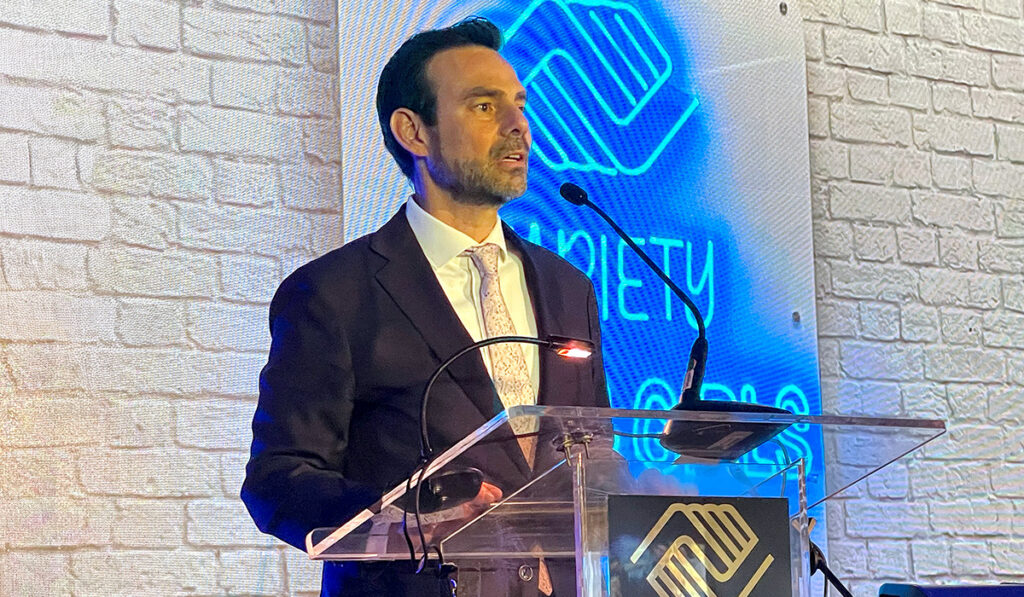
He had already been put through an emotional evening filled with surprise appearances from friends, former colleagues and family members. His brothers had surprised him the day before during a visit to the club. Then his father arrived from Mexico.
Acuña insisted he hadn’t cried. “I don’t cry because I’m Mexican. I’m a macho,” he told the room. Something had simply gotten in his eye. That was his story, and he was sticking to it.
Acuña admitted that surprises are not exactly his favorite thing. He likes being in control. This event had other plans.
For instance, there was the small matter of his speech.
Until shortly before the gala, Acuña apparently believed this would be a relatively intimate affair and hadn’t prepared remarks for a ballroom filled with hundreds of people. At least four people, he said, suggested the obvious modern solution: use artificial intelligence.
“Being who I am,” Acuña told the room, “I decided to choose natural stupidity.”
Thus the headline.
Fortunately, natural stupidity turned out to be pretty effective.
The theme Acuña kept returning to was opportunity. “When I think about the club, I think only one word, and that word is opportunity,” he said.
Acuña knows something about that firsthand. He received scholarships to attend college and graduate school. Throughout his life and career, people admitted him to schools, hired him, mentored him and opened doors without knowing where those opportunities might eventually lead.
“Someone decided that I was worth investing in,” he said.
That, Acuña explained, is what the Variety Boys & Girls Club is doing for the young people we had watched take the stage throughout the evening. The scholarships, programs, instructors and mentors aren’t determining what those kids will become. They are giving them the chance to discover it for themselves.
“We don’t know which ones of these kids will be a doctor, a lawyer, an entrepreneur, an artist, a teacher,” Acuña said. “Or maybe they’ll come back and help the next generation.”
Then came the line that, for me, summed up both his speech and the reason everyone was in that ballroom. “Our job is not to decide what their future will be. Our job is to make sure they have the opportunities to find out.”
Toward the end of his remarks, Acuña turned directly to his father and spoke to him in Spanish, thanking him for the encouragement, love and example he had given him throughout his life. He told his father that everything he had achieved had been built upon the foundation he provided.
You didn’t really have to understand exactly what Acuña was saying to understand the emotion behind it.
I’m pretty sure I had something stuck in my eye right after.
That’s my story, and I’m sticking to it.
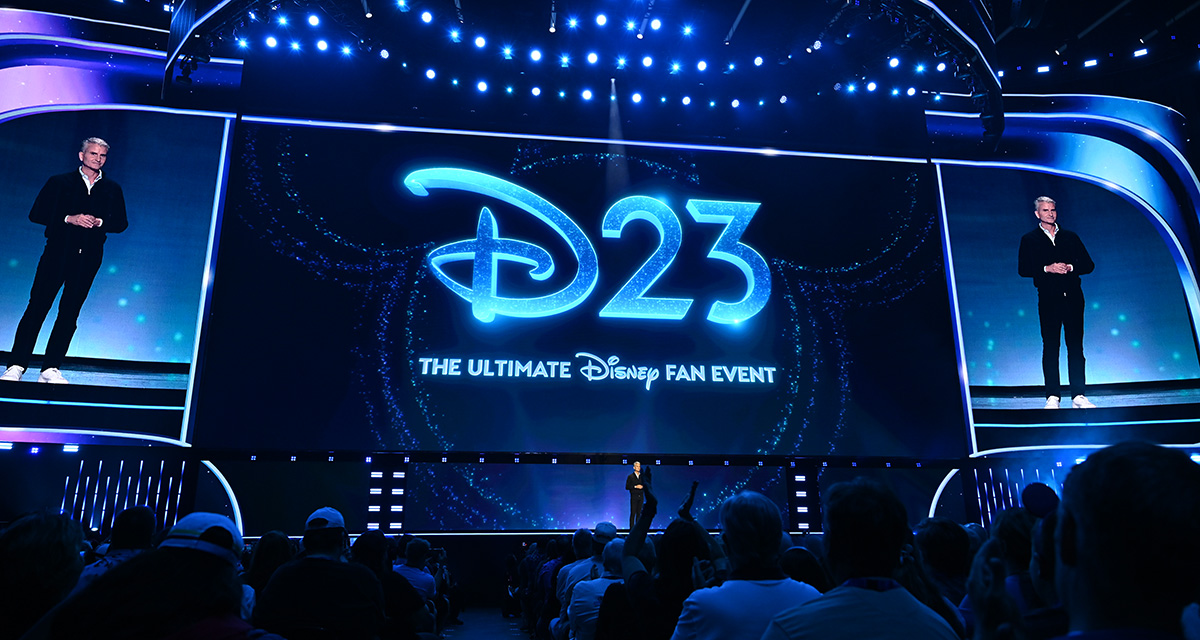
Disney Turns D23 Into a Three-Year Theatrical Slate Preview
Disney’s D23 fan event may have been staged for the faithful, but exhibitors should have been taking notes. Over the course of its entertainment showcase in Anaheim, the studio effectively laid out a theatrical roadmap stretching from this December’s “Avengers: Doomsday” all the way to “Coco 2” in November 2029.
In between is the kind of release pipeline cinema operators have spent the past several years asking studios to provide. “Star Wars: Starfighter,” “The Bluey Movie” and “Frozen 3” arrive in 2027, followed in 2028 by “Tangled,” “X-Men,” “Lilo & Stitch 2” and “Incredibles 3.” Disney also has Pixar’s original “Ghost Market” and Walt Disney Animation’s “Clay” on the calendar, while “Zootopia 3” is already in early development.
Yes, the slate is heavy on sequels, remakes and familiar intellectual property. No one is likely to confuse Disney’s strategy with an outbreak of reckless originality. Then again, D23 is hardly the place to spend valuable stage time touting original films to fans who came to celebrate characters they already know. From an exhibition standpoint, however, the larger point may be visibility. Disney repeatedly described many of these films as releasing “exclusively in theatres.”
That visibility is especially notable in 2028. Disney currently has “Tangled” set for March 31, “X-Men” for May 5, “Lilo & Stitch 2” for May 26 and “Incredibles 3” for June 16, before even accounting for the rest of its theatrical calendar.
For theatre owners trying to plan capital investments, premium screen allocations and marketing calendars, three years of reasonably identifiable product is not a bad thing to have.
D23 is designed to make Disney fans excited about what comes next. This year it also gave exhibitors something they have wanted for quite some time: a clearer look at what will be coming through their doors.
Source: Celluloid Junkie
NCM Looks Beyond the Movie Theatre With $275 Million Captivate Deal
National CineMedia is expanding its definition of where a captive audience can be found. The largest cinema advertising network in the United States has agreed to acquire Captivate for USD $275 million, extending its reach from movie theatres into office buildings, elevators and residential properties across North America.
Captivate operates more than 26,000 digital video screens in over 11,000 office and residential buildings across more than 170 designated market areas. Combined with NCM’s roughly 22,000 theatre and lobby screens, the deal would give the company a network of more than 48,000 screens across 185 markets, including all of the top 100.
The logic is not simply diversification away from movie theatres. NCM can potentially offer advertisers something considerably broader: access to affluent professionals at work, consumers where they live and the younger, diverse audiences that continue to make cinemas particularly attractive to brands. Captivate also opens the door to business-to-business advertising categories such as financial services and enterprise technology that historically have had little reason to buy cinema inventory.
Just as importantly, those Captivate advertisers can now be sold movie theatre audiences as part of the same campaign. In other words, NCM may be expanding beyond cinema partly as a way of making cinema advertising easier to buy.
The acquisition comes as NCM’s core business is already improving alongside the domestic box office. Second-quarter revenue increased 12.7% year-over-year to USD $58.4 million, while adjusted OIBDA rose to USD $2.1 million from USD $700,000 a year earlier.
The expansion does come with some financial weight. NCM plans to fund the transaction with USD $275 million in new term debt and has paused its dividend and share repurchase programs as it expects leverage to reach approximately 3.9 times at closing.
Source: Celluloid Junkie
NEON Takes UK Distribution Into Its Own Hands With “Hope”
NEON is no longer merely acquiring films for UK and Irish audiences. It is going to start putting them into cinemas itself.
The U.S. independent distributor will directly release Na Hong-jin’s sci-fi thriller “Hope” in UK and Irish theaters on September 25, marking the company’s first direct theatrical release in the territory. The move follows reports in July that NEON was preparing to establish its own UK distribution operation.
“Hope” is a suitably ambitious film with which to make the leap. The Korean production premiered in competition at Cannes and stars Hwang Jung-min, Zo In-sung and HoYeon alongside Taylor Russell, Alicia Vikander and Michael Fassbender. It has already topped the box office in South Korea and will receive its UK premiere in IMAX at the Edinburgh International Film Festival before opening commercially.
NEON has acquired UK and Irish rights to films before, but direct distribution represents a different level of commitment. Rather than licensing titles to established local distributors, the company can control theatrical strategy, marketing and release execution itself while retaining more of the upside when a film connects.
That model has served NEON rather well in North America, where its increasingly distinctive slate has made it one of the most influential independent distributors in the market. Extending that operation into the UK and Ireland gives the company another major English-language territory in which to apply the same playbook.
Whether “Hope” is the beginning of a steady pipeline or simply the first step in a more selective strategy remains to be seen. Either way, a month after NEON was reportedly considering a UK distribution launch, it appears the consideration phase is over.
Source: Screen Daily
Cineplex Says Gen Z Is Tired of Small Screens. Its Numbers Back That Up.
Cineplex CEO Ellis Jacob has a theory about younger moviegoers: they may finally be getting tired of staring at small screens. Fortunately for Canada’s largest exhibitor, there are some numbers behind the optimism.
Cineplex reported the highest second-quarter revenue in its history at CAD $383.7 million (USD $276.53), up 9.8% year-over-year, as attendance increased 9.3% to 12.7 million guests. Box office revenue reached CAD $176.2 million (USD $127 million), its strongest second quarter since 2019, while the company set all-time quarterly records for both box office and concession revenue per patron. Adjusted EBITDAaL increased 20.4% to CAD $40.8 million (USD $29.4 million).
Jacob believes younger audiences are helping drive that growth. “They’re tired of looking at the small screen,” he told The Hollywood Reporter, pointing to moviegoing as a social experience for Gen Z. It is an appealing theory for exhibitors, though getting younger consumers through the door once is different from turning them into regular customers.
That is where another set of Cineplex numbers gets interesting. CineClub, the company’s subscription program, just celebrated its fifth anniversary, with more than 250,000 members participating over that period. According to Cineplex, members visit its cinemas four times more frequently than non-members, suggesting that price, perks and habit can matter almost as much as whatever happens to be opening on Friday.
Of course, having movies people actually want to see helps. Cineplex credited a more consistent and diverse slate for its record quarter, while “The Odyssey” and “Spider-Man: Brand New Day” subsequently delivered the highest weekend box office and theater food service revenue in the company’s history.
Gen Z may indeed be tired of small screens. Cineplex’s results suggest that when the movies, experience and value proposition line up, they’re willing to trade up to a very large one.
Source: Hollywood Reporter
D-BOX Makes Its Move Into Malco Theatres
Malco Theatres is adding a little more movement to the moviegoing experience.
The Memphis-based exhibitor has signed its first agreement with D-BOX Technologies to install the company’s haptic motion seating in 13 auditoriums across four theaters in Tennessee and Arkansas. Three auditoriums at Malco Paradiso in Memphis, four at Malco Collierville, three at Malco Razorback in Fayetteville and three at Malco Fort Smith will receive the technology, with installations beginning in late September and all 13 expected to be operating by Thanksgiving.
D-BOX seats use synchronized movement, vibration and other haptic effects programmed to match the action onscreen. But what appears to have appealed to Malco was not simply another premium amenity.
Wes Lunsford, Senior Vice President and Executive Committee member at Malco, specifically cited the flexibility of offering D-BOX across multiple auditoriums, films and showtimes as an important factor in the circuit’s decision. That matters at a time when exhibitors are trying to give audiences differentiated experiences without necessarily dedicating an entire auditorium to a single premium format.
The agreement also represents a sizable opening move between the two companies. Malco operates more than 330 screens across 31 locations in the Mid-South, while D-BOX has been expanding its U.S. exhibition footprint this year through new agreements with B&B Theatres and Marcus Theatres.
For Malco, the deal adds another premium option without requiring the circuit to commit entire auditoriums to a dedicated large-format concept.
Source: Celluloid Junkie
Sponsor Spotlight
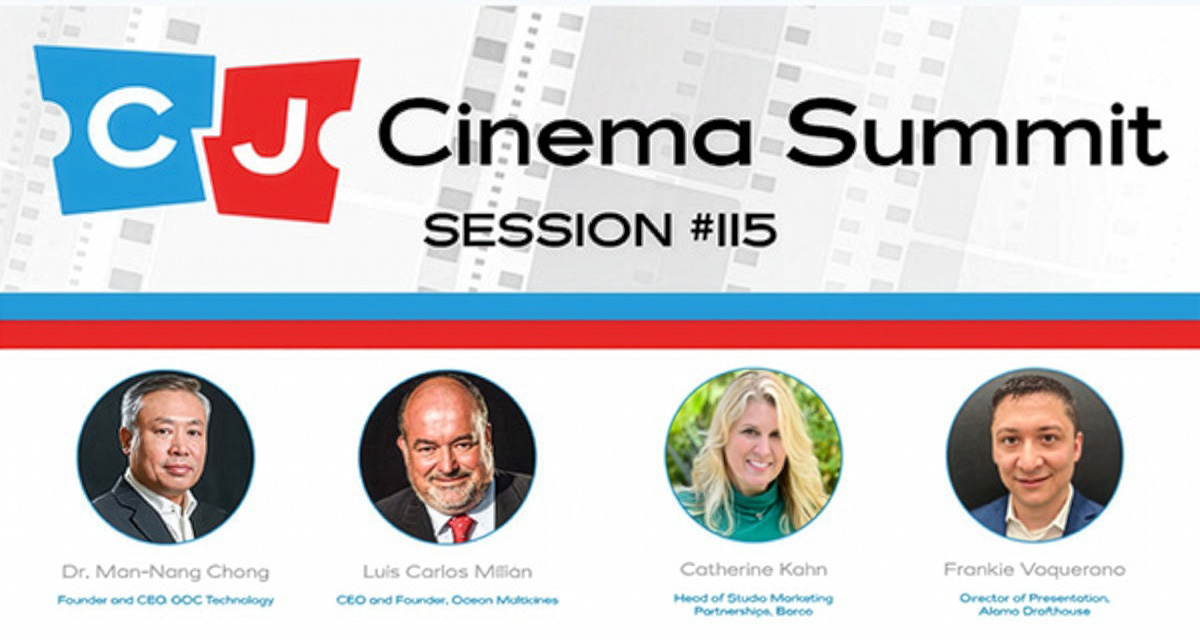
HDR, LED and the Next Wave of Premium Cinema Presentation
Premium cinema presentation is moving beyond any single format, feature or screen size. In CJ Cinema Summit #115, executives from GDC Technology, Barco, Odeon Multicines and Alamo Drafthouse explore the technologies shaping the next generation of theatrical presentation, from HDR and LED cinema screens to the operational and investment questions exhibitors face when evaluating them. The conversation examines where innovation is actually improving the audience experience… and moving the needle for cinemas.
