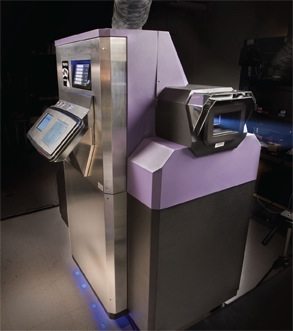
Kodak Laser Projection System
Kodak’s plans to create a light engine for digital cinema projectors that can compete with Texas Instruments DLP chip reached a crucial milestone earlier this week. The Food and Drug Administration (FDA) approved the variance application clearing the way for the commercialization of Kodak Laser Projection Systems which feature Kodak Laser Projection Technology.
Maybe, like me, you’re wondering what the FDA has to do with regulating anything that isn’t a food or a drug. Don’t they have eggs to inspect and clinical trials to oversee? Well yes, they do, however they also oversee any manufactured device that emits radiation. For the most part that means lots of medical equipment and x-ray machines, though laser light displays also fall into this category.
Much in the way pilots and drivers need licenses, a federal license demonstrating basic laser knowledge and safety is required to operate high powered laser systems. For instance, night clubs with laser light shows need to obtain variances for their lighting equipment. I’m not sure exactly what kind of variance Kodak applied for, but according to Les Moore, Kodak’s chief operating officer for Digital Cinema:
“The FDA variance serves as a template to be followed by manufacturers that we license to incorporate this new laser technology.”
Read More »
Popularity: 4% [?]
Earlier today shares in the Eastman Kodak Company skyrocketed 12% after the company announced their third-quarter financial results had beaten Wall Street expectations. It wasn’t that Kodak had turned a huge profit, but rather it hadn’t lost as much money as had previously been forecast.
Per U.S. generally accepted accounting principles (GAAP), Kodak had third-quarter losses from continuing operations of USD $43 million or $0.16 a share on sales of USD $1.785 billion. That may not sound like good news, though compared to last year’s third quarter loss of USD $111 million or $0.41 it’s a huge improvement.
Kodak has inkjet printers to thank in large part to its improved performance. Turns out those little inkjet cartridges that always seem to be empty in your printer produce a hefty profit margin. Revenue from the company’s inkjet products grew by 23 percent, helping its digital commercial printing division expand by 13 percent. In fact, all of Kodak’s digital businesses were up a combined 10% during the quarter, the fourth consecutive quarter to show year-over-year increases.
It wasn’t all good news for Kodak however, and it is in an area of more specific interest to our readers that the company suffered steep decline. Sales for Film, Photofinishing and Entertainment Group amounted to USD $431 which is down 25 percent from last-year’s third-quarter. Per Kodak’s announcement:
Read More »
Popularity: 2% [?]

For the past several weeks there have been whisperings in conversations throughout the motion picture exhibition industry about organizational changes at Kodak Digital Cinema. To put an end to the conflicting reports that were coming my way I did the most simple of things; picked up the phone and spoke with someone directly at Kodak. Strange, I know, given that this business has gotten us all so used to playing our cards close to the vest, but sometimes a direct approach actually works.
Indeed, Kodak Digital Cinema is dramatically changing the focus of its business. Bob Gibbons, Director of Marketing and Communications for Kodak Digital Cinema lived up to his title by being very upfront in explaining the company’s new strategy. “We’re going to really concentrate on areas that build more directly on our unique capabilities of service and intellectual property licensing,” said Gibbons. “We’re going to discontinue all development and manufacturing of our preshow advertising systems, our Kodak screen management servers, our Kodak theatre management systems and what I refer to as our role as a feature systems integrator, putting the packages together and marketing the packages.”
Acting as a systems integrator has been the most visible part of Kodak’s digital cinema business up until now. Moving forward, Kodak Digital Cinema will instead develop and license digital cinema technologies to be commercialized by others while continuing to provide services and support for existing systems. Though Kodak may not be manufacturing preshow video players any longer, they will continue to prepare and distribute preshow content and playslists.
Read More »
Popularity: 20% [?]
–Barco has enterted into a supply agreement with Kodak to provide exhibitors fully integrated digital cinema systems that combine Barco digital cinema projectors and Kodak’s digital screen management servers and theater management systems.
“Barco has a long-term commitment to high quality projection technology in digital cinema,” said Les Moore, chief operating officer for Kodak Digital Cinema. “We are already working with them in a number of multiplexes in the United States and beyond. By combining Barco’s capabilities with ours, we can jointly provide a complete solution to the marketplace. This new agreement will be a good fit for both companies and for our customers worldwide.”
According to this morning’s announcement, Barco could deliver up to 10,000 digital cinema projectors to support Kodak’s worldwide deployment.
–Lionsgate’s “My Bloody Valentine 3D,” which grossed $51.5 million in the box office, largely from the digital 3D screens, comes out today in anaglyph 3D on Blu-Ray Disc and DVD. Opinions have been mixed about anaglyph and whether it will help or hinder interest in digital 3D. Sales of this release will be something to watch.
Popularity: 31% [?]